(source: I live in Reykjavík and have witnessed first-hand the increased stench from the Hellisheiði geothermal plant)
- contemporary photovoltaic panels require all sorts of strange metals to make, which have environmental impacts via mining. This might change with new materials. Solar also tends to have quite high carbon dioxide impacts due to the manufacturing process. These are obviously way less than gas or coal, but about double compared to other renewables and nuclear.
- hydroelectric is notorious for destroying huge ecosystems stretching far above and far below the dam and its reservoir. Hydro is so bad that California doesn't let large projects count in the Renewable Portfolio Standard.
It's tough; there's no perfect energy source.
Certain kinds do (e.g. CdTe and CIGS), but not the kind that you'd put on your house. If modern solar panels required significant amounts of rare earths they wouldn't be as cheap as they are.
"Solar also tends to have quite high carbon dioxide impacts due to the manufacturing process."
About 30g/kwh of CO2 vs. coal's ~900g/kwh, and a lot of that is simply because it is usually currently made without green power (i.e. it will go down).
"It's tough; there's no perfect energy source."
There's a lot of half truths told about really good energy sources.
- wind: 11 g / kWh [1]
- nuclear: 12 g / kWh [2]
- solar PV: 45 g / kWh [3]
- gas: 450 g / kWh [4]
Of course, 12 g vs 45 g is NOTHING compared to 45 g vs 450 g (and coal is another 2x atop gas!), so I'm making a bit of a mountain out of a molehill.
[1] http://www.nrel.gov/analysis/sustain_lca_wind.html
[2] http://www.nrel.gov/analysis/sustain_lca_nuclear.html
http://inhabitat.com/updated-cornell-study-shows-fracking-ca...
As it stands, of course, it makes everything worse.
This is not quite right. A few kinds of contemporary PV require exotic elements such as indium, gallium, and tellurium. But the market is dominated by crystalline silicon cell technology (about 93% market share in 2015): https://www.ise.fraunhofer.de/content/dam/ise/de/documents/p...
10 cubic kilometers of water: It's the worldwide-recognized ratio under which hydro is considered renewable, and above which the ecosystem destruction is too important.
Of course, dirty alternatives have their own toll on wildlife.
1. http://www.smithsonianmag.com/smart-news/how-many-birds-do-w... 2. https://www.sciencenews.org/article/cats-kill-more-one-billi...
15,000x fewer than house cats do though.
Having said this, I think the risk of man-made earthquakes is exaggerated. I mean, I think it might be possible to trigger small seismic events, but they should not be the destructive kind. I doubt we can trigger massive destructive eathquakes like this. Also, from what I understand, smaller seismic evnts should lower the energy that the bigger ones have.
It might sound alien if you have a certain way of looking at things, but really, is my question not logical?
I wonder similar things about solar - what effect is there on global weather patterns when enough solar energy to make a difference is extracted from the environment? Like, what would happen globally if the entire state of Arizona was in the shadow of solar arrays?
So the Earth has a heat stored which is (4K miles / 50 feet)^3 times larger than a blast furnace.
i.e. about 7x10^16 times larger.
If everyone on Earth had their own personal blast furnace, we'd be controlling 10 million times less energy than what's in the core of the Earth.
Similar calculations apply to other calculations. A Physics 101 calculation I did (years ago) was how much a tidal plant would slow down the rotation of the Earth. The answer was by less than a second a day, after 100 years of running.
> ke, what would happen globally if the entire state of Arizona was in the shadow of solar arrays?
The plants wouldn't grow. :)
But seriously, the energy has to go somewhere. If it's hitting solar panels instead of the ground, the net effect to the world is essentially zero.
Maybe locally the ground would be cooler because it's in the shade. But that's about it.
That means that if you built 100 of those plants that in 1 year you'd change the length of the day by 1 second.
The 2011 Tōhoku earthquake and tsunami released 3.9×10^22 joules of energy[1] and changed the day by just over a microsecond[2]. A single Tsar Bomba releases 2.1×10^17 joules, so you'd need the energy of around 200 thousand of those to produce the same amount of energy as the earthquake, and then assuming you can direct that energy you need 1000 times more to shift the day by a second instead of a microsecond.
That means that each one of your proposed tidal plants would need to generate the energy of 20,000,000 Tsar Bombas per year.
That's one Tsar Bomba's worth of energy being released every 1.5 seconds at each one of those 100 plants. Buy stock in sunscreen companies now!
Each one of your 100 plants would satisfy all of current yearly world energy production in just 30 minutes[3][4].
I'm too lazy to calculate what that would do to the surrounding area, but I'd wager that they're going to severely depress local property prices due much of the surrounding beach-side property area now being turned into permanent molten lava.
The good news is you could probably build really good wind power plants now, due to constant hurricane winds not seen on Earth since the K–T impact, but I digress.
I didn't check your molten rock calculation but given how off your tidal plant calculation is I wouldn't be surprised if it's way off as well.
1. https://en.wikipedia.org/wiki/2011_T%C5%8Dhoku_earthquake_an...
2. https://www.nasa.gov/topics/earth/features/japanquake/earth2...
3. https://en.wikipedia.org/wiki/World_energy_consumption
4. ((5.67x10^20)/(2.1x10^17))/1.5/60 = 30
It was a recollection of a problem from 25 years ago for crying out loud.
Thinking about it some more, it's probably slowing down the rotation of the earth by 1 second over the course of 100 years. Not 1 second per day. Which makes about 4-5 orders of magnitude difference.
> I didn't check your molten rock calculation but given how off your tidal plant calculation is I wouldn't be surprised if it's way off as well.
The point was to get a "back of the envelope" calculation. Not to get a precise answer to 4 decimal places.
What's with the bike shedding? Is the point here to have a discussion, or to prove that you're smarter than everyone else?
he showed his work for his first calculation. Looked reasonable to me.
    > And these furnaces are maybe 50 feet across. [...]
    > So the Earth has a heat stored which is
    > (4K miles / 50 feet)^3
It also seems to assume that a 50ft^3 blast furnace contains energy equivalent to 50ft^3 of molten mantle. If you look at diagrams of blast furnaces you can see that a relatively tiny part of them is actually molten material.
Not being able to find numbers on the stored joules of industrial blast furnaces, I'm just going to just state that 50ft^3 of mantle has a crapload more potential energy than 50ft^3 of blast furnace, most of which is air, equipment & empty space, not molten material.
He is right that there's at least as much energy stored in the earth as he's saying, but it's going to be a crapload more than that.
The insides of blast furnaces are also significantly colder than the average temperature of the mantle.
Fermi was known for asking questions like "how many gold balls git into a suitcase". The point isn't to get a perfect answer. The point is to get a reasonable answer.
In this case, the point is to answer the OP question in laymans terms. Using not much more than reasonable assumptions, and grade 5 math.
Or, you can bike shed over details.
Still off by a factor of 1000, a microsecond is one millionth of a second.
* [...] 20,000,000,000 Tsar Bombas per year
* One Tsar Bomba going off every 1.5ms
* World energy production satisfied in 1.8 seconds
We're also going to need more sunscreen.
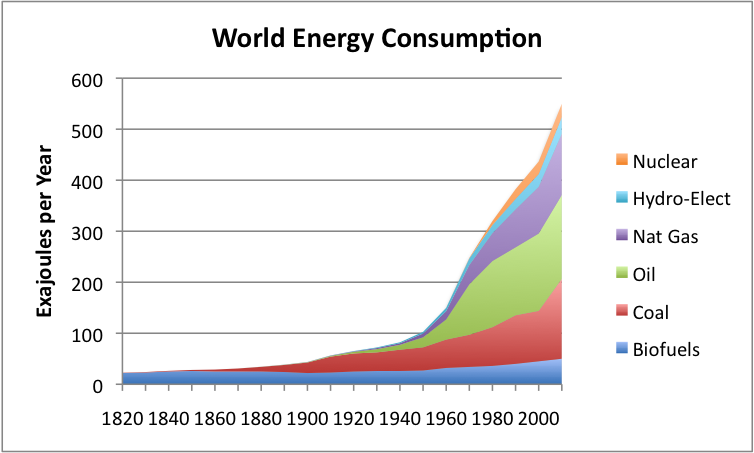
I imagine that if we were able to tap into deep geothermal energy the continuing exponential growth would eventually pass some sort of geothermal limit point.
But I am a bit sceptical to the no impact scenario. We know a lot allready about the inside of the earth, but afaik we do not really understand it. There are many flows underneath etc. and small changes can have big impacts. Look for example at the amount of artifical CO2 from humans. It is tiny in comparison with the rest of the atmosphere. And yet it gives us a lot of troubles.
And about geothermal: well, here in germany there have been allready some minor earthquakes, probably caused by geothermal plants ...
(German) http://m.focus.de/wissen/klima/tid-14230/energie-mythen-myth...
Even if you don't understand French, you can look at pictures of this article: http://www.lefigaro.fr/actualite-france/2013/11/19/01016-201...
Another experiment was stopped in Switzerland for the same reason: https://www.theguardian.com/world/2009/dec/15/swiss-geotherm...
https://mobile.nytimes.com/2016/11/18/science/fracking-earth...
As for solar, the incoming energy would have been mostly converted to heat. When we use the electricity produced, we convert it back to heat again. If the entire state of AZ were covered with solar panels, and all the energy spent in NY, there would be some localized changes but not much in the global scale. For the foreseeable future, we are not even close to covering up just 1% of the land area of AZ.
Well, with efficiency gains in the latest years energy consumption (not only electricity) actually is constant or decreasing in developed countries. Add to that decreasing population fertility and if you expect that developing countries are going to follow the same trends after a certain threshold then that's not a good assumption long-term.
Japan: https://en.wikipedia.org/wiki/Energy_in_Japan#/media/File:Ja...

US: https://en.wikipedia.org/wiki/Energy_in_the_United_States#/m...

Europe: http://ec.europa.eu/eurostat/statistics-explained/images/thu...

For me, the more interesting one, which was the 'bad guy' in the forgettable movie "The Core". The earth's magnetic field is created by the motion of the fluid iron (which is conductive) surrounding the solid core[1]. That it is moving and carries charge creates a dynamic dynamo which determines the strength of the magnetic field. Changes in the fluid are why the magnetic poles move around and sometimes change places.
The number 1 feature of the magnetic field (for me at least) is that it deflects the solar wind (those charged particles racing out from the Sun) which would otherwise collide with the gases surrounding our planet and accelerate them outward. Eventually stripping the planet of most of its atmosphere.
One of the less well known ways the solar system could wipe out humanity.
Worst case, you run them continuously at half capacity, but then your cost per kWh is about 2x.
Wait, I haven't looked at geothermal in a long time so I'm not at all up to speed on the current state of the at. But previously you wrote:
>and so geothermal plants are generally only built in areas that require shallow (1km) wells
That sounds like your "30 years" number there is for shallow wells. Intuitively it doesn't seem like this logic would necessarily be identical for deeper wells: obviously at some depth the rock is always extremely hot (or, in fact, molten). The article seems to indicate that they expect a deeper well to produce higher temperatures and pressures, in turn allowing more energy production, and that seems like it'd make sense. Maybe 1km vs 5km makes no difference in lifetime beyond that, but does your analysis include deep wells already in an equivalent area? Otherwise it doesn't seem reasonable to extrapolate past lifetimes of shallow wells to future lifetimes of deep wells, even ignoring that they say they'll be able to achieve far higher energy generation per well.
There are physical limits to the heat capacity of the rock, and the heat flux into the region. Deeper wells are not necessarily hotter. Going hotter adds other costs (drilling mud, water=>co2, casement, etc), so its a big multivariate optimization.
Not if you keep pumping in water to run a steam turbine.
I assume that's how geothermal energy works, and I'm not going to double check.
Are you being serious? In terms of known capabilities the Kola borehole shows that even with older tech we can drill down to over 12km in depth, and there have been decades [1,2,3] of efforts drill all the way through the Mohorovičić discontinuity into the mantle (20+km minimum from a continental starting point, 5-10+km from ocean). Lithosphere/mantle boundary tends to be defined by temperature, in that around 1800°F is when the weakest common mineral (olivine) begins to exhibit viscosity. Well before that it'd reach the point where the amount of pressurized water we could pump through it wouldn't be able to keep up with new thermal load. So yeah, at some depth the rock is always extremely hot.
In terms of economics though of course there is some set of balance points for a given level of tech and economics between cost of drilling to a given depth, gains in lifetime/power density, maintenance costs, costs/losses of actually moving working fluid from heat point to generator, reliability advantages, etc etc. Presumably experts go through and consider all of this, it should be tractable within some set of risk bars. If an experienced power company is actually putting down millions on doing a project after evaluation, I see no reason to doubt that they've done the math to their/their investors' satisfaction to a level sufficient for a pilot project.
1. http://www.smithsonianmag.com/science-nature/decades-long-qu...
2. https://en.wikipedia.org/wiki/Chiky%C5%AB
3. https://www.extremetech.com/extreme/247370-drill-baby-drill-...
I don't know what the Mohorovičić discontinuity is, but I'm sure it doesn't change this physics fact.
Anyone know as to why this is the case? At first pass it seems like your cutting tools should wear out in proportion to depth. But I suppose as things get warmer tool wear becomes faster. What types of tool materials are used for rock boring? Diamond? Tungsten carbide? Is is more of a "conventional machining" process, or an abrasive / water jet? Or explosive like in hard rock mining? What else has an effect on cost for deep holes? Shaft length gets longer, so the twist becomes more of a problem if your are driving rotating bits from the top? Does it have to do with removing the material from the bottom of the hole to the top? Others?
Think of a telescopic antenna. That structure is similar to what is done to bore a well. You start with large casing diameter and add progressively smaller casings until you reach the target depth. The deeper you go the bigger the casing you must start with. Offshore deep water stuff can be a meter in diameter with 10cm solid steel walls; monstrously heavy and costly materials. And you use kilometers of the stuff.
There are a lot of reasons why costs scale as they do with depth; casing is just one of the more obvious.
True, but aren't there plenty of such regions around the world? In the US I can think of at least Hawaii and Yellowstone.
Not the greatest population centers, but power lines have a good range. Also, Iceland is making good use of its comparative advantage by doing power intensive production like aluminum smelting and bitcoin mining.
https://en.wikipedia.org/wiki/List_of_Cascade_volcanoes
...how deep do you have to go to get to the 400C temperature level on some of those volcanoes??
Also many hot springs could be potential GeoThermal candidate areas http://www.hotspringsenthusiast.com/USsprings.asp
That said, geothermal activity isn't confined to the park borders, and there may be a suitable spot outside of the park. But again, politics. Building a geothermal plant in the middle of natural gas country would be a challenge.
Small note about Iceland- My web host (1984) is located there, and the servers run on 100% geothermal. That, in combination with the stellar privacy laws, make Iceland a nice fit for me.
That said, I agree that it would take a lot to get anything like that built.
I shudder to consider the quantities of hardware consumed to drill 4km+ you would get all kinds of crazy hard rock down there, not to mention the time it would take for rod pulls.
Article:
"Although geothermal energy is still preferable to gas, coal and oil, it's not 'completely renewable and without problems... As soon as you start drilling you have issues to it, such as sulphur pollution and CO2 emission...'"
The chapter is only 4 pages long and he quickly works out that if done sustainably, even blanketing the entire country with geothermal plants could provide at most 2 kWh/day per person in the UK. Current consumption is about 125 kWh/day per person. So even without the capex argument, it is just not a very efficient source of energy long-term.
> Other places in the world have more promising hot dry rocks, so if you want to know the geothermal answers for other countries, be sure to ask a local. But sadly for Britain, geothermal will only ever play a tiny part.
Wind, solar, geo... they all work together better than as a single unit.
If you combine it with renewables, you get high fluctuation of demand from the grid, which selects for the exact opposite technology (higher opex, lower capex). Natural gas fits the bill, so that is where the market is going.
Conventional geothermal is about 4-5 cents/kWh, on par with natural gas in the US. The dominant capital cost is drilling a large well (you need volume), and so geothermal plants are generally only built in areas that require shallow (1km) wells.
Well costs are ~quadratic in depth. Given how much money has already been spent optimizing drilling for the oil&gas industry, along with how cutthroat that market is, I don't see the cost coming down significantly. As a result, deep geothermal will likely be limited to niche regions like Iceland. And you need deep geothermal to scale it past the existing locations.
I would love to be wrong, since geothermal checks all the boxes for renewables and is also suitable for base load power, but I don't see an obvious path forward short of a drilling tech miracle.
(source: Climate and Energy R&D group)