So the Earth has a heat stored which is (4K miles / 50 feet)^3 times larger than a blast furnace.
i.e. about 7x10^16 times larger.
If everyone on Earth had their own personal blast furnace, we'd be controlling 10 million times less energy than what's in the core of the Earth.
Similar calculations apply to other calculations. A Physics 101 calculation I did (years ago) was how much a tidal plant would slow down the rotation of the Earth. The answer was by less than a second a day, after 100 years of running.
> ke, what would happen globally if the entire state of Arizona was in the shadow of solar arrays?
The plants wouldn't grow. :)
But seriously, the energy has to go somewhere. If it's hitting solar panels instead of the ground, the net effect to the world is essentially zero.
Maybe locally the ground would be cooler because it's in the shade. But that's about it.
That means that if you built 100 of those plants that in 1 year you'd change the length of the day by 1 second.
The 2011 Tōhoku earthquake and tsunami released 3.9×10^22 joules of energy[1] and changed the day by just over a microsecond[2]. A single Tsar Bomba releases 2.1×10^17 joules, so you'd need the energy of around 200 thousand of those to produce the same amount of energy as the earthquake, and then assuming you can direct that energy you need 1000 times more to shift the day by a second instead of a microsecond.
That means that each one of your proposed tidal plants would need to generate the energy of 20,000,000 Tsar Bombas per year.
That's one Tsar Bomba's worth of energy being released every 1.5 seconds at each one of those 100 plants. Buy stock in sunscreen companies now!
Each one of your 100 plants would satisfy all of current yearly world energy production in just 30 minutes[3][4].
I'm too lazy to calculate what that would do to the surrounding area, but I'd wager that they're going to severely depress local property prices due much of the surrounding beach-side property area now being turned into permanent molten lava.
The good news is you could probably build really good wind power plants now, due to constant hurricane winds not seen on Earth since the K–T impact, but I digress.
I didn't check your molten rock calculation but given how off your tidal plant calculation is I wouldn't be surprised if it's way off as well.
1. https://en.wikipedia.org/wiki/2011_T%C5%8Dhoku_earthquake_an...
2. https://www.nasa.gov/topics/earth/features/japanquake/earth2...
3. https://en.wikipedia.org/wiki/World_energy_consumption
4. ((5.67x10^20)/(2.1x10^17))/1.5/60 = 30
It was a recollection of a problem from 25 years ago for crying out loud.
Thinking about it some more, it's probably slowing down the rotation of the earth by 1 second over the course of 100 years. Not 1 second per day. Which makes about 4-5 orders of magnitude difference.
> I didn't check your molten rock calculation but given how off your tidal plant calculation is I wouldn't be surprised if it's way off as well.
The point was to get a "back of the envelope" calculation. Not to get a precise answer to 4 decimal places.
What's with the bike shedding? Is the point here to have a discussion, or to prove that you're smarter than everyone else?
he showed his work for his first calculation. Looked reasonable to me.
    > And these furnaces are maybe 50 feet across. [...]
    > So the Earth has a heat stored which is
    > (4K miles / 50 feet)^3
It also seems to assume that a 50ft^3 blast furnace contains energy equivalent to 50ft^3 of molten mantle. If you look at diagrams of blast furnaces you can see that a relatively tiny part of them is actually molten material.
Not being able to find numbers on the stored joules of industrial blast furnaces, I'm just going to just state that 50ft^3 of mantle has a crapload more potential energy than 50ft^3 of blast furnace, most of which is air, equipment & empty space, not molten material.
He is right that there's at least as much energy stored in the earth as he's saying, but it's going to be a crapload more than that.
The insides of blast furnaces are also significantly colder than the average temperature of the mantle.
Fermi was known for asking questions like "how many gold balls git into a suitcase". The point isn't to get a perfect answer. The point is to get a reasonable answer.
In this case, the point is to answer the OP question in laymans terms. Using not much more than reasonable assumptions, and grade 5 math.
Or, you can bike shed over details.
Still off by a factor of 1000, a microsecond is one millionth of a second.
* [...] 20,000,000,000 Tsar Bombas per year
* One Tsar Bomba going off every 1.5ms
* World energy production satisfied in 1.8 seconds
We're also going to need more sunscreen.
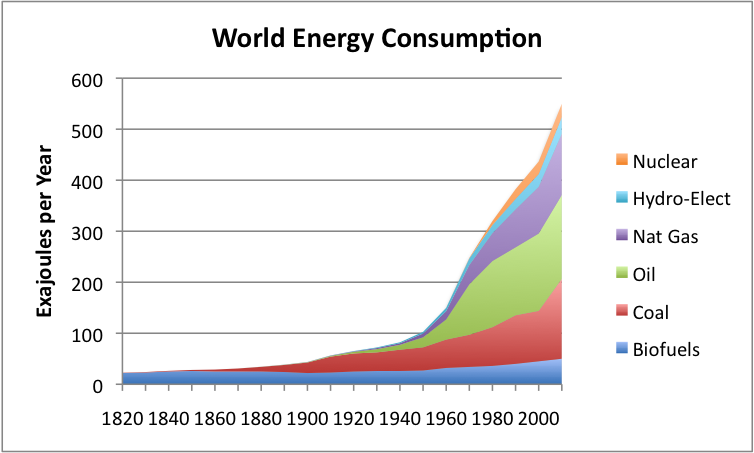
I imagine that if we were able to tap into deep geothermal energy the continuing exponential growth would eventually pass some sort of geothermal limit point.
But I am a bit sceptical to the no impact scenario. We know a lot allready about the inside of the earth, but afaik we do not really understand it. There are many flows underneath etc. and small changes can have big impacts. Look for example at the amount of artifical CO2 from humans. It is tiny in comparison with the rest of the atmosphere. And yet it gives us a lot of troubles.
And about geothermal: well, here in germany there have been allready some minor earthquakes, probably caused by geothermal plants ...
(German) http://m.focus.de/wissen/klima/tid-14230/energie-mythen-myth...
Even if you don't understand French, you can look at pictures of this article: http://www.lefigaro.fr/actualite-france/2013/11/19/01016-201...
Another experiment was stopped in Switzerland for the same reason: https://www.theguardian.com/world/2009/dec/15/swiss-geotherm...
https://mobile.nytimes.com/2016/11/18/science/fracking-earth...
As for solar, the incoming energy would have been mostly converted to heat. When we use the electricity produced, we convert it back to heat again. If the entire state of AZ were covered with solar panels, and all the energy spent in NY, there would be some localized changes but not much in the global scale. For the foreseeable future, we are not even close to covering up just 1% of the land area of AZ.
Well, with efficiency gains in the latest years energy consumption (not only electricity) actually is constant or decreasing in developed countries. Add to that decreasing population fertility and if you expect that developing countries are going to follow the same trends after a certain threshold then that's not a good assumption long-term.
Japan: https://en.wikipedia.org/wiki/Energy_in_Japan#/media/File:Ja...

US: https://en.wikipedia.org/wiki/Energy_in_the_United_States#/m...

Europe: http://ec.europa.eu/eurostat/statistics-explained/images/thu...

For me, the more interesting one, which was the 'bad guy' in the forgettable movie "The Core". The earth's magnetic field is created by the motion of the fluid iron (which is conductive) surrounding the solid core[1]. That it is moving and carries charge creates a dynamic dynamo which determines the strength of the magnetic field. Changes in the fluid are why the magnetic poles move around and sometimes change places.
The number 1 feature of the magnetic field (for me at least) is that it deflects the solar wind (those charged particles racing out from the Sun) which would otherwise collide with the gases surrounding our planet and accelerate them outward. Eventually stripping the planet of most of its atmosphere.
One of the less well known ways the solar system could wipe out humanity.
I wonder similar things about solar - what effect is there on global weather patterns when enough solar energy to make a difference is extracted from the environment? Like, what would happen globally if the entire state of Arizona was in the shadow of solar arrays?