News for hackers. Stuff that matters.
Re:The end of smartphone innovation by fullshark on Saturday March 25, 2017 @12:21PM (#13956301)
> I increasingly think that augmented reality is the next fundamental platform shift.

I read these articles and everyone seems to be operating from the assumption that a fundamental platform shift is inevitable and coming within the next few years.

Is it really unthinkable that smart phones that you carry around in your pocket are the dominant platform for the next 50+ years?

Re:The end of smartphone innovation by arglebarnacle on Saturday March 25, 2017 @12:51PM (#13956469)
I wouldn't rule it out, but no computing hardware platform has ever been dominant for 50 years before so there are reasons to believe we're not about to get started with that kind of cycle now.

Mainframes, minicomputers, desktop personal computers, laptops, and now tablets and smartphones. Maybe we have reached the end (for 50 years at least), but I think the safer bet is that the next big technology 30 years from now will be something that surprises us, not something we already have or could easily predict having wide adoption.

Re:The end of smartphone innovation by coldtea on Saturday March 25, 2017 @01:42PM (#13956700)
>*I wouldn't rule it out, but no computing hardware platform has ever been dominant for 50 years before so there are reasons to believe we're not about to get started with that kind of cycle now.

"Mainframes, minicomputers, desktop personal computers, laptops, and now tablets and smartphones" -- yes, so we had like 5 generations of computing hardware platforms. And we began with so premature and begging for improvement technologies (when they started in the 50s) and so large form factors that we had Moore's law going on for decades until a few years past.

Now we've reaching physical limits in CPU shrinking, and we have components so small (e.g. Apple Watch) than if they were any smaller you couldn't handle their buttons, or fit a camera lens, or speakers, or a large enough screen in there.

My point is, just because something has been going on for 5 generations of form factors, it's nowhere near enough evidence to be meaningful statistically or otherwise to deduce it will go on forever.

A turkey is fed every day by the farmer for months on end. But after 300+ observations that make it think feeding is never ending and inevitable there comes thanksgiving.

Re:The end of smartphone innovation by mr_overalls on Saturday March 25, 2017 @03:01PM (#13957041)
> if they were any smaller you couldn't handle their buttons

Voice-interfaced intelligent agents like Siri/Alexa/etc will continue to evolve.

Given a sufficiently advanced AI, buttons won't be needed for most computing tasks - any more than stirrups and a bridle were needed to drive the first automobiles.

Re:The end of smartphone innovation by bigato on Monday March 27, 2017 @08:02AM (#13966943)
I don't like talking to my devices, specially because most of the time I'm around other people and I don't want to share what I'm doing with them.
Re:The end of smartphone innovation by Gargoyle on Saturday March 25, 2017 @02:15PM (#13956848)
The next form factor is pervasive computing, of which Alexa and Google Home are the first stumbling attempts.
Re:The end of smartphone innovation by foooker on Sunday March 26, 2017 @04:31AM (#13959794)
How do you use them in a public space, where others are trying to do the same thing ?
Re:The end of smartphone innovation by sickmartian on Sunday March 26, 2017 @09:16AM (#13960623)
You wear the controls to your own wearable computer/smartphone, which might or not be linked to a better one on the environment that can do a lot more for you.
Re:The end of smartphone innovation by Main_ on Sunday March 26, 2017 @08:40AM (#13960457)
Voice Biometrics?
Re:The end of smartphone innovation by coldtea on Sunday March 26, 2017 @08:50AM (#13960496)
And who said you'd like for others to hear what you use them for?
Re:The end of smartphone innovation by moe on Saturday March 25, 2017 @02:02PM (#13956782)
> if they were any smaller you couldn't handle their buttons,

They will connect to our brains.

> or fit a camera lens, or speakers, > or a large enough screen in there.

Not needed when they are connected to our brains.

Re:The end of smartphone innovation by thegp on Saturday March 25, 2017 @02:35PM (#13956929)
Trust me, they won't for a while and you don't want them to. Do some research into bio-compatibility. After that, do some research into electrolysis. You can do a fun experiment by connecting a battery to your tongue for a while. Just google it before please to know what is happening.

Meanwhile, non invasive BCI are getting AWESOME...if you are a quadriplegic with no other options.

Now imagine we solve those problems, and the first BCI is on the market. It's safe, it's a little bit faster than typing/reading (hey, first generation right). Who is going to be the first early adopter to undergo massive brainsurgery? Turns out upgarding cochlear implants is so hard they are made to last 100 years (they get surrounded by bones and scar tissue...) so upgrading will be really hard. And who wouldn't want to have their blackberry implanted into their head right now...even worse, if we have proprietary technology in the first ones and now your brainberry can only talk to other brainberries...or we go full internet of shit and it needs a cloud server to do anything:)

Re:The end of smartphone innovation by coldtea on Saturday March 25, 2017 @02:10PM (#13956820)
Yeah, don't hold your breath for those.

You'll be needing an oxygenated brain for when they arrive.

Re:The end of smartphone innovation by kakarot on Saturday March 25, 2017 @02:31PM (#13956916)
We will probably end up controlling our microdevices (hopefully optionally implanted beneath our skin) with interfaces like Google's Project Soli[0], voice commands, "Morse code" style tapping commands, etc and also through hub devices like screen membranes underneath our skin or a device similar to a phone.

[0] https://atap.google.com/soli/

Re:The end of smartphone innovation by cf on Saturday March 25, 2017 @04:56PM (#13957523)
My presumption is that we will interact with most computers through wireless devices. For example, the chromecast has no buttons on it, and I haven't felt limited by that.
Re:The end of smartphone innovation by cc439 on Saturday March 25, 2017 @05:43PM (#13957706)
The desktop PC became the dominant computing platform almost 40 years ago with the introduction of the first generation of affordable home computers (Apple II being the primary example). Even though laptop sales have overtook desktop sales around 10 years ago, the preferred form factor (15"+ screen) and intended use (sits at a desk 90%+ of the time) of the vast majority of laptop owners means the majority of laptops are nothing but desktops that happen to be easier to move to another desk.

Even though the amount of time spent using desktops and laptops in a desktop-like manner is decreasing, it's still a form factor found in every home. There may be more smartphones in that home but in my opinion, any product which is universally present in people's home is dominant even if it isn't being used as often as other options. Another example of this would be the microwave versus the oven. I'm not sure which one is used more often than the other but both are still dominant in terms of their universal presence in every home.

Re:The end of smartphone innovation by dredmorbius on Saturday March 25, 2017 @07:43PM (#13958110)
"Dominance" of the PC was more late 1980s than late 1970s, and that's if you count only office use. PCs didn't hit 50% residential penetration until ~1998:

http://farm3.static.flickr.com/2244/2199183615_c2a8acbaff.jp...
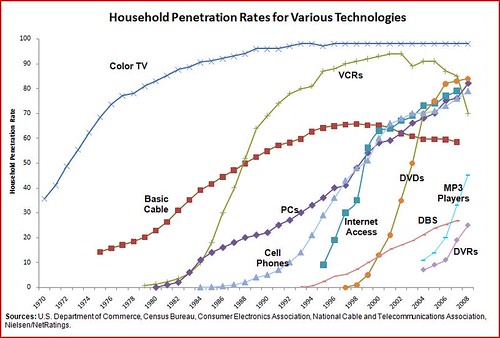
Yes, you could buy a PC in the late 1970s. But they were still pretty rare, and even a freestanding home PC didn't become hugely common until the 1990s -- networking was the missing step.

Mainframes have had buffers put between them and end-users, but are still highly utilised today. And the computerisation of the office was proceeding at mixed rates through the 1980s and 1990s (though well advanced by the early 1990s).

Re:The end of smartphone innovation by brcha on Saturday March 25, 2017 @06:11PM (#13957794)
Well, imagine being able to project your "laptop" where ever you want using AR? Then you could use it as your home desktop-laptop and carry it everywhere with you.

Tablets are cool and you can carry them everywhere, but you can't really work important stuff on them since they are still too small.

On the other hand, even if laptops had very good battery life (which usually is not the case), they are still too big and heavy to carry around unless really needed (ie. for a meeting or something like that).

But an augmented reality laptop that lives in your phone is something people might want to use. Not for gaming, but for normal office work, be it programming or using spreadsheets.

And, at that point, regular users might think about obsoleting desktop PCs and laptops.

Re:The end of smartphone innovation by nradov on Saturday March 25, 2017 @11:07PM (#13958871)
A projected AR display would only be useful for creative and business work if it can completely occlude the background. I won't be able to see the spreadsheet clearly if light leaks through it through from the window in front of me. Due to limits imposed by optics, complete background light blockage is always going to require a bulky, awkward head-mounted display. No one has proposed any way to get around this issue even in theory.
Re:The end of smartphone innovation by brcha on Sunday March 26, 2017 @09:30AM (#13960689)
Well, you can always project the virtual laptop's screen on a pizza box or a wall or something like that. But I agree in general. I'd prefer a foldable laptop, but I doubt the technology for something like that is anywhere near, while this AR laptop could be made tomorrow. There already are virtual machines made for mobile phones, all that is left is connecting them to AR glasses and voila.
Re:The end of smartphone innovation by nradov on Monday March 27, 2017 @09:29AM (#13967518)
Walls and pizza boxes aren't sufficiently smooth or reflective to use as projection screens for real work. An AR laptop couldn't be made tomorrow because the glasses exist only in limited prototype form with poor display quality.
Re:The end of smartphone innovation by Banthum on Saturday March 25, 2017 @02:44PM (#13956962)
I don't disagree with your main point but I think it's worth saying - Pen-and-paper is a computing hardware platform! And it ruled for much longer than 50 years.

And to no small success - they worked out quantum mechanics and a lot of other very difficult problems on this platform.

People still even make games for this platform too.

Re:The end of smartphone innovation by Chinjut on Saturday March 25, 2017 @02:53PM (#13956995)
Well, pen and paper is a memory device; the actual computing was carried out by human brains. But, yes, human brains have been successful for much longer than 50 years, and still enjoy success in many domains…
Re:The end of smartphone innovation by riffraff on Saturday March 25, 2017 @04:37PM (#13957455)
Maybe slide rules/abacus/soroban ? "Computing" in the most literal sense :)
Re:The end of smartphone innovation by cft on Saturday March 25, 2017 @12:54PM (#13956484)
Except the Moore's law has (almost?) ended now, for the first time in 50 years.
Re:The end of smartphone innovation by wpietri on Saturday March 25, 2017 @01:57PM (#13956757)
Unfortunately that heuristic is useless in deciding when periods of change end. Ditto when periods of stability end.

I could say, "The manually driven, privately owned internal combustion car and truck have been dominant in transport for 100 years, so the safe bet is that they will continue to be." And that is definitely safe bet. But the interesting work will be done by people making the unsafe bets.

Re:The end of smartphone innovation by blitmap on Saturday March 25, 2017 @09:04PM (#13958405)
I think we'll struggle for a long while to make the smartphone our main computer. One that can interface smoothly with wireless displays and peripherals at home.

I could totally see a smartphone hooking up to another computer for gamers - like the Thunderbolt 3 chassis allowing you to use an external GPU. Or simply when you walk into your house your phone connects to a more powerful hub giving you sensor data and processing power?

Eventually I think we'll socially "shift" to allowing electronics within our bodies to augment our abilities. We can't fit everything into a smartphone and we can't keep shrinking it. We can make things more efficient but it's more likely we'll begin building onto humans. Bodies are bigger than phones.

I'm more excited than terrified about an implant attached to my optic nerve for true augmented reality. Imagine everyone having a photographic memory. I'd love to see more done to store data on crystal - or on DNA.

Let's get freaky. :-)

Re:The end of smartphone innovation by toothbrush on Saturday March 25, 2017 @11:35PM (#13958969)
You should watch Black Mirror S1E3, entitled "The Entire History of You". https://en.wikipedia.org/wiki/The_Entire_History_of_You
Re:The end of smartphone innovation by narrator on Saturday March 25, 2017 @01:27PM (#13956635)
The next big technology revolution is AI. Should be pretty obvious at this point. The next one after that will be consumer technology integrated with human biology. All the fitness trackers are the first primitive attempts at that, but lab on a chip and brain machine interfaces are on their way. The $6 cell phone semen analyzer is a harbinger of this.
Re:The end of smartphone innovation by petra on Saturday March 25, 2017 @04:16PM (#13957362)
>> brain machine interfaces

I'm pretty skeptical of the common "brain machine interface". It probably requires surgery, and for what ? to make people smarter in a world with AI ?

No, i think the main motivation for a brain machine interface should be experience/emotion oriented, And there's a big question if people will take surgery for it, or would they suffice with an external device ?

One such modality is fmri neurofeedback - using fmri analysis to give detailed and accurate feedback of what happens inside your brain, so you could achieve better control of it, and your internal world.

How much better control ? well, there's some early research about treating depression/anxiety, etc. but the more interesting research is about letting people train themselves to reach(very rapidly, unlike years/decades as a monk) a state very similar to the buddhist enlightenment, where you are content and free of ego. Another type of training session has taught people to increase empathy. And i'm sure you could do a lot more, since fmri is relatively accurate and fine-grained.

This line of research is early, and very expensive to do, but the technology is drastically improving[1], and with it will research.

And once you have that, once you could potentially become internally satisfied and happy, why would you risk that with a brain surgery , in order to have somewhat better virtual reality ?

[1]mri's are expensive, but marie lou-jespen is working on a $100 mri helmet

Re:The end of smartphone innovation by pflanze on Saturday March 25, 2017 @09:04PM (#13958407)
Re your [1]: Mary Lou Jepsen.

https://www.maryloujepsen.com/resume?_escaped_fragment_=#! "Goal: Replace the functionality of MRI (Magnetic Resonance Imaging) with a consumer electronics wearable using novel opto-electronics to achieve comparable resolution to MRI."

(Couldn't find anything else really; https://www.engadget.com/2016/05/05/oculus-exec-mary-lou-jep... "she will focus on "curing diseases with new display technology," by bringing MRI machines to every doctor' office in the world."; links a TEDxYouth talk but that doesn't talk about it.)

Re:The end of smartphone innovation by AsyncAwait on Saturday March 25, 2017 @01:38PM (#13956685)
> The next big technology revolution is AI. Should be pretty obvious at this point.

Unless you mean strong AI, which isn't anywhere close, I don't think this AI rush has much wider chances than the previous one, except for some narrow use cases.

Re:The end of smartphone innovation by coldtea on Saturday March 25, 2017 @01:47PM (#13956712)
>The next big technology revolution is AI. Should be pretty obvious at this point.

I don't think so. I think AI is just one of those fads that come up every now and then, and then get abandoned for the next one.

I'm calling AI as in "actual working strong AI" or useful soft AI stuff as fad.

I'm calling "AI" as in the thing currently every VC/company is investing in and we see various helpers like Cortana and Siri based, the machine learning craze, on etc. Besides some obvious and fitting applications (like in self driving cars) it will go nowhere fast.

VR has already reached this stage, without making any large dent on the market in the first place even temporarily.

Note that this is the second time AI is promised and will get nowhere (the first was back in the 80s, with the "AI winter").

Re:The end of smartphone innovation by pacala on Saturday March 25, 2017 @02:13PM (#13956841)
Google.com is today's Ai. No reason to believe it will stop improving.
Re:The end of smartphone innovation by dredmorbius on Saturday March 25, 2017 @07:10PM (#13958006)
Stop? I can't wait for it to start!
Re:The end of smartphone innovation by nradov on Saturday March 25, 2017 @11:14PM (#13958901)
And yet their search result quality subjectively seems to be stable at best or declining slightly. If that's AI then it's certainly not as smart as the spammers and black-hat SEOs. On the mobile side, when the latest version of Google Assistant misunderstands what I want so often as to be worse than useless.

Still hoping to see some improvement but not holding my breath.

Re:The end of smartphone innovation by coldtea on Sunday March 26, 2017 @08:49AM (#13960490)
Well, Google search results have been declining for some years now, as observed by very many.

And there's nothing to Google.com more than a simple heuristic algorithm, which can be totally dumb to context and nuance.

Re:The end of smartphone innovation by dredmorbius on Sunday March 26, 2017 @01:03PM (#13961732)
Any pointers to such accounts?

(I've written my own, but I'm interested in others'.)

https://ello.co/dredmorbius/post/qc4ip4m_33unj0eipgyhga

Re:The end of smartphone innovation by adrianratnapala on Saturday March 25, 2017 @04:40PM (#13957468)
I don't know about platforms, but I think a shift in UI must come.

The thing is that touchscreen mobile phones are terribly clunky interfaces. It's much harder to express you intent with fat human fingers than with keyboard-and-mouse device. The advantage of the phone is entirely in its mobility, and the fact that you want a telephone anyway.

If some interface (augmented reality, voice, direct neural probes) becomes a workable UI that is both expressive and mobile, then it will take over.

Re:The end of smartphone innovation by nradov on Saturday March 25, 2017 @11:17PM (#13958910)
There's potential in building a mobile UI around gestures from the start instead of around touch on a flat rectangular screen.
Re:The end of smartphone innovation by flogic on Saturday March 25, 2017 @02:51PM (#13956984)
That's really 2 questions in one. The first is "is there demand for another shift?". The second being "does the capability exist?". My inclination is to say the answers to those 2 are "yes" and "maybe" respectively.

Smart phones are awesome but by their very nature they have some limitations. The slowest aspect on any computer is communication from the user to the machine. We're slow and the constrained real estate of phones only makes it worse. I wouldn't consider typing all this on a phone. The next slowest is the other direction. So if you can figure out how to improve those channels in a highly portable way people will most likely buy it.

That brings us to the capability question. Voice kinda improves things when you can't use your hands but it's always been unreliable. Physical keyboards on phones are out of fashion. Smart watches are tiny and power constrained. Google glass looked neat but is expensive and again power constrained. It seems to be a serious question of how do you get a bigger device without the drawbacks of getting a bigger device.

Re:The end of smartphone innovation by jest3r1 on Saturday March 25, 2017 @03:47PM (#13957224)
Product innovation doesn't always have to be a new feature, or a paradigm "shift" with new technology like AR.

Smartphones could be due for a substantial reduction in price (there's certainly demand for that). Not just hardware pricing, but also carrier pricing.

From a hardware perspective Apple must innovate (or have you believe they're innovating) to keep the product price and profit margins as high as possible. However, as the article points out, the smartphone market is mature. There's not much left to innovate in terms of the "hand held" form factor, other than price, or improving on already available features (better camera, better voice control, wireless charging etc).

The iPod provided good insight into "size", and even when given smaller sizes (like the nano), consumers generally preferred the standard, easier to hold sizes, with displays big enough to read. The Sony WM-10 cassette Walkman from 1983 was about the same size!

Size has been consistent for over 30 years.

It must be getting harder and harder for Apple to spin each revision as groundbreaking enough to pay the same price as last year. Android capitalizes on this. But it's still a pricing monopoly on both sides, which carriers enjoy as well.

When will there be a substantial reduction in price?

Does the capability exist yet?

Re:The end of smartphone innovation by petra on Saturday March 25, 2017 @04:45PM (#13957488)
Phones are quite cheap already(~$140 for a pretty decent xiaomi). The largest share of price of a phone is the monthly bill. It's mostly due to monopolies, so even though there's some news technologies that promise 25x-50x reduction in costs[1] with some of those already availble, it's hard to tell whether consumers will see that.

Another place where the smartphone could help with costs: currently great noise cancelling earphones are very expensive($300) .And in general are well loved by those who can afford them.

but what happens if we remove most of the hardware(cheap) and compute($0 on phone) to the phone ? And create place in the app store for noise-cancelling apps ?

[1]http://5gwnews.com/index.php/90-r/670-wireless-abundance-is-...

Re:The end of smartphone innovation by nradov on Saturday March 25, 2017 @11:21PM (#13958923)
The cell phone carrier market is the classic example of a "confusopoly" where the dominant market players make it as hard as possible for consumers to make fully informed decisions. None of the carriers actually has a monopoly outside of a few isolated areas.

https://en.wikipedia.org/wiki/Confusopoly

Acoustics make it impossible to do good noise cancellation using just an app. You really need a specialized microphone mounted directly on the headphones.

Re:The end of smartphone innovation by petra on Sunday March 26, 2017 @12:45AM (#13959200)
Sure you need a high quality microphone on the earphone - but that's men's , could be very cheap in volume. And the rest is something interface chip on the phone, and than some digital logic which is cheap.
Re:The end of smartphone innovation by throwanem on Saturday March 25, 2017 @09:08PM (#13958422)
It stops working, because the latency is too high for the inverse-phase signal to match up with the unwanted incident signal it's intended to cancel.
Re:The end of smartphone innovation by petra on Sunday March 26, 2017 @12:51AM (#13959215)
You could have a low latency digital processor in the phone/soc. At that level, digital is cheap.

Of course the other part is that high-frequnecy noise is hard to cancel. But still Bose does a great job.

Re:The end of smartphone innovation by throwanem on Sunday March 26, 2017 @06:47AM (#13960099)
You can't have a wireless round trip with latency low enough to work.
Re:The end of smartphone innovation by petra on Sunday March 26, 2017 @11:28AM (#13961242)
I'm not sure wireless is a necessity for sucsess. sure it's less comfortable, but a lot depends on how much people value silence.
Re:The end of smartphone innovation by tvural on Saturday March 25, 2017 @02:52PM (#13956986)
One possibility is that the resolution of VR goggles becomes so good that you can simulate looking at a screen. Then you might have something as easy to carry as a smartphone but with unbounded screen size.
Re:The end of smartphone innovation by Nokinside on Saturday March 25, 2017 @01:35PM (#13956666)
Innovation in saturated markets is different from growing markets.

When smartphones become household items, visible innovation has turned into small tricks and gimmicks. People need smartphones for their daily activities and innovation that is directed towards low cost may be more profitable.

TV, computer monitors and smartphones seem all to be riding on screen technology. If there is development VR or AR technologies that make it into mass markets, it can disrupt all these markets.

Re:The end of smartphone innovation by eksemplar on Saturday March 25, 2017 @01:10PM (#13956566)
I agree with your sentiment, but I think someone is going to figure out a device that does what a smartphones does, minus the "carry around" bit. And I don't think it'll take 50 years. Google glass wasn't it, but that doesn't mean it's not happening.
Re:The end of smartphone innovation by Shivetya on Saturday March 25, 2017 @01:21PM (#13956609)
well we always can have a ST:TNG generation inspiration and use jewelry or similarly disguised devices at the communication device. Still the one point against miniaturization is how do you visually communicate something?

if anything the smartphone will just become. become an everything. it will seamlessly interact with whatever device is nearby that you want to use and be the source point for your data and inquiries. get in your car, it takes over the center console. sit down at your desk and you work is right there like you left it. need to show a group something, point it at a display.

Re:The end of smartphone innovation by naasking on Saturday March 25, 2017 @01:40PM (#13956694)
> Is it really unthinkable that smart phones that you carry around in your pocket are the dominant platform for the next 50+ years?

Yes: a) dominant consumer-facing platforms don't tend to last much longer than 10 years these days, b) smartphones only really took off exactly 10 years ago with the iPhone, so it's presumptuous to think we've hit the perfect sweet spot that will last us much longer.

It's almost like arguing the ENIAC would be the pinnacle of computing for the next 50 years. A lot of evolution happened, and "phones" 20 years from now will probably be nearly incomparable to phones today, just like your phone is just somewhat different from ENIAC.

Re:The end of smartphone innovation by wpietri on Saturday March 25, 2017 @02:09PM (#13956814)
I don't think it's presumptuous at all.

ENIAC (which is 70 years old) had some obvious flaws: it was too big, too expensive, too hard to use, and didn't do enough. This has been true for computing hardware ever since. The first portable PC [1] is 35 years old. It was too big, too expensive, too hard to use, and didn't do enough. Ditto the first laptop, the first handhelds, the first smartphones, and pretty much every other first.

But that's no longer true for modern phones. Few complain their phones are too big, and many wanted larger ones, leading to the rise of the phablets. Phone prices could be lower, but they're cheaper than the phone service over the phone's life, so making them much cheaper won't make a big difference. They could still be a little easier to use, but ease of use isn't keeping anybody from buying one. And now they do pretty much everything; phones are the computing swiss army knife.

We may find a new direction to take things in, and there are some plausible candidates. But you can't use the history of computing platforms to predict future change in personal devices, because we've mostly solved the problems we set out to solve. As we've experienced with cars or buildings, we could easily be looking at decades of incremental change.

Re:The end of smartphone innovation by panic on Saturday March 25, 2017 @01:47PM (#13956715)
The improvements since ENIAC have mostly been miniaturization. It seems like smartphones are about as small as you can make a computer before it starts to become less usable.
Re:The end of smartphone innovation by naasking on Saturday March 25, 2017 @04:00PM (#13957280)
A general computer you interact with via your hands, but those aren't the only kinds of computers we may use throughout the day, nor the only types of interfaces possible.
Re:The end of smartphone innovation by eximius on Saturday March 25, 2017 @02:12PM (#13956837)
and speed, efficiency, complexity...?
Re:The end of smartphone innovation by coldtea on Saturday March 25, 2017 @01:55PM (#13956749)
>Yes: a) dominant consumer-facing platforms don't tend to last much longer than 10 years these days

Citation needed. Although the addition of "these days" doesn't let us check any historical precedent, as makes the claim more like "it might have been different in the past, but from now on dominant consumer-facing platforms don't tend to last much longer than 10 years".

>smartphones only really took off exactly 10 years ago with the iPhone, so it's presumptuous to think we've hit the perfect sweet spot that will last us much longer.

That's irrelevant, since smartphones are just the continuation of computing platforms, so they herald back to ENIAC's time too. They are more portable computer in essence (that also takes calls -- which are now of course digitally communicated) than some novel technology.

>It's almost like arguing the ENIAC would be the pinnacle of computing for the next 50 years.

At the moment ENIAC has developed everybody knew it was early days, and tons of innovations unexploited for improvement. Heck, computing hadn't even hit the market much yet, it was all research work.

Today we already have exhausted Moore's law, and we're near physical limitations for further shrinking. It's as if people don't understand that innovations in platforms are S curved such that one see more improvement in a platform before it plateaus, before all the low hanging fruits have been implemented, and further research yields marginal returns for very expensive costs.

Re:The end of smartphone innovation by ChuckMcM on Saturday March 25, 2017 @02:09PM (#13956817)

   > Is it really unthinkable that smart phones that you carry around in your
    pocket are the dominant platform for the next 50+ years?
Yes it is :-). We have not yet entered the age of carbon (still in the Silicon age) and when we get there (and it will be in the next 10 years or so) you'll see a large increase in computer power per watt. Combine that with the fact that we have imagined a more interesting future than the one we're in, and it pretty much insures evolution in personal technology.
Re:The end of smartphone innovation by oconnore on Saturday March 25, 2017 @05:02PM (#13957547)
The world we're in is one where the dominant use of pocket supercomputers is to send pictures, video, and messages around to our friends.

Extrapolating to massive improvements in computing power per watt, and the main question is still: are augmented reality UIs and neural interfaces better at snapchat and poop emojis?

Re:The end of smartphone innovation by GrinningFool on Saturday March 25, 2017 @07:09PM (#13957998)
I would expect new AR versions of those things to supplant the current iterations.
Re:The end of smartphone innovation by rokhayakebe on Saturday March 25, 2017 @01:35PM (#13956668)
Yes it is. Mobile phones are incredibly not user friendly. They are just the best thing we have for the moment.

For consumers (not necessarily business use cases) you shouldn't have to pull your phone out every time you need direction, make a phone call, check your email, listen to a song etc...

Re:The end of smartphone innovation by coldtea on Saturday March 25, 2017 @01:57PM (#13956759)
>Yes it is. Mobile phones are incredibly not user friendly. They are just the best thing we have for the moment.

Who said user friendliness is some inevitability?

Some tasks (if not all) have some inherent complexity.

Even if we had strong AI, we'd just delegate the tasks to it to handle -- we wouldn't reduce the complexity of handling them ourselves, we have just bypassed it.

Re:The end of smartphone innovation by mwfunk on Saturday March 25, 2017 @05:11PM (#13957599)
It's possible, but I think there's also something akin to the Anthropic Principle that affects what sort of articles get the most views and links- if the authors didn't think big change was inevitable, they wouldn't write the articles, or the much more sober and realistic articles that they would write instead wouldn't get nearly so many views and links in aggregators like HN. The nature of the medium favors people making exciting predictions (that might even come true, who knows), not people throwing cold water on other people's exciting predictions (who are more likely to be correct but don't prompt nearly as much sharing and discussion).
Re:The end of smartphone innovation by pacala on Saturday March 25, 2017 @02:10PM (#13956822)
I'm deferring so much of my details knowledge to google that's it not even funny. Even for casual lunch convos I pull the phone to google specific facts. I'd rather have a less intrusive and awkward interface.
Re:The end of smartphone innovation by aorth on Sunday March 26, 2017 @03:06AM (#13959605)
The alternative is to stop checking the facts constantly. See this article about disabiling "infinity apps" on your phone.

https://medium.com/time-dorks/the-distraction-free-iphone-or...

Re:The end of smartphone innovation by pjmlp on Saturday March 25, 2017 @12:48PM (#13956447)
The problema is all those OEMs and their shareholders that need something to hold on, so that they can keep targeting growing targets year after year.
Re:The end of smartphone innovation by cm2187 on Saturday March 25, 2017 @04:07PM (#13957317)
Yeah, I think most people aren't keen to wear glasses, AR or not.
Re:The end of smartphone innovation by andrewfong on Saturday March 25, 2017 @04:18PM (#13957374)
I think something like 40% of Americans already wear glasses. Make them light and comfortable and it's not hard to see AR eyewear taking off.
Re:The end of smartphone innovation by cm2187 on Sunday March 26, 2017 @03:25AM (#13959649)
So you think the customer base for AR is a middle aged to senior population?
Re:The end of smartphone innovation by jlarocco on Saturday March 25, 2017 @01:16PM (#13956585)
> Is it really unthinkable that smart phones that you carry around in your pocket are the dominant platform for the next 50+ years?

Nobody knows the future, and maybe phones really are the end of the line for computing form factors, but I doubt it - there are too many problems with phones. Tiny, hard to read screens; poor battery life; fragile and easy to break, etc.

They certainly won't go away, because not even mainframes have completely disappeared, but they're already not the hot new thing, and the more time goes by the more people will be looking for shiny new devices.

Re:The end of smartphone innovation by erikb on Saturday March 25, 2017 @01:01PM (#13956520)
Agreed. The assumption that after one innovation the next has to follow is the flaw. It was like this for the last maybe 100 years. But it doesn't mean that it keeps going on like that. For the longest part in history innovation was a rare thing. And at some point we reach the global cool down of the innovation S curve.