"Mainframes, minicomputers, desktop personal computers, laptops, and now tablets and smartphones" -- yes, so we had like 5 generations of computing hardware platforms. And we began with so premature and begging for improvement technologies (when they started in the 50s) and so large form factors that we had Moore's law going on for decades until a few years past.
Now we've reaching physical limits in CPU shrinking, and we have components so small (e.g. Apple Watch) than if they were any smaller you couldn't handle their buttons, or fit a camera lens, or speakers, or a large enough screen in there.
My point is, just because something has been going on for 5 generations of form factors, it's nowhere near enough evidence to be meaningful statistically or otherwise to deduce it will go on forever.
A turkey is fed every day by the farmer for months on end. But after 300+ observations that make it think feeding is never ending and inevitable there comes thanksgiving.
Voice-interfaced intelligent agents like Siri/Alexa/etc will continue to evolve.
Given a sufficiently advanced AI, buttons won't be needed for most computing tasks - any more than stirrups and a bridle were needed to drive the first automobiles.
They will connect to our brains.
> or fit a camera lens, or speakers, > or a large enough screen in there.
Not needed when they are connected to our brains.
Meanwhile, non invasive BCI are getting AWESOME...if you are a quadriplegic with no other options.
Now imagine we solve those problems, and the first BCI is on the market. It's safe, it's a little bit faster than typing/reading (hey, first generation right). Who is going to be the first early adopter to undergo massive brainsurgery? Turns out upgarding cochlear implants is so hard they are made to last 100 years (they get surrounded by bones and scar tissue...) so upgrading will be really hard. And who wouldn't want to have their blackberry implanted into their head right now...even worse, if we have proprietary technology in the first ones and now your brainberry can only talk to other brainberries...or we go full internet of shit and it needs a cloud server to do anything:)
You'll be needing an oxygenated brain for when they arrive.
Even though the amount of time spent using desktops and laptops in a desktop-like manner is decreasing, it's still a form factor found in every home. There may be more smartphones in that home but in my opinion, any product which is universally present in people's home is dominant even if it isn't being used as often as other options. Another example of this would be the microwave versus the oven. I'm not sure which one is used more often than the other but both are still dominant in terms of their universal presence in every home.
http://farm3.static.flickr.com/2244/2199183615_c2a8acbaff.jp...
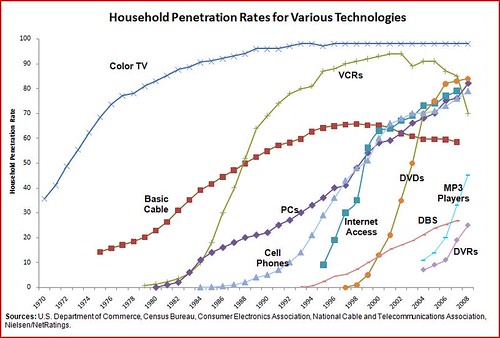
Yes, you could buy a PC in the late 1970s. But they were still pretty rare, and even a freestanding home PC didn't become hugely common until the 1990s -- networking was the missing step.
Mainframes have had buffers put between them and end-users, but are still highly utilised today. And the computerisation of the office was proceeding at mixed rates through the 1980s and 1990s (though well advanced by the early 1990s).
Tablets are cool and you can carry them everywhere, but you can't really work important stuff on them since they are still too small.
On the other hand, even if laptops had very good battery life (which usually is not the case), they are still too big and heavy to carry around unless really needed (ie. for a meeting or something like that).
But an augmented reality laptop that lives in your phone is something people might want to use. Not for gaming, but for normal office work, be it programming or using spreadsheets.
And, at that point, regular users might think about obsoleting desktop PCs and laptops.
And to no small success - they worked out quantum mechanics and a lot of other very difficult problems on this platform.
People still even make games for this platform too.
I could say, "The manually driven, privately owned internal combustion car and truck have been dominant in transport for 100 years, so the safe bet is that they will continue to be." And that is definitely safe bet. But the interesting work will be done by people making the unsafe bets.
I could totally see a smartphone hooking up to another computer for gamers - like the Thunderbolt 3 chassis allowing you to use an external GPU. Or simply when you walk into your house your phone connects to a more powerful hub giving you sensor data and processing power?
Eventually I think we'll socially "shift" to allowing electronics within our bodies to augment our abilities. We can't fit everything into a smartphone and we can't keep shrinking it. We can make things more efficient but it's more likely we'll begin building onto humans. Bodies are bigger than phones.
I'm more excited than terrified about an implant attached to my optic nerve for true augmented reality. Imagine everyone having a photographic memory. I'd love to see more done to store data on crystal - or on DNA.
Let's get freaky. :-)
I'm pretty skeptical of the common "brain machine interface". It probably requires surgery, and for what ? to make people smarter in a world with AI ?
No, i think the main motivation for a brain machine interface should be experience/emotion oriented, And there's a big question if people will take surgery for it, or would they suffice with an external device ?
One such modality is fmri neurofeedback - using fmri analysis to give detailed and accurate feedback of what happens inside your brain, so you could achieve better control of it, and your internal world.
How much better control ? well, there's some early research about treating depression/anxiety, etc. but the more interesting research is about letting people train themselves to reach(very rapidly, unlike years/decades as a monk) a state very similar to the buddhist enlightenment, where you are content and free of ego. Another type of training session has taught people to increase empathy. And i'm sure you could do a lot more, since fmri is relatively accurate and fine-grained.
This line of research is early, and very expensive to do, but the technology is drastically improving[1], and with it will research.
And once you have that, once you could potentially become internally satisfied and happy, why would you risk that with a brain surgery , in order to have somewhat better virtual reality ?
[1]mri's are expensive, but marie lou-jespen is working on a $100 mri helmet
https://www.maryloujepsen.com/resume?_escaped_fragment_=#! "Goal: Replace the functionality of MRI (Magnetic Resonance Imaging) with a consumer electronics wearable using novel opto-electronics to achieve comparable resolution to MRI."
(Couldn't find anything else really; https://www.engadget.com/2016/05/05/oculus-exec-mary-lou-jep... "she will focus on "curing diseases with new display technology," by bringing MRI machines to every doctor' office in the world."; links a TEDxYouth talk but that doesn't talk about it.)
Unless you mean strong AI, which isn't anywhere close, I don't think this AI rush has much wider chances than the previous one, except for some narrow use cases.
I don't think so. I think AI is just one of those fads that come up every now and then, and then get abandoned for the next one.
I'm calling AI as in "actual working strong AI" or useful soft AI stuff as fad.
I'm calling "AI" as in the thing currently every VC/company is investing in and we see various helpers like Cortana and Siri based, the machine learning craze, on etc. Besides some obvious and fitting applications (like in self driving cars) it will go nowhere fast.
VR has already reached this stage, without making any large dent on the market in the first place even temporarily.
Note that this is the second time AI is promised and will get nowhere (the first was back in the 80s, with the "AI winter").
Still hoping to see some improvement but not holding my breath.
And there's nothing to Google.com more than a simple heuristic algorithm, which can be totally dumb to context and nuance.
(I've written my own, but I'm interested in others'.)
Mainframes, minicomputers, desktop personal computers, laptops, and now tablets and smartphones. Maybe we have reached the end (for 50 years at least), but I think the safer bet is that the next big technology 30 years from now will be something that surprises us, not something we already have or could easily predict having wide adoption.