http://farm3.static.flickr.com/2244/2199183615_c2a8acbaff.jp...
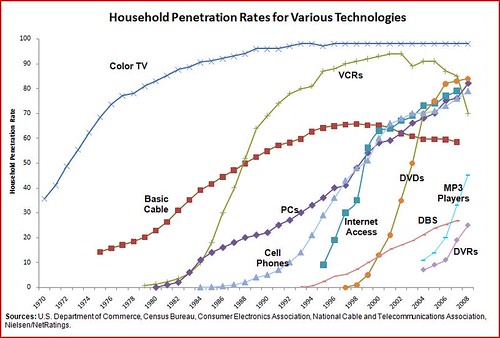
Yes, you could buy a PC in the late 1970s. But they were still pretty rare, and even a freestanding home PC didn't become hugely common until the 1990s -- networking was the missing step.
Mainframes have had buffers put between them and end-users, but are still highly utilised today. And the computerisation of the office was proceeding at mixed rates through the 1980s and 1990s (though well advanced by the early 1990s).
Tablets are cool and you can carry them everywhere, but you can't really work important stuff on them since they are still too small.
On the other hand, even if laptops had very good battery life (which usually is not the case), they are still too big and heavy to carry around unless really needed (ie. for a meeting or something like that).
But an augmented reality laptop that lives in your phone is something people might want to use. Not for gaming, but for normal office work, be it programming or using spreadsheets.
And, at that point, regular users might think about obsoleting desktop PCs and laptops.
Even though the amount of time spent using desktops and laptops in a desktop-like manner is decreasing, it's still a form factor found in every home. There may be more smartphones in that home but in my opinion, any product which is universally present in people's home is dominant even if it isn't being used as often as other options. Another example of this would be the microwave versus the oven. I'm not sure which one is used more often than the other but both are still dominant in terms of their universal presence in every home.