Without access to the source code or a well-reversed disassembly of the FTDI driver, and a good grasp of the logic used in the counterfeit chip, one cannot be certain about this. And surely not to the extent of urging Microsoft to revoke driver signatures.
http://www.ftdichip.com/Drivers/FTDriverLicenceTerms.htm
"Use of the Software as a driver for, or installation of the Software onto, a component that is not a Genuine FTDI Component, including without limitation counterfeit components, MAY IRRETRIEVABLY DAMAGE THAT COMPONENT."
May cause more problems than it fixes.
Of course if they have deliberately broken people's hardware that is a different matter, that clause in the license does not give them permission to in any way (either by my reading of the wording, or my understanding of how the law usually works in such cases).
Of course they should roll back the drive and investigate, but what if the problem is due to a new feature that can't be implemented some other way, and there is no way to detect a "genuine" chip? Should users of their chips do without a feature (or have to mess around opting in) because some other manufacturer's chip has a problem with it?
The only law broken by the counterfeiters is trademark violation for printing the FTDI logo on their chips. That's it! Everything else they did was legal. Otherwise, Intel and AMD would be bricking CPUs right now.
Reverse engineering is legal. Emulation is legal. Creating hardware that's compatible with another vendor's software is legal. Flashing your hardware with another vendors firmware is legal. Modifying hardware you purchased from a vendor is legal. Modifying software you purchased from a vendor is legal.
etc... etc...
Does anyone even know what entity designed and made the fake FTDI chip?
I find many people don't seem to understand what making compatible chip means. It's very common to have legitimate, drop in replacement for popular ICs. But this fake FTDI chip is certainly not the case here.
:-)
It doesn't matter if it's trademarkable. The entire purpose of VIDs is to distinguish between different vendors' devices. If I'm allocated a VID it's not my responsibility to ensure my drivers interoperate with other vendors' products.
How many products using counterfeit FTDI chips don't advertise USB compliance?
There are legal routes available to FTDI that don't involve bricking devices. I'm guessing that FTDI didn't talk to internal counsel before making this change.
I'll be quite surprised if Microsoft doesn't pull this patch.
marcan: "In case anyone was still wondering if this is intentional and malicious... Straight out of their driver. Function/variable naming and comments mine.
https://marcan.st/transf/ftdi_evil.png
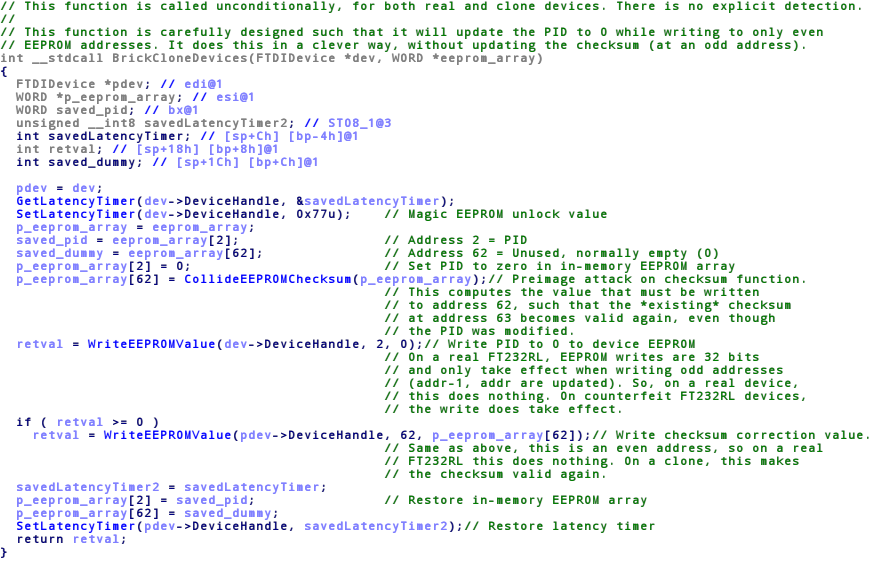
I figured out what's going on with the real chips: turns out their EEPROM is written in 32bit units. Writing to even addresses is ignored; the value is buffered and the address discarded. Writing to odd addresses writes the entire 32bits, using whatever value was last buffered for the other half. So both the PID write and the checksum write are ignored on real FTDI chips, as they are both written to even addresses. I still don't know why it works on clone chips though, since the checksum is written to the wrong place (it should normally be on an odd address); presumably they don't check it."
Basically driver is fuzzing 'chips claiming to be FTDI' with illegal instructions. Want to play clone games? better emulate me completely, otherwise tough titties. I like it. Might not work to well for FTDI in the end due to PR nightmare, but from engineering standpoint its quite brilliant.
> A company can choose to sign their own drivers rather than go through the WHQL testing process. These drivers would not qualify for the "Certified for Windows" logos, but they would install on 64-bit versions of Windows and install without a warning message on 32-bit versions of Windows Vista or Windows 7. However, it will not install without a warning message on Windows XP.
If they are, I don't know enough about how rigorous Microsoft's certification process is now to comment. It used to be just looking for things that would cause kernel instability but it seems the standards have increase a lot since its exception.
That alone would cause enough inconvenience to manufacturers to make sure they use legitimate parts.
It's the (unethical) bricking of the parts that has everybody up in arms.
Probably just putting a message with priority "Error" in the windows event log would be enough to warn computer-literate users.
The problem in that case is not the actual new drivers, but the process of uninstalling the old working drivers.
  The new Windows driver changes the PID to 0, and then the driver won't
  recognize the device (even if you edit the INF file), and you can't use
  the config tool. The workaround is to use a Windows XP or Linux system to
  change the PID back, and then don't use the new driver.
This is really skirting the ethical line and I'm not sure I can agree with their methods. I'm fine with them writing a driver that fails to work with counterfeit chips, but not actively disabling the chip. What if the device is attached to more expensive equipment that will also fail? We can't ensure that these chips are knowingly purchased after all.
This motivation reminds me of when the U.S. and Syrian governments disseminated sabotaged munitions that explode in the weapon, killing/maiming the operator, among their opponents. The danger is that they will find their way back to friendlies.
It is NOT OK to modify the HARDWARE in ANY WAY, including changing the PID.
That is the issue.
Further Most people defending FTDI assume this code will be 100% pure and never incorrectly identify a real chip as fake, I find that claim to be suspect.
Lastly I would find it very hard to support vendors that take these aggressive risks and stances, I certainly would never incorporate a device from a manufacturer that uses these types of tactics into a mass produced product.
Unfortunately for me, I chose today to rotate.
I don't work for FTDI; I'm not even British. But I did build that Adafruit altoid tin MP3 player eight years ago, which used a FT232.
Why am I wasting my time on this argument? I don't really know, aside from I hate the "internet dogpile" effect.
My credibility as a greenbean is nil of course, but oh well.
Edit: obviously folks do not believe me. Serves me right for trying to answer. jessaustin, I hope you at least feel like you got your answer. I get the feeling it doesn't actually matter what I say or even who I really work for- I'm branded.
Let's take this from another point of view:
You purchase a device or some piece of hardware for a project which becomes useful to others and you decide to make the project marketable and release your own line. You source your components and one of them happens to have an FTDI chip that you believe legitimately came from the company. Your project is accepted by others and everyone is happy.
Then one day, your supplier decides to switch out a source for the chip in one of the components of your project to one that's cheaper (the supplier may not suspect these are counterfeit). You don't see any difference either as you haven't tested it with the latest driver, which may not be out yet. The project is now shipped.
A new driver is released. An overwhelming number of customers now hit your support system saying the update has stopped your project cold. Rolling back the update has no effect. You don't know which component caused the problem as your project uses several from different suppliers. It may take days or even weeks to track down the problem, but meanwhile, your customers grow angry.
This is now your fault and you're left holding the bag.
This scenario need not be hypothetical, as this is just the same as GM "fixing" a problem with their ignition switch that has already claimed lives, but leaving the part number the same. This makes recalling a nightmare as there's now no way to tell which cars are affected until the switch fails or someone dies again.
Just the same as there's no way to tell which one of your project's components carry counterfeit chips and you need to issue a recall for potentially 100K units since you don't know which ones carry a counterfeit and there's no software fix anymore as the chip is bricked. Your project is also potentially being used in mission critical infrastructure that cannot be shut down to do a test without costing a lot of money. Better hope no one follows "best practices" and updates the driver as it may also contain a security fix.
FTDI is well within their rights to protect their product. But are they doing the ethical thing by costing unsuspecting customers and potentially hundreds of other businesses that rely on their product valuable time and money? All for not knowing that somewhere along the supply chain, someone cut a few corners and got their chips from a counterfeiter? Should they be victims twice; once by the counterfeiter and again by the company?
Yes, I take this answer at face value. I didn't really think there were only two possibilities here. Perhaps I was a bit blunt in the hopes of eliciting a "real" answer like this one.
They are not entitled to break the hardware by changing the PID so it doesn't work with any drivers.
There are other drivers that work when the PID is left intact.
I rarely eat breakfast in the first place, sadly.
Refusing to work with counterfeit hardware is entirely appropriate, destroying it in a way that most consumers cannot recover from is in no way acceptable or defensible.
You may as well have come into my home and destroyed my cookware because I bought a stove from you and the pots I had weren't your brand. It's uncalled for, inappropriate, unethical, and immoral and I'm not certain that it's not illegal. Your employer has no leg to stand on.
The device violates the USB specification by using a protected VID; it is already to be considered as broken regarding the USB specification.
A more appropriate analogy would be a car that has its chassis number filed off and written back on with black marker.
If FTDI have an issue with a company ripping off their IP then go sue that company. But what they're doing is catching consumers in the firing line, who will wind up with multiple dead USB devices. There's no reasonable way a consumer can know they are buying something with a fake chip and this could kill devices years old, which will be outside of warranty.
I am totally serious that Microsoft should step in. FTDI's driver is so defective that it is literally killing hardware, if they won't step in for this then what will they step in for?