News for hackers. Stuff that matters.
Re:The Lowdown on Lidar by ihaveajob on Thursday July 31, 2014 @11:37AM (#8114729)
Speed radars are good for speed traps, but not so great to prevent speed related incidents. They share the same fatal flaw with all other single-point speed meters: You can just slow down for a minute, while you pass by the speed trap, and then speed up for the rest of your trip. Instead, a 2-point speed meter (i.e. license plate readers every few miles, measuring time between matching reads) system is superior because a) their margin of error is negligible and b) they measure sustained speed over a long distance rather than at a single hot spot, thus making roads safer. I can't believe it's not implanted at least in all interstate freeways.
Re:The Lowdown on Lidar by growse on Thursday July 31, 2014 @11:52AM (#8114825)
Possibly because the cost/benefit just isn't there.

In the UK, the data shows that speeding (excessive speed for the conditions above the speed limit) is the primary cause in single digit percentage of accidents. I believe there's data from 1996 and 2007 for this, will dig it out when I'm not on mobile.

If you want to spend money on accident prevention, there's much better things to target than speeding.

Re:The Lowdown on Lidar by saosebastiao on Thursday July 31, 2014 @12:21PM (#8115010)
I have yet to get into an accident, but I actively avoid walking across several streets in Seattle because of a combination of entitlement thinking (This road is mine because I'm in a car!), and pervasive speeding. I'm not the only one...I recently found out almost nobody on my side of a local road will cross the road due the same problem. The road, therefore, has become a barrier to commerce and has split a community in two.

Preventing accidents isn't the only reason to enforce traffic laws.

Re:The Lowdown on Lidar by quux on Thursday July 31, 2014 @01:08PM (#8115390)
There aren't any traffic lights and crosswalks on this street?
Re:The Lowdown on Lidar by saosebastiao on Thursday July 31, 2014 @01:15PM (#8115444)
There are some crosswalks, 8 blocks away from each other. No lights for at least a mile. In WA state, every intersection is automatically a legal crosswalk with pedestrian right of way (unless marked with a "No Pedestrian Crossing" sign), but the lack of enforcement combined with the high speeds makes that right of way effectively meaningless.
Re:The Lowdown on Lidar by e40 on Thursday July 31, 2014 @02:01PM (#8115834)
I walk a lot in CA. Not long ago I saw a cop not yield to a pregnant woman pushing a baby in a stroller, in a 4 lane road. She was in the crosswalk, clearly marked. There was no light or stop sign, but she was in the middle of the 4 lanes when the cop drove past her in the closest lane. I really couldn't believe what I was seeing.

When the cops don't even respect the laws, the laws are meaningless.

Re:The Lowdown on Lidar by kelnos on Thursday July 31, 2014 @06:28PM (#8117391)
This doesn't surprise me. I walk a lot too, and I constantly see cops flip their lights on for the few seconds required to make an illegal left turn, run a red light, etc., and then turn them right back off.
Re:The Lowdown on Lidar by coldpie on Friday August 01, 2014 @08:51AM (#8119512)
Yet another consequence of police immunity from prosecution.
Re:The Lowdown on Lidar by scott_karana on Thursday July 31, 2014 @03:38PM (#8116473)
Hypothetically remove speeding from the equation, and keep the entitlement.

Would you feel safe crossing the road now?

Re:The Lowdown on Lidar by saosebastiao on Thursday July 31, 2014 @04:14PM (#8116704)
Safe(r), yes. Speeding decreases the chances you will die in a collision, and decreases reaction distance.
Re:The Lowdown on Lidar by koenigdavidmj on Thursday July 31, 2014 @02:50PM (#8116160)
What road are you talking about in particular?

If it's something like 15 Av NW in Ballard, it's pretty obvious that you're meant to cross at a light, even if you legally have more of a right to cross at the uncontrolled intersection one block away. It's unreasonable to expect a highway-in-all-but-name to stop for one person when marked, lit crossings exist within five blocks at all points along the road.

Re:The Lowdown on Lidar by saosebastiao on Thursday July 31, 2014 @03:26PM (#8116391)
In Ballard there are two. I'm specifically talking about Leary between Market and the 15th Ave overpass, but Market itself is quite the same way east of 15th.

Even in the case of normal 2 lane roads, drivers here still act like pedestrians do not have the right to cross anywhere but a crosswalk (and some don't even respect the crosswalk), and it only gets worse with 3 and 4 lane roads because that is where the drivers tend to drive significantly over the speed limit.

And yes, I do consider it reasonable to expect cars to stop for pedestrians in all scenarios where pedestrians have the right of way. A 5 block detour to cross the street can add another 15 minutes to your quick trip...what would happen if the situation were reversed? Can you imagine the outrage that would happen if cars had to drive 15 minutes out of their way? Slowing down for 5 seconds to let someone walk across the street is a miniscule inconvenience in comparison.

Re:The Lowdown on Lidar by Fomite on Thursday July 31, 2014 @04:38PM (#8116840)
I feel this way in the vast majority of Maryland.
Re:The Lowdown on Lidar by aidenn0 on Friday August 01, 2014 @12:44PM (#8121306)
Northern Virginia is that way too. Even with marked crosswalks with yield to pedestrian signs, crossing at an intersection without a traffic light is downright scary.
Re:The Lowdown on Lidar by Retric on Thursday July 31, 2014 @12:39PM (#8115135)
%of total accidents is amost meaningless. % of accident deaths or even %of totaled cars would be a much better indicator. A parking lot fender bender is vary different than an 80MPH head on collision.

Also, even if speeding is not the direct cause of an accident it increases the damage resulting from an accident.

PS: It has been estimated that hard limiting private vehicles to 40MPH would have saved over 2 Million lives in the US. Not that I am promoting such a low speed limit but people really don't understand the dangers of speed. Every year after 1945 at least 30,000 people died with a peak well over 50,000.

Re:The Lowdown on Lidar by rrreese on Thursday July 31, 2014 @01:00PM (#8115329)
New Zealand keeps fairly good records which can be downloaded here: http://www.transport.govt.nz/assets/Uploads/Research/Documen... page 62 lists the percentage of crashes, crashes with injuries and crashes with fatalities. Speed is constantly found in around 30% of fatal crashes.
Re:The Lowdown on Lidar by nucleardog on Thursday July 31, 2014 @07:23PM (#8117576)
Saying speed is found as a factor in around 30% of fatal crashes doesn't really say much as to the effectiveness of these sorts of measures. I mean, right off the bat I have to ask - what is the overlap between "people in fatal crashes with speed as a factor" and "people who receive automated speeding tickets".

I think as a percentage it would be unimaginably tiny which supports the assertion that it is misplaced enforcement if safety is actually the goal.

Re:The Lowdown on Lidar by CamperBob2 on Thursday July 31, 2014 @07:27PM (#8117589)
And when you consider that more than 30% of drivers are typically speeding on many/most roads...
Re:The Lowdown on Lidar by Rapzid on Friday August 01, 2014 @11:55AM (#8120751)
If only we were so lucky. 30% of drivers in NZ drive 20km/h below the speed limit on the motorway is more like it :|
Re:The Lowdown on Lidar by selectodude on Thursday July 31, 2014 @12:00PM (#8114876)
It's not about saving lives. It's about revenue generation.
Re:The Lowdown on Lidar by MichaelDickens on Thursday July 31, 2014 @12:32PM (#8115082)
Speed limit laws don't exist to generate revenue. They exist to disincentivize speeding.

If speed limit laws didn't exist, can you imagine lawmakers saying, "We need more money. Hey, I know! Let's charge people money for driving over a certain speed!"

Re:The Lowdown on Lidar by pyre on Thursday July 31, 2014 @12:51PM (#8115241)
The laws aren't put into place with the "let's generate revenue" mentality, but their enforcement is definitely done with respect to that mentality. If it's all about getting people to slow down, then:

1) Why aren't law enforcement more focused on getting people to slow down than writing tickets?

2) Why do traffic cops have monthly quotas for tickets?

3) In places where monthly quotas are against the law, why do 'performance revues' of traffic cops only focus on '# of tickets' as the largest performance metric? (basically a quota by another name)

4) Why is it so easy to bargain down a speeding ticket in a large city, whereas in a small town they are only willing to haggle on the points on your license (hint: because they still want you money)?

Re:The Lowdown on Lidar by saosebastiao on Thursday July 31, 2014 @01:40PM (#8115680)
How is a ticket quota any different than a SLOC quota or a SLOC analysis in a performance review?. Quantity of tickets issued is a productivity metric, as flawed as it is. Their existence does not imply that tickets exist for revenue.
Re:The Lowdown on Lidar by evilduck on Thursday July 31, 2014 @12:57PM (#8115297)
Just like no community has ever been found to be shortening yellow light timers after setting up red light cameras, and no cops ever dubiously search cars for drugs so they can seize assets.

Just because they weren't conceived for a purpose doesn't mean that's not how they're used. Speed enforcement is very frequently performed by small town cops sitting on highways that are just barely in their jurisdiction. They're doing it for money, plain and simple.

See https://www.google.com/maps/preview?client=safari&q=hampton+... for proof of this.

Re:The Lowdown on Lidar by selectodude on Thursday July 31, 2014 @01:44PM (#8115707)
>They exist to disincentivize speeding

Where I live, in Chicago, the speed limits are so low on some freeways that 91-98 percent of people are going over the speed limit, and the average speed is over 70mph. So everyone, including the police it seems, agrees that the speed limits here are not for my safety, but exist as a way for the officers to cherry pick essentially any car they want and write them a ticket.

Re:The Lowdown on Lidar by omegaham on Thursday July 31, 2014 @02:24PM (#8115980)
The idea of a speed limit is sound. But there are organizations that work to game the system. A great example is the multitude of sleepy towns right next to highways. They have a police force that is exclusively utilized on the five miles (or less) of highway that officially fall within the town limits, writing tickets to people who pass through. For example, Lindale, Ohio has a population of about 170 people and collects about $800,000 a year from speeding tickets.

My mother got snagged in one of these in Virginia a while back - they have a hill where the speed limit drops from 65 to 45 at the bottom of it, with a specially planted copse of trees where the police sit with their detectors. A quarter mile down the road, they have a specially built parking lot for people to get their tickets. They even provide envelopes and stamps for people to send their checks! Nice people.

Re:The Lowdown on Lidar by LordKano on Thursday July 31, 2014 @05:29PM (#8117112)
Virginia is also a state that bans the use of RADAR/LIDAR detectors.

I suspect that this business model is in trouble if GPS makers begin to track speed-limit information and pass that along to their users.

Re:The Lowdown on Lidar by spott on Thursday July 31, 2014 @03:04PM (#8116253)
Speed limit laws started as a safety thing, then they were a car efficiency thing (during the 70's oil crisis). The problem is that the municipalities started to increasingly depend on the income from traffic enforcement.

No, lawmakers don't say "Hey, I know! Let's charge people money for driving over a certain speed!", they instead say: "lets install these red light cameras on this intersection that doesn't see a lot of accidents.", or "this long straight stretch of highway, with few accidents, but lots of speeding should be better policed". The enforcement of laws becomes more about making money from the tickets than from concerns about safety.

Re:The Lowdown on Lidar by shoeless on Thursday July 31, 2014 @12:41PM (#8115147)
The manufacturers of speed cameras take a percentage, and it is a windfall for the municipality.

I live in an area where stationary speed cameras are around every corner (Montgomery Co, Maryland). I've lived here long enough to know that there's no way the county would spend money on the equipment and man power to maintain and operate that network, just to break even for the sake of safety.

Re:The Lowdown on Lidar by Liesmith on Thursday July 31, 2014 @12:38PM (#8115117)
Don't be ridiculous, If it was about revenue there would just be more toll booths.
Re:The Lowdown on Lidar by mortov on Thursday July 31, 2014 @12:50PM (#8115227)
That would only be the case where people accept tolls & toll booths on roads as an acceptable thing.

Sure, they're common in Canada and the US but in some other countries they lead to years of civil disobedience, protests and eventual scrapping by newly elected governments : http://en.wikipedia.org/wiki/Skye_Bridge#Toll_controversy

Speed fines have the semi-respectibility claim of trying to reduce accidents/dangers on the road (with some validity).

Re:The Lowdown on Lidar by Scoundreller on Thursday July 31, 2014 @09:10PM (#8117934)
I'm waiting for someone to calculate the greenhouse gas emissions created by toll booths.
Re:The Lowdown on Lidar by kaoD on Thursday July 31, 2014 @12:47PM (#8115197)
Tolls booths are obviously about the revenue, which make the voter angry.

Not that I support his claim, just refuting yours.

Re:The Lowdown on Lidar by Thrymr on Thursday July 31, 2014 @01:30PM (#8115574)
Even if it's not the primary cause, accidents are much more dangerous at higher speeds. It also makes reaction times shorter for avoiding other things.
Re:The Lowdown on Lidar by malchow on Thursday July 31, 2014 @11:58AM (#8114865)
"I can't believe [average speed camera systems are] not implanted at least in all interstate freeways."

Possibly because a civil society, favoring the preservation of a measure of basic autonomy, does not implement every measure for tracking, enforcing, circumscribing, and monitoring the people.

Re:The Lowdown on Lidar by timthorn on Thursday July 31, 2014 @12:37PM (#8115113)
In practice, they're actually very good for improving traffic flow on busy roads - because almost everyone is driving at the same speed, jams just don't form in the same way. The utilitarian argument for them is very strong.
Re:The Lowdown on Lidar by michaelt on Thursday July 31, 2014 @03:36PM (#8116459)

  The utilitarian argument for them is very strong.
Doubtless a national numberplate recognition system would be effective at enforcing the speed limit.

Once we have it, it would also be of great utility to investigate kidnappings and terrorism. And serious and violent crime. And vehicle thefts. And drug trafficking. And driving without a license, insurance, or tax. And lying about your address to get your kid into a good school.

And who could object, when we're already storing proof of what really happened, to that proof being used to vindicate the innocent in a divorce hearing, or an employment tribunal?

As faithful believers in the free market, what better way to fight congestion and encourage the use of public transport than a tax that only applies on congested roads, and only at peak hours of the day? What luck, the infrastructure is already in place.

No doubt the system will be expensive to design and operate. It would help defray the costs if we release citizens' travel records to some carefully vetted partners, such as academic researchers, urban planning consultants, insurance companies, marketing companies and credit rating agencies.

Re:The Lowdown on Lidar by Shivetya on Thursday July 31, 2014 @07:28PM (#8117592)
We already have numberplate recognition and its essentially on a national scale, just not completely linked up from jurisdiction to jurisdiction. License plate scanners are becoming rampant in some areas, they apparently have never been successfully blocked, all for reasons you listed and also as "license plates and vehicles don't have rights". The favored method for abusing a person's rights is to target their things
Re:The Lowdown on Lidar by erobbins on Friday August 01, 2014 @02:19PM (#8121942)
Perhaps I can incorporate my car, and get it some rights!
Re:The Lowdown on Lidar by ghkbrew on Thursday July 31, 2014 @12:53PM (#8115256)
Do you have evidence to back up that claim? It seems counterintuitive that slowing down the top few percent fastest drivers would improve traffic. If there's enough traffic to cause congestion wouldn't they be stuck behind slower drivers anyway?
Re:The Lowdown on Lidar by TeMPOraL on Friday August 01, 2014 @08:12AM (#8119383)
As you go faster, your stopping distance (that is, the distance you should maintain between you and cars in front and behind you) increases. This leads to roads having a maximum capacity somewhere in the area that speed limits are set. If you go faster than that, you're reducing efficiency of traffic.
Re:The Lowdown on Lidar by timthorn on Thursday July 31, 2014 @01:21PM (#8115503)
Anecdotal evidence, but it also makes intuitive sense if you consider that vehicles travelling at a range of speeds and particularly changing lanes to overtake the slower drivers is effectively a turbulent flow. If that flow can be smoothed, as a body it travels faster.
Re:The Lowdown on Lidar by saosebastiao on Thursday July 31, 2014 @01:44PM (#8115703)
I know the trucking industry regularly criticizes the safety implications of having a separate speed limit for them, as it makes lane changes much more complicated. They aren't impartial to the financial impact of the speed limit though, so there's that.
Re:The Lowdown on Lidar by ylhert on Thursday July 31, 2014 @12:51PM (#8115234)
In France they have a system that sort of works like this, most/many highways are toll based. There are toll booths at regular intervals(every 100 miles or so). If your time between toll booths is below a certain time, they know you were speeding at some point. To get around this, my always speeding grandpere would just have us stop for gas, un cafe, etc right before each toll booth.
Re:The Lowdown on Lidar by TeMPOraL on Friday August 01, 2014 @08:15AM (#8119386)
> To get around this, my always speeding grandpere would just have us stop for gas, un cafe, etc right before each toll booth.

That sort of defeats the point of speeding. Why endanger your lives and the lives of the others if you even don't get faster to your destination as you make additional stops to "defeat" anti-speeding systems?

Re:The Lowdown on Lidar by ylhert on Friday August 01, 2014 @03:42PM (#8122387)
I don't think his speeding was a logical, reasoned thing
Re:The Lowdown on Lidar by colanderman on Friday August 01, 2014 @10:08AM (#8119861)
You are supposing he stops for gas when his tank is full?
Re:The Lowdown on Lidar by TeMPOraL on Friday August 01, 2014 @10:48AM (#8120098)
I'm supposing he stops for gas when his tank is still more than half-full to top it up, so that he stops exactly enough times to avoid being fined for speeding.
Re:The Lowdown on Lidar by draven on Thursday July 31, 2014 @01:43PM (#8115700)
The one I've seen were not installed on the toll booths themselves (those are only there when entering or exiting the freeway) but on separate kind of portals above the road.

A camera records the traffic, a computer extract the plates. Then later you have the same setup, and they can then calculate your average speed between the two. The French name is "radar tronçon".

Re:The Lowdown on Lidar by jpmattia on Thursday July 31, 2014 @12:44PM (#8115173)
> I can't believe it's not implanted at least in all interstate freeways.

If you're around DC, there are a bunch of automated speed detectors built into the highways, and it's the same story: People slow down for the trap, and then speed up afterwards.

If you're from out of town, you're pretty well screwed because you'll be following some guy who will, out of the blue, slow down for no apparent reason.

Re:The Lowdown on Lidar by throwaway0010 on Thursday July 31, 2014 @01:40PM (#8115670)
Interestingly the system you describe, marking two points and measuring time between them is illegal in California:

Definition of a speed trap: http://www.dmv.ca.gov/pubs/vctop/d17/vc40802.htm

Speed traps are prohibited: https://www.dmv.ca.gov/pubs/vctop/d17/vc40801.htm

Re:The Lowdown on Lidar by grecy on Thursday July 31, 2014 @12:10PM (#8114937)
> I can't believe [average speed detector is] not implanted at least in all interstate freeways.

They are very common in Australia. It takes a photo of your license plate, then another 10km (or whatever) down the freeway. If the two photos are less than x seconds apart, you get a speeding ticket.

Re:The Lowdown on Lidar by goodcanadian on Thursday July 31, 2014 @01:05PM (#8115369)
I was going to say something similar. However, the ones I have seen are only applied to large trucks. So far, at least, cars can speed through with impunity.
Re:The Lowdown on Lidar by grecy on Thursday July 31, 2014 @02:19PM (#8115952)
The Melbourne->Geelong road (Australia's busiest, and deadliest) has many, and they will ding regular cars.
Re:The Lowdown on Lidar by reustle on Friday August 01, 2014 @01:19PM (#8121564)
They also have these in Norway. The 2nd camera has a light on it and will blink yellow if you should expect a ticket in the mail.
Re:The Lowdown on Lidar by bentcorner on Thursday July 31, 2014 @01:42PM (#8115692)
I expect to see a post about time synchronization problems with remote equipment.
Re:The Lowdown on Lidar by mrdmnd on Thursday July 31, 2014 @01:32PM (#8115599)
The Mean Value Theorem strikes again!
Re:The Lowdown on Lidar by Zelphyr on Thursday July 31, 2014 @12:11PM (#8114942)
Unfortunately, because police departments are often (mostly?) funded by things like tickets[1], they actually have an incentive to care less about traffic safety in this case. If the goal was truly to get people to stop speeding the municipalities could increase fines to a level that actually serves as a deterrent.

1: I only have second-hand/anecdotal knowledge that these departments are funded by fines. Still, I believe my point remains.

Re:The Lowdown on Lidar by randyrand on Thursday July 31, 2014 @03:41PM (#8116487)
I think the punishment should reflect the crime.

If fines and or punishments are used primarily as a deterrent, then why not just have huge punishments all over the place?

Do you see how that's immoral? Fines should be used as punishment, not deterrence (punishment is a form of deterrence, but is merely a side effect). If I decide to litter, it's because I think "this is not that big of a crime. I'm not harming people very much." It's not anyones natural moral instinct to think, "I would do this, but the penalty is to high" - we're conditioned to think that. But as is all to often, a lot of times people are not even aware that their actions may be illegal, or may not be aware the consequences are vastly harsher than the crime. Do you know what the penalty is for driving with one bad headlight? me neither. I hope its reasonable, especially when I make the decision to do it, but I base the decision off the fact that driving without a headlight does not seem that egregious of a crime.

So shouldn't our punishment system be base off the same thing that people use to guide their decisions? The results of our actions?

The answer is yes. I don't want to live in the world you are imagining. Even if there is no litter on the ground and no one speeds.

If you say, just inform everyone of the laws really really well so they know beforehand when making a decision, that is utterly impossible. Foreigners exist. People are busy. All laws are not even totally known to the lawmakers. It is an impossible task.

Back to your point: If the goal was to stop speeding, they would make it physically impossible to speed. Either by really pervasive robotic enforcement, or governors in cars. But they don't do that, they want the money.

Still, the punishment should reflect the crime, even in the robotic police world.

Re:The Lowdown on Lidar by stronglikedan on Thursday July 31, 2014 @11:57AM (#8114854)
Perhaps it's because you're ticketing the vehicle's registered owner, but not necessarily the driver.
Re:The Lowdown on Lidar by gambiting on Thursday July 31, 2014 @12:03PM (#8114893)
That argument works in some countries while in others it doesn't. In UK only people who are explicitly listed on the insurance document can drive the car, and the police can demand that you tell them who was driving the car at the time. In some other EU countries like Poland, you buy insurance for the car,not the driver,so literally anyone can drive it(with your permission of course). Then if you are caught by a speed camera and your face isn't visible you can say that someone else was driving and you don't remember who - in theory there is a penalty for not saying who(200zł = ~$60), but most people opt to pay it instead of the speeding ticket which can be higher - or go to court and dispute that they cannot pay for the crime they didn't commit and they cannot be forced to remember something which they don't remember - and they sometimes win.
Re:The Lowdown on Lidar by tompko on Thursday July 31, 2014 @12:21PM (#8115011)
> In UK only people who are explicitly listed on the insurance document can drive the car

That's not entirely true, it depends on your insurance. It's an offence to drive a car without insurance, and an offence to allow someone who is uninsured to drive your car. Some insurance policies do not extend the insurance you took out to driving other peoples cars. However, some fully comprehensive policies do have third party insurance while you are driving someone else's car with their permission. In that case it's fully legal to drive.

Re:The Lowdown on Lidar by gambiting on Thursday July 31, 2014 @12:28PM (#8115052)
Ok, I didn't know that. Still, it works another way around than it does in countries like Poland - you have to have your own insurance,to drive somebody else's car. While in Poland you only buy insurance for the car,and anyone with a valid drivers licence is automatically covered by the insurance purchased for that car(unless they are doing it without the permission of the owner, in which case the insurance is invalid).
Re:The Lowdown on Lidar by TeMPOraL on Friday August 01, 2014 @08:21AM (#8119403)
I don't get why people are bringing this point up like this was something weird, IMO it should be obvious. You own a dangerous kinetic weapon, you should be responsible for how it's used, either by yourself or by anyone who you lend it to.
Re:The Lowdown on Lidar by colanderman on Friday August 01, 2014 @09:50AM (#8119763)
As someone who daily drives a highway [1] that is marked 15 MPH below what it ought to be (as almost all highways are), I hope this system never comes to fruition.

Now, automated tagging of morons who stare at their phone while driving? Bring it on. Those fuckers are a plague.

[1] The Mass Pike (I-90); which is a toll highway that is marked 65 MPH, on which traffic averages 75 MPH, and 80 MPH is well under the speed the highway can safely support (given attentive drivers).

Re:The Lowdown on Lidar by mokus on Friday August 01, 2014 @01:35PM (#8121676)
On the other hand, as someone who also believes speed limits are too low, I sometimes wish they _were_ enforced to draconian extremes because then the 95% of drivers who just ignore the law instead of trying to change it might actually get off their asses and vote.
Re:The Lowdown on Lidar by colanderman on Friday August 01, 2014 @02:09PM (#8121877)
Likewise, I secretly hope vehicle speeds would be electronically limited (say, radio-controlled by highway transmitters) for the same reason.
Re:The Lowdown on Lidar by hyperbovine on Friday August 01, 2014 @11:28AM (#8120500)
> (given attentive drivers).

Good god man, since when is that a given? The situation worsens with each passing day.

Re:The Lowdown on Lidar by colanderman on Friday August 01, 2014 @12:22PM (#8121087)
Hence my assertion that police should crack down on such inattentive drivers.
Re:The Lowdown on Lidar by chrisBob on Thursday July 31, 2014 @01:50PM (#8115749)
2-point speed meters would work especially well on toll highways. They already know exactly what time my car go on and off of the MassPike, but if you cover the 60 miles in 30 minutes then you get charged the same $5 as always.
Re:The Lowdown on Lidar by jpollock on Thursday July 31, 2014 @12:56PM (#8115288)
This can be intentional. If there is a dangerous piece of road where the average speed of traffic is higher than the road will take, then put a trap in to slow the traffic down to the limit. It doesn't have to be over the entire highway system to have an effect on accidents.

For example, in NZ, there is a speed camera half-way down Ngauranga gorge in Wellington - a place where there is a blind turn down a steep slope and where the limit goes from 100kph down to 80kph.

http://en.wikipedia.org/wiki/Ngauranga_Gorge

Re:The Lowdown on Lidar by btbuildem on Thursday July 31, 2014 @05:48PM (#8117194)
It's not the speed that is the problem - it's the relative difference in speed between two nearby vehicles that you should be concerned. Someone doing 55 in a 55 when everyone else is doing 70 is being a hazard, in their case following the speed limit is outright dangerous.

This is of course in context of freeways - residential streets etc do require a hard speed limit.
Re:The Lowdown on Lidar by legohead on Thursday July 31, 2014 @12:49PM (#8115216)
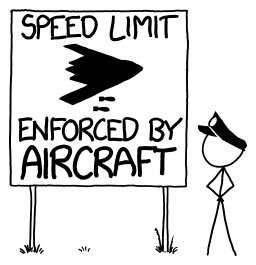
If you've traveled around the country, you've invariably come across those "speed is monitored by aircraft" signs, and what you described is how they do it (tracking how long it takes cars to go from point A to B)
Re:The Lowdown on Lidar by cardiffspaceman on Saturday August 02, 2014 @02:08AM (#8124139)
In California the CHP (California Hwy Patrol) plane has to do the same thing the CHP car would have to do: match your speed and then note its own speed. Measuring time between points is forbidden no matter what the observer's vehicle is. Radar is also used from the ground but was not available to CHP when they started using aircraft. The planes are on the inexpensive side so sometimes they have to dive to achieve the speed. Also recently CHP got to use radar statewide so they don't use aircraft so much.
Re:The Lowdown on Lidar by onan_barbarian on Thursday July 31, 2014 @11:40PM (#8118274)
I've always been a bit nervous about those "speed is enforced by aircraft" signs (as opposed to "monitored"). I always get a mental picture of a aircraft strafing near my car until I slow down...
Re:The Lowdown on Lidar by dTal on Friday August 01, 2014 @03:29PM (#8122324)
You may enjoy this image from XKCD then:

http://what-if.xkcd.com/imgs/a/87/radar_aircraft.png

Re:The Lowdown on Lidar by wastedhours on Friday August 01, 2014 @05:21AM (#8118939)
Yeah, but the initial ones in the UK were lane based (SPECS?), meaning if you changed lane at any point during that section, they wouldn't work. I assume this has been fixed now?
Re:The Lowdown on Lidar by cge on Thursday July 31, 2014 @05:37PM (#8117141)
If I recall correctly, for reasons I don't understand, this is not only not implemented in California, but not even legal there.
Re:The Lowdown on Lidar by thrownaway2424 on Thursday July 31, 2014 @11:44AM (#8114770)
The fundamental reason is because drivers feel entitled to speed and most voters are drivers. People with expensive cars further believe they've paid for the privilege of violating more laws more often, and those people are also more influential in policy setting.

There are lots of expressions of this fundamental reason, such as people throwing a fit about automated license plate reading in the name of privacy. But our all boils down to the fact that a person turns into a sociopathic scofflaw as soon as he gets behind the wheel.

Re:The Lowdown on Lidar by fossuser on Thursday July 31, 2014 @11:58AM (#8114866)
OR it could be because speeding isn't that dangerous and the current limits on most roads don't represent what speed people actually drive at or what speed people could safely drive at.

It's different on residential streets, but on freeways I think the way Germany handles it is better. Speeding tickets (and most traffic violations really) are not about safety or curbing behavior they're about generating revenue for the town/city.

Re:The Lowdown on Lidar by reitanqild on Thursday July 31, 2014 @12:38PM (#8115120)
A Dutch engineer once told me (back before 2004 I guess ) that they once raised the speed limit on the roads in Netherlands only to find average speed decreased.

His explanation IIRC was that 1. once people broke the limit it didnt matter how much and 2. when speed limits felt more correct more people respected them.

I'd love to know if anyone has any pointers to research on this as around here speed limits are weird. (80 in places where you obviously can't even drive 80 and 80 on the highway, -four lanes)

Re:The Lowdown on Lidar by grndn on Thursday July 31, 2014 @12:57PM (#8115291)
I used to live in Los Angeles. On the freeways, the speed limit was 55mph but I read once that the actual average speed was around 17mph.

My (unscientific) theory is that with higher speed limits, you get more traffic waves, and people try to change lanes more often, causing delays.

If the speed limit on LA freeways was only 25mph, I would hope that people would chill out and the traffic would flow more smoothly, resulting in a faster average speed than at present.

Re:The Lowdown on Lidar by bri3d on Thursday July 31, 2014 @06:49PM (#8117464)
Look up "rolling speed harmonization," an attempt to mitigate atrocious traffic to and from the mountains here in Colorado by using a pace car (effectively a strictly-enforced lowered speed limit).

Initial "tests" with lighter traffic conditions proved that the system helped stabilize closing speeds and volume, but in the actually troublesome heavier traffic conditions the state has been unable to figure out when and where to deploy the pace vehicles effectively.

Re:The Lowdown on Lidar by goodcanadian on Thursday July 31, 2014 @01:19PM (#8115488)
Be careful with your average speeds. I often drive in excess of 70mph on the (65mph limit) freeway in LA, and I am far from the fastest car. The key difference is that I don't drive in rush hour. A 25mph speed limit would be absurd.
Re:The Lowdown on Lidar by Liesmith on Thursday July 31, 2014 @12:37PM (#8115112)
Speeding is extremely dangerous. It's ludicrous to argue otherwise. A third of crashes (including fatal crashes) involve speeding, and the faster you are driving the more likely you are to die or fatally injure another.

Also, changing the speed limits on roads have been studied and it doesn't make a humongous difference. The government usually sets the speed limit at slightly lower than the average speed people actually drive.

Re:The Lowdown on Lidar by vonmoltke on Thursday July 31, 2014 @06:49PM (#8117461)
> Speeding is extremely dangerous. It's ludicrous to argue otherwise.

Actually, blanket arguments like "speeding is extremely dangerous" are ludicrous. "Speeding" is exceeding a semi-arbitrary speed threshold. If that threshold is, say, 70 mph I'm OK at 70 but if I go to 71 I am being "extremely dangerous"? 71 is speeding in that case, after all.

> A third of crashes (including fatal crashes) involve speeding,

If a third or more of all drivers speed, that statistic is meaningless.

> the faster you are driving the more likely you are to die or fatally injure another.

Indeed, and that statement has nothing to do with speeding. It is a continuum from 0 to whatever the top speed of a given vehicle is. This statement is equally valid when you are under the speed limit.

> Also, changing the speed limits on roads have been studied and it doesn't make a humongous difference. The government usually sets the speed limit at slightly lower than the average speed people actually drive.

I have seen that happen before, but in my experience that is the exception rather than the rule.

Re:The Lowdown on Lidar by colanderman on Friday August 01, 2014 @10:15AM (#8119904)
A third of people driving are speeding.

"The government usually sets the speed limit at slightly lower than the average speed people actually drive."

I don't think you've ever driven on a US interstate.

Re:The Lowdown on Lidar by grndn on Thursday July 31, 2014 @12:50PM (#8115228)
> the current limits on most roads don't represent what speed ... people could safely drive at.

If there's a sidewalk or any t-junctions, that's about 20mph tops. Anything faster, and you can't stop in time, plus in a collision, kinetic energy goes as the square of the speed.

For local trips, with stoplights that slow you down anyway, driving slower adds only a few extra minutes to your journey time. Personally, I'm not seeing the need to be so hurried all the time.

http://www.rospa.com/roadsafety/adviceandinformation/driving... http://blog.americansafetycouncil.com/why-speeding-is-danger...

Re:The Lowdown on Lidar by colanderman on Friday August 01, 2014 @10:18AM (#8119921)
I think the GP is talking about speed limits on controlled-access highways, not on residential or commercial streets.
Re:The Lowdown on Lidar by simias on Thursday July 31, 2014 @12:01PM (#8114881)
I'm not sure speed traps are preferred by voters over a 2 point system. I can say that as a driver I'd much prefer the 2 point system instead of the vast quantity of speed trap radars we have in france right now.

I think the main difference is the price, especially since 2 point systems turn into n-point systems if you have a lot of intersections.

Re:The Lowdown on Lidar by throwaway888888 on Thursday July 31, 2014 @12:00PM (#8114877)

  a person turns into a sociopathic scofflaw as soon as he 
  gets behind the wheel
Boo this man!

That is an ideological position, and I could easily apply the same blanket label of absolute sociopathy to law enforcement, and I'd be just as wrong.

But there's a difference between a mechanized, automatic law enforcement system and a law enforcment system that is implemented as a practice performed by living human beings. The human version is prone to imperfections and corruption, yes. But mechanized, automated law enforcement really COULD express a perfect ideology and attempt to enforce it perfectly, with an unforgiving brutality, which could not otherwise be accomplished with the complicity of human beings. Please understand that difference.

If you think placing a human being behind the machinery of an automobile is automatically bad, think about what it might mean to place a human being behind the machinery of a fully automated law enforcement system, with that same lens of blanket sociopathy.

Re:The Lowdown on Lidar by Karunamon on Thursday July 31, 2014 @12:13PM (#8114958)
Sociopathic? Maybe not, but scofflaw? Most definitely. Drivers have a really hard time with really basic things. Speed limits, red lights, turn signals, proper lane etiquette, and other common courtesies.

Every single one of those things has a law attached. People either forget or think that the law doesn't apply to them.

Re:The Lowdown on Lidar by scotty79 on Thursday July 31, 2014 @03:41PM (#8116494)
I'm a scofflaw every time when I approach the computer and/or (not) read terms and conditions or license.
Re:The Lowdown on Lidar by Karunamon on Thursday July 31, 2014 @03:51PM (#8116551)
As are most of us.. however there is no point at which ignoring the average EULA will endanger a life.

People who speed, hang out in the left lane, run red lights, don't signal their turns and lane changes, and so on are a danger to themselves and others.