If he says the city condones Banksy's work then he's going to immediately get asked "Who's job is it to decide which graffiti is art and which will get you arrested?" He's got 10,000 more important things to deal with so he just says it's vandalism and will be treated as such and then moves on to the rest of his day.
"For $41 million — what Citibank paid to sponsor the program for five years — our city bikes became Citi Bikes. To make certain you don’t forget this fact, a Citi Bike sign hangs in front of the handlebars, Citi Bike is printed twice on the frame, and a Citi Bike billboard drapes the rear wheel on both sides. The font is the familiar Citibank font and the Citibank signature decoration floats over the “t.” There is no way to see a Citi Bike without thinking Citibank. The 6,000 bikes so far rolled out, of a possible 10,000, and their signs are a Day-Glo cobalt blue that you see on banks. Nobody wears this color. Nobody paints his or her apartment this color. This blue is bank blue."
http://www.nytimes.com/2013/10/20/opinion/sunday/color-me-bl...?
There is no way to see a Citi Bike without thinking Citibank
If I consider my own experience, I'd say it's pretty easy to miss on that.
Extract: Initially The KLF's earnings were to be distributed by way of a fund for struggling artists managed by the K Foundation, Drummond and Cauty's new post-KLF art project, but, said Drummond, "We realised that struggling artists are meant to struggle, that's the whole point."[12] Instead the duo decided to create art with the money.
I’m talking about definitions and the argument about definitions that’s happening here. Arguing about definitions is foolish, it’s point- and meaningless. Who cares what vandalism is? The important thing is how one views a certain act, not how one defines vandalism. That only clouds the issue.
Also, I find people who think there are absolutes when it comes to this issue extremely funny.
Take, for example, the classic "if a tree falls in a forest and no-one is around to hear it, does it make a sound?". Resolving this question comes down to seeing that it depends on how sound is defined: pressure waves in the air or a neural state change related to those waves hitting an ear.
Once we see that a words (like "sound") has several definitions it allows us to see the world more clearly. Perhaps we invent new words for the sub-concepts that are generated.
However you define sound, the material facts of the situation are unchanged. You do not change anything in reality by defining it differently, you are merely changing something in your brain, i.e. how sound is represented inside it. That is also why the tree question is anything but deep. It’s extremely straightforward, there is no mystery, it’s only our brains screwing up (in the way it represents things).
Therefore, if it seems like some word is differently defined by different people all that has to be done is that everyone has to make clear what their definition is, that’s all. There is no point arguing about it, there isn’t even much point in trying to come to an agreement (except convenience).
If everyone know everyone else’s definition of something it’s perfectly possible to talk about it, even if all individual definitions are contradictory, it would just be hard to keep track of everything.
When they start asking for permission before painting other people's stuff.
The article is seeping thru with "I have no idea what it means" and so on. Well, what it means is you are not an art owner-type but are suddenly an art owner anyway, so you'd best sell that shack or otherwise get rid of it or remove it from the owners control before screwing it up, probably permanently and certainly very publicly.
The story wouldn't read any differently had someone tied a cow to her fence and run off. "I'm the accidental owner of a heifer" and "I have no idea what it means". Well, you're not going to figure it out quickly so use the magic of the market to hand it off to someone who does know what to do.
Its a popular, overdone trope, think of all the hollywood sequels along the lines of "three men and a baby".
In an CS proofs class, that would be considered a "proof by contradiction".
I must say, I quite love this seeming (or maybe it’s real?) contradiction. There are no absolutes. That’s what makes Banksy’s work so cool.
One could argue that if an artist breaks a law to make a statement (about either the law itself or wider sociological issues), then your perspective of the morality of the act could be influenced by whether or not you agree with the artist's statement.
Also, I think you're conflating legality and morality. I can think of situations for all 8 cases of (legal|illegal)(moral|immoral)(agree|disagree). However, you're probably right that agreement/disagreement influences morality judgments.
I do not know about Shakespeare 'breaking' any rules, or any pre-XIX Century painter. Or the Greeks, you know? What rules did the Parthenon's architect break? Or the sculptor of the Laocoon group?
The 'breaking rules' stuff is all very well for some things but it is not the definition of art. Please.
(Spanish examples because I am a Spaniard, but you understand).
Edit: romantical/romantic.
Possibly the 'please' in my comment is paternalistic, but then again your definition of the job of an artist is quite simplistic. So it may not be paternalistic but a plea for sensible speculation.
I guess my general point is that to be an artist, you have to be creative. To be creative, you have to do something new. To do something new, you have to depart from what exists in some way. Whatever exists can be called authority, tradition, or "the rules". And then something new is a challenge to that authority. If you build a skyscraper in a town with no skyscrapers, you are challenging authority, even if all the other towns have skyscrapers. When parents make a baby, it's a creative act, and the baby ends up challenging the authority of the parents; the baby breaks the existing rules of the family structure. It's the same with the work that an artist does. It doesn't have to be socially rebellious in nature. An expression of beauty that has not been seen before is breaking the rules about the limits of beauty.
Even more generally speaking, when an artist does manage to break the rules, they end up challenging our preconceptions of what can be - these preconceptions are the true "rules" - and it opens us up to a deeper experience of the world. As examples, anything that creates a feeling of awe, anything that touches on sublime beauty, is operating on this level. I think if you look closely, all of the artists you named are working in this way; it's not mere repetition of what came before.
Some would argue that even those now 'breaking rules' have been subsumed by the massive market around art - as soon as the price tag is astronomical, and the method of display only a safe gallery, the rebellion has been captured in aspic and rendered safe.
Banksy is an interesting take on this as much of his work is trying to break out of the confines of the gallery, but he has still been trapped in a system he's at least partly unhappy with by the rising value placed on his work, and has resorted to trying to undermine this with stunts like that $60 sale. It's interesting that the perceived value of the spraypaint with his signature has resisted even that sort of rebellion.
So I don't think saying it must be provocative or break the rules is a very good definition of art, indeed, for most people, even those buying faintly rebellious work in the 20th/21st century, art is decoration (I don't mean that in a derogatory way, but that is how it is consumed), rebellion is an optional extra.
You are indulging in a circular definition in which most creative stands in for best or most worthy art, which of course depends on the premise which you set up in the first place, and which is a peculiarly 20C view of art. Only with the break down of the patron system and in quest of a new definition of art and a new place in the world did artists turn to the idea of being a creative force challenging the status quo (economic and artistic).
I don't think Michelangelo for example would have recognised your definition of his art as only meaningful in as much as it breaks the rules. His art was almost all in service of the church, which was the dominant political and economic force of the time. You can try to rewrite the history of art as a history of innovation and rebellion, but why bother? Why not understand it in its totality, which is certainly not as an instrument of rebellion, or even as a force for change - for much of the history of art change was gradual and consensual over decades and centuries, and nothing to do with challenging authority, quite the reverse, it was usually in the service of authority, used as propaganda, teaching materials and social proof. Art was a useful craft for most of its history.
Great art can include rebellion, but it is not confined to it, and frankly I think you're defending a pithy but inaccurate slogan which falls far short of capturing the full role of art in our society.
I struggle to see what you would find humiliating in either my post or pfortuny's above - you issued a remarkably general assertion (all art is x in any medium, in any time period) which is in my view invalid, and I offered a counter-example.
In my post and I believe pfortuny's there was no attempt to shame you for your point of view, just a disagreement with that point of view based on our understanding of art history. Disagreement is not incivility.
If you disagree and this is true of all things considered art you should be able to reel off lots of examples and easily disprove the counter-examples given, since your assertion holds true universally.
Asking for a transition point makes the assumption that they are mutually exclusive. But Banksy is by any reasonable definitions both a vandal and an artist. Hence Bloomberg is simultaneously cleaning up vandalism and destroying art. Whether you think this is a good thing depends on how you weigh these two aspects. Personally, I think it just makes his work more precious. It is the nature of the medium that his work is temporary.
With Banksy a lot of people (certainly in the UK) don't even think of the vandalism, they jump straight to artist - something they probably wouldn't do for a lot of other graffiti. Why so? Publicity? Celebrity sales? The fact the piece has immediate value?
It's not vandalism if the owners of the buildings are happy to have the piece.
If I scrub a brick wall clean, is it vandalism? No.
If I glue a solid pound of gold to a brick wall and the building owner takes it, is it vandalism? No.
If I have a work painted on my property that draws crowds and will probably have a "market value" of a lot of money, and I'd rather have the work have been painted than not exist, is it vandalism? No.
If I'd be happy or even would actively desire to have a Banksy piece painted on my property, is it vandalism when it does happen? No.
> If I'd be happy or even would actively desire to have a Banksy piece painted on my property, is it vandalism when it does happen? No.
Haha, reminds me of when Banksy would turn up in a van and overalls in the middle of the day, whitewash a wall and then stick up a 'Designated Graffiti Area' sign.. The wall would be covered a few days later... :-)
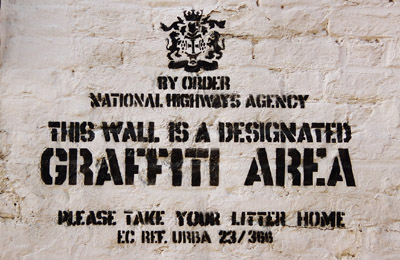
When they stop vandalizing.
Private property is one of the foundations of market economy, and I can't think of any necessity of art that calls for suspension of it.
On the same vein, the Mayor can't sue on behalf of private owners. If the owners like it, then its OK.
Although it seems hard to press charges without the property owner's cooperation.
Can express permission to paint a graffiti given afterward?
Honestly, he couldn't pay for that kind of publicity, and unless the good Mayor is actually in on it, Banksy must be grinning from ear to ear at the irony.
There ya go...
Why do you think writers use names like ads ? This is a quest for identity by people that have essentialy been made transparent and ignored by society. They reclaim urban space. "This is mine too, it has my name on it". "You can't do as if I didn't exist".
Being the target of such vandalism is no fun, for sure. I have been. When I did, I tried to remind myself tags are scars forgotten kids draw into average and blind people's landscape.
In this world of writers Banksy is a pacifist. He's addressing average people in their own language. He's talking to us with subtlety and good points, he's touching us, instead of shouting on us.
Be it him or any other writer, don't kill the messenger. If tags are pimples, then our society is sick. Would removing the symptoms cure the disease ? I doubt it, and I guess you do too. We know this all too well for a long time but still don't act on it as a group. These are only reminders, or first symptoms, of what is to come if we continue to indebt ourselves to other human beings. They'll reclaim.
Of course, tagging in public, perhaps in a hard to reach place, is a separate skill requiring its own practice... I'd just prefer they did it after having practiced the tag in their backyard first. Like Banksy.
The solution is of course to have legal walls. But that would be far too progressive for most councils.
Tagging doesn't require permanent paint.
Legal walls don't satisfy the goal of getting somewhere challenging.
The definition of art is more a philosophical question that varies from person to person, so getting consensus on defining what Banksy is is bound to ask the question. Perhaps that's one of his objectives.
Modern art is usually full of clever subtexts and messages that aren't apparent to outsiders. Like a really complicated and abstract piece of jazz music.
Ask a knowledgeable modern art fan to decrypt some paintings for you sometime, it's quite interesting.
>A dripping wet canvas covered the entire floor … There was complete silence … Pollock looked at the painting. Then, unexpectedly, he picked up can and paint brush and started to move around the canvas. It was as if he suddenly realized the painting was not finished. His movements, slow at first, gradually became faster and more dance like as he flung black, white, and rust colored paint onto the canvas. He completely forgot that Lee and I were there; he did not seem to hear the click of the camera shutter … My photography session lasted as long as he kept painting, perhaps half an hour. In all that time, Pollock did not stop. How could one keep up this level of activity? Finally, he said 'This is it.'
In many ways it mirrors the accounts of psychics or other frauds, many of whom are self-deluded and thus not frauds in the common sense. The lone genius, the strange process, the way the world falls away while he's at work, a flaw no one but the guru can keen - these are the type of things we seem to be wired adore. So we should be suspicious of any new tastes we acquire while exposed to them.
Once his work became popular, they became positional goods, like yachts or a diamonds, so we should be doubly suspicious of the tastes of those who paid for it.
Take a random person, get him or her to drip paint onto a canvas however they see fit. Create many paintings every day, save the ones that seem, by hap, to be the most pretty. I contend critics and buyers alike would not be able to reliably distinguish between the works of Pollack and the works of the random person. He created a new style of painting - one that happens to require no skill. I have no idea if he bought his own shtick, but I like the idea that he didn't.
Unfortunately, I think graffiti art will be accepted one funeral at a time.
Also, for reference, My wife is an Art History Professor at a highly respected liberal arts college and she takes Banksy seriously.... though she would not want to be called a critic.
Disclosure: owner of a Mr. Brainwash original
[Goes to play some Weird Al on Spotify ;-)]
In the UK a lot of people are genuinely gutted when a Banksy gets removed or covered - like something (a gift?) has been removed from the community. People who have their buildings 'vandalised' are often incredibly proud. But at the end of the day, it's still graffiti, still vandalism and I can understand Bloomberg's zero tolerance attitude. I wonder how he'd feel if it was on a building he privately owned (not that he needs the money...)?