News for hackers. Stuff that matters.
Re:Economics of Orbital vs. Terrestrial Data Centers by wmf on Monday December 15, 2025 @06:20PM (#46282348)
rad-hard silicon ... or just silently accept wrong results, hardware lockups and permanent failure

Somehow I don't think those are the only options. AFAIK Starlink is using a lot of non-rad-hard silicon already.

Re:Economics of Orbital vs. Terrestrial Data Centers by johnsmith1840 on Monday December 15, 2025 @07:00PM (#46282812)
My understanding is non rad hardened method get around this by basically doubling or some multiple of repeating calculations and chexking data often.

Random errors will occur you just need to be checking fast enough to fix and update that bad bit flip.

I am sure there's all sorts of fun algorithms in this space but I am under the impression there is SOME tax to doing this. What is the tax? Is it 10% ir 60% I have no idea would love to know!

Re:Economics of Orbital vs. Terrestrial Data Centers by danpalmer on Monday December 15, 2025 @07:10PM (#46282914)
There's more than that, it's possible to get permanent hardware damage from radiation at smaller (modern standard) process sizes.
Re:Economics of Orbital vs. Terrestrial Data Centers by johnsmith1840 on Monday December 15, 2025 @07:38PM (#46283162)
I didn't think about that, so yeah, basically space based compute centers are just hype on top of hype.
Re:Economics of Orbital vs. Terrestrial Data Centers by marcosdumay on Monday December 15, 2025 @11:14PM (#46284700)
Why make a GW datacenter on the ground if you can make two and pay to launch them into space?
Re:Economics of Orbital vs. Terrestrial Data Centers by danpalmer on Monday December 15, 2025 @07:13PM (#46282936)
Starlink is however operating at ~500km where radiation is less of a concern, but where the lifetime of a satellite is only 2-3 years.

The unit economics of orbital GPUs suggest that we'll need to run them for much longer than that. This is actually one of the few good points of orbital data centers, normally older hardware is cycled out because it's not economic to run anymore due to power efficiency improvements, but if your power is "free" and you've already got sufficient solar power onboard for the compute, you can just keep running old compute as long as you can keep the satellite up there.

Re:Economics of Orbital vs. Terrestrial Data Centers by wmf on Monday December 15, 2025 @07:28PM (#46283075)
I think they last 2-3 years after they run out of argon fuel, so more like 7-8 years total. It looks like some Starlinks from Nov 2019 are still operational.
Re:Economics of Orbital vs. Terrestrial Data Centers by perihelions on Monday December 15, 2025 @09:53PM (#46284204)
Or in theory, indefinitely,

https://news.ycombinator.com/item?id=16527007 ("First firing of air-breathing electric thruster (esa.int)" (2018))

Re:Economics of Orbital vs. Terrestrial Data Centers by danpalmer on Monday December 15, 2025 @10:55PM (#46284598)
My understanding was that anything at ~500km needed readjustments every few months in order to not come down. Much less than 2-3 years.

I'd be interested to know what the average lifespan or failure rate of Starlink has been. That's good that some are still up there 6+ years later, but I know many aren't. I'm not sure how many of those ran out of fuel, had hardware failures, or were simply obsolete, but an AFR would be interesting to see.
Re:Economics of Orbital vs. Terrestrial Data Centers by verzali on Tuesday December 16, 2025 @05:52AM (#46287075)
The atmosphere is still thick enough to drag you down at 500km. You would last typically last a few years before burning up - the rate of fall is pretty low at 500km. But you do need fuel to do collision avoidance manoeuvres and for attitude control (otherwise your panels will no longer face the Sun and your antennas will not face the ground).
Re:Economics of Orbital vs. Terrestrial Data Centers by danpalmer on Tuesday December 16, 2025 @11:51PM (#46298404)
Thank you, I think it might have been collision avoidance and/or attitude control that I was thinking of then, rather than actually burning up. I remember reading about this in relation to the ISS which needs frequent adjustments, although is a bit lower than 500km.
Re:Economics of Orbital vs. Terrestrial Data Centers by jaywee on Tuesday December 16, 2025 @09:24AM (#46288846)
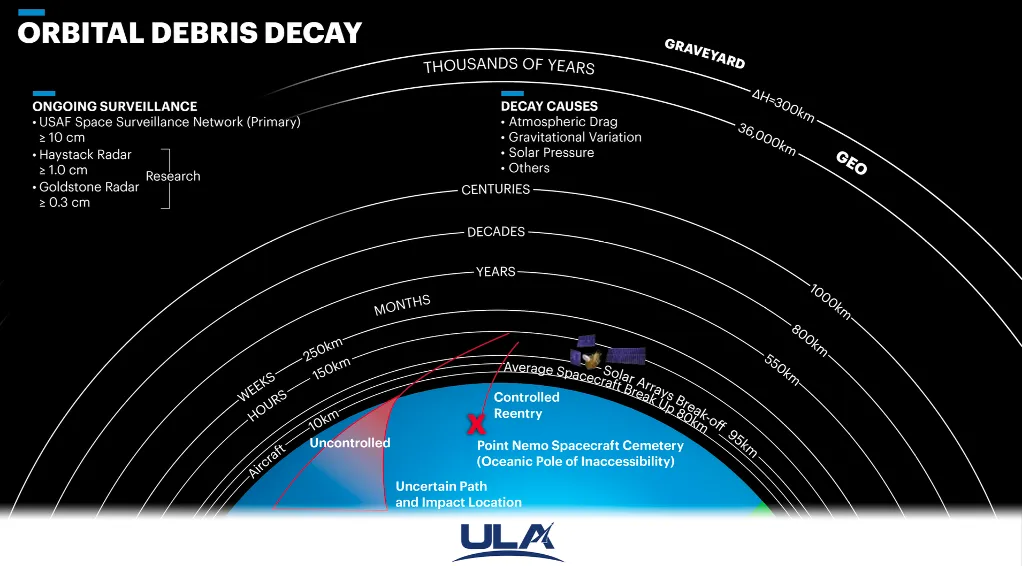
Quite helpful infographics from ULA: https://blog.ulalaunch.com/hubfs/orbital%20debris.jpeg
Re:Economics of Orbital vs. Terrestrial Data Centers by jaywee on Tuesday December 16, 2025 @02:42PM (#46293380)
Jonathan McDowell keeps track of all the Starlink Sat orbits, including failures:

https://planet4589.org/space/con/star/stats.html

Re:Economics of Orbital vs. Terrestrial Data Centers by notahacker on Monday December 15, 2025 @06:57PM (#46282782)
Your other options of fault tolerance typically achieved by doing everything at least twice and being willing to reboot (and accepting attrition from total ionizing radiation) or lots of shielding are fine for building functioning space hardware but suboptimal for building datacentre business models...
Re:Economics of Orbital vs. Terrestrial Data Centers by tekno45 on Monday December 15, 2025 @10:56PM (#46284607)
they throw those satellites to a fiery doom on a regular cadence.
Re:Economics of Orbital vs. Terrestrial Data Centers by enderfusion on Tuesday December 16, 2025 @12:15AM (#46285036)
The radiation effects on the silicon solar cells is often underestimated, it's not just the GPUs!