In large part due to regulation. Reflexively adding more regulations to deal with the negative effects of existing regulations is like "fixing" a bug by adding special-case logic for inputs which trigger the bug, without understanding why the bug actually occurred. Just like code, regulations should ideally be simple and elegant with a minimum of special cases.
Bad EU regulations and overregulation caused other problems. For example it is illegal for me to throw old socks full of holes into trash, I am supposed to take it to recycling centre on other side of the city.
As for the socks - my city has like ~5 locations where old textiles can be recycled, the closest one in slightly less than 1km from where I live. I see no problem with going there twice a year :)
I just throw them away with rubbish and get less supportive of people and institutions that created this law.
Contrast this with contract and property law. These laws were created primarily out of common law, a long evolutionary process arising out of series of decisions from a judiciary attempting to reconcile conflicts between the parties. This is judicial or conciliatory law.
Crucially, most if not all the advances and the rise of extreme productivity from capitalism that supports populations in excess of 8 billion as opposed to about 0.5 billion, have come from emphasis and pre-eminence on the latter kind of law and the smashing of the former kind of law, i.e., the destruction of the guild system of privileges, removing or minimizing protectionist laws, etc. And the former kind of law has either been nominal, merely codifying the advances caused by the latter law like in the case of child labor, or it has been reactionary and hampered the progress of the latter sort of law.
So... You are assuming market regulations still exist? Because without those, no, bio-chemical industry is absolutely one that consolidates quickly.
I see too much bad faith shit thrown around.
This is a meaningless statement without specifics. It has absolutely nothing concrete in it that would actually inform someone about what drives insulin production. It's a wrong and overly simplifies.
Are you really saying the regulations regarding the actual production of insulin is what drives up costs? We've been manufacturing insulin for > 100 years now.
And can you find a single resource that agrees with your assessment?
When you say "big players", you mean the top 3 right? Would regulating monopolies in the pharmaceutical industry maybe be a good thing?
Why do other counties pay less if it costs so much to make? Why does regulation in the US make US consumers pay more but not Europe, for example?
Do you think PBM's have any part to play in this? What about over-zealous patents by the monopoly at the top?
Do you have any actual experience in this field or are you just parroting talking points?
Note that I am not saying that they tried to push (or worse, capture) regulators to achieve that end. I'm just saying that they didn't mind.
"From when insulin is produced by the drug manufacturer to when it goes to a pharmacy, profit is extracted at every step of the way. The insulin market is dominated by three large drug manufacturers—Eli Lilly, Sanofi, and Novo Nordisk—that, with little competition, have raised their list prices in lockstep. But there are other players besides the Big Three that are contributing to the problem. Pharmacy benefit managers, or PBMs, contract with insurance carriers and act on behalf of the insurer to negotiate the price of insulin with the drug manufacturers. In negotiating the price, PBMs place a drug higher or lower on their tier of preferred drugs and receive rebates based on a percentage of the list price. This kind of system incentivizes high list prices, which determine the amount of co-insurance patients pay. And if patients have a high deductible or are uninsured, they might pay the entire list price."
https://medicine.yale.edu/news-article/the-price-of-insulin-...
My position is simply that it is better to solve problems by taking regulations away than piling them on.
The fact is that with insulin the regulation issues comes from the patchwork system of healthcare the US developped through political concesssionns and lobbying from private firms, which makes the developpment and the subsequent commercialization expensive relative to Europe where centralized national bodies negotiate with the pharma companies.
Regulation can be good or bad, in our era it is ineffective because politicians are boomers disconnected from the issues or in the EU a pseudo-technocratic (not really listening to technocrats recommendations) body far from reality
This series of posts is a nice forray into managerialism (the source of many regulation issues) https://baazaa.github.io/2024/10/16/managers_p1.html
Unlike the US, where federal minimal wage remained flat since 2009 or where Black Rock is buying all available housing to keep the prices as high as possible.
Regarding BlackRock, I'm disappointed to see what appears to be populist misinformation on HN: https://www.investopedia.com/no-blackrock-isnt-buying-all-th...
The blackrock thing seems like a myth, but private entities are also buying housing en masse in Spain for exammple
Many other countries have official minimum wages and a big % of people working black, unreported because the minimum wage is to high relative to the average (Spain, Greece, Italy)
Not sure how the US consumer benefits from being banned from having such choices?
Ensuring that regulation is necessary and as straight forward as possible to comply with is good for consumers.
Power has become infectious and capitalism has changed. The game is about power and extracting more and more money from the productive economy, making it less competitive. Who wins? Those who already have excessive capital.
The only one who would have enough legal power is exclusively the state. It’s no surprise the state is under attack from so many fronts.
We don’t need competition in insulin production. It is a know quantity with fixed and closed quality parameters. Fix the price and let suppliers compete on cost.
Note that if you cause by regulation or stupid laws something to be expensive to produce/import and then make it illegal to sell above that price - then you will get shortages.
As noone will want to produce insuline if required paperwork costs more than it's selling price.
Note that even if currently adding more regulation to solve problems caused by more regulation will not cause it, it may happen in future.
US healthcare regulations are on Nth round of that.
This is what I meant by compete on cost. The manufacturers that are best at cutting these costs will make the most profit. That’s where competition should be focused on such generic items.
We've been producing insulin for 100 years now. You guys are just making things up and it's wild.
I don't think a single person who is claiming that regulation is driving up insulin prices has even Googled it to make sure what they're saying makes sense. Spoiler alert: It's not.
The cost of insulin is a result of monopolies, pharmacy benefit managers, patents, and most importantly: a LACK of regulation on drug prices.
i don’t buy it. no other oecd nation has insulin prices as absurd as the us. this is a greed problem.
the only people to blame when the government starts producing insulin will be the pharmaceutical companies and their refusal to be decent members of society. if they were even a tiny fraction more decent they wouldn’t be in the mess they’re directly causing.
far too often companies are directly to blame for regulation as they repeatedly absolutely refuse to self-regulate and be decent pieces of society.
I'll take it even further, if you look at the price of goods over time, it's even possible to see the ebb and flow of greed in the numbers:
https://pbs.twimg.com/media/G5Qi8_vXwAAbRTn.jpg?name=orig
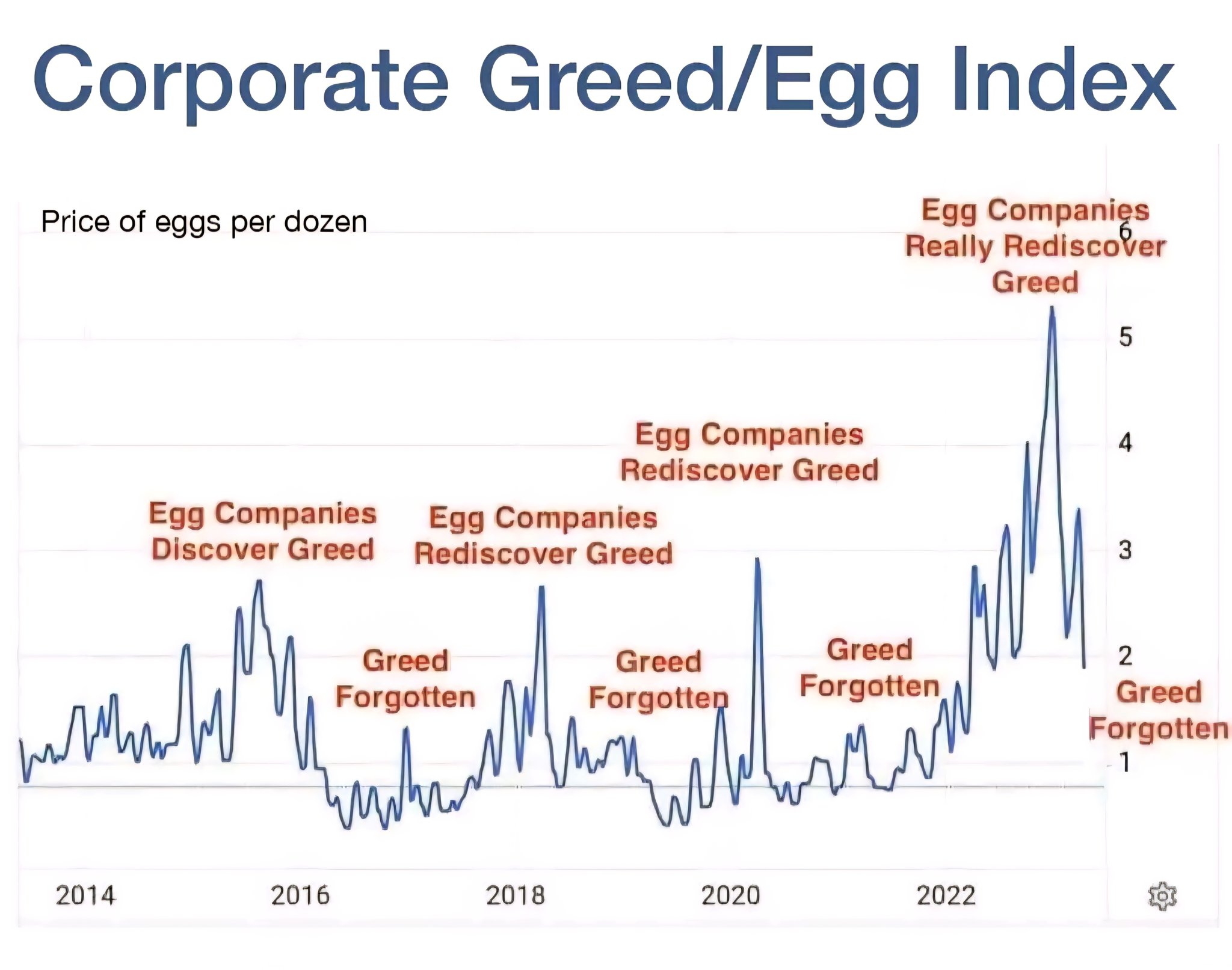
I wonder if prices are really a measurement of fluctuations in some underlying supernatural or cosmic psychic force?
Also that. But overregulation makes too hard for others to compete and offer cheaper insulin.
This has absolutely nothing to do with insulin costs. Nada. Zip. Nil.
> As noone will want to produce insuline if required paperwork costs more than it's selling price.
Where are you getting this information from? I've been in the industry for a bit now and this is a first for me. That the reason why insulin is so expensive in the US is because it costs money to make????
Why do you think there are so few insulin producers then?
https://www.npr.org/sections/health-shots/2015/07/15/4229352...
And the answer is because it's a monopoly that the govt refuses to regulate.
You do know these people are scientific experts and have teams of scientific experts working for them, right. It’s not some blazing skulls stuffed shirt lol
There is nothing subjective about insulin quality you dimwit
Oh Lordy what has become of HN a load of fresh dummies with no grounding in the basic principles of libertarianism. All the fire none of the intellect.
Just no sport.
Competition alone is never good enough to make price down, because companies and shareholders hate competition and will happily “consolidate” competitive markets into much more profitable oligopolies (when it's not straight monopolies).
I don't know if this applies to insulin production, but in several other areas enforcing anti-monopoly regulations is lacking at such a degree that the regulations are almost completely ignored.
If you allow imports from countries with looser regulations, you are basically putting your own sectors at a competitive disavantage in your own market. It's akin to killing it basically.
It's obviously extremely stupid but in the case of the Mercosur agreement, predictably Germany doesn't care because the agribusiness is in France and they themselves will be able to export their cars.
Generally speaking, Germany never cares about deeply shafting the rest of the union when it gives them a small advantage. See also how their economy is deeply unbalanced, they have under invested for decades and they only survive because they are part of a monetary union devoid of a fiscal union giving them the tremendous advantage of an undervalued currency at the expense of basically every southern members. See also how they made joining the currency union mandatory for entering the common market and are pushing for adding more poor eastern countries to exploit which also conveniently vote for the EPP and dillute any chance the southern countries could ally to oppose them.
Obviously, the currency union has no clear path to exit it.
2. These countries tend to prioritise their immediate safety from Russia to any economical considerations and are strongly NATO aligned. They have historically voted for parties which are close to the EPP, the currently dominant European party which is itself controlled by and subservient to German interests. See how Von Der Leyen was basically saved by Poland in 2024. This ensure the EPP remains the dominant force in Europe and significantly dilutes the voices of countries strongly disavantaged by how the eurozone is working and which could be tempted to ally to try to push reforms (Portugal, Spain, Italy, Greece, France). Generally, expension strongly favours the current status quo, itself extremely favourable to Germany, Austria and the Netherlands. 2004 is certainly amongst the worst things to ever happen to the EU.
Originally, it was the French during Mitterrand times who pushed for a unified European currency. Kohl granted it to them in exchange for their consent to unify Germany, but wasn't happy about it, because he knew that conservative German voters were attached to the strength of the Deutsche Mark.
Nevertheless, 15-20 years on, it actually turned out that a weaker euro was a problem for industry in places like France and Italy, while supporting German exports. Germany had a streak of really strong exports.
Nowadays, it does not matter anymore, though. Aging of the population, expensive energies, bureaucracy gone wild and bad immigration policies have made Germany a sick man of Europe again. When it comes to raw industrial growth, the strongest player in the EU is now Poland, which does not even use the euro.
I have no personal opinion on NATO being a big scheme to keep the dollar strong. I personally think its creation had more to do with limiting the spread of the USSR and ensuring the former European empires remained in vassal positions following the second world war. Still, as a net importer, the USA generally benefits from a strong dollar. The dollar is in a fairly unique position anyway as it remains the internation reserve currency.
I fail to see what's not adding up here personnaly.
Replying to inglor_cz here because dang rate limited me because one of my post about Rust was apparently grounded but written in what dang considers a "flamebaity" way while being highly upvoted:
To me, that's a deep misrepresentation of the systemic issue at stake.
Germany didn't magically happen to have strong exports while it became an issue for France and Italy. That's a structural feature of the monetary union. The euro was always going to be weaker that the DM and stronger than the Lira. That gives an inherent advantage to Germany and conversely deeply disavantage Italy. That's why there never was a currency union without transfers in history before the euro. It plainly can't work.
What Mitterand and Delor did was take a gamble. They pushed for an unsustainable currency union hoping it would extend to a fully featured fiscal union when a crisis inevitably came. Sadly, that's not what happened when said crisis came and we are now stuck with a setup which is either slowly erroding the competitivity of the periphery or forcing it into pro-cycle austerity in the name of a political doctrine it never chose while it favors a few core countries widely misallocating their excess savings while pretending to be virtuous. Our saving grace
It's obviously completely unsustainable hence the constant rise of extremist parties in the perepheric countries but like a good quasi-neocolonial setup, you will see a lot of people actually defend it with arguments which are roughly the same as the one the empires used to use: leaving will be economical ruin, the alternative is chaos, you obviously can't manage your economy without us.
It's no surprise the strongest industrial player in the EU is becoming Poland. It is because they are out of the euro. Look at how while they are theorically forced to join by the treaty, they are doing everything they can to stay out.
Amusingly, we might all end up being saved by Trump because tariffs on top of two decades of systemic underinvestements have put the German economy so out of balance, we might finally witness the end of ordoliberalism.
I would say the causality goes the other way, we are a net importer because foreigners need dollars since they are the reserve currency.
Conversely, it’s extremely overvalued for the economy of the periphery. If you look at their trade balance and policies, their own currency would be far weaker. Paradoxically this would be a boon for them. Sure it would impact their ability to import but it would make their exports far cheaper in relative terms.
Adding country with economy pulling down the value of the euro is therefore extremely advantageous to Germany at the expense of the periphery. This is by design. A currency union can’t work without transfers.
That’s why it’s extremely unfair to impose the euro as part of the criteria for joining and why you see country like Poland doing its best to not join. Sadly, Spain, Portugal, Greece and Italy are stuck in. I personally can’t refrain from strongly resenting the union every time I see someone from the advantaged core pretending to be morally virtuous while being the direct beneficiary of one of the most unfair transfer setup since decolonisation and pretend the south should just go with austerity which is the exact reverse of what’s actually needed (investment and devaluation).
I somehow understand how we got there and the weight the completely botched unification of Germany in 1990 carries in it. It doesn’t really make the pill easier to swallow.
Me personally, if I have to choose between food 10% cheaper that will give 1 in 1000 people a cancer, or eating something more local/boring I prefer the latter, even if I would never buy it myself.
Returning to the topic to which I responded: I prefer some organization responsible to make and check a set of rules about food, rather than each person to have to do their own research (and the first does not exclude anyhow the second). I find that smart in the sense that it will reuse knowledge of some people and will not require a lot of people learning a lot of things. I have the impression that I do care about food quality more than the average, so I am not at all worried about too strict requirements.
Wait, what? With this type of claim I was sure you were going to back it up with at least some evidence but apparently I was wrong.
I'm sorry, but the irony in this comment too much. The reason insulin is so high is because of a lack of regulation.
If the government took a stronger stance towards monopolies in the pharma industry, this wouldn't be happening. If the government REGULATED insulin prices, it wouldn't be so high. If the government reigned in PBMs, it wouldn't be so high. IF the government reigned in patents and the tricks drug companies play with them, it wouldn't be so high.
You're confusing fixing with negotiating.
The govt provides healthcare. They pay for the meds. Are you saying the government shouldn't be allowed to negotiate what it pays for it's own insurance????
Or maybe you are thinking that government force is "negotiating". Something along the lines of give us this price or we make it illegal for you to do "x". Or, alternatively, we will allow you to do "x" if you give us this price. While that is technically negotiating it is malignant government behavior known as coercion.
In 49 US states, you can walk into a Walmart with $25 and walk out with a vial of insulin, no prescription necessary. For $75, you can get a much newer Novo Nordisk analog insulin.
Regulations exist for different reasons, not one reason. Some of those reasons are good reasons, like regulations against dumping or against contract killers or for food safety. Some of those are bad reasons, like regulations of parking minimums implemented to appease the property owning class. Some of those are for bad reasons pretending to be for good reasons, like the regulations that block renewable energy which are allegedly for the environment, but the true motives are more about aesthetic displeasure or ideological hostility.
Due to current market conditions we can sell all apartments without any parking spaces, therefore regulation defining a housing unit with foresight for future market conditions is bad.
> the regulations that block renewable energy
Can you name one regulation that outright blocks renewable energy generation specifically and not externalities created by developments, that sometimes happen to be renewable energy?
This regulations are crucial for preventing cities from being littered with cars (more tgan they already are). If developers were allowed they would build only very limited parking space and then people living there would have to park in public space burdening everybody. If anything it's a regulation against property owning class.
We’ve ended up with such car-centric cities (in the U.S.) thanks in part to the presence of ample free (subsidized) parking thanks to parking minimums and free street parking. If the cost of parking was actually borne by car owners, it would reduce car ownership thanks to higher cost. This is less true today thanks to car ownership being near-mandator, but with the right investments that can change. I’d describe parking minimums as a regulation against non-car owners as they still pay in part for the parking spaces required by their apartment/home/every business they visit in most cases.
As an aside, have you looked at how parking minimums are often set? It’s only loosely correlated with the goal of sufficient parking.
Yes, but I'm more concerned about practical aspect than esthetics. Blocked walkways, lower visibility for drivers, longer distance between place of living and the car, and the car you had to park far away on the crowded street snd your business. This are all costs that developers love to externalize to all members of society instead of passing them to the future owners of the property they are building.
I'm not really talking about situation in US where people live so sparsely that they have plenty of space to patk their car when they are at home. Parking minimums I'm supporting are for medium to high density residential intermixed with conmercial zones. That is pretty much majority of spaces in European cities.
I'm sure that mininum parking requirements for businesses in US in purely commercial zones might be too high.
Try to rethink how money is created and how money gets its value and how and by whom that wealth is distributed. Regulation as in "make rules" does not enforce rules, which is the definition of (political) power.
> The other important requirement is to increase the staffing of the regulatory agencies so that their individual workload doesn't become a bottleneck in the entire process. There is a scientific method to assess the staffing requirements of public service institutions. According to that, a significant number of government departments all over the world are understaffed.
Why are you claiming "There is a scientific method" and do not provide it? Governments do (risk) management by 1 rules, 2 checks and 3 punishment and we already know from software that complexity in system is only bounded by system working with eventual necessary (ideally partial) resets. Ideally governments would be structured like that, but that goes against governments interest of extending power/control. Also, "system working" is decided by the current ruling class/group. Besides markets and physical constrains.
Please elaborate.
Every governing decision and rule is either fully made by powerful shadow interests, proposed by said interests and is only thwarted (for the time being) by some politicians on the other side or made out to be benign or even beneficial but is in actuality compromised in some major way.
The Useful Idiots(TM) will be along shortly to tell you how you're technically wrong because the rules are "only" 99% made/proposed by shadow interests.
They weren't created for that reason, but it end up being used precisely for that.
That is the conundrum we all face - how much power do we give the gvt.
Now let's look at the specific problems here with a much narrower scope than 'regulations'. The first problem is the type of regulations. Some regulations are too arcane and don't reflect the current state of technology. Others affect the unprivileged people disproportionately. The solution for that is to amend these regulations fast enough - not deregulation. It's also important to assess the negative impacts of loosening these regulations - something I don't see discussed in this article.
The other important requirement is to increase the staffing of the regulatory agencies so that their individual workload doesn't become a bottleneck in the entire process. There is a scientific method to assess the staffing requirements of public service institutions. According to that, a significant number of government departments all over the world are understaffed. Regulatory agencies and police departments top that list. Increased workload on their officials lead to poor experience for the citizens availing their services (this is very evident in policing). Yet those same experiences are misconstrued and misrepresented to call for deregulation and defunding of these institutions - the opposite of what's actually needed. (PDs need more staff and more training in empathy. Not defunding, nor militarization.) This is exactly what I see in this article. An attempt to target regulations as a whole using a sob anecdote.