There's a more basic question: How do we know the galaxies are moving? It seems (I haven't seen any other response, like... ever) that we have one and only one way to measure the speed of galaxies: the red shift.
It's impossible to triangulate those huge distances and the time scale would also be a barrier, so no way of confirming the red shift calculations with a different method. That means that if the red shift was caused by any other effect, say the light "degrading" after millions of years of travelling the void, all the calculations would be invalid.
I've asked about this many times and the answers are in the line of "we don't know any other reason for the light to red shift" and "the current theoretical frame is consistent", even if there isn't any other measure to be consistent with.
There was a prediction (expansion is related to Big Bang) that the far away galaxies, being younger, would have a different composition. This prediction seems to be failing, but advances in instrumental could give us a more precise answer in the future.
The interpretation of redshift as velocity is also the primary reason cosmologists think the universe is expanding.
If they could, Hawking radiation would interfere with the eternal orbit.
Yes, at high energies and with electrons or atomic nuclei nearby.
https://en.wikipedia.org/wiki/Two-photon_physics
> Hawking radiation would interfere with the eternal orbit
For tractability Hawking radiation tends to be studied using a non-interacting scalar field (often massless), rather than the fields of the Standard Model (which are very much interacting, and have a variety of masses).
Hawking started that in his "Black hole explosions?" (1974) which (if you're not allergic to sci-hub) you can read at <https://sci-hub.se/https://www.nature.com/articles/248030a0>: "consider (for simplicity) a massless Hermitean scalar field \phi which obeys the covariant wave equation ... in an asymptotically flat space time containing a star which collapses to produce a black hole.". In the short paper, he's very much not considering photons or pions, and really doesn't need to in order to make his point.
The thermal spectrum of a real black hole will be in all the Standard Model fields, and except very late in the eventual evaporation will be dominated by very low energy photons originating at a fair distance outside the event horizon.
What do you mean by "eternal orbit"?
Real black holes do not extend to the infinite past. If a black hole ultimately Hawking-evaporates, in finite time there's nothing left to orbit. Late in the evaporation, there will also be a lot of very high energy gamma rays and heavier particles excited in their respective quantum fields of the Standard Model. These will all tend to participate in high-energy multi-particle interactions rather more complicatedly than the end result of Hawking's 1974 description.
As a first step, you could can check out <https://en.wikipedia.org/wiki/Photon_sphere> and <https://en.wikipedia.org/wiki/Innermost_stable_circular_orbi...>
Astronomy is the paleontology of photons. You should take an astronomy course if you really want to know, but essentially a "ladder" was built of distances, starting with the very near and slowly building outward using various techniques and discoveries of physics as they became available. This is called the cosmic distance ladder. You start with stellar parallax, then after that you go farther with "standard candles" (particular types of variable stars). But then you have to get even further out, where you can no longer see an individual star, and then you rely on specific breeds of supernovae. Only then do you get to redshift, and compounding tons of data from step three seems to verify the redshift estimates. By the time you get to the Hubble constant, it was a huge rift between two communities over what was still a factor of two difference.
It's quite fascinating, but I can't really dump out an entire book into a comment.
But my objection is still unanswered: that for long distances the ONLY measure of speed is the red shift.
The only other measurable magnitude is the apparent size of the galaxies: assuming that galaxies are more or less the same average size, you get that the more distant a galaxy is, the more red-shifted it gets.
But again, this coincidence is also consistent with the light getting "degraded" somehow. I don't (can't) dispute that there are good reasons against this interpretation, but I haven't seen one. Ever.
Every time I ask this, the discussion gets muddled: historical reasons, too complex to explain... apparently it seems more logical to declare the whole Universe is expanding, the space itself is expanding than there's something about the light travelling immense distances that we still don't know. Well, maybe. But people trying to explain that are doing a lousy job.
Speaking of which, do you happen to know a good book which illuminates this whole story step by step? I have yet to find one which doesn't start with "Let us assume an FLRW metric…"
The theory has to explain why the light gets redshifted, but does not get blurred, and the spectral lines do not get broadened. This severely restricts the type of interactions possible. Also the theory has to explain the consistency between redshifts within our own galaxy, to that of far-away galaxies.
Galaxies are BIG. Andromeda is faint, but the same angular size as the moon. It's 2.5Mly away, but it's also 150kly across. Over a long enough time line you could do triangulation on it. In fact it's moving toward our galaxy, but very, very slowly compared with its diameter at 110kps. But yeah, in theory you could do triangulation on it over a very long period of time.
https://en.wikipedia.org/wiki/G%C3%B6del_metric
There are versions of this which do provide another reason for red shift.
Personally I keep this in mind as a means to free my thinking from a single narrative.
"Short" distances are calculated by parallax, taking Earth's orbit diameter as the base.
From there, it's a extrapolation of the spectrum of known types of objects. Not triangulation. Moreover, IIRC individual stars can't be discerned in other galaxies, even the nearest ones, except maybe supernovas.
So at the distances that red shift manifests, no triangulation, only red shift.
More precisely, we see that galaxies started accelerating away from us a few billion years ago; before that they were decelerating (moving away from us but with the "speed" decreasing instead of increasing).
> People often point to the observation that the further away a galaxy is, the faster it appears to be moving away from us, implying acceleration.
That observation tells us that the universe is expanding, but by itself it does not tell us whether the expansion is accelerating or decelerating or neither. So you are correct that that observation alone is not sufficient to show that the expansion is accelerating.
What we look at to see how the expansion rate changes with time is a comparison of three pieces of observed data, galaxy by galaxy: redshift, brightness, and angular size. The relationship between these three quantities is what cosmologists use to construct a model of the expansion history of the universe, which in turn tells us things like what I said above, that the expansion has been accelerating for the last few billion years but before that it was decelerating.
I think the story is that dark energy is indeed created, in the new emptiness resulting from the expansion of space.
<mumble> I believe it's supposed to be spacetime that expands, not 'space'. But it's beyond me to explain what that even means; as I understand it, spacetime refers to the whole Universe, across all of time. To 'expand' means 'to become larger over time'. But if the thing that's expanding includes time itself, then I'm bewildered.
That is, in the past, galaxy clusters are relatively close together, and in the future they are relatively very far apart.
If you need an image, think of a vase of cut flowers, with the stems tightly bound together at the bottom of the vase, and the flowers loosely separated at the top. Time is in the direction away from the vase's bottom. A super thin slice through a stem represents a snapshot of a galaxy cluster at a particular time in its existence.
https://s3-eu-west-1.amazonaws.com/images.linnlive.com/de6e1...

<https://media.istockphoto.com/id/578833902/vector/expansion-...> : time increases from the left to the right.
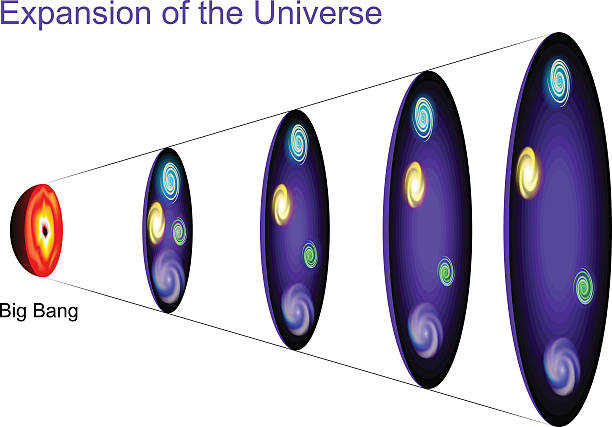
Because that's how a cosmological constant works.
There are alternate models where there is "dark energy" (as in, stress-energy that causes accelerated expansion) whose density does change with time (for example, a "Big Rip" model in which the dark energy density increases with time), but such models do not match our best current data.
< 47k years: radiation-dominated era
< 9.8G years: matter-dominated era
> 9.8G years: dark-energy-dominated era
In your explanation, I think we'd expect to see some very distant, very slow-moving galaxies moving toward us. And there may be some very fast-moving galaxies close to us that just started really far away. Objects would be entering our local universe from outside it, and that simply doesn't happen.
I fully agree. I suppose I'm not really questioning the big bang piece. Im only questioning the continued acceleration piece. Feel free to disregard the "in random directions" part of my original post.
I'm picturing more of an explosion in empty space. A firework of sorts. Any individual dust/shard of the explosion still sees all other objects moving away from it and the rest of my post stands.
But I suppose this would imply a "center" to the explosion, which I've also heard is not the case, and which I further don't understand :)
No, that's not what the big bang is.
> this would imply a "center" to the explosion, which I've also heard is not the case
That's correct. The big bang does not work like anything ordinary that you are used to imagining. The math is straightforward and unambiguous, but there is no good ordinary language description that corresponds to the math.
Another thing: suppose I point a laser beam to the space and by chance this laser beam never finds any kind of matter in its way, where is this laser going to? To an infinite void? Is it correct to say that stars radiate energy to the infinite then?
Photon will hit something, or will travel until it will be redshifted to obvilion, or will travel until end of the medium (photon is a wave, so it waves something).
That sounds suspiciously like postulating the 'ether'. Surely what a photon 'waves' is the electromagnetic field, which is not a medium, and which fills the whole of spacetime. There is no 'end of the medium'.
No, you’ve simply hit the limits of needing/wanting to understand something in terms of something else similar or more familiar.
Makes the same point on a related matter: https://youtu.be/Q1lL-hXO27Q
No, it's not, it's our best current model's description of the actual physical reality of our universe.
> nobody can prove than a model is correct
That's true, but it's also true that we can show models to be incorrect, as in, falsified by the data. For example:
> Photon will hit something, or will travel until it will be redshifted to obvilion, or will travel until end of the medium
For the scenario that was posed, a laser beam that never hits anything, none of your statements here are true. The first is ruled out by the scenario; the second is known to be false because there is no "gravitational redshift" of light in the universe as a whole (because models in which there would be such a redshift are known not to correctly model our data on the universe as a whole), and there is no "end of the medium" (again, models in which there would be an "end of the medium", i.e., where the universe stopped containing matter and started being just vacuum, are known not to correctly model our data).
I have described what actually happens in my own response to the GP upthread.
> (photon is a wave, so it waves something).
Light is an electromagnetic wave; what "waves" is the electromagnetic field. (If you use a "photon" model, you are using the quantum electromagnetic field as opposed to its classical approximation.) There doesn't have to be any other "medium"; the electromagnetic field is present everywhere.
OK, it's our best model, but it doesn't invalidate other models, less complete or less popular, it compete with them.
> That's true, but it's also true that we can show models to be incorrect, as in, falsified by the data.
Yep. The article is about the Huble Tension, which invalidates Big Bang model. We still use it.
> the second is known to be false because there is no "gravitational redshift" of light in the universe as a whole (because models in which there would be such a redshift are known not to correctly model our data on the universe as a whole)
The Big Bang model is incomplete too: galaxies with FTL speeds, different speeds of expansion, no center of bang, no flows, no source of energy, it stretches time and space, etc.
I assume that the only infinite thing in infinite Universe is Universe itselft. All other things are finite. Thus, a photon has finite life, like any other wave.
> there is no "end of the medium"
The right-hand rule in EM suggests that we are in north hemisphere of something, so south hemisphere will have symmetrical rule, unless you believe that God chose right-hand rule for the whole infinite universe. If we are in a sphere, then that sphere rotates and have a boundary.
> what "waves" is the electromagnetic field.
"Field" is an array of numbers. You are mixing model and reality.
One model can't invalidate other models. Only data can invalidate a model.
What other models do you have in mind?
> the Huble Tension, which invalidates Big Bang model
No, it doesn't. It means we have more work to do, to figure out why two calculations of the Hubble constant, by different routes, give different answers.
Invalidating the Big Bang model would be finding evidence that there was no Big Bang at all. The Hubble tension is nothing of the sort.
> The Big Bang model is incomplete too: galaxies with FTL speeds, different speeds of expansion, no center of bang, no flows, no source of energy, it stretches time and space, etc.
None of these are issues at all. The model accounts for them all in a perfectly self-consistent fashion.
Also, your nomenclature is biased: for example, the "FTL speeds" you refer to are coordinate speeds, which have no physical meaning. "FTL" in General Relativity means "moving outside the light cones", and that does not happen.
> The right-hand rule in EM suggests that we are in north hemisphere of something
The right-hand rule is a human convention. It tells us nothing about physics.
> You are mixing model and reality.
No, you are incorrectly assuming that the word "field" can only refer to the model. That's not the case. Physicists commonly use the word "field" to refer to both the mathematical object in the model and the actual physical thing that is being modeled. Light is "waves of the electromagnetic field" in the latter sense.
We have no evidence of any time when the universe was not expanding. At the earliest times we have evidence of, the universe was already expanding (extremely rapidly--much, much, much more rapidly than it is now). At those times, our observable universe was indeed contained in a very small volume.
> suppose I point a laser beam to the space and by chance this laser beam never finds any kind of matter in its way, where is this laser going to?
Since the universe is spatially infinite in our best current model, the laser beam will just keep on going forever.
> To an infinite void?
According to our best current model, no, the laser beam will never stop passing by matter, of approximately the same average density as the matter we can see.
> Is it correct to say that stars radiate energy to the infinite then?
Yes, as long as you recognize that "the infinite" never becomes a "void".
I didn't understand this part, why would the laser beam would never stop passing by matter? Because of the metric expansion of the universe? Isn't it reasonable to assume that there is a skirt of the universe where matter keeps expanding into nothingness?
Because there is matter everywhere in our universe. It never stops.
> Because of the metric expansion of the universe?
It is true that, in order for there to be matter everywhere in our universe, it must be either expanding or contracting. (There is an edge case, the Einstein static universe, but it is unstable against small perturbations, like a pencil balanced on its point, so it is not a viable option.)
> Isn't it reasonable to assume that there is a skirt of the universe where matter keeps expanding into nothingness?
No. Such a model cannot match our observed data.
Sure, but to argue that this explains what we observe today, you would need to show that as of today it has been “long enough,” which is its own can of worms to open.
You might say “obviously it has been long enough for full sorting, because we observe a fully sorted data set of speed correlated with distance.” But that would be begging the question.
The surprising bit is that the far away stuff seems to be even more red shifted than that, so we're not just expanding, but the rate of expansion seems to be accelerating.
Not in our actual model of the universe, no. The redshift of light is determined by the spacetime geometry and the worldlines of the emitter and receiver. That is a general formula that works in any spacetime.
> Gravitational redshift is a thing
Not for the universe as a whole, no. Gravitational redshift is only meaningful in certain kinds of spacetimes, namely stationary spacetimes (which, roughly speaking, describe objects that either don't change with time at all, or which are periodic, like a rotating planet or star). The spacetime that describes our universe as a whole is not stationary and there is no meaningful concept of gravitational redshift.
> our model of gravity is incomplete
In the sense that we do not have a quantum theory of gravity, yes. But that does not affect anything under discussion here. Our current theory of gravity, GR, works fine for treating the expansion of the universe and whether or not it is accelerating.
Then why are there phantoms in the data that need dark matter and dark energy to make the supposed working model fit them?
The terms "dark matter" and "dark energy" are just names for, respectively, "stress-energy that acts like the matter we can see, but we can't see it", and "stress-energy that acts like a cosmological constant". Neither of those things poses any problem for GR, since both types of stress-energy are allowed for in the theory.
"Dark matter" poses a problem for particle physicists, who have so far been unable to find any fundamental particles that would produce the observed properties. "Dark energy" only poses a problem if for some reason you don't like having a nonzero cosmological constant.
It's clear to me why we haven't made any new discoveries in cosmology in the past two decades. It's this exact attitude of "the model is the truth". All models are wrong. The data can help you improve it, but you have to at least want to improve it.
How do you propose they do it differently?
What evidence do you have that what they are doing now doesn't work, and does the all the evidence of how they work support your hypothesis?
Be detailed, because your comment just has some motivational speaker nonsense but no depth. For example, in the last 20 years cosmology has:
+ Refined its model of stellar formation based on observational data of the number of planets found observationally, and used this to validate and invalidate several model adjustments.
+ Observed galaxies that appear not to have dark matter, and by their existence and behavior validate some theories of dark matter, and validated others, which predict such galactic behavior. (e.g. some theories attempting to update gravity).
+ Run simulations of stellar and glactic formation that predicted structures in the universe that were later observed.
Everywhere they look they are finding things the models don't explain well, and refining the models - that is literally using the data to improve the models.
If you think you can come up with something better, then do it - all you gotta do is make up some mumbo jumbo and write down any old equation. It probably should:
- provide the same results as were observed when the plugging in the experimental parameters of existing experiments.
- explain "wierd stuff" in the data that existing models couldn't.
- predict future observations of the known phenomena with the same or better accuracy as the old model
- predict currently unobserved and unpredicted phenomena
Go ahead and take a stab real quick - I'm sure you can do it. I mean Gallieo did it, so did Newton and Einstein. Next up is willis936.
If one does commit themselves to their passion they should strive to push the field further forward, not stagnate it.
It can be done.
Is that true?
At least for my hobbyist understanding of the progress of cosmology, quite a lot seems to have happened in the past two decades. Confirmation of the Higgs Boson at CERN [0] kept me up all night to watch the press conference; I found it extremely exciting. (Maybe you count this strictly as observational particle physics and not cosmology, but I might appeal for it to be allowed in the context of your critique).
And what of TFA? Isn't what we're reading now a new discovery in cosmology?
What about the rush of exoplanet discoveries?
What about the dramatically different galactic properties now observed in increasingly strange corners of the observable universe (including some which perhaps give insight into some of the properties of "dark matter" or whatever it ends up being)?
0: https://home.web.cern.ch/news/news/physics/new-results-indic...
And trust me, all scientists know that all models are wrong. This isn't some unique insight that is beholden to amateur scientists on the sidelines.
The conclusion that the expansion is accelerating was a quite recent result: 1990s, I believe. It's based on careful measurements of supernova explosions of a type with computable intrinsic brightness in increasingly distant galaxies, and the exact pattern seen in their apparent redshifts vs. apparent brightness. It was a shocking discovery when it came out, with two separate teams announcing the result pretty much neck and neck. There's also independent and compatible evidence for acceleration from the exact pattern of variations in the temperature of the cosmic microwave background seen at different points in the sky.
I didn't even realize how many people held that belief til that article about how the universe isn't as big as we thought
If the universe were expanding uniformly, we would see galaxies moving away from us. The further away they are, the faster they would move. Distance and velocity would have a linear relationship, with the Hubble Constant as the scaling factor.
But what we actually see is that, if we measure precisely enough, galaxies further away are moving faster than that. The conclusion is that the expansion is accelerating.
No, you have it backwards. Accelerating expansion means, roughly speaking, that we see galaxies further away moving away slower than a "uniform" expansion would predict. Remember that we are seeing galaxies further away as they were a longer period of time ago--so "accelerating expansion" means the universe was expanding slower then, when the light was emitted, than it is now.
Actually, though, we don't observe the distance to a galaxy directly. We infer it from other observations. The actual observed quantities are redshift, brightness, and angular size, and the relationship between those three observed quantities is what tells us the expansion history of the universe.
-Galaxies are not accelerating, space is expanding.
> Imagine there are some objects in space all moving in random directions and speeds, relative to Earth...
-No, In your scenario then end result would be a most static average distance between all objects in the universe. As an infinite number of objects come from infinite distances, there would ALWAYS be objects in the neighborhood.
I think what you're imagining is a bunch of objects in a box, give them random vector and then remove the box. If they maintain course, all will eventually move outside the original box boundaries, and away from each other. (not the way the universe is).
They know space is expanding. The primary mechanism we know this is the speed with with we measure an object (moving away) is redshifted. Objects at the same distance from Earth, but opposite regions of space are moving at the ~SAME measured velocity.
There simply is no existing theory which can account for what we are seeing besides space expanding. I'm not big on thinking we understand it all, but in this particular measurement, there is basically zero doubt. Space is expanding, which has the affect of accelerating all objects in the universe away from you, with an acceleration relative to the distance. The more space between you, the more opportunity to expand.
But then, I'm back to what does "space is expanding" mean? What is doing the expansion?
And secondly, what is the mechanism for "space expanding"? What is "space" in this context? What actually is expanding?
So again, how can you tell the difference between space expanding or two things actually just moving away from each other (to keep it to a very simple example of two bodies).
Space moving would be like balls placed on a bed sheet and the sheet expanding. The galaxies aren't moving- the sheet is.
What's actually happening is more like galaxies moving around on a sheet that's being pulled further at all sides.
is there a difference if there isn't a difference?
https://bigthink.com/starts-with-a-bang/universe-speed-of-li...
How do we know that galaxies are accelerating away from us and not moving at constant speed? People often point to the observation that the further away a galaxy is, the faster it appears to be moving away from us, implying acceleration.
However, wouldn't we expect to see the same observation even without any acceleration? Imagine there are some objects in space all moving in random directions and speeds, relative to Earth. After long enough time, all objects will appear to be moving away from Earth, even if they were moving towards it initially. And after long enough time, the objects that move fastest should be farthest away, by the simple definition of speed!
In short, even if galaxies weren't accelerating, we would still see that the further away a galaxy is, the faster it recedes.