I think the story is that dark energy is indeed created, in the new emptiness resulting from the expansion of space.
<mumble> I believe it's supposed to be spacetime that expands, not 'space'. But it's beyond me to explain what that even means; as I understand it, spacetime refers to the whole Universe, across all of time. To 'expand' means 'to become larger over time'. But if the thing that's expanding includes time itself, then I'm bewildered.
That is, in the past, galaxy clusters are relatively close together, and in the future they are relatively very far apart.
If you need an image, think of a vase of cut flowers, with the stems tightly bound together at the bottom of the vase, and the flowers loosely separated at the top. Time is in the direction away from the vase's bottom. A super thin slice through a stem represents a snapshot of a galaxy cluster at a particular time in its existence.
https://s3-eu-west-1.amazonaws.com/images.linnlive.com/de6e1...

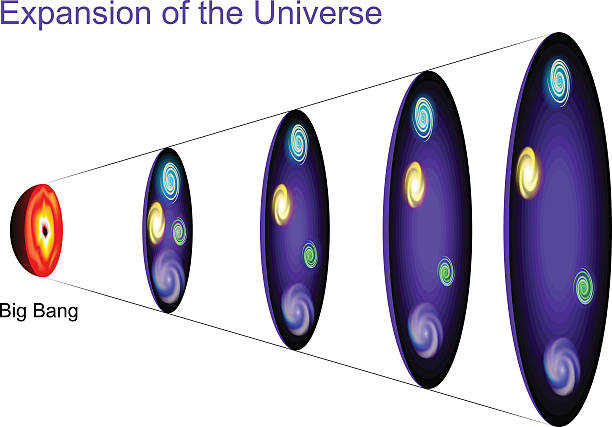
<https://media.istockphoto.com/id/578833902/vector/expansion-...> : time increases from the left to the right.
Because that's how a cosmological constant works.
There are alternate models where there is "dark energy" (as in, stress-energy that causes accelerated expansion) whose density does change with time (for example, a "Big Rip" model in which the dark energy density increases with time), but such models do not match our best current data.
< 47k years: radiation-dominated era
< 9.8G years: matter-dominated era
> 9.8G years: dark-energy-dominated era
More precisely, we see that galaxies started accelerating away from us a few billion years ago; before that they were decelerating (moving away from us but with the "speed" decreasing instead of increasing).
> People often point to the observation that the further away a galaxy is, the faster it appears to be moving away from us, implying acceleration.
That observation tells us that the universe is expanding, but by itself it does not tell us whether the expansion is accelerating or decelerating or neither. So you are correct that that observation alone is not sufficient to show that the expansion is accelerating.
What we look at to see how the expansion rate changes with time is a comparison of three pieces of observed data, galaxy by galaxy: redshift, brightness, and angular size. The relationship between these three quantities is what cosmologists use to construct a model of the expansion history of the universe, which in turn tells us things like what I said above, that the expansion has been accelerating for the last few billion years but before that it was decelerating.