An interesting deep dive on one component of hideous new development: https://marker.medium.com/why-everywhere-looks-the-same-2489...
It doesn't help that architecture (and most other artistic fields) is currently dominated by the belief that beauty is almost completely subjective. Under that philosophy, why not just design the thing that's going to at least win some awards for being "innovative" or "striking?" (These are almost always euphemisms for "offensive" but for people who think offense is a purely subjective experience)
This. Being upset that your entire neighborhood has been boxed in by ticky-tack five overs is a pretty natural response IMO.
People like to hate on NIMBY's here but for many cases (not all) I think it's reasonable to care about your neighborhood and to want to prevent outside interests from fucking it up.
I guess the slide has been big but isn't the term mostly about, like, prisons, pubs, waste collection centres etc. that they want, but just not near them?
"Sure, the Seattle area needs more housing, but not in our quaint little suburb, that's already gone downhill since whenever I moved in" is a standard NIMBY line.
> not all
If the supply of buildable zoning was more lax, people would have more latitude for fripperies.
Low-end Italianate and Gothic Revival yielded the gorgeous Brooklyn brownstones. Low-end Corbusier yields the hideous, cultureless 5-over-1s perfectly prepared for a Chipotle logo.
Source: I show up at things like city council meetings to support housing as a YIMBY.
Saying that I agree that some people will just find any excuse possible to resist. But their opinions are just as valid as the next guys and this is why we need to find compromise. I support thoughtful development and in making the dense part of town more dense.
Towns that do not grow wilt away and die. There are absolutely towns that didn't grow across America. You can recognize them by their landmarks like the closed factory, the "fod lease" signs along Main Street, and so on.
>Not to come off wrong but people want to live next to people of a similar class and standing as their own. Renters (and landlords) don't have the same skin in the game as home owners.
This and your reference to "the dense part of town" tend to point to a different meaning towards "don't have the same skin" than the initial read suggests. Even if that was not your intention, it's absolutely the practical effect of reinforcing old injustices by claiming the rich white areas should remain that way while the denser, inevitably more diverse areas have to absorb all change.
Source: I show up at the same meetings. And for the record, am agnostic on the [NY]-imby scale. I just wish the Y contingent wouldn't be so self-satisfied in their pretension that anytime someone questions the wisdom of latest pork barrel / snake oil proposal put forth by the development industry -- why, it's because they're a selfist, narcissistic you-know-what who just hates progress and loves to whine.
People need a place to live. It is driving so many problems in our society that they don't. Sprawl causes massive CO2 emissions. Homelessness. People forced to move away from where they grew up. Businesses that struggle to hire.
And "my" backyard is accurate: people being told by others what to do with their own property is a big part of the problem. If it is your backyard, no one is going to force you to build anything in it.
Clearly, not all new development is perfect and awesome all the time, but one thing we used to do is to allow it: and then, crucially, allow it to change and adapt over time into something better.
It's not snake oil because it's new. But because of the blatant lies (and occasionally more subtle distortions) in the developer's project proposal, staring everyone right in the face.
Nor is all new development bad, nor old development ipso facto good, by any stretch. We get the issues, and understand the tradeoffs.
And I, at least, don't demonize YIMBYists. I just wish they'd stop being so smug, and find a better way of supporting their position than simply responding to any expression of opposing viewpoint with facile generalizations and tired caricatures.
Oregon passed HB2001 a few years back, which re-legalizes up to 4-plexes anywhere single family units are allowed. Good stuff with bipartisan support!
And this lady was out there in the paper wailing about how we were going to see tricycles in yards https://ktvz.com/news/bend/2021/09/13/some-bend-residents-op...
And you see the unsatisfiable concerns over and over and over again. It's pretty rare to see a "yes, this project looks ok, but could we add this thing to it or do this other thing a bit differently?", where the asks are within reach and not impossible.
Anything less than a confirmed Yes vote (perhaps with caveats, but ultimately: a Yes vote) to whatever the developer proposes is, in the YIMBYist book, equivalent to the objections of that lady in Oregon.
Most public comments are simply unrealistic or "no!", though.
No project is going to be perfect, ever, and we're desperately in need of more homes, so yeah, let's build more!
The tricycle lady wasn't just some random person, either, she used to be on the planning commission, and helped kill a number of badly needed apartments in the 'nice' bit of town.
There is a real reason: lack of skilled trades. Those old, beautiful buildings are the work of skilled tradespeople such as masons (skilled in stonework), master carpenters (skilled in joinery), glaziers, plasterers, painters, sculptors, blacksmiths, ironworkers...
Modern buildings use so much metal and glass because these materials don't require skilled trades to mould and shape them on site, they are delivered whole and assembled according to plan. To build an old-style building today would cost a fortune because the few surviving practitioners of those traditional trades are considered highly specialized experts and historians of construction techniques.
Their whole m.o. is to put up a new building, sign as many incoming students as they can to leases, then mysteriously fall behind schedule for the opening of the building. This leaves hundreds of students stranded without a place to stay at the start of school term. They then offer these students a “free” lease transfer to the old building, thereby renting out a bunch of crappy rooms no one wanted in the first place.
Also we need to be training up skilled tradespeople in general, even for the basic basic stuff.
What do you mean?
Pretty much every single building I see being constructed around the Seattle area is a 5-over-2
Not sure where you're referring to, but at least around here in the actual city the architecture and landscaping is varied enough to not be bland. And we're seeing genuine increases in density and walkability/bikability and "urbanism" in general. I put 10x more miles on my electric scooter than I do my car now.
> who knows whether the buildings will still be around.
Not sure what this means.
>> who knows whether the buildings will still be around.
>Not sure what this means.
Just that I've seen buildings demolished within a timeframe, where the trees wouldn't have time to fully grow :)
A non-trivial part of the problem is the requirement of having access to two stairwells for each apartment. This is theoretically helping with fire safety, back in a world without sprinklers, but it also leads to far more space dedicated to hallways. Basically every apartment building I lived in while in Spain would be illegal to build in most of the US, and adding that second staircase, in a different fire-proof structure, would have cut the number of units by 25%. The two stairwells only start becoming cost effective when your building has a very large floor plan, at which point, you might as well have skyscraper.
Way too many things that people consider just the natural way of doing things just come down to regulatory regimes that don't quite ban alternatives, but make them uneconomical. Even when we assume every bit of regulation was added for good reasons, ultimately we shouldn't judge said regulation by what it intended to do, but by what it causes.
Make building the 8 story block less difficult and more profitable than the alternatives, and it'll get built without having to actually force anyone into building them.
I'm curious if this bears out in how much property and casualty damage is there from multifamily dwelling fires between Spain and the US? In any case, it's a good example of why we should keep in mind that every safety regulation is necessarily a tradeoff against cost and efficiency.
Density tends to come not so much from height but lot coverage, and for various reasons, people insist on really low lot coverage from tall and supertall buildings, which puts extra constraints on density you don't get in mid-rise buildings.
[1] Or rather had, as they apparently swapped the exhibit out a few years ago, though much of the material remains online.
I used to believe that but I don't think it's actually true.
I can't speak for Europe but as far as the USA, the evidence seems to show the _silent_ majority actually prefer the suburbs instead of 5-story buildings.
The above claim will be hard for readers to accept if they are well-versed in the constant negative news articles in New York Times, etc and Youtube channels like NotJustBikes, StrongtownsOrg, CityBeautiful, ClimateTown ... all disparaging the "soulless" suburbs.
What happens is the proponents of "walkable cities" have inadvertently created a "filter bubble" and now mistakenly think most families don't want to live in suburbs.
But what about all those surveys where people preferred "walkable" cities to go to businesses like grocery stores, theaters, and museums without a car?!? That's true but the surveys' methodology and framing are flawed because they don't structure the questions as a set of tradeoffs so the responders can see if they prioritize other things above walkability such as bigger house sq footage, yard and pool to play in, garage for hobbies, not sharing apartment/townhouse walls with noisy neighbors playing music too loud, etc.
So the _silent_ majority in America do like walkability... but they also prioritize other aspects of residential living that ends up sacrificing the walkability. It's the unstated tradeoffs that explains the paradox of people supposedly wanting "walkability" but yet we still all end up with car-centric suburban sprawl.
Where in the US is made of "5-10 storey blocks with internal courtyards" that the op referenced? I don't know anywhere that that's an option on the table. People live in suburbs because it's what is available, full stop. If there were dense 5-10 storey areas sitting empty while the surrounding suburbs were full, then you'd have a point
Not really directed at you, but more at the general topic which causes all the stereotypes to appear and I don’t see them in the real world. Everyone I’ve met in an apartment living space wishes for a home. I know I did.
I think what confuses some people about this topic is that their mental image of "suburbs" is a quiet street surrounded by lawns & trees, with minimal traffic, while their mental image of cities is of noisy, stinky, dangerous streets with lots of traffic.
I would argue that the "pleasant" qualities that we associate with taking a walk are orthogonal to the density of the neighborhood itself, and that the negative qualities people see in cities are really a problem of their car-centric design in the US. For example, see a neighborhood like Sunnyside, NY, just a few subway stops from Manhattan:
https://www.newyorkitecture.com/wp-content/gallery/sunnyside... https://www.newyorkitecture.com/wp-content/gallery/sunnyside...
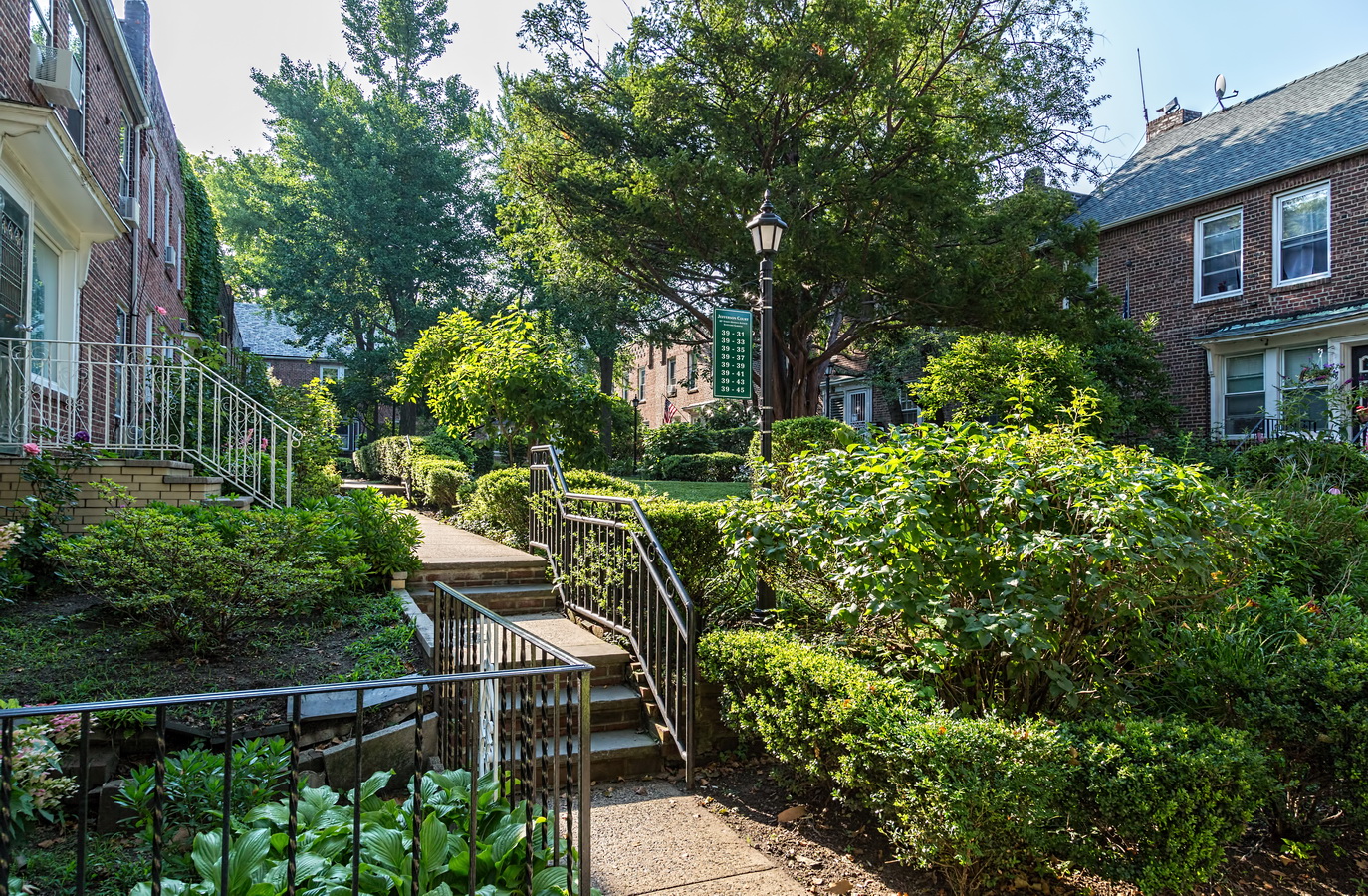
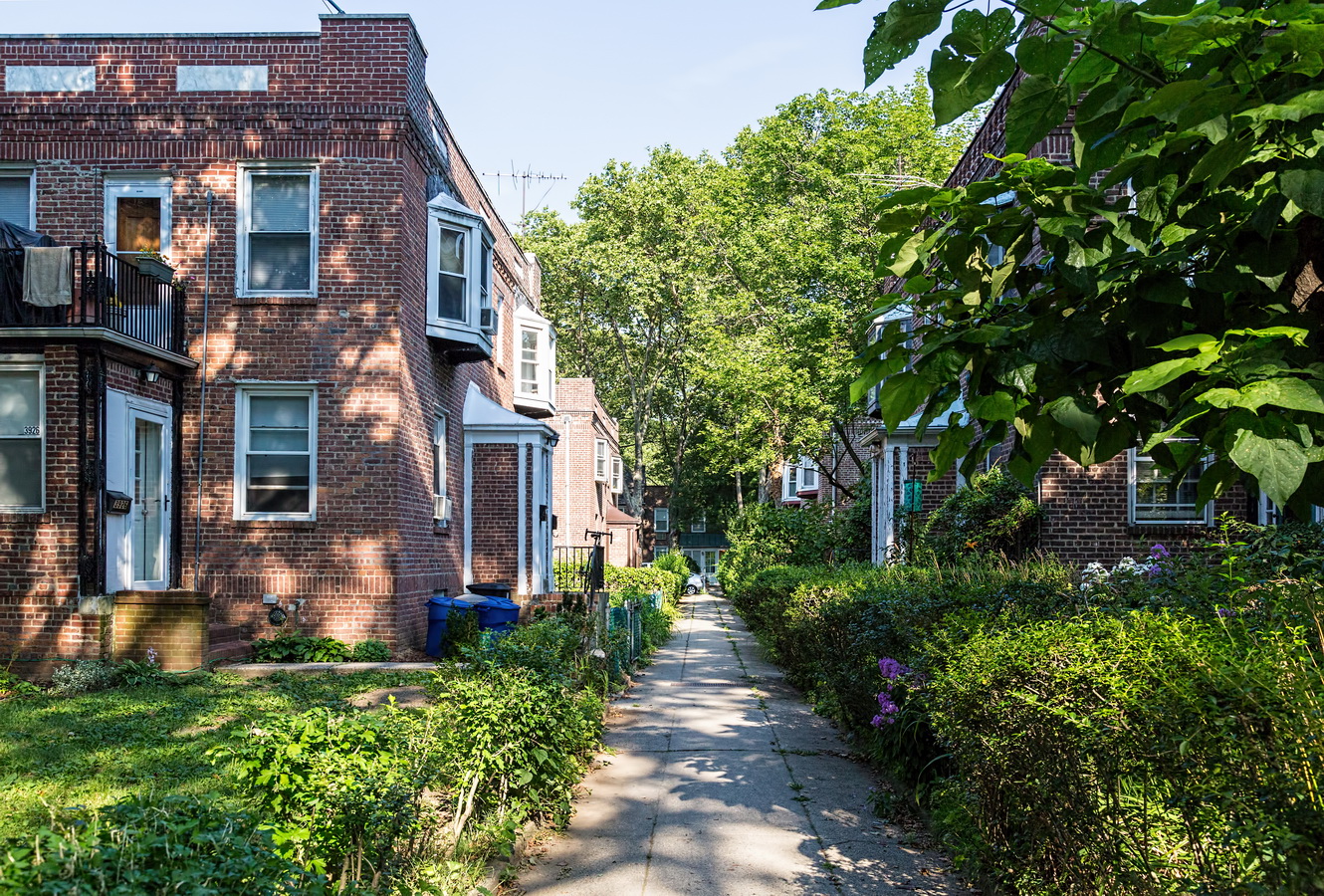
Highly dense row-housing, but with ample green spaces and many pedestrian-only pathways. Has enough density to sustain many local businesses within walking distance, features a number of subway stops easily reachable on foot--it's very possible to live in this neighborhood without driving.
It would be impossible to build a low-density neighborhood that works as well without a car, because there won't be enough people to sustain the businesses required to serve them within a walkable distance. And once you start assuming that everyone will own a car and will use it for every errand, then you inevitably get sprawl + congestion + traffic.
> Not everything has to be centered around consumption/consumerism
If you're arguing for a completely non-consumptive lifestyle in which you grow/forage all of your own necessities, then I concede that my argument doesn't apply to you, but I think most suburb-dwellers are not at your level. Suburbs are typically much more resource-intensive to maintain than denser neighborhoods.
No one is asking for suburbs to be made illegal, simply that other development patterns be allowed.
Also, we don’t give people the choice between suburbs and dense neighborhoods. People need to be allowed to make tradeoffs. This is especially true for the lower middle who can’t afford expensive areas, We don’t know if they would choose long commute and backyard, or short commute and apartment.
As evidence, look at what people are willing to pay for a tiny apartment in London.
But the canyon effect of cities built entirely of skyscrapers is also not nice.
Great cities also have trees and grass everywhere.
And mixed use is needed. Being able to walk a block to get eggs from the corner store or grab a pint at the pub is amazing. That also is not possible with US style single use zoning.
We have also tried “towers in the park” style developments. Those are too spread out to walk or bike.
There is probably a way to get density for public transport and walkability, a few taller buildings but not too many to cause canyons, and street level businesses, but the easy answer is to stay with what has worked all over the world and simply build mid-rise buildings.
Also, US style sprawl is expensive. The upkeep to pave the roads every 5-10 years, maintain sidewalks, and the longer utilities, is usually far more than what the homeowners pay in taxes. Cities either raise taxes, let older neighborhoods crumble (common), or subsidize suburban areas with tax revenue from the dense areas (common). US urban sprawl is not sustainable.
What's strange is that most people seem to agree that the best cities are made up of mid rise 5-10 storey blocks with internal courtyards. Basically how we did the best architecture from before the 1920s. Yet when it comes to it, barely anywhere is building enough of that kind of building.