https://www.theguardian.com/environment/2022/sep/12/colorado...
Hmm, wouldn’t want to address the elephant in the room though.
If you're missing river and aquifer water, you want to tackle the users of river and aquifer water
And the water needed to produce all of their food, which is way more calories than they end up giving back.
And their daily water need, which comes out as urine, which pollutes the nearby environment.
> If you're missing river and aquifer water, you want to tackle the users of river and aquifer water
Exactly. If that is farmers growing crops to feed livestock, tackle that.
tldr: alfalfa is an unnatural food for unnaturally kept horses
source: have horses on range land.
(Aside: Anybody who wants free horses to break (not to turn into dog food), let me know.)
Second, there is very much a way to manage water while ranching — the main thing is to have the herds help you maintain healthy soil (which retains and regulates surface water), rather than destroying it like in feed lots. You make sure you can move them to a different section of the land.
Third, livestock and crops can co-exist onsite, and there are mutually beneficial processes between the two. Most farmers and ranchers do one or the other. Combined with notill and letting limited grazing on fallow land, what would be toxic runoffs from manure turns into adding fertilizer back into fallow lands.
Fourth, price of meat should reflect the added cost. People keep using feedlots because they want meat factories and cheap meat.
Solutions already exist.
It's only not a solution because people want cheap meat. And just to be clear, I'm not advocating for all plant-based, vegan diet or using vat-grown meat. I think a clearer assessment of what we actually need to thrive, nutritionally speaking, would be of benefit.
This is already available only to rich people at gourmet grocery shops for $13/lb for ground beef, and $30 for 12 oz for a steak
If you are advocating to remove the cheaper options of meat, and leaving only grass-fed and premium meats available on the market - I am not sure this is a good approach.
This is very elitist approach that could come from coastal elite only
I also don't live on the coast. I'm not sure where you got that idea from. I don't know if you can call me an elite.
A friend of mine looking into the Carnivore Diet plans out hunting trips, where taking down big game, plus some smaller game and a share in livestock (such as chickens) would feed the whole family for a year.
He's using the protein for fitness and bodybuilding. And yes, he can totally afford taking time off and having the fitness, skill, and equipment to hunt. There is a virtuous cycle where fitness enables the physical capability to go hunt, which feeds back to fitness. That's not a lifestyle that is accessible to everyone, either by personal interest or capital to get started.
But, the unanswered question is still: how much meat does a family really need? There's been a meat inflation going on since the 80s. We don't really think about the McDonald's Quarter Pounder as a big burger anymore, and yet, when it was introduced, it was considered huge. Now it is supplanted by the Double Quarter Pounder.
How much quality meat do you really need? You need less of those grass-fed gourmet meat to stay fit. Poorer quality meat, such as ones from McDonald's, has net-negative nutritional value. You get this illusion of eating a lot of meat, for cheap, but what you actually get out of it is poorer health.
How much of the craving for large volumes of meat is coming from you, or coming from the gut bacteria that depends on that volume of meat and signals your brain to seek it out?
How much is the meat factory industry incentivized to keep the meat flowing?
So I state it again -- I think clearly assessing what we actually need to thrive, nutritionally speaking, would be beneficial.
although I agree with your overall argument
The real problem, and the real elephant that no one wants to address, is the human population size.
Usually nobody engages this because it's a boring conservative talking point. Do I consume too much? No, it's the world that's overpopulated. And they usually have drastic authoritarian solutions that have no chance of being enacted. But go ahead, you have the floor, what are your proposals?
Well, might want to look those up before you continue down this line of thought.
https://ourworldindata.org/uploads/2020/01/Global-land-use-g...
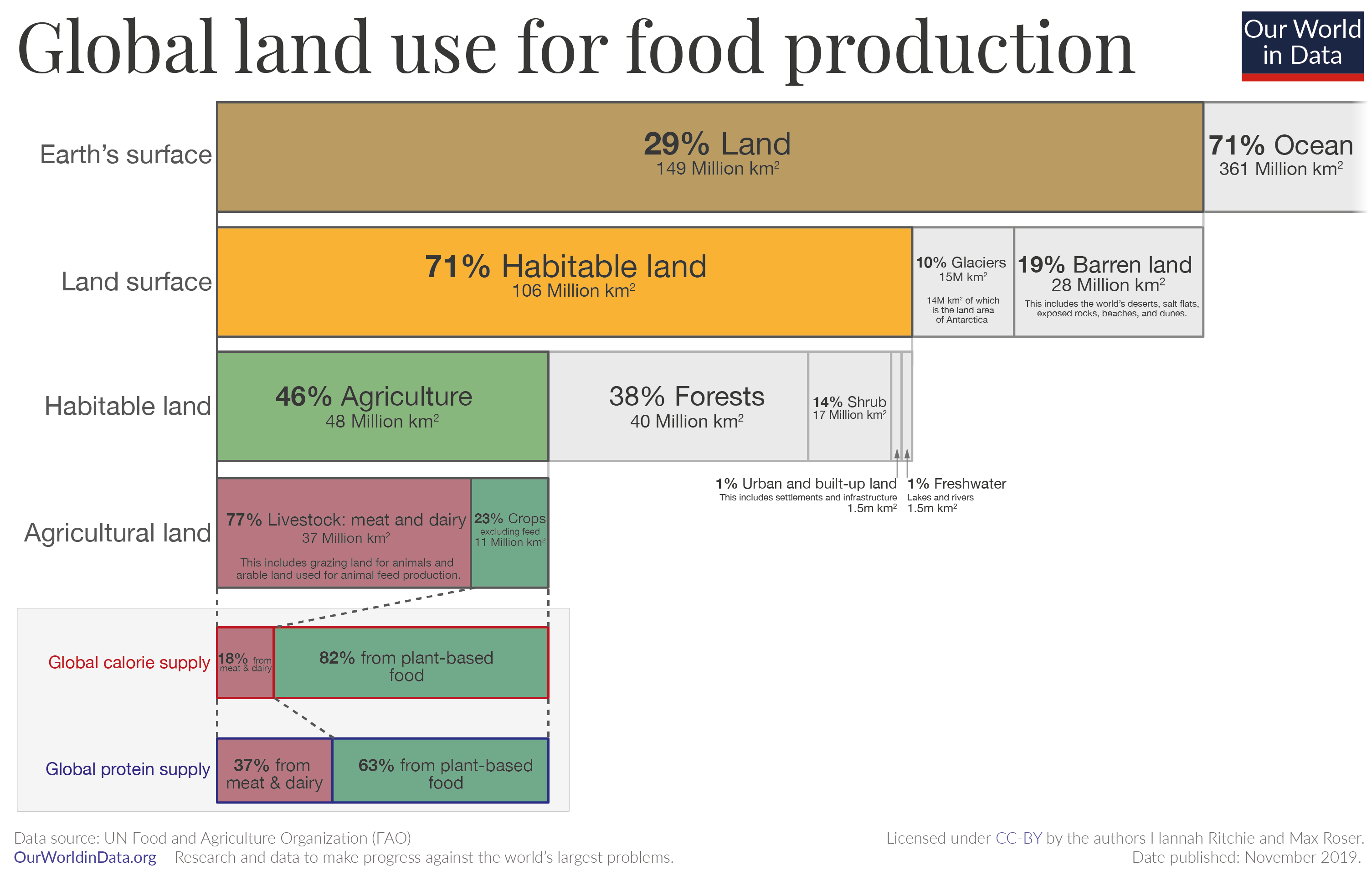
Built-up land is 1% of habitable land.
Forests 38% of habitable land.
Agriculture 46% of habitable land.
Of ag (100%), there is
    77 % ... livestock (18% calories, 37% proteins)

    23 % ... crops for humans (82% calories, 63% protein)
---
https://ourworldindata.org/land-use-diets
If the world adopted a plant-based diet we would reduce global agricultural land use from 4 to 1 billion hectares, and return 35% of habitable earth to wildlife and nature
https://journals.plos.org/climate/article?id=10.1371/journal...
Rapid global phaseout of animal agriculture has the potential to stabilize greenhouse gas levels for 30 years and offset 68 percent of CO2 emissions this century
https://www.theguardian.com/environment/2018/may/31/avoiding...
Avoiding meat and dairy is ‘single biggest way’ to reduce your impact on Earth
https://www.colorado.edu/ecenter/2022/03/15/it-may-be-uncomf...
The animal agriculture industry is the leading cause of most environmental degradation that is currently occurring.
https://www.researchgate.net/publication/320356605_Agricultu...
Agriculture production as a major driver of the Earth system exceeding planetary boundaries
---
We could stay on our 1% of habitable earth, lower our agricultural footprint from 48% of land to 15%, use quarter of pesticides, herbicides and fertilizers, double forest area and store entire 1.5C carbon budget (https://www.nature.com/articles/s41893-020-00603-4) in the process, and enable return of wildlife and sealife (also storing a lot of carbon in them https://www.oneearth.org/how-restoring-key-wildlife-species-...).
All of that just by eating plants, something we are perfectly capable of doing and thriving on (https://talkveganto.me/en/facts/suitable-for-all/).
1 almond requires 1 gallon of water 1 egg requires 50 gallons of water 1 8oz steak requires 900 gallons of water
I'm definitely not an expert here. Please correct me if this is all BS.
They are essential, ask any vegan :)
> but because they sell a lot in China
https://en.wikipedia.org/wiki/Almonds_in_California
"Farmers exported $4.5 billion worth to foreign countries in 2016, about 22% of the state's total agricultural exports. The majority of these exports went to the European Union [37%], China [8%] and India [15%]. While the EU is the largest consumer, the latter two countries are expanding markets ...". Canada, Japan and UAE have 6% each.
> created a circle of increased water consumption
https://www.vox.com/the-highlight/23655640/colorado-river-wa...
1_049_555 million gallons ... beef, dairy
__125_218 million_gallons ... soy, rice, almonds, potatoes
https://www.theguardian.com/environment/2022/sep/12/colorado...
"Agriculture – mainly alfalfa – consumes 80% of the Colorado River’s dwindling water supply ... One out of every three farmed acres in the valley is dedicated to growing alfalfa ... used as food for livestock."
"In 2021, nearly 20% of alfalfa produced in the west was shipped abroad."
https://www.vox.com/the-highlight/23655640/colorado-river-wa...
"The Colorado River is going dry ... to feed cows."
"That means altering the demand side of the water supply-demand equation and shifting diets globally to foods that use less H2O, which ultimately means less meat and dairy, as well as fewer water-intensive tree nuts like almonds, pistachios, and cashews (nut milks, however, require much less water to produce than cow’s milk)."
https://environment.yale.edu/news/article/the-other-side-of-...
"1 kilogram of almonds produces less than 1 kilogram of carbon emissions. (For comparison, the Environmental Working Group estimated that beef causes more than 20 kilograms of CO2-eq emissions, cheese more than 10, and beans and vegetables around 2.)"
https://foodrevolution.org/blog/almonds-sustainability/
The authors compared the nutrition content of 42 different California food crops. They also ranked the economic value of 44 food crops. They concluded that for the water needed to produce them, almonds ranked among the most valuable foods grown in California for their dietary and economic benefits.
https://ourworldindata.org/grapher/environmental-footprint-m...
Cow milk is still 2x more water intensive than almods, needs 16x more land, produces 4x more CO2 and 6x more euthropication.
Almonds simply aren't good.
In reality, middle America probably grows an entire magnitude more food calories than california, and most of that is inefficiently turned into beef, or ethanol for cars. America does not need to be worried about starving. We literally throw away like a quarter of the food we purchase, and for incredibly stupid reasons like people swallowing the "Best By" dates as gospel and refusing to eat food with a bruise. This doesn't even consider the massive amount of farmland that we used to use in plenty of rural states across the nation that just aren't as profitable as the factory farms that own the markets nowadays. My state used to produce mountains of potatoes for the entire country but got outcompeted by Idaho and now is stuck growing niche crops and small batches of broccoli for local consumption.
They're not perfect, but to my body, also clearly not meaningless.
Consider that food producers are logically often already under ample pressure to set those dates in reasonable thresholds on both sides by their reputations and their own supply chain lags.
I'm not saying this to be dismissive. These effects can be incredibly strong, I could not eat pork cutlets for years after I had an extremely strong migraine when I ate one. After my body associated the smell and taste with it and noped out every time I got close to one.
If anyone has more information on this I’d be very interested to read it, because it’s landed firmly in the area of … sounds legitimate, but could also be modern “old wives tale” type of stuff where people just say it because it sounds scientific enough to be true and no one has ever researched it because it’s obviously wrong scientifically speaking but is addressed by unrelated fundamental knowledge in a scientific field Im not knowledgeable about such as industrial scale food science or something else.
So yeah would greatly appreciate anything more knowledgeable people on the topic can share, this little throw away line nerd sniped me.
https://en.wikipedia.org/wiki/Histamine_intolerance https://duckduckgo.com/?q=low+histamine+diet&atb=v376-1&ia=w... https://old.reddit.com/r/HistamineIntolerance/comments/cr9pf... https://www.mastzellaktivierung.info/downloads/foodlist/21_F...
Anecdotally, I've had major digestive issues my entire life. It's particularly frustrating because foods that are supposed to be extremely healthy (low fodmap! gluten free! whole 30!) are still bad for me. Following the last list I posted has actually helped.
Although now that I think about it, the original poster's migraines could be caused by chemicals leaching out of the can liner.
This is a pretty thorough paper on histamine intolerance specifically, and it discusses buildup of histamines in certain foods and associated symptoms.
"omg lets just move the farms to where the water is"
like you're not talking about growing plants rooted in the literal ground, some that must be cultivated over multiple years to yield quality product.
like we're not all going to be chasing water on a hotter planet with a chaotic climate.
In fact, if warming occurs, the US and Canada stand to net gain arable land and have increased growing seasons.
Of course the counter to that will always be “… but we’re going to have like SO much climate chaos!” which has become the perfect scary, vague and ultimately unprovable argument.
That certain regions are expected to "win" does not fully grasp the impact on our overall economic stability, the systems that keep necessities like food cheap and accessible. Whether you like it or not, the food market is global[1].
"Climate chaos" is not hyperbole.
1. https://www.pbs.org/newshour/world/global-wheat-prices-jump-...
Calling a flood, hurricane or even several years long drought a “climate related disaster” doesn’t count. These events have occurred since time immemorial.
Every weather measurement deviation from average is not some “disaster” that can be blamed on evil corporations and people driving SUVs.
I'm talking about businesses, yes. Many of which will, as you say, need multiple years to start up elsewhere. I freely and readily acknowledge that this will probably be a difficult process for those businesses. Fortunately, food supply chains are now globe-spanning and de-emphasizing agriculture in drought-prone parts of the US is very unlikely to result in food shortages, much less famine.
We could start more gently by having them pay a fair price for the natural resources they require and are thus not available for everything else that needs water.
If anything, the last few years have shed light on is just how fragile global supply chains are. The war in Ukraine has impacted wheat prices globally.
> de-emphasizing agriculture in drought-prone parts of the US is very unlikely to result in food shortages, much less famine
There's a reason food security is considered a national security issue[1].
1. https://www.forbes.com/sites/forbesbusinesscouncil/2022/10/1...
You're absolutely right.
Yet, much like the "No Farms No Food" bumper-sticker slogan, there's some rhetorical sleight of hand going on here. Those stickers are correct in a general sense, but the slogan is rarely deployed in a general sense. It's generally used to defend uneconomical farming in environmentally questionable places.
Similarly, you're completely correct in every single way that we need agriculture and banning it is not a solution. However, there's perhaps a substantial difference between banning all agriculture everywhere and matching the agriculture in a location to the resources available to support it. If there's inadequate water or sun to grow crops that need lots of both, perhaps that location is not the best for those crops.
Agriculture is essential for human survival. It's possible that growing almonds in areas with sharply limited and poorly managed water is less than essential for human survival.