If you're missing river and aquifer water, you want to tackle the users of river and aquifer water
And the water needed to produce all of their food, which is way more calories than they end up giving back.
And their daily water need, which comes out as urine, which pollutes the nearby environment.
> If you're missing river and aquifer water, you want to tackle the users of river and aquifer water
Exactly. If that is farmers growing crops to feed livestock, tackle that.
tldr: alfalfa is an unnatural food for unnaturally kept horses
source: have horses on range land.
(Aside: Anybody who wants free horses to break (not to turn into dog food), let me know.)
Second, there is very much a way to manage water while ranching — the main thing is to have the herds help you maintain healthy soil (which retains and regulates surface water), rather than destroying it like in feed lots. You make sure you can move them to a different section of the land.
Third, livestock and crops can co-exist onsite, and there are mutually beneficial processes between the two. Most farmers and ranchers do one or the other. Combined with notill and letting limited grazing on fallow land, what would be toxic runoffs from manure turns into adding fertilizer back into fallow lands.
Fourth, price of meat should reflect the added cost. People keep using feedlots because they want meat factories and cheap meat.
Solutions already exist.
It's only not a solution because people want cheap meat. And just to be clear, I'm not advocating for all plant-based, vegan diet or using vat-grown meat. I think a clearer assessment of what we actually need to thrive, nutritionally speaking, would be of benefit.
This is already available only to rich people at gourmet grocery shops for $13/lb for ground beef, and $30 for 12 oz for a steak
If you are advocating to remove the cheaper options of meat, and leaving only grass-fed and premium meats available on the market - I am not sure this is a good approach.
This is very elitist approach that could come from coastal elite only
I also don't live on the coast. I'm not sure where you got that idea from. I don't know if you can call me an elite.
A friend of mine looking into the Carnivore Diet plans out hunting trips, where taking down big game, plus some smaller game and a share in livestock (such as chickens) would feed the whole family for a year.
He's using the protein for fitness and bodybuilding. And yes, he can totally afford taking time off and having the fitness, skill, and equipment to hunt. There is a virtuous cycle where fitness enables the physical capability to go hunt, which feeds back to fitness. That's not a lifestyle that is accessible to everyone, either by personal interest or capital to get started.
But, the unanswered question is still: how much meat does a family really need? There's been a meat inflation going on since the 80s. We don't really think about the McDonald's Quarter Pounder as a big burger anymore, and yet, when it was introduced, it was considered huge. Now it is supplanted by the Double Quarter Pounder.
How much quality meat do you really need? You need less of those grass-fed gourmet meat to stay fit. Poorer quality meat, such as ones from McDonald's, has net-negative nutritional value. You get this illusion of eating a lot of meat, for cheap, but what you actually get out of it is poorer health.
How much of the craving for large volumes of meat is coming from you, or coming from the gut bacteria that depends on that volume of meat and signals your brain to seek it out?
How much is the meat factory industry incentivized to keep the meat flowing?
So I state it again -- I think clearly assessing what we actually need to thrive, nutritionally speaking, would be beneficial.
although I agree with your overall argument
The real problem, and the real elephant that no one wants to address, is the human population size.
Usually nobody engages this because it's a boring conservative talking point. Do I consume too much? No, it's the world that's overpopulated. And they usually have drastic authoritarian solutions that have no chance of being enacted. But go ahead, you have the floor, what are your proposals?
Well, might want to look those up before you continue down this line of thought.
https://ourworldindata.org/uploads/2020/01/Global-land-use-g...
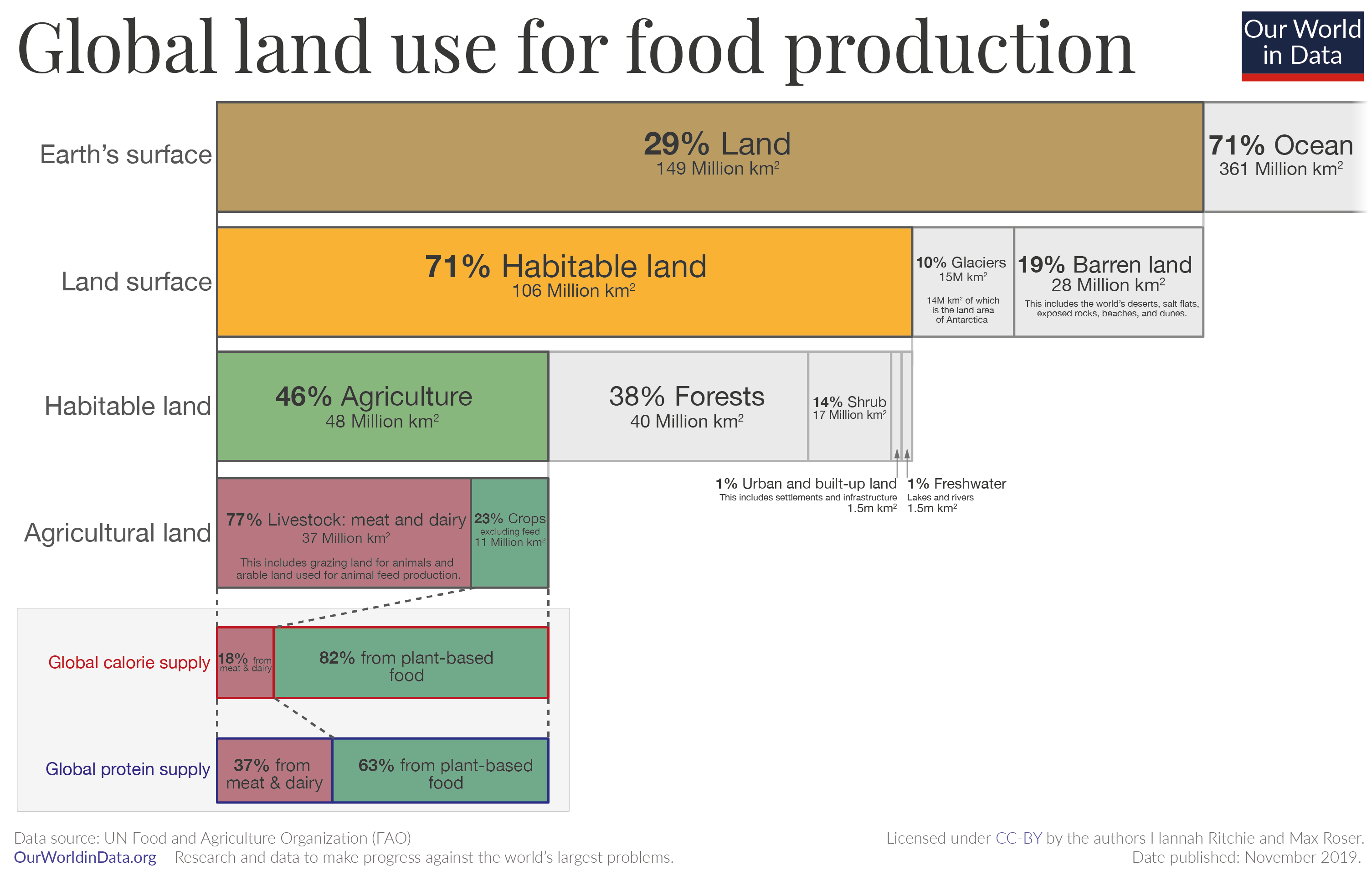
Built-up land is 1% of habitable land.
Forests 38% of habitable land.
Agriculture 46% of habitable land.
Of ag (100%), there is
    77 % ... livestock (18% calories, 37% proteins)

    23 % ... crops for humans (82% calories, 63% protein)
---
https://ourworldindata.org/land-use-diets
If the world adopted a plant-based diet we would reduce global agricultural land use from 4 to 1 billion hectares, and return 35% of habitable earth to wildlife and nature
https://journals.plos.org/climate/article?id=10.1371/journal...
Rapid global phaseout of animal agriculture has the potential to stabilize greenhouse gas levels for 30 years and offset 68 percent of CO2 emissions this century
https://www.theguardian.com/environment/2018/may/31/avoiding...
Avoiding meat and dairy is ‘single biggest way’ to reduce your impact on Earth
https://www.colorado.edu/ecenter/2022/03/15/it-may-be-uncomf...
The animal agriculture industry is the leading cause of most environmental degradation that is currently occurring.
https://www.researchgate.net/publication/320356605_Agricultu...
Agriculture production as a major driver of the Earth system exceeding planetary boundaries
---
We could stay on our 1% of habitable earth, lower our agricultural footprint from 48% of land to 15%, use quarter of pesticides, herbicides and fertilizers, double forest area and store entire 1.5C carbon budget (https://www.nature.com/articles/s41893-020-00603-4) in the process, and enable return of wildlife and sealife (also storing a lot of carbon in them https://www.oneearth.org/how-restoring-key-wildlife-species-...).
All of that just by eating plants, something we are perfectly capable of doing and thriving on (https://talkveganto.me/en/facts/suitable-for-all/).
Hmm, wouldn’t want to address the elephant in the room though.