Oppositions to lockdowns were always about tradeoffs and whether they were worth it. Its just such a boring critique.
My main question still remains, what would your plan have been if we still didnt have a vaccine? From my perspective lockdown supporters got completely bailed out by one of the greatest medical/scientific achievements in human history (developing and deploying an extremely effective vaccine within 1 year).
The only thing lockdowns do is push cases into the future.
Fully agreed; saving lives / community responsibility is the noble choice.
Work on a vaccine began almost immediately, no? I trusted that shifting the focused lens of US policy toward medical research would produce some incredible results, especially with the diversified private sector pharmaceutical behemoths battling it out, so to speak.
I also don't think it was any stroke of luck that resulted in vaccines being made quickly. Our scientific establishments correctly devoted their resources to developing vaccines. A lot of us were closely following their development and knew that they were just around the corner. Even without advancements in MRNA technology, other types of vaccines were being made that could prevent the majority of deaths.
heres an article in the NYT about managing vaccine expectations.
https://www.nytimes.com/interactive/2020/04/30/opinion/coron...
also you argument falls apart when lockdowns (restrictions, npis, whatever you want to call them) continued way beyond vaccine rollout. I was first in line to get vaccinated and im very glad i did, because they promised us that would be a return to normal, but it wasnt for at least a year afterwards and i still havent been given an explanation why.
County / MSA hospital capacities, percent available ICU beds, ventilator use, admission increase rates, deaths, and various other stats were factored into restrictive policy decisions. However, this varies city by city and state by state (I suppose as an effect of federalism).
0. https://usafacts.org/visualizations/covid-vaccine-tracker-st...
…maybe think harder, then?
If I could make my car crash proof (me getting vaccinated in this analogy), i would have no issues with people wanting to drive as fast as they like (they already do it anyway).
also, even if vaccines did stop transmission your argument still doesnt make sense. I can protect myself by being vaccinated. I dont give a shit if the person next to me is unvaccinated, im already protected myself. If you decide not to, you are consenting to increased risk.
Enjoy dying on this hill, Anthony.
I'm just guessing, but an obvious reason would be because the vaccines were not as effective against the new variants? As in, while the vaccines still protected the vaccinated person, they did not effectively prevent spread of the disease, so other ways to do so remained relevant...
The idea we needed to "flatten the curve until a vaccine" was obsolete the day many states closed their completely unused field hospitals. That should have been the indicator that covid wasn't nearly as bad as predicted. That was the day everything should have gone back to complete normal.
These lockdown "experts" never had an end game. They kept pushing the goal posts further and further until they completely lost the plot. That was one of my first objections to such mitigations. There was zero success criteria. Fuckers were just winging it. Which might be okay for some minimally invasive crap like enhanced handwashing protocols but it is absolutely bat-shit insane for something as impacting as lockdowns.
What we did was insane. I still have no idea how people look back, given all the data, and say "yup, what we did made sense". None of it make a single ounce of sense at all...
Even without vaccination, mortality from covid is significantly lower than it was early in the pandemic.
This can be rephrased as "it's just obvious/common sense that lockdowns work" and it's a really common argument, but wrong.
Unfortunately there's nothing really obvious or intuitive about viruses. The Diamond Princess cruise ship showed right at the start that lockdowns would be ineffective. They locked down everyone on the cruise ship the moment the first outbreaks were confirmed, confining them to cabins. In the transmission model that lockdowns rely on that would have ended the outbreak immediately. But it didn't, instead people kept coming down with COVID completely at random, scattered all over the ship. From this two things could be concluded:
1. SARS-CoV-2 is airborne, that is, it can move long distances in gaseous clouds, i.e. through air ducts, by hanging in the air for long periods and other ways that lockdowns can't affect.
2. The clouds must have circulated through the ship, yet not everyone was susceptible.
This wasn't a terribly surprising result because investigators had concluded the same things about SARS-1 back in the day. SARS-1 clouds were able to move within apartment buildings even when everyone was locked down in their apartments, apparently via air ducts.
https://www.nejm.org/doi/full/10.1056/NEJMoa032867
Some people pointed out at the time that this would render lockdowns irrelevant right back in March 2020, and were ignored, but time has proven them right. There's no correlation between lockdown severity and results.
You don't need to have a "medical background" to debate lockdowns or masks. The decision to use those should never have been made exclusively by people with "medical backgrounds". It isn't their job. Just because the "medical people" say it's gonna work, doesn't mean it is worth the cost to society. And it isn't at all the place of people with "medical backgrounds" to figure out what those costs are and if they are worth it...
"Experts" shouldn't be decision-makers. They should only inform decision-makers. A good decision-maker should take input from everybody who will be impacted. This was never done at all. Had it been done openenly and transparently we'd never have done lockdowns, school closures or anything else. Such things are completely insane no matter how much "medical experts" suggest to use them.
You’re right; I’m really glad I polled thousands of fellow employees before forcing multifactor auth, or that time I chatted with a sysadmin to make sure they really did mean to open RDP on a public server before taking it offline.
Sarcasm aside, in a time of a medical emergency, it is the job of medical professionals to make decisions, because public safety supersedes individual freedoms. It’s why we have speed limits. It’s why you have to wear a seatbelt. It’s why you can’t shoot fireworks off during a drought. It’s why products are restricted from being sold. The concept is fundamentally the same.
It’s also the same reason I’m glad cybersecurity policy, strategy, and operations are not a truly democratic process.
This might be true for like the first week or two of march but after that... the response should absolutely not be solely in the hands of nothing but "medical experts". Those people were never elected, are not accountable at all for their actions, and were granted virtually unlimited control. That is what we call a dictatorship.
I would much, much rather have a diverse party of people calling the shots and not just one very specific niche class of "expert". Without a diverse set of people involved you'll wind up where we got... an extremely myopic fixation on exactly one single respiratory virus for two+ years to the complete disregard for the damage it caused to our children and communities.
I used to think technocracy would be awesome. What better than to have a bunch of experts doing things "the right way". But covid opened my eyes to how incredibly bad of an idea that is. Experts are only expert on one specific thing. All their advice and mandates are made through that narrow lens.
> You’re right; I’m really glad I polled thousands of fellow employees before forcing multifactor auth, or that time I chatted with a sysadmin to make sure they really did mean to open RDP on a public server before taking it offline.
But you also chatted with business people to get insight into the costs of forcing multifactor auth on people would be worth the security gains? Right? Because forcing 2FA is absolutely not something a security expert gets to decide. A good security expert would realize they are an advisor and not the person calling the shots. They know their role is to outline "what would happen if we did blah blah" and then let the business people know the pros and cons so said business people can make a decision. The business people, if they are any good, realize that there are multiple often conflicting requirements and have the hard work of deciding what the right tradeoffs to make are. Experts don't get to decide those tradeoffs at all...
I mean, could you imagine if the only input you got for a product, say a car seat, was just from a bunch of lawyers? The product would be absolutely lawsuit proof but I bet it would suck as a car seat.
This wasn't the case, and to say so is a blatant misrepresentation of the past. Did Fauci issue a travel ban, enact the Defense Production Act, or redirect the supply of medical equipment? Did the CDC somehow supersede congressional authority and directly fund research via the CARES Act? Were appellate courts no longer hearing cases regarding COVID and civil liberties?
> you also chatted with business people to get insight [...]
this reinforces my point: anyone who happens to be impacted is not entitled to input. Conversations between medical professionals and public officials were occurring every single day. But - do you think Trump was genuinely listening to his advisors?
> there are multiple often conflicting requirements and have the hard work of deciding what the right tradeoffs to make are
that's exactly my point, again. No one knew it was going to mutate that quickly and stay an issue. The tradeoff for doing less was more people dying.
That is quite simply not true at all.
I did a study of mask based on self reports early in the pandemic and I did show a significant slowing of the progress of the pandemic in states that had a high claimed rate of mask use. I had (I thought) some clever ways of eliminating other differences between states in my analysis and was surprised to see so much slowing. However, I am not sure which way the causality runs. I can easily see heavy masking making it such a bummer to go to bars (e.g.) that the lack of socialization caused the slowing.
But in summary, to your point, to the medically knowledgeable there was a lot of evidence before that masks would not do much (not nothing) and there is a lot more now that masks didn't do much
The nurses who thought so are either fired, dead, or updated their thinking.
But if you don't trust your own eyes, maybe the Cochrane Collaboration is enough for you? They published a meta-review of mask studies.
https://www.cochranelibrary.com/cdsr/doi/10.1002/14651858.CD...
Remember, you don't get to claim you're right because you fired everyone who pointed out you're wrong. It's painful to accept this, but masking was a lie from start to finish which is why the position of all the medical staff at the start was that masks don't seem to do anything and there's no evidence community masking would help. That position was correct. They changed it later for ideological reasons and the politician's fallacy.
This is simply factually incorrect.
The situation in the US provided a textbook ANOVA scenario with various individual counties adopting a hodge podge of approaches.
For example, one of many such studies
https://www.degruyter.com/document/doi/10.1515/jom-2021-0214...
concludes:
These data showed statistically significant lower averages of SARS-CoV-2 daily infection in counties that passed mask mandates when compared with counties that did not.
The difference-in-difference analysis revealed a 16.9% reduction in predicted COVID-19 cases at the end of 30 days.
You might want to look into why meta reviews, particularly those plucked from popular COVID forums, aren't the bees knees you seem to think they are.
Problems with this paper:
1. It's just a study of public data so should be trivially replicable, but they picked data points "via Microsoft Excel’s random number generator function" so it's non-replicable by design. Right up front this makes it incompetent work because there'd be no way to detect P-hacking.
2. Because it's not an RCT they can only show a correlation, not a causation, yet their claims are causal. An obvious confounder is that going out with a mask is no fun so you'd expect people to socialize more in places without a mandate, yet this isn't mentioned.
3. The effect size is tiny: ~4 cases a day! In counties with tens of thousands of people! This is NOT how mask mandates were advertised to the population.
4. "We did not record compliance with mask mandates". Yes I'm sure the residents of places like Anderson County Tennessee followed public health orders meticulously.
5. They ignore all the contradictory evidence.
Again, I cannot stress this enough, we know mask mandates don't work because of the times they were introduced with no change in case trends. Here's a single example:
https://pbs.twimg.com/media/FPHy4ZoUYAIsYbt.jpg:large
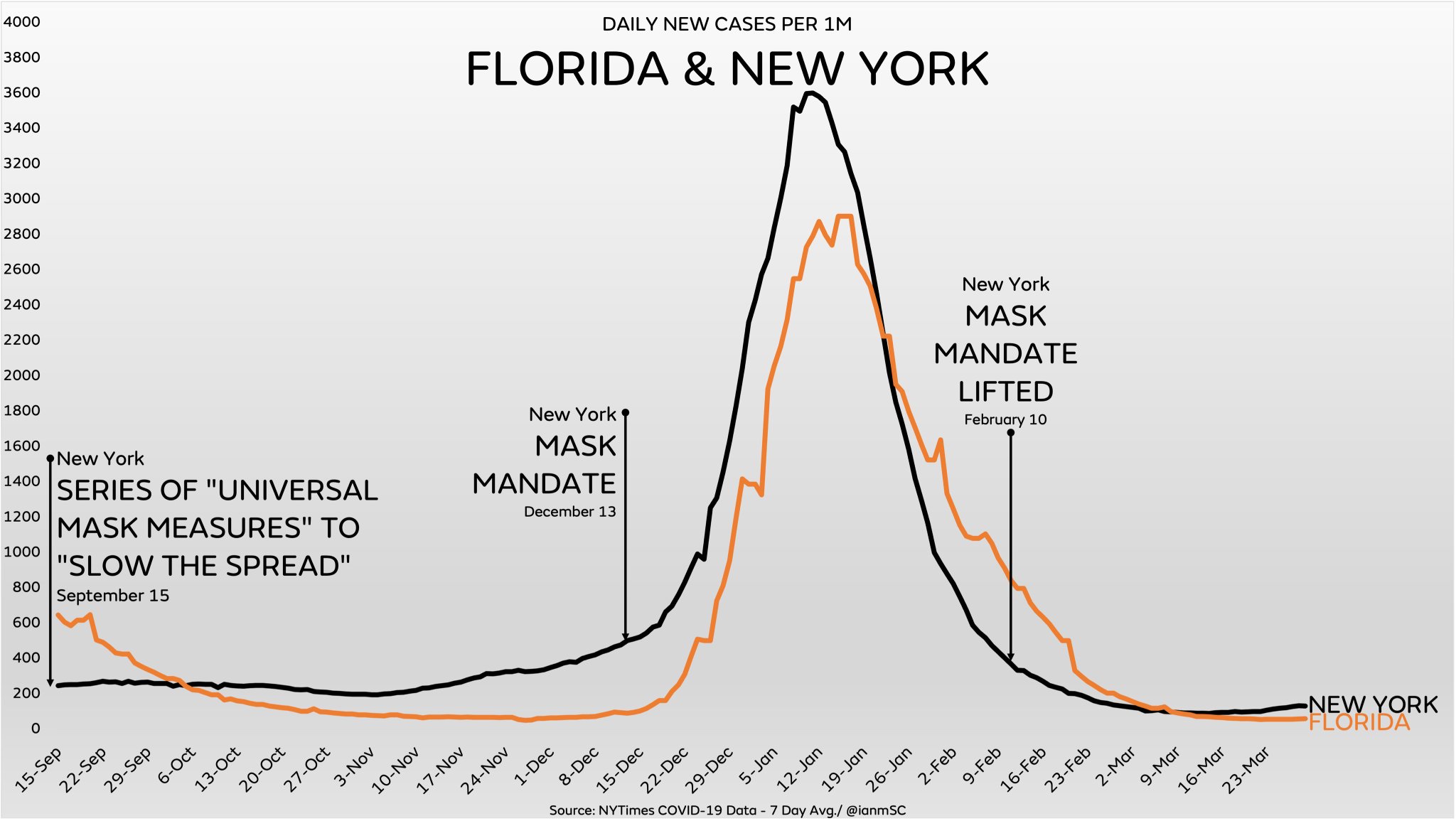
Because the claim is "mask mandates always reduce transmission", it only takes one counter-example to disprove the claim. There are hundreds of charts like that one, but only one is required. That's the nature of falsifiability.
To conclude that mask mandates work you have to be able to explain the times when they didn't. Crap studies like this one (cited 3 times, well done for finding it) are produced by academia all the time, but they get ignored because they can't explain that, and the authors are invariably biased. These guys even cite a claimed 0.5% reduction in cases and call this "effective"! Imagine if governments had stated up front when imposing mask mandates for the first time, "we think this will be effective because it might reduce case counts by half a percent". What would people have thought of the sanity of this cost/benefit tradeoff, exactly?
Second, there is no "debate" regarding efficacy of masks and limiting exposure via quarantining. Masking reduces the likelihood of contracting SARS from others, and staying home reduces the spread to others and strain on hospitals. Unsurprisingly, the people attempting to debate this typically had no medical background whatsoever.
Millions died in the US alone, and a non-trivial percentage of them would likely still be alive if our public officials did a better job of respecting the medical professionals and their recommendations.