Very weird thing to hear from someone who claims to be a vegetarian.
I can brew my own beer in my own home.
Can I make lab-grown meat in my own home?
We've also been educated to buy and prepare our own meals from the most natural/unprocessed ingredients as possible and avoid heavily industrialized/preprocess ingredients for health reasons.
Lab grown meat is the opposite of both of that.
I am just playing Devil's advocate here. I understand the appeal and potential environmental benefits as well.
This is partly the fault of Sci-fi, bio-engineering is rarely shown as a positive in TV and Film.
This will be mostly solved with time, eventually it may become economically unviable to buy "field meat" (not sure what the term will be), and it will become a lot more accepted when they see the people around them enjoying it without severe consequences.
"Icky" is ignorance.
That’s why there are laws to keep them from seeing it. Which might be why so many HNers think animals grow up in sunshine and rainbows and it’s the sterile lab that's icky.
I'm vegetarian for environmental reasons, not ethical. Nothing wrong with eating a chicken or a pig who had a good life on an open field for me
So if you are vegetarian for environmental reasons and had to eat a chicken, you should go with the battery-farmed one.
You would go with the (arguably mythical) happy chicken if you were vegetarian for moral reasons.
> feed (less energy expended from movement)
Less muscles, more disease, worse health, lifespan of 4 weeks, &c.
They're free to move about at least in their "bay" and have the company of other hens that can wander about too. Sure, they don't get the marketing feelgood "sun on their backs and wind in their feathers", but they also don't get raptors, foxes, or rats.
You can get rescue hens and they're just about savvy enough to figure out - after you've lost one or two - that predators are a thing, and you'll get an egg every couple of days per hen. They'll eat all the bugs in your garden (and most of the herbs, and the tops of your carrots) and shit everywhere.
I think the golden rule is a good basis for morality even for our relations with animals. Personally I would rather live in this open world that includes dangerous predators (that have killed some of my closest friends) and other risks than in a safe institution ... whether I get harvested for my meat at the end or not.
Given the same amount of money, I'm assuming they mean buy less chicken (but from non-factory sources) and spend the remainder on other foods with less environmental impact.
https://www.sentienceinstitute.org/global-animal-farming-est...
No kidding. They could start by using a single (and known) definition for "factory farmed".
Unless you are in the business of refining that data, this study is useless.
Except that this phrase doesn't mean anything.
And that is only if you stay within the reasonable people. Almost everybody with an impulsion to talk about this subject uses unreasonable definitions. How is a single name that applies to all that still meaningful?
Because this is HN, where someone is sure to nitpick and/or take my next statement to logical extremes, I must be very careful about how I word this. I will regret it, but here I go:
I like eating chicken. I know lots of tasty recipes. I understand this involves killing the animal. Yes, I don't do it myself, but I could if I wanted -- I'm not squeamish. But factory chicken make me uneasy, it seems well past the inhumane line, almost like an extermination camp for chicken. I think free range chicken are happier, for whatever degree of "happiness" their tiny bird brains can understand. I like thinking that the chicken I eat lived a happy if short life trampling on actual grass and all that "breeze in their feathers" stuff. Yes, in the end it still involves killing them, but I think it's way better.
1) If I avoid all meat I cannot be held ethically accountable for it's provenance when, for example, a company's marketing department lies to you or the FDA does not sufficiently protect certain terms of art like "free range" which imply a lack of cruelty that wouldn't pass muster if I saw the treatment with my own eyes
2) If I am vegetarian, I will support vegetarian options, and I create support for companies and businesses that are unambiguously dedicated to reducing cruelty/suffering
essentially all animals raised for slaughter in the US are factory farmed
Why vegetarian then? It's easy enough to buy meat that was raised on a local farm. Get a chest freezer, reach out to a local 4H club, and buy the whole animal. They'll butcher and vac-seal it for you. You could buy some kid's highschool project.
I live an hour from SF and I get much of my meat this way. It's surprisingly inexpensive. There are agricultural communities close enough to every urban environment to make it worth the drive.
I think we’re going backwards by trying to replace the natural bio reactor of the body with steal and piping. It’s all too labour intensive. To make this work we’ll need to genetically engineer an animal that has only the parts we’re interested in. Including skin to replace the steel bio reactors.
Cows due to generations of selective breeding are already remarkably close to this.
We also have to pasteurize it. Or we don't, and germs from cows are hundreds of times more likely to make us sick, despite generations of selective breeding.
I understand you’re saying the challenges lab grown meat faces arent insurmountable, but short of some outside influence (statutory interference?) I don’t see how it can compete with traditional cattle on the cost perspective
At 380 ppm anything that doesn't either directly alter reflectivity of the atmosphere or drastically lower CO2 in the atmosphere is just not going to work.
But you're not growing milk in those facilities, only storing and processing it. That's an important distinction, because it means with milk it's totally fine to deal with those "single germs" with long-understood sterilization techniques.
If you try to sterilize your "lab grown meat" cultures to deal with the germs, you're going to destroy your "meat" too.
Once you have it.
> The problem is keeping it sterile while it's growing/brewing.
This is what I was talking about.
> It can be done, as has been with breweries, but it is os not an easy task.
I think growing meat in a vat is only superficially similar to brewing beer.
To fix this it is processed in food factories that you can describe as squeaky clean massive installations of ceramic tiles and shining steel.
I’m not talking about cow milk
Raw milk is generally better tolerated than homogenized/pasteurized milk. However, in the early 1900s, as supply chains lengthened and the travel time for largely un-refrigerated milk from cow to table increased to days, we found that milk was a primary source of food-borne infections. The absolute risk was still low, but the relative risk was high. Thus, pasteurization became common and in most places, mandatory.
People have drunk raw milk for millennia and have not suffered from hormone-related effects..including people on dairy-centric diets. If you're talking specifically about rbGH, it's very easy to find milk free of it, which I would recommend anyway - I'd hazard a guess that's more common. It’s disputed that it has any ill effects, but I’m totally on board with not risking it.
Everything else aside, powerlifters aren’t recommending crazy diets like gallon-of-milk-a-day (GOMAD) and bodybuilders aren’t paying out the nose for human breast milk because milk has estrogenizing effects.
They ended up building a kind of exploded steel cow, all pipes and vats and such. It seems we are heading in this direction.
I have often wondered what it would be like to start with a cow, then engineer it to be anencephalic, then start paring away "features" or moving them around. Skip the legs, but do have networks of heart-like cells providing a contractile rhythm for the muscles, and so on.
Frank-Lin takes industrial ethanol, city water, and flavoring, and makes a large number of alcohol-based products. They make over a thousand brands, but there are only a hundred or so different recipes, they admit. Each brand has its own label, and many have their own bottles. A few years back, they moved to Fairfield, CA, to be next to the bottle factory.
The Skyy Vodka article was updated accordingly. Skyy marketing was not happy.
A lot of vegetarianism is cloaked aesthetics.
What I notice though is that people get attached to their diets and act offended when you don't eat something that they consider to be some core part of their life style(barbeque, steak, meaty burritos, sushi, vegan fake meat). Some people can and do get butt-hurt when they find out I don't eat meat and then want to play "gotcha" reindeer games.
Not a vegetarian FWIW.
I don't want to live in a future in which all we have left is your 6x6cm of Google chicken and your 2x6 Amazon bacon stripe
By having a bit less of mass scale animal abusing factories ? I fail to see the correlation
Problem is, there was never that many of us. Hell, for most of human history there was less than 1/8 of us now.
The future is going to be somewhat cyberpunk because generations before us already made some choices that we have to live with now.
Never has been as many obese people nor food waste. We can and should eat less anyways
We're clearly not producing for sustenance, but for profit
Yeah, but 20% less, not a quarter of what we do now, because we obviously wouldn't survive on that.
The food waste is because food's extremely cheap. The fix is to make it expensive.
Something like this:
Whereas alternatives can be made at home from raw ingredients and minimum processing, today, cheaper than meat, just as nutritious, without the need of anything more technological than a stove
This is due to the fact that at this stage, this meat is academia-driven and not marketing-driven.
There's not much less things that I care about when talking about food. I care about taste, texture, nutritional value, availability of ingredients or ease of preparation. If some Italian-Mexican-Japanese fusion scores better on that then I'll very happily eat it too.
Efficiency is all that matters if resource utilisation is your metric.
Supermarkets effectively give the meat away for free because quite often farmers are locked into contracts that end up paying less than cost.
Don't buy any of your food from supermarkets.
You'd probably never drink coffee or beer again if you saw how it was made. Come to think of it, you'd probably never eat any kind of processed food if hygiene is unacceptable.
If a vegan had said it, it might have been interesting as a talking point, but a vegetarian who sees no problem with eating animals said it. The two are nothing alike. He is LARPing vegetarianism.
What condescension? I am not a vegan. You are projecting a lot of insecurities onto a complete stranger whilst making a very big assumption, and this speaks volumes about you.
But you are correct that I’m projecting a bit. This is because as a vegetarian, I’ve seen so much vegan arrogance, condescension, and outright aggression toward vegetarians that I am indeed particularly sensitive to it. So if I see it I call it out. In my experience, an average vegan has more hostility toward a lifelong vegetarian than they have toward a lifelong meat-eater (granted that most vegans hold no hostility at all— so this would be a smaller subset of vegans that do hold hostility— a great many can be seen on any random Facebook vegan group).
"I don't eat meat for environmental reasons, but would prefer traditional farm-animal-meat to this" is a valid opinion. It is also easy to confuse with "I don't eat any animal products for ethical reasons, but still find eating real meat better than this", which would be much more surprising and interesting, but is not something expressed here. It's important to note the difference, though let's avoid judgements to avoid descending in a flamewar
There are many, many reasons to be ethically-motivated but not go all the way to 100% veganism. Some of them include:
* Having beliefs that are more socially compatible and being able to attend a wide spectrum of social events and enjoy them with others allows one to exert greater influence on others (especially if you believe that e.g. 10 people reducing meat intake by 25% is better than 1 person reducing by 100%). There's a good chance that hard vegans don't get invited to a lot of things, and are effectively locked out of a lot of opportunities to exert influence.
* If you are pragmatic and believe the world is highly unlikely to stop eating meat altogether but can reduce meat intake to a point where peoples' appetites are satisfied but factory farming isn't necessary
* If your ethical reasons are largely carbon-motivated, in which case going 90% vegan (time-wise OR portion-wise) is scientifically, mathematically, close enough to 100% that environmental concerns become a non-issue
* If your body's physiology cannot cope with a vegan diet but can cope with a 90% vegan diet
There are lots of other reasons, and while veganism is respectable, I disagree that black-and-white thinking is the only way to approach ethics.
It's no more relevant than someone who designs PC cases chiming in on chip architecture whilst leaning on the fact they have something to do with computers in an abstract way, somehow giving their opinion credence.
It's a misdirection to prop up this idea that lab-grown meat is wrong because it's unnatural and they're a vegetarian. Well, cancer treatments are unnatural, sterile and hygienic hospitals too, as are most things in life. Is the world better off for medical progress even though Christian Scientists et al who hold no real medical qualifications disagree? Yup.
This puritanical angle is bizarre, and doesn't make the point he thinks it does, whilst giving others who aren't vegans or vegetarians a pithy soundbite of "this vegetarian wouldn't even eat this shit", which once it's been repeated a few times, very quickly becomes "vegan".
There's a subreddit that even makes fun of the "As an X, I dislike Thing Y that I'm supposed to like, now upvote me fellow Thing Y haters!" device.
It just looks like steak.
Food I already eat is produced in factories, including things like Quorn or Beyond Meat, and I don't find it off-putting whatsoever. For health reasons, I try to ensure the majority of my diet is home cooked plant-based whole foods, but that's only because the current evidence is diets based on "ultra processed food" are harmful. However, it doesn't seem to be at all clear yet on what specifically makes processed food diets harmful in aggregate, so I can't currently make an educated decision on whether one type of processed food is healthier than another. I just treat anything processed as junk food to be enjoyed occasionally, and the same would be true for me if we had viable lab grown meat.
By comparison, I find those occasional tiny maggots in farm-grown strawberries much more off-putting, but strawberries taste so good that I do my best to just focus on the free protein.
I don’t care at all whether the food I eat is “natural”. I don’t even care whether the ingredients are authentic, if there isn’t a health hazard; my reaction to the article’s mention of rodent DNA contamination is “who cares”. So of course I’ve tried plant-based meat alternatives, but found that they don’t taste right, while also being higher-calorie. My layman’s hope is that lab-grown meat will be able to replicate the taste more accurately. I realize that there’s no guarantee it will, even if they do succeed at producing something edible that’s made of animal cells (but has a very different structure). But it might.
Impossible's only problem for me is the price makes it impossible for them to succeed in the market. Their product tastes fine; it's not enough better than $3/lb ground beef for people to pick it.
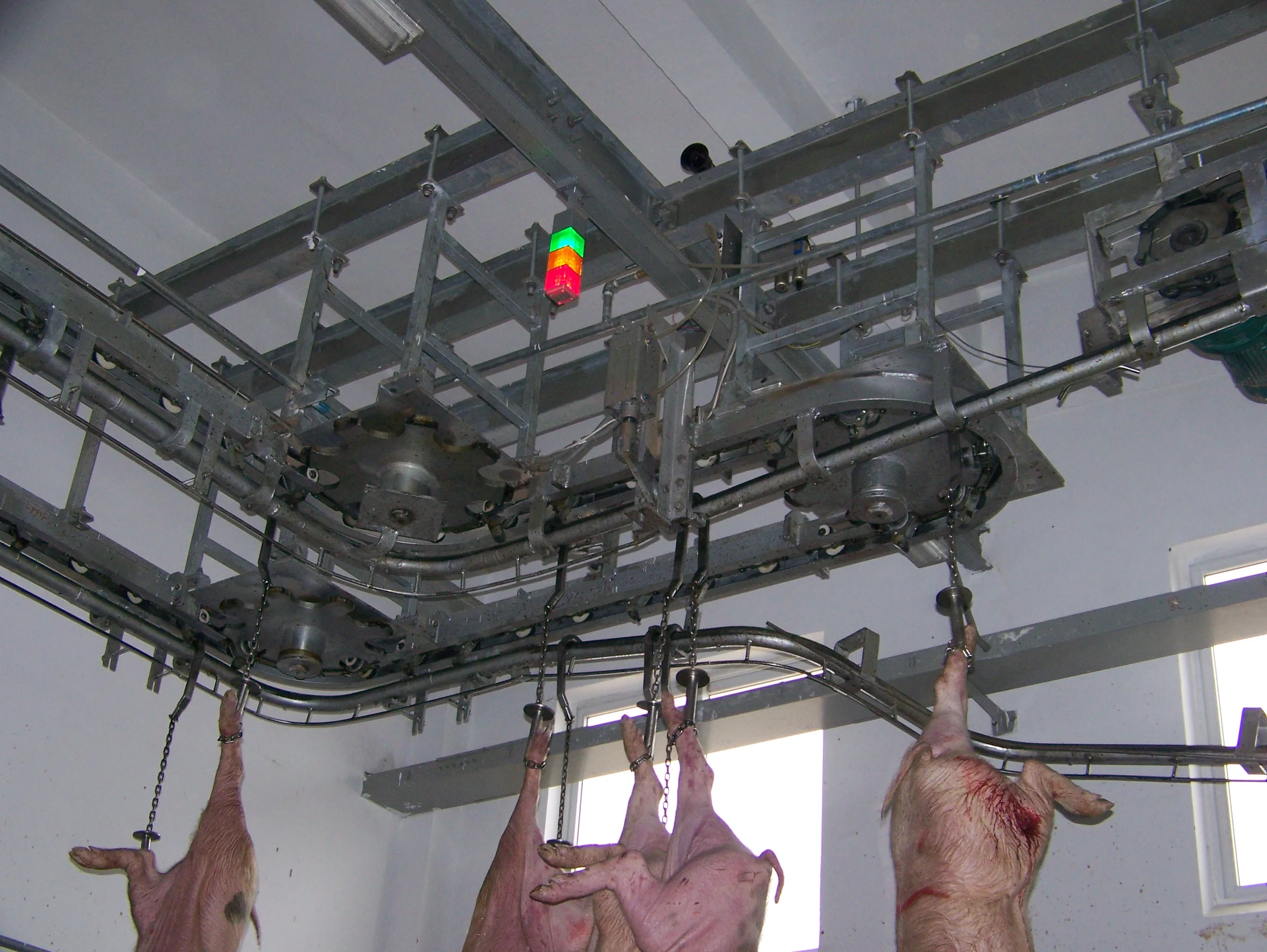
Those are also full of stainless steel machinery: https://sc01.alicdn.com/kf/HTB1HETwX5LrK1Rjy1zdq6ynnpXax/225...
1) If you're going through so much time and expense to simulate meat, why not just change your diet to something more akin to "primary sources" - i.e. vegetables, or other food that is better than meat in your desired criteria (land use, water use, etc)? That is more naturally grown and more appealing?
2) By the time you spend so much money/energy/biochemical processes to simulate the real meat, is what you get just as energy intensive/unhealthy as the original?