In the UK when my mother got told she was terminal and had a couple of months left, she chose to spend them at home. In the end she left hospital in mid-December and died the following May. 5 months at home in a specialist bed, provided by the hospital, all of the equipment required to keep a dying person comfortable again provided by the hospital. Nurses and doctors there every day.
Because of her illness, the government paid her rent, it paid my father a carers allowance, so he was able take time off work.
Total cost: £0.
5 months of excellent at home care for £0.
You shouldn't be dismissing the article as clickbait, it shouldn't cost $145k to die, there shouldn't need to be a discussion here.
You should be so very angry that a country that takes in $3tn a year in federal taxes won't support a working healthcare system
"In December, as many as 500 patients per week were dying in Britain because of E.R. waits, according to the Royal College of Emergency Medicine, a figure rivaling (and perhaps surpassing) the death toll from Covid-19. On average, English ambulances were taking an hour and a half to respond to stroke and heart-attack calls, compared with a target time of 18 minutes; nationwide, 10 times as many patients spent more than four hours waiting in emergency rooms as did in 2011. The waiting list for scheduled treatments recently passed seven million — more than 10 percent of the country — prompting nurses to strike. The National Health Service has been in crisis for years, but over the holidays, as wait times spiked, the crisis moved to the very center of a narrative of national decline."
https://www.nytimes.com/2023/01/25/opinion/uk-economic-decli...
Correct, but the US has the rather odd status of spending even more per capita in public funds towards healthcare before they even get to the privately funded portion. The NHS has a lot of problems, but at least it's not (outside of dentistry) making us pay both ways at once.
But that also makes it easier to understand the need to get rid of them and have the government fund healthcare.
My mom passed away recently (Monday) and it would have been impossible for her (because it was impossible for me) to try and navigate insurance claims (and subsequent denials lol), hospital billing, Medicaid, Medicare, Ohio Medicaid, and other programs. It's just level after level of waste and all of this could be combined into just one god damn program that does the same work and we would save money. But jobs. Oh and also let's not forget the now 3-6 spam calls I get daily from official sounding scam artists who try to "help" with your medical problems (steal money) in your darkest hours and most vulnerable. Does nobody seriously care? Why does the United States of America allow its citizens to be robbed?
When we were clearing out her things we probably had an entire trash bag worth of prescription medication.- Waste Maybe you should be required to return the empty? All those pills had to be safely disposed of.
Equipment - thankfully we could donate this to a local charity but many hospitals and healthcare facilities won't accept things like wound bandages even if they are brand new and sealed in a box.
Transportation - It's unreliable. Companies like Caresource contract with the government to provide rides to get patients to appointments, but they then further subcontract these rides to the most obviously shitty companies imaginable and then those companies contract the rides out to random people who will go pick people up for money. It works sometimes, but ultimately things happen. We had multiple no-call, no-shows and my mom who needed lifesaving cancer treatment had a hard time getting to scheduled appointments. More waste.
I could go on and on.
The thing that pisses me off the most is that we're explicitly opting in to spend more money. It's just a tax that goes to the health insurance industry instead of the government. Health insurance companies are just parasitic entities and do not innovate or provide market efficiencies - they just work to find how they can deny claims and try to "innovate" on billing complication. Unlike pharmaceutical companies and healthcare equipment companies. There are still efficiencies to be had there with licensing, drug patents, trials, etc. but health insurance is a complete scam. If we just did single-payer then we could see some actual innovating on the insurance side from whatever business was remaining that the "wealthy" could afford - which I'm fine with.
I do dislike the usage of "free" to describe the NHS or any government run healthcare program since it's inaccurate (nothing is free) but as another user pointed out the US system is like double cost because you pay taxes, you don't get any of the benefit, and then you have to pay too. Philosophically I prefer people to say "hey we should fund this" versus "I need my free thing from the government" because the former is indicative of a society coming together to support itself and the other is indicative of social collapse. People don't call Social Security free very often, but instead support it because "I paid for it".
The main thing is knowing that if you need any procedures, services, an ambulance, critical or emergency care, etc, you'll not be asked up front to pay for it, you'll just be treated. Seeing that principle erode over time is heartbreaking and terrifying.
(rant) Healthcare as an industry doesn't function properly under a capitalist model, which expects that competition and consumer choice will encourage innovation and further competition, leading to a better outcome for the consumer. If you need healthcare, you don't really have a choice in it, or your choices are artificially restricted by circumstance, so you can't benefit from a competitive marketplace. It's a broken system, as far as I am concerned.
I agree with your statement that "Free" is likely short-hand but I personally still don't like it because I prefer to think of items like that less so as entitlements because entitlements are easy to attack and dismantle. On the other hand when someone feels like they paid for something they are more likely to defend it. Social Security in the US is IMO a good example of this.
[1] Price discovery is impossible in a free market where you can't be denied service. Since society is (in my view correctly) not willing to let people die on the street if they can't pay for treatment the health insurance industry can't function except as a parasite with the aim to extract as much as it can and redistribute it to employees and shareholders. I do think healthcare costs would be cheaper under a "pure" free market where we let people die on the streets, though, but again I just don't find that acceptable.
The system works, assuming it's adequately funded, which it hasn't been for a while. Salaries aren't high enough to live on (thanks to the conservative government and creeping privatisation), and then brexit and other immigration policies have caused a shortage of trained professionals and no one willing to fill the vacancies.
There's a whole heap of issues (I've left out quite a few) stacked up against the NHS, and yet it powers on, doing its best.
No. Often repeated, never true. The NHS has had at or above inflation budget increases every year of Tory government[1]
https://ichef.bbci.co.uk/news/976/cpsprodpb/166A5/production...
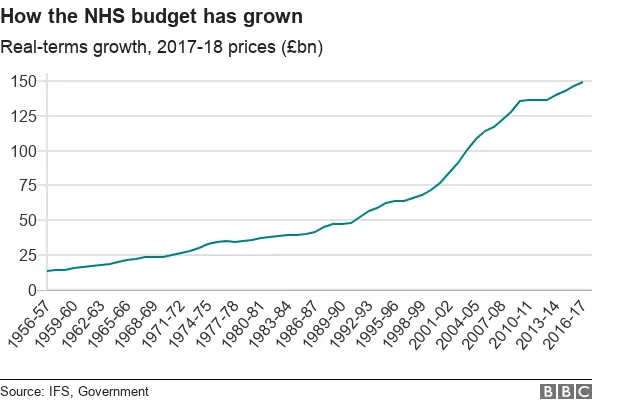
Look! Real terms money on the Y-axis, it only goes up!
"Squeezing in terms of funding", "Try and privatise it" are common myths repeated by the Labour party to get elected, and NHS bosses to increase the pie even further.
(2) The government is destroying it in other ways, such as not having a proper recruitment pipeline, outsourcing the lucrative parts to the private sector, and failing to pay staff adequately (literally - nurses going to food banks).
Yes, there has been mismanagement with the recruitment pipeline, because every government prefers to pillage poorer nations for their healthcare staff since it's quicker than training them.
But remember, that's not the original claim is it - I didn't say the Conservatives are doing a perfect (or even good) job, I said they're not "squeezing it dry of funding" and not "trying to privatise it", which are both, still, false.
Also "outsourcing the lucrative parts" - give source for your claim please. They do cross subsidize, allowing private patients to pay for treatment in NHS hospitals, but that's not the same thing.
That seems… incredibly low for a licensed profession
The people in the NHS that I talk to say it's running on goodwill and sticking plasters right now.
This one indicates "unfunded mandates" - a trick the GOP in the US has done for decades (notably so-called Medicare Advantage which created a crisis that didn't exist): https://www.theguardian.com/commentisfree/2022/apr/05/tories...
Another specific tactic is privatizing things that didn't need privatization (or the result is less efficient than what existed before, but it happened to make some corporations and ministers/secretaries a lot of money) - see "failed efficiency savings and privatization" here:
https://www.opendemocracy.net/en/nhs-crisis-rishi-sunak-cons...
Of course, Brexit (another Tory gift to their owners) really messed up things for NHS and caused a number of challenges (see above).
The bulk of the budget should go to front line workers not administrators.
We know perfectly well that we pay for it through taxes.
The only issue with public healthcare is the government corruption that tries to kill or diminish public healthcare, but it's still a hell of a lot better for society than private.
In the words of Luke Skywalker: Amazing. Everything you said in that sentence is false.
But focusing on the "it's not free" part; perhaps a distinction should be made in terms of "background passive costs paid regularly (e.g. taxes)" vs "additional costs once you're ill".
What is "not" free in the NHS is the first, but the latter is generally free.
This distinction becomes very meaningful when you realise that, in the US, things like the £145k quoted in the article fall in the latter category, while still paying for the former (in terms of regular insurance or whatnot).
This "dishonest" comparison made when the "NHS is not free" argument is thrown to justify why in the US things cost money, is to ignore the fact that you are also paying the background stuff in the US too, even in the absence of illness, but this is rarely counted in these discussions.
I would love it if someone armed with more numbers than I could give a breakdown of what it costs annually a person to passively contribute to the NHS through taxes vs an average US medical insurance scheme (assuming the US does not have other healthcare related taxes which I do not know about).
The U.S. government pays about the same amount per capita (1.2 trillion for ~400 million people or $3000/person) on healthcare as the UK gov. That’s before private insurance costs. Some of this is on things like Medicare, Medicaid, and the VA, which are nationalized health systems for specific portions of the population, but the point still stands that we’re not avoiding taxes going the private route.
This is complete nonsense. The British public knows very well that the HNS is (or was) and should be "free at point of use", and also paid for via tax. The public want it and want it well funded. The current British political establishment does not like this state of things and seeks to privatise it, but due to the popularity of the NHS, cannot just come out and and say it.
"That's the standard technique of privatization: defund, make sure things don't work, people get angry, you hand it over to private capital."
No, the collapse is caused by the government which has been methodically dismantling it for a couple of decades now, replacing it with private health insurance and moving the ownership of NHS trusts and GP offices to private companies.
It’s basically what they chose in this case, Medicare would’ve paid for the hospital and hospice. Even if there was a bill no one is obligated to pay it unless the estate has money for private care. In this case it’s assumed her estate doesn’t have the funds to pay for private care or rent an apartment.
Her case also seems complicated because assisted living and hospice couldn’t tend to her needs but the hospital thought a lesser facility could provide it. Bouncing her back and forth.
Regardless, setting up a mini hospital in someone’s home is just dumb. There is no reason for such a high level of service. You want to die at home? Sure. I’m down for MAID at home.
You want a suite of private doctors and equipment at home? Pay for it. If you want public service you should go to public service facilities.
And somebody has to pay the medical support staff.
The sense that "this is necessary so it should be free" is not unique to the parent comment, but it is incorrect.
These taxes are harvested from capitalist economic activity.
Consider the “out” for the US debt ceiling being bandied about is minting a trillion dollar coin.
What's the long term plan for the UKs elderly healthcare programs that it's an aging country?
The American Healthcare system is insane but at least in this one regard the cost of being an unreasonable egoist is not being paid by the rest of society. Go fucking die in a hospital like everyone else and don't take away limited resources from people that might actually get better. Or if you do, at least pay the bill yourself.
State paid nursing home fees are like $150k/yr last time I checked, most of that going to administration. It's certainly not going to the nursing assistants that they don't hire who aren't checking on you. Plus the portable mobile equipment (xray etc) that someone drives over and wheels in to perform perfunctory diagnostics, plus the ambulance rides back and forth to the hospital as the nursing home covers their ass, plus all the bills you rack up at the hospital as you're repeatedly dumped into the emergency room.
Like it or not, that system has already been heavily socialized in the US. The only time someone is on the hook to pay is if their estate has money, which is avoidable with some estate planning (5?) years ahead of time. That's the fallback option for everybody "lucky" enough to reach it. It's gruesome, but not because it's cheap.
FWIW When I was going through this with my dad, the private "insurance" company (a medicare advantage vendor) was starting a program where they wanted to send doctors into your home to check on how you were doing, because keeping you out of the hospital saved them a significant amount of money.
And to be clear: It would be great if we had enough doctors, nurses and resources for everyone to die in their own home with all the amenities of a hospital specialized to end of life care but hat is practically impossible. And I don't mind socializing healthcare. On the contrary, I think it's a necessity for any civilized country. But given the aging societies of basically all western nations I would bet all I own that by the time I need end of life care, at home care with private nurses will become the privilege of the super wealthy.
Here in Germany, the system is already essentially collapsing and it's not even a money issue, it's a personal issue. But sure let's burn it all to the ground for the now-dying so by the time my generation needs it there's nothing left.
I don't think that doctors and nurses are the limiting factor for home care, but rather home health aids and CNA's - basically people that check in on patients around the clock and make sure they're kept clean.
In the context of the US system, your original comment is just completely off the mark. Our healthcare system is universally terrible, independent of the cost ("not my job" at every level). Consigning a elderly person to that system is basically the last thing anybody wants to do, hence the focus on dying at home etc.
I can't speak about Germany's system. But it's worth remembering that money is not equivalent to resources, and that spending an imprudent amount of money on elder care right now doesn't imply that there won't be resources left for you later. Whether the system is "burnt to the ground" has more to do with if the institution is destroyed or hollowed out, rather than how much it costs.
a lifetime of having way more than HALF your income stolen from you..... 0? okay..
The theft you talk about is mostly connected to extremely bad, costly and possibly corrupt policy decisions like US wars in Vietnam, Iraq, Afghanistan or even the war on drugs. And probably a lot of these policy decisions are influenced by lobbying from various industries and special interest groups.
It's positively utopian! Meanwhile, in the hellscape:
> On average in the U.S., the length of time between a call for help and the arrival of emergency medical services is about eight minutes.
[0] https://www.reuters.com/article/us-health-emergency-response...
seems to me that "some of us" will be perfectly happy buying the services, and some other of us will be perfectly happy NOT buying the services
and where would I go? it seems that universally around the world there are a large amount of people that feel that they are entitled to rob their fellow citizens, at ultimately what is gunpoint threat of being put in jail.
if I just go mind my own business, and conduct business with other likeminded people, and the regime finds out, they will send their brownshirts with guns to drag me away, simply for refusing to give them half
Somalia seems to be the only actually tax-free country. I think border control is lax enough that you can "safely" go live there if you wish.
Not the same thing.
I don’t understand your logic. You claim that the “services” offered to you by your government are worth the taxes you pay. But you don’t want them to be opt-in. Aren’t you tipping your hand a bit? Seems like you might not be so confident that the services are worth it, and that a ton of people wouldn’t opt out.
I pay for water, and then i pay 150% taxes on the water because reasons.. I would just hire someone to drill a well for me on market terms, but the regime made it illegal
edit: actually its about 300% taxes on the water
https://listentotaxman.com/?year=2022&taxregion=uk&age=0&tim...
and what does it matter to you if I can opt out of paying? one less person to serve? great? everyone is happy.
either way, that is not the case for the majority of my income. and dont get me started on when I go to purchase gasoline here in europe, not only am i first hit with 50% income tax, then a cool >20% sales tax, and then the outrageous taxes on the gasoline itself and the related industries. so I buy €100 worth of product, and more than 95 of them go to the government. Thanks! you sure did 95% of the work for me there (not)
I'm more familiar with the Canadian and American systems than with the UK, so I'll use it as an example. For Americans with decent insurance, it's generally easier and faster to find and get in to see both a general practitioner as well as a specialist, than in Canada. On the other hand, in Canada it's all part of one insurance scheme. So you can go see any doctor, or go to any hospital in the province, if they have a slot for you.
Surgeries that are not life critical (but still darn important, like knee joint repair) have a much shorter average wait in the USA. Essential surgeries happen about as quickly in either country, with comparable outcomes.
For Americans without decent insurance, they suffer denial of care due to inability to pay more than people do in Canada. But the dirty secret is that denial of care for inability to pay is still common in Canada. Lots of things aren't actually covered by the public insurer. When something isn't actually covered by the public insurer in Canada, the free market is just that, almost completely unregulated. There are no laws against insurers discriminating on the basis of pre-existing conditions or etc.
In the USA, publicly-funded care is actually better for some diseases where the US federal government has set up special programs to provide it. For example, everyone HIV+ and earning 400% or less of the US low income cut-off, is eligible for free HIV medication and doctor's visits and even hospital care. There's no analogy in Canada; in Ontario such drugs are covered for the very poor, and the working class is expected to pay much of it themselves.
Broadly I'd say there's more variability in the US. In the US, at a well-selected clinic or hospital, with excellent insurance, that is some of the best healthcare available in the world. Better than Canada's average care. But Canada's average care is still fairly close, and is available to nearly all residents of the country. Quality of care in the USA seems a fair bit worse for the poor.
https://en.wikipedia.org/wiki/Liverpool_Care_Pathway_for_the...
As others have pointed out, it didn't cost "£0". It cost your fellow citizens the full amount. "The government" didn't pay her rent. Your fellow citizens did. "The government" didn't pay your father a carer's allowance. Your fellow citizens did. "The government" didn't pay for doctors and nurses to travel to her home. Your fellow citizens did.
Now, I, personally, would prefer to see massive reforms in the U.S. system. But pretending that any system is going to cost "£0" is just intellectually dishonest.
Because the OP was claiming it cost "£0", when it clearly did not.
> This is not a secret, there's not some common misconception that health care isn't actually paid for with money.
Maybe you should tell the OP, since he is clearly operating under that exact "misconception".
Oh? So he didn't say "it cost £0"? I just made that up?
Spin harder, dude.
No it is clickbait because it says "she died at home" when in fact she died in an expensive rented apartment. This fact is unrelated to the reality that the system is broken and people can't get the care they need.
But presumably not 24/7 = 168hr per week, which makes all the difference (and the vast majority of the $145k in costs). 168hr / week of care will require 3 to 4 FTEs, no way around that.
In fact it even motivates me to start planning out costs with them.
Sometimes the point of articles can simply be to relate one’s own experience to other people.
>Medicare should restructure hospice reimbursement to cover more of the hands-on caregiving, thus decreasing the financial burden of dying at home.
The main pitch is somewhat hidden in the middle of the article. Its a tough point to open with, but I think leading with the thesis statement is proper.
If the deceased person owed the medical bills - well guess what? she is dead and won't have to pay them unless the creditors go after her estate - if the family's complaint that now their inheritance is going to be less than they thought - too bad.
"I saved my whole life, and wanted to make sure I could give a little back to my loving family, but instead the healthcare industry soaked it all up during my final months."
In civilized countries, somebody else would pay for it. Not through magical fairies, but through taxpayer-funded public healthcare. Instead, in the USA, we're Rugged Individuals™ so we prefer to have a gigantic profitable End Of Life Industry precisely designed to sponge up whatever remains of an elderly person's savings. If you have $500K in assets left, your end of life care will cost $500K. If you have $100K left, your care will cost $100K. If you have $10K left, it will cost $10K.
The solution, in our flawed system, is to do smart estate planning so you die with zero assets. I don't need my parents' money when they go, and I've already told them if they want to help out my sibling or give it to charity, either do it before they die or get it in a structure that can't be confiscated by death profiteers. Either way, have $0 to your name when you finally pass away. Don't give these vultures another gold-lined toilet for their executive suite.
Somebody else paying doesn't make the cost go away. Would it be better to make their children or grandchildren pay?
"I saved my whole life, and wanted to make sure I could give a little back to my loving family, but instead the healthcare industry soaked it all up during my final months."
An awful lot of people in this country will never get an inheritance; why is it fair to ask them to pay higher taxes so that the most privileged people can leave bigger inheritances to their kids?
I have no problem with people leaving money to their kids - after they pay their own bills. Don't ask me to pay them so your kids can get a bigger windfall.
Why is this civilized?
Yes. Where are all the people who were apoplectic about the Nord Stream post?
The tragedy of modern medical care if you're over 65 is that it's hard to die. Medicare only pays hospitals for results, so there are powerful incentives to limit hospital stays as much as possible - unless you're in an ICU or similar scenario, if you are hospitalized more than a week it's likely because someone fucked up, and Medicare will reimburse the hospital next to nothing as a result.
It's easy to get sick or become incapacitated, but people can and will "save" you and leave you in a situation where you are not well, but not dead. The options are 120 days of Medicare nursing home coverage, followed by a slow drain of all of your assets and ultimately Medicaid enrollment. Nursing home means you're effectively warehoused, and the more help you need, the less care you get as you become a cost center.
It's not just a matter of finances, it's a matter of humanity. The harsh reality is your disabled loved one will be treated like cattle unless someone who cares is directly engaged in caring for you. After the horror that my father went through after a suffering a stroke, and the pain caused to my mother after she took on full-time care, I did what most doctors do and have DNR care instructions on file with every hospital in a 50 mile radius.
From what I can gather, the $145K cost was the cost of medical care over the months (years? the article never says) at the end of the grandmother's life -- not the cost of "dying at home".
The bulk of the cost seems to come from:
> the total monthly cost was $16,200: $13,000 a month for the 24-hour care, plus $3,200 to rent the apartment
It seems silly to include rent, and then of course round-the-clock private care is going to be $$$.
As far as I can tell, the grandmother needed hospital-level care, but the family didn't want to keep her in a hospital. It's not surprising that hospital-level care at home costs a small fortune.