You can go out into the middle of nowhere in CA and find houses huddled together 2 feet from another behind a giant wall, like some kind of nazi concentration camp for houses. And the sadest part is that there’s tons of land in every direction you look and people are forced to commute vast distances.
Oh, well then, we'll just assign each person an acre, problem solved.
Which one do you want? Apparently you'll be fine with one -- maybe even two -- in the middle of nowhere, as your comment seems to assume that each has equal value, independent of either natural or social geography.
The "nobody wants to live where no jobs are/nobody wants to build where there's no employees" deadlock can be solved by ensuring new economic engines are deliberately sited in areas that needs a boost. Sorry, Amazon, HQ2 is going in Gary, Indiana.
Eliminating private land ownership would remove many of the worst NIMBY objections. How many people are really "we don't want higher density homes near us" and not "It MiGhT hUrT oUr ReSaLe VaLuE tO bE nEaR pOoRs?!" It might also make it easier to remove some of the worst planning blights-- dead malls and abandoned facilities.
A central planning dictate also makes it that much easier to get commercial/industrial development, housing, and transit all on one page. I'm picturing a proactive model almost like the Chinese "Ghost City" phenomenon, where you're cutting ribbons on subway stations in the middle of swamps today, knowing that Phase III-k of the development plan means in five years the station will be servicing 8,000 commuters per day.
Now we just need to build condos that are appropriate for all stages of life -- not just young singlehood and coupledom.
Building up will not solve the "not enough SFH/townhomes" problem, but it will fix the homeownership problem. And it may help with the former, if there are enough current SFH/townhome owners who would prefer a really nice condo close to work/downtown/parks/amenities/etc.
But one issue there is that we currently build condos but don't build the public spaces that serve to supplement them and make them comfortable for, e.g., families with kids. As a result, they're full of a certain demographic, and less appealing to others, reinforcing the issue.
Can you share some ideas about what this would look like?
If we could only scale and therefore make this cheaper.
> we currently build condos but don't build the public spaces that serve to supplement them and make them comfortable for, e.g., families with kids.
you need
* several bedrooms
* some utility space (for things one would have otherwise done in the garage)
* nearby [safe] parks and playgrounds
* nearby recreation centers
* good schools
etc
I grew up in an apartment building that absolutely felt like a neighborhood in itself. There were at least 10 other kids in the 400-unit building my own age. In the local neighborhood (consisting of other apartment buildings) there were easily another 30 kids my age, any of whom I could see in a 5-10 minute walk. Few people owned cars (it was NYC after all!) and the area was quite safe traffic-wise.
I spent countless evenings outside walking or biking along promenades, or just hanging out in parks, playgrounds — all literally steps from my apartment building — and as I got older, in libraries, cafes, restaurants, shops, etc. The building I lived in also had a pool and multiple community “rooms” that were several thousand sqft large, which we reserved for birthday parties and other events.
It was fantastic. There were kids there because the spaces were designed to support families, and the “must have SFH with yard before having kids” attitude among the middle and upper-middle class is pretty weak in NYC, so my neighbors could be similarly-high SES because not all parents immediately flee apartment living for the suburbs.
Today, I live in a Bay Area inner suburb. There are, again, 10 kids my preschooler’s age in the local (couple blocks) neighborhood. But they can’t bike alone (or even walk alone, really) because drivers often hit 50mph and don’t look where they’re going. Each of our back yards — though we have one! — is tiny, much smaller than the community rooms I had growing up, so for any serious physical activity we have to get in the car to drive somewhere, contributing to the “traffic is a problem” problem.
The closest public park is a 4000-square-foot grass triangle in a quiet almost-cul-de-sac that takes 10 minutes to walk to and 30 seconds to walk across. There is a library 5 minutes’ walk away, and it is a saving grace.
If I could transplant the apartment building I grew up in to my local neighborhood, which is about 2 miles square — 100 million sqft — its 16000 residents could be housed in about 16 buildings, each of which would have a 25,000 sqft footprint, totaling 400,000 sqft and leaving 99.6 million square feet for fantastic parks, promenades, playgrounds, schools, trails, open space, basically any use you could imagine. Each apartment could be owned, 2000+ sqft, with private decks/patios/balconies and wonderful views.
If that were available in the Bay Area…we could build them at 2x the density described above and house the next 20 years of newcomers…
I have a single-family house with a garage, and things like woodworking, painting, or even having a 3-D printer are not necessarily things I want in my utility room or garage. They require special fittings or space levels not available when you're trying to fit around a car.
It would also provide a great central hub for people to meet, because projects are a natural thing to socialize about.
Maybe its inevitable and necessary to force more people into condensed housing, maybe the societal benefits really outweigh the tradeoffs.
I live in an apartment block and so does everybody else for miles around. Our building, like almost every other around here, tops out at seven storeys. It's very solidly constructed, so there's little to no noise from neighbours, not that they make much noise to begin with as they're a pretty considerate bunch.
The downside to this way of living is almost nonexistent, but the upside is massive. Instead of everybody having their own plot of land that's too small to do anything really interesting with, and which they have to maintain themselves, we have a communal garden. When that's not enough, there are no less than four parks within two minutes' walk.
Because this higher density of living is able to sustain more amenities, everything you could possibly ever need is, at most, a short bike ride away. And I do mean everything. Bars, restaurants, shops, medical facilities, swimming pools, a velodrome, a planetarium...
I've no need of a car because it's all on my doorstep. If I do need to travel, public transport's great.
You can keep your "autonomy", I'll be too busy reaping the benefits of living among other people to worry about that.
Neither of these things have been even remotely true in any apartment I've lived in the US, even ones billed "luxury". It's always been thin-walled garbage where I can hear every word of every conversation of my neighbors, who have typically felt that listening to music 24 hours a day and slamming down their boots while walking between rooms is the right thing to do.
I feel this is mostly a US problem.
In most of Europe, apartment blocks are solidly built, especially the older ones, even in Eastern Europe.
and that's why single family homes should be more expensive, because it is better. People continue to bid it up, because they still believe that the price is worth and hasn't reached a ceiling yet.
In asian hubs like hong kong or shanghai, they've reached a certain ceiling on land, and so building up is now what most people could buy and so they do that. The cities in countries like canada, australia and the west coast of the US, it hasn't reached that point due to large available land mass, and people prefer commute (or WFH now!) over living densely.
Of course, regulation plays a part - i think there's unnecessarily large amount of red tape in making taller denser buildings, as well as a lobby of existing owners who don't want it near themselves.
There’s a lot that can be done to add autonomy and privacy to the condo living. And then more to make it cheaper and accessible. It’s mostly a technical problem.
The degrowth movements garden variety neo-pastoralist misanthropy makes it blind to the fact that more humans (given a good system of governance and rules) is actually an amazing thing.
Hoarding medicine isn't a trend and even so, this market correction doesn't happen. Look at all the medicines with insanely high prices because there won't be any competition.
How come aspirin or penicillin isn't expensive? They are more commonly used, and so if the hoarding method works, it would've been even more profitable!
The patent system does this in medicine.
This is the sort of gospel/dogma that free market absolutists like to propagate, but plainly reality proves this wrong. Markets are a tool, but not a universally useful one.
That's not how the market works. That's not how patents work. That's not how medicine works. That's not how any of this works.
The fact that this is very likely prevents most of the speculation in the first place.
The difference with real estate is that the owners get to determine production levels, via local zoning laws.
Sure, there is some natural scarcity: Land cannot be created, but in most cases artificial scarcity is the issue.
I'm part of a local YIMBY group, and show up to hearings to try and get housing built, write letters, etc...
I have never, ever seen 'investors' write in or speak at these things. It's all our neighbors who show up and scream about not building homes.
Additionally it kind of strains belief that people are buying homes, paying property tax, etc. just because they like collecting them the way a kid likes collecting pokemon cards. More likely they'd buy a home because they expect home prices to rise and they'll be able to sell the home for more in the future. It may be unintuitive, but if your market is not incredibly supply-constrained this is actually a good thing.
Here's why. Let's say there's an up-and-coming college town, and speculators think that in a few years the town will become trendy and many people will want to move there. If they're right, demand will go up and home prices will rise. That means you can buy a home now on the cheap and sell it in a couple years when houses are more expensive to make a profit. But of course, when you buy a house now, you're contributing to demand for houses, so you're making the price rise in the present in response to a change in demand you anticipate happening years from now. Since home prices are rising, it now becomes more profitable for people to build new homes. (Their costs haven't changed, but now they can sell the homes to speculators who are willing to pay a lot because they expect to sell the homes to the people who'll move in as the town becomes trendier.) So what you get is people building homes now in preparation for people wanting to move here years from now. Making homes available will cause home prices to go down, until the market is at equilibrium and homebuilders are no longer willing to build homes for the price that homebuyers are expected to be willing to pay.
So in theory it all works out quite nicely. In practice, people who own the homes hate this because they like that the home they bought for $200k in the 90s is worth $2M now, so the lobby to get local governments to ban people from building homes. If there were enough homes that everyone who wanted to live there could, the prices of housing would come crashing down and homeowners would lose the bag they worked so hard to get (not).
When the very rich park wealth in real estate, it is precisely in the ares where prices are highest. Not much point in parking wealth in a cheap house in the midwest.
https://nypost.com/2021/08/05/nearly-half-of-luxury-units-em...
Of the NYC housing stock, close to 63% are rentals. Of the rentals, more than half are regulated (stabilized mostly). Of the owned homes, you have houses, condos and co-ops. Co-ops predominate in Manhattan (where you'd expect the rich to want to live), but condos only make up the smallest fraction of the for-sale home types (115K according to 2017 statistics).
Of the condos, if you're an international rich you want low carry and maintenance costs. So typically they buy the "tax abated" new luxury condos, and sure they accept to eat the maintenance costs. But if they want to eat the taxes, those can be ginormous, a quick streeteasy search will confirm.
NYC is just a pain to do that in unless you want to be there part of the time. Paris is like that - you buy for your trips every few months to go shopping, or whatever rich people do.
London is better, the carry costs are lower, being instead of property taxes they rely on council taxes, which first of all are WAY lower than anything property tax in the U.S. (not the least of which NY State), but secondly they capture more tax from the exchange (stamp duty).
As always it's fine to explore injustice and sources of inequality, but we have to be nuanced and analytical before we repeat the slogans.
P.S. - the link above is from 2021. Yes, in summer of 2021 the luxury units were empty because NYC was a shitty place to live in 2021, not the least of which because of how much had closed up, how much was still not opening, and how unpleasant the sidewalks were. So if you're a luxury rich person, you're going to spend the summer where there are mountains or beaches.
Sources: https://rentguidelinesboard.cityofnewyork.us/wp-content/uplo...
So even if 5 buildings out of 300 skyscrapers are at 50% occupancy on their own don’t matter much they still impact the market when combined with similar investments. Worse they prime the bubble by convincing more people to invest without putting them up for rent.
People love the "investors and billionaires are buying up the market" story because it suggests a convenient villain, when the truth is that the millions of ordinary Americans who oppose new housing in their neighborhoods are a much bigger factor. Of course, that's not as satisfying as blaming a Disney villain.
We've been under-building for decades. We have a massive shortfall of new units, far beyond the number of empty luxury apartments. Frankly, at this point I'd support a meaningless vacancy tax just so we could put this objection to bed and focus on things that matter.
https://www.cnbc.com/2021/12/09/new-york-city-rents-jump-22p...
One clear the example of the outsized impact is these buildings bought up air rights from multiple properties. So, they reduced the legally available space. When the city makes space for ~100,000 apartments and actually gets less than 1/10th that it’s a problem.
Another is the extreme cost of the associated tax breaks for affordable housing for minimal gain. The city set the tax break based on price while the number of affordable houses was based on the number of apartments. A seemingly obvious problem looking back, but still a problem for city residents.
See: https://www.millersamuel.com/files/2022/02/Feb22QNSrent-nyVA...
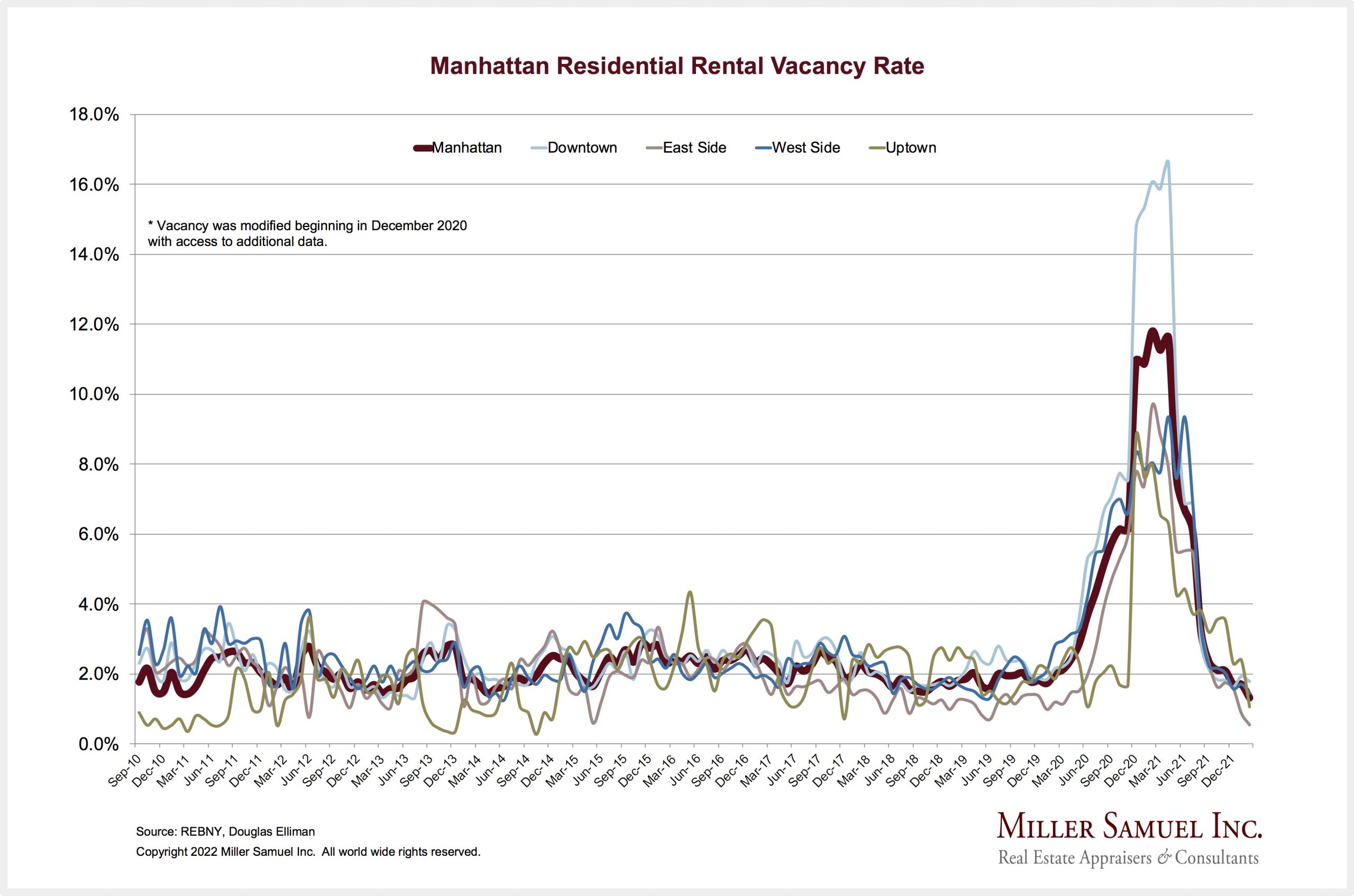
Another way of looking at 2% vacancy is over 20 years an apartment is vacant less than 5 months. People move, die, go to prison etc, so there is some inherent friction represented in a 98% occupancy rate. Dropping to 1% long term takes more than just higher demand it would require increases in transaction efficiency.
And a couple of tall buildings in manhattan isn't gonna be making any difference. The difference would come from building denser everywhere.
> Additionally it kind of strains belief that people are buying homes, paying property tax, etc. just because they like collecting them the way a kid likes collecting pokemon cards. More likely they'd buy a home because they expect home prices to rise and they'll be able to sell the home for more in the future.
That second sentence is, of course, precisely what I'm talking about. Although that is also the same motivation, at least in my experience, of a lot of Pokemon card collecting. When I was in middle school, you could buy a Charizard for $100, and it wasn't because you could win back that $100 by playing that Charizard in a tournament, and it wasn't because you got $100 of value admiring the aesthetics of the card. Also of note, those Charizards now sell for tens of thousands of dollars, and it's still not being of their value in competitive play or their aesthetic value.
The problem in the market is that buying real estate is the economically rational thing to do, because you get great returns on that capital, just like owning some amount of stock.
The problem is primarily the structure of the market, and not the actions of individuals within it. We need a land value tax, and we need to make it easy to build new homes.
> the value of homes seems to be almost entirely divorced from the fact that people need homes to live in.
The value of homes is so high precisely because people need somewhere to live, desperately. The price is not disconnected from need, it's entirely because of need.
And it's not that wealthy people are buying and hoarding homes. There's not some magic supply of 20-30% vacant unoccupied housing, there's desperately low vacancies, absolutely criminally low amounts of vacancies.
But refusing to acknowledge the panacea of building new homes does serve the purpose of wealthy people who currently own home. Because they are not hoarding homes, they are hoarding land. They are hoarding access to the ability to build more homes, the homes that are desperately needed. And in high demand areas, every person that goes and opposes new homes, that opposes upzoning, is directly responsible for displacing however many people those new homes would have built.
There is only one solution to high home prices, and that's building more. (Well, we could also institute strict border controls and price controls and completely destroy freedom of movement and access to jobs.)
Downplaying the primacy and necessity of building enough homes for people that want to live in an area only fuels higher prices, more hoarding of land, and more exclusion. There's zero upside to saying "we don't need to build" except to enable further financialization of housing and concentration of wealth in homeowners.
This is exactly what buy to let landlords are doing.
The real problem isn't a problem of vacant units, it's a problem of unbuilt units.
When you say "This results in a transient population," I'm not sure exactly what you mean by "this" but perhaps it's renting at all? If so, the only reason renting leads to "transient" population is the rising rents and displacement caused by lack of building.
> There is no lack of building
Putting something in italics doesn't make it true. In the vast majority of high demand areas, there's a smal smattering of new construction, far far less than comes close to meeting population demand, and locals freak out about the construction and vastly overestimate the amount. If your particular location is building 3%-5% more units per year, great, but most of the country is not and that means that every other place that's under building is displacing it's residents to where you live, easily swamping whatever you call "more than natural population growth"
You should also mention that this medicine rich people are collecting also has dozens of other alternative medicines with hundreds of thousands in volume because other cities exist.
Also you should mention that some of these rich people are not rich people at all, but working class people who's lived in a location for decades which has become a desirable location in recent years thanks to some other people who generated wealth in the area.
Also you forgot to bring up the local government ran by some of these rich people who are blocking any measure to increase the supply of the medicine in the area. This certainly can crash the entrenched medicine cartel in the city, but some of these cities are North Korean style de facto one party system where no other opposition may challenge the status quo.
Now you can dismiss these things as inherently less meaningful than, and therefore rightly subjected to, the economic desires of asset holders. That's a much more radical position than I think you're wanting to take here though. When you say or imply people facing unaffordable housing can just move somewhere else, this is a position you're endorsing.
The analogy doesn't have to cover every nuance of the situation to be valuable. A necessity of life has become a competitive investment vehicle, and the people most hurt by this are told that it is good and correct and they should accept it by wildly upending their lives for no personal benefit.
> A necessity of life has become a competitive investment vehicle, and the people most hurt by this are told that it is good and correct and they should accept it by wildly upending their lives for no personal benefit.
I agree also with your other comments that this view is fundamentally inhuman. So many people in this thread are responding with, “Don’t like it? Move!” To the extent that is a humane viewpoint it is either privileged or defeatist. Society is us. We have chosen social policy which turns the fundaments of life into investment strategies for the over-propertied. We can choose differently.
When african nations import manufactured products from europe that money leaves the local community. This means african countries must export their resources to the countries they are selling to.
Alternatively they can move to europe to work there so they can manufacture products to export to africa. Except in europe they will get insulted that they are economic refugees and should get lost. As if europeans ren't running an economy that benefits from this arrangement.
no we cannot, because it's not a choice. It's an effect. A different "choice" to have a desirable effect of your choosing is both hard, and can (and will, i bet) have undesirable consequences. A choice for example, could be to switch to a command economy instead, but i bet that would create housing projects that noone wants to live in.
My perspective is that a necessity of life (land) has started bumping up against the limits of nature. Population has drastically increased, and for various reasons such as increased access to information, economic agglomeration, etc, certain areas of land are in far more demand than others relative to supply.
Allocating scarce resources (sufficient land to have a detached single family home and a driveway) in such a scenario will always lead to some people getting what they want, while others do not.
Some options are (not exclusive to these)
-letting certain classes of people have higher priority than others (such as California’s law that keeps property taxes artificially low for those who were there before others)
-letting the amount of money determine who gets to live where, due to increasing house prices and commensurate increases in property taxes.
-changing zoning laws so that areas are modified from low density to high density housing, increasing the supply. This one causes various knock on effects, hence it is fought against in popular places that have reached its limits under the existing scheme (such as Bay Area and SFH)
There are no options where no one has to sacrifice. The investment vehicle aspect of land is negligible and more of a consequence of the extreme variations in demand of land in different regions.
I think this is another all-too-convenient scapegoat, similar to "we just need more houses." I would again suggest that perhaps the problem really truly is that people are using houses as collectibles rather than as places to live.
https://www.redfin.com/news/?p=73975
All the data I see does not indicate that people are buying regular houses as collectibles in hot markets. There is simply that much demand and basically no supply, especially in western cities. I do not have hard data on how many of these sales are owner occupied or not, but from personal experience over the past 10+ years, none of these neighborhoods seem empty for part or all of the year.
Yep. Why should we tell people "cities are fungible, just go live somewhere else so we can buy all the collectible homes here" instead of "cities are fungible, just go buy collectible homes somewhere else so we can live here"?
This comes up a lot when people argue in favor reforming how real estate is taxed.
When real estate isn’t for sale, it’s “value” is synthetic.
I wouldn’t actually sell my house for less than 400% what similar homes are worth.
For some people that means the value is 400% that of similar homes.
Thankfully the real estate tax folks don’t see it that way.
if you value your house too high, you'd pay more tax than you'd need of course, but guarantee that it isn't going to be immediately bought up by the tax man. If you value it too low, you're risking a sale. So the ideal is to value it at market price - where the tax man will have no incentive to actually buy it out.
Imagine a homeowner who uses public transportation, sends their children to public schools, and and supplements their income with public assistance.
They need to create a price for their home. They live in an area with good public transit and good public schools. These public services figure heavily into the price of the house, pushing it up for tax purposes.
Imagine the same house being owned by someone who sends their kids to private schools and drives everywhere. The quality of public schools and transportation doesn’t affect the value of the house.
In practice, people who are poor are less mobile than people who are wealthy. This tax system favors people who are mobile (and don’t consume public services).
How important is it that you stay at your current residence? The more you make, the easier the move (moving costs money too).
Also, because public assistance doesn’t change with the value of the home, the larger the tax payment, the greater the fraction of the tax bill it is.
This sounds nice, but is ultimately a tax on people who aren’t mobile.
>
> if you value your house too high, you'd pay more tax than you'd need of course, but guarantee that it isn't going to be immediately bought up by the tax man. If you value it too low, you're risking a sale. So the ideal is to value it at market price - where the tax man will have no incentive to actually buy it out.
I use to think this too, but it looks too easily gamed, and over many iterations the taxman would be left selling a bunch of properties lower than the price they paid for it.
In effect, this would be passed off onto the taxpayers, so the net effect is going to be that the taxpayers are paying for the profits of private speculators who purchase from the taxman and sell or rent the property for a profit.
Say, I live next door to my child’s school, and an elderly parent I care for.
I might not sell for anything.
The “market price” has to include what people are willing to pay for the item, not just what they’re willing to sell for.
This is the reason for things like California Prop 13. It gives a benefit to long-time locals to continue living in the same place. Which on the whole seems like a good thing. People can set down roots and become "locals" instead of having a city of ever-changing population who then don't really care so much about the area because they are transient and will be moving away soon.
But most housing threads on HN favor the idea that incoming outsiders should be able to efficiently displace locals as long as they have more money to do so, and thus oppose prop 13.
Building more houses is generally good too, but it's a bit of a cop-out to blame the whole situation on that. Totally independent of supply concerns, I would argue that it's not great that in so many areas the value of homes seems to be almost entirely divorced from the fact that people need homes to live in.
Imagine if a bunch of very wealthy people just decided to start collecting medicine, not to use as medicine, but to just collect and perhaps sell later at a higher price. Is that within their legal rights? Sure, it seems like it. Would producing more medicine be a good thing? Yeah, sure, more medicine is probably generally a good thing. But is it still really crappy that people's habits for collecting medicine are driving up the cost of medicine for people who want to take the darn medicine? Yeah, it's crappy.