Cost of living calculation between Dallas and Houston says costs are roughly 15% different (as apples to apples a city I can identify to isolate zoning effects). So definitely some effect and a good lever to pull (in addition to others I am sure.)
I agree that zoning reform is part of the issue, I think zoning reform combined with other tweaks would go a long way.
I think that multiple issues cause these problem, we have runaway negative feedback loops in multiple areas, the problems has evolved organically over time so I doubt any one factor is enough to resolve the issue (as nice as that would be.)
I'm not making the assertion that zoning is the sole issue so I don't need to defend it but I figured I could take a quick look and bring some numbers into the mix so we have some numerical grounding for conversation and exploring the problem.
I'm not familiar with the ordinances in Dallas, but I think this may not be as much of an apples to apples comparison as you imagine if the thesis of that comparison is that "Houston has no zoning".
You have to find an actual free city to do the comparison.
Anecdotal, but Greater Houston differs from DFW as it's more blue collar and DFW tends to be fairly white collar/corp focused. Ironically, Houston also has much more wealth. So what this means is DFW feels like it IS middle class with some lower, some upper, and a few Mark Cuban's. Houston has a whole neighborhood of Mark Cuban's, you see lower income everywhere, and it's kind of unclear where the middle is. In the exurbs? Is exurb A a middle, upper middle, etc. it's not clear where those lines get drawn. Dallas in particular is more segregated on income (which is correlated with.. you know) with the southern part of town being almost exclusively lower income. Houston is more integrated in this regard, there are pockets of wealthy areas surrounded by lower income areas and the folks interact with each other.
I actually don't hear a ton about the big money buying here in Dallas (Zillow, etc). It's just people that sold their west coast house for $2M+ and move here cash rich. I see a lot of mid-lifers so school district & distance to office is the biggest draw for which areas are seeing the largest price gains.
Dallas itself is competing with it's suburbs, Plano/Frisco etc. The development you see was planned 2+ decades ago and really only a surprise to folks that don't keep up (most people, I know, but I tend to keep up with this stuff and like to buy and hold land ahead of development). Bishop Arts for example has been a 3 decade overnight success, similar story with other areas you mentioned. Many of those areas I felt like they took way longer than they should have to get developed, and it's because all money goes north to the burbs. Uptown is about as far south as most money is willing to go. Design District, Deep Ellum, Cedars are proximity plays after Uptown got kind of expensive.
I don't really do much nightlife stuff. But about 10-15 years ago, Uptown was like the young professional/college kid place to be. Many of those folks moved to the burbs after a certain age. But many stayed. Now the prices are high, it seems like it's more full of those same folks that never married, never had kids, etc and just happen to be 10-15 years older. I think it still has the reputation but realistically, younger crowds (<30 or so) don't seem to spend much time there anymore in favor of Deep Ellum, etc.
Houston does rely on a lot on developers being able to put "deed restrictions" in place, which seems like their free-market/libertarian/state enforced private contracts solution.
I'm not familiar with Japan but their property laws are not unregulated so I think it's worth sussing that out so people can properly back their assertions with arguments and maybe we can derive a defendable % cost impact from zoning laws.
The only areas free of zoning that I know of are slums, shanty towns, and favelas.
It is illegal to build in Houston properties that would be legal in Japan or Europe.
I've looked (links below) and have done more querying than a comment thread like this probably warrants but wasn't able to find your assertion articulated anywhere.
Neither Japan or Houston are unconstrained free-markets without land use control so I'm doing my best to roughly/quickly tease out zonings isolated impact on affordability. Neither locations have 0 laws so they are close to apples to apples and since we're just doing relative comparison I'd rather keep things data driven. Houston has deed restriction but that is a simple free-market/libertarian private contract solution. Does Japan ban deed restrictions? Both japan and houston have historical zones
I've linked these two jstore articles as well as a more digestible video.
https://www.jstor.org/stable/724839 https://www.jstor.org/stable/30238667 https://japanpropertycentral.com/real-estate-faq/building-re... https://www.planetizen.com/news/2021/04/113144-watch-debunki...
I think this is a "Yes, and..." situation
https://nebula.app/videos/not-just-bikes-the-houses-that-can...
A clip about Houston zoning specifically is in the "Why City Design is Important (and Why I hate Houston)" video at 12:30.
https://nebula.app/videos/not-just-bikes-why-city-design-is-...
My plan to cheap housing
1) Unfuck Zoning. Be like Texas.
2) Unfuck building codes. Person signs their own death warrant? Let them live in a yurt or a the kind of shack people keep their garden tools in. There's a county east of Tucson like this, guess what, people no ded.
3) End all subsidies and government involvement in mortgages. Best way for skyrocketing price is for government to guarantee loans in a way a relatively free market would not.
4) Permit fees dropped for building housing. Cost of evaluating permits should drop without zoning or building codes. Only examine development to make sure it doesn't cause imminent harm to those outside the property line.
Japan is the model I'd like to see: inclusionary zoning. A small number of zones that allow for maximum use.
The entire housing industry is designed around lending. If policies are make that screw with the status quo, the industry is going to collapse then reform around the new one, and that could take decades.
We have regulations for a reason. When you blindly get rid of all of them, history repeats itself. We find ourselves looking to solve the same problems. It wasn't that long ago in the USA when entire cities would burn to the ground because a cow kicked over a lantern because lack of building codes meant buildings weren't built with safety in mind.
Aight, so if I'm the lender for myself let me nix them. If they're for some third party lender, let the lender and lendee solve that through private market rather than government. Surely someone can be trained to inspect a house.
> [ mention of Great Chicago Fire ]
The classic "make hundreds millions of people work for decades to afford a house, costing tens of millions of lifespans of work so we can save 300 people once a century from the great Chicago Fire". The calculus there is way way way off.
I'll take my chances.
>It wasn't that long ago
It wasn't that long ago housing was far more affordable.
> because a cow kicked over a lantern because lack of building codes
You've fallen victim to a big tale, like santa clause. No one knows the cause of that fire. We do know that many of the conditions were completely unsubject government, such as a windy dry spell.
>We have regulations for a reason
They're there for good reasons, unfortunately the worst tyrannies and misdeeds happen at the gunpoint of those who purport to be acting for the common good. Building codes in practice are as much about taking your life away as they are as preserving it.
2) Unfuck building codes.
I think it could be greatly simplified by holding the building owner/manager criminally liable for defects that lead to major injury or death, and civilly liable for smaller defects.
There's no reason for the government to have an opinion about what type of concrete you're using or how many feet of wire you're using. They should be policing outcomes, not hiring and sending inspectors all over. If a building collapses, the people who own it and the people who built it should go to jail.
And insurance companies can come after the owners for the smaller problems.
How is "let the building collapse then send the owner to jail" an improvement over "don't let the building collapse"?
Why would we get rid of building codes, but then still jail people who don't follow the old building codes that we just got rid of. All this would accomplish is sending well-meaning people to jail, just because they didn't know their house had a serious problem, because we got rid of the building codes.
I am so confused by your rational.
Not sure such a way exists...
I think your idea would be great, but there would be turmoil while the liability hot potato is thrown around until the industry figures out where that lands (probably some form of "malpractice insurance" on builders would become a thing, with higher premiums on those who suck more, eventually forcing them to be better or quit entirely).
Inevitably when these become government programs, they simply throw money at the problem without addressing fundamental supply and demand issues and accomplish very little except drive up prices. Then, when investors see prices going up and to the left, they rationally throw money at it in a way to make even more money, which drives up prices even more.
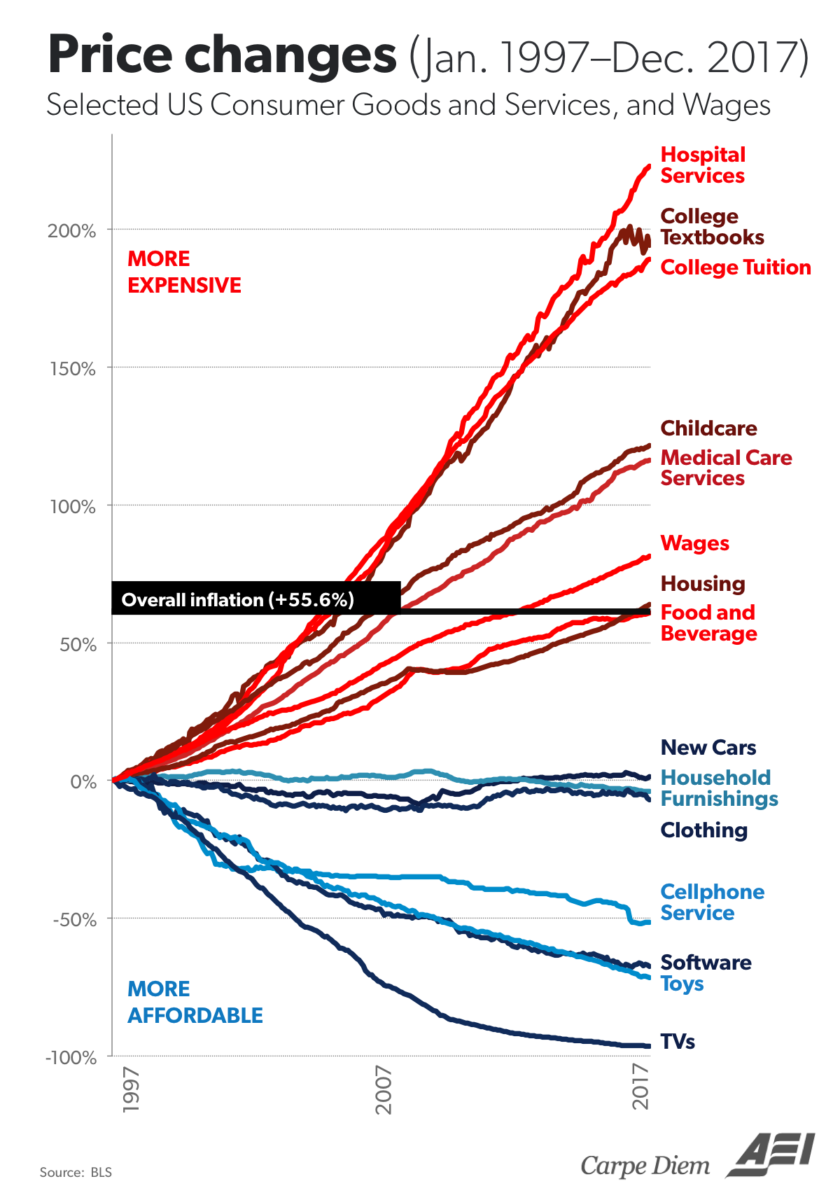
There’s so many charts like https://ritholtz.com/wp-content/uploads/2018/02/pricechanges... that clearly show the trend. It’s insane.
There’s a really good book I recommend called “Systems Bible” [https://www.amazon.com/Systems-Bible-Beginners-Guide-Large/d...] that beautifully articulates this phenomenon in a way that applies to government policy, software systems, management, org structures, or any complex system of people or machines.
You may enjoy this article [0]. To quote from it:
> In the past fifty years, education costs have doubled, college costs have dectupled, health insurance costs have dectupled, subway costs have at least dectupled, and housing costs have increased by about fifty percent. US health care costs about four times as much as equivalent health care in other First World countries; US subways cost about eight times as much as equivalent subways in other First World countries.
Of course adjusting for inflation.
Thank you for the book recommendation.
[0] https://slatestarcodex.com/2017/02/09/considerations-on-cost...
The obvious fix is a nationwide property tax that doesn’t apply to primary residences, but again it’s hard to say what that would do.
Why do you say this?
There have been numerous bills introduced at the local, state, and federal levels which specifically aim to address housing affordability. Seriously, just type in "affordable housing bill" into your favorite search engine and look at all the articles coming up from the past six months.
My local city council has affordable housing on the agenda for several of the committee meetings.
In my area/state they've dropped most of the zoning restrictions for locating apartments and ADUs. So you can add an ADU (a small dwelling that can be rented out), but that takes capital that most residential homeowners don't have. Add to this the fear that by building an ADU your property tax will likely go up very substantially and there aren't a lot of takers.
tl;dr Most affordable housing efforts are currently aimed at people who make poverty level incomes (and that's great). I don't see much locally aimed at providing housing that's affordable to folks in the middle. And as rents rise, more and more folks in the middle are not able to afford housing.
If anything current affordable housing initiatives just make things worse by discouraging new development. Building 10,000 new apartments is strictly better than building 5,000 apartments even if you designate 30% of them to be affordable. The ideal solution is to designate minimum density, so for every acre of land you must have at least X homes.
Worse it doesn’t actually help. The incentives are there to develop land it’s only local zoning that prevents it.
Most limited company buy to let mortgages in the UK are underwritten by a directors personal guarantee. It's just a technicality compared to a personal mortgage and so only shakes out the laziest of landlords
That said I would support a hard progressive tax on non-primary residence homes. It should really hurt for them to own multiple homes.
Further the value of property would decrease, but the cost of empty properties would increase. That would put downward pressure on rental costs.
I think you are confusing home loans (which are subsidized) and business loans which are not subsidized).
Fannie Mae/Freddie Mac loans are only on 1 primary home and 1 secondary home for individuals. These loans are limited and really don't work in high property value states. You should google the difference between "conforming" and "non conforming" loans.
You might be thinking of the mortgage deduction on the income tax. Trump already did this. This only hurt young people in high property value states.
Business real estate loans are more expensive because they are not subsidized. However, businesses do pay taxes only on earnings (income-expenses). Loan payments are expenses that reduce the earnings. Good luck on getting rid of business expenses. Yang proposed changing the tax law because of this.
All this means your proposal would have a very limited impact. It would only hurt individuals who live in an expensive property where the homeowner has mostly paid off their mortgage (old people) and used the principal to buy a rental (up to 750k).
I understand these policies work differently in expensive markets. But as per this article, investors are targeting rentals in less expensive markets.
[1] https://www.quickenloans.com/learn/conforming-loan-limits
[2] https://sf.freddiemac.com/working-with-us/origination-underw...
The neighborhood supported the increase in value, but gets nothing in return.
So what is the Fed's motivation to raise interest rates to curb inflation in this case?
As it stands, mortgage rates being below the rate of inflation make housing a very attractive investment.
The sources of mortgage subsidy that I am aware of are secondary market purchases:
A big portion of quantitative easing by the Federal Reserve is buying billions of mortgages every month. The Fed is trying to start unwinding this now, but they have had trillions of mortgages on their books since the GFC.