I think the endgame is clear in the US. Most states have dropped all restrictions and those that haven’t will suffer economically and politically until they drop their restrictions. The only question is how much economic and political suffering individual cities and states will tolerate.
Virginia voters threw out their entire Democrat government and governor and will likely join the list of states banning restrictions.
In the end I don’t think it will be about Covid at all. One by one we’ll move on because the people will demand an end to restrictions.
Because whether we like it or not the virus is still going to be around and kill people and saturate hospitals.
So, to me, the question seems to be:
will living with the virus means "we don't treat covid patients anymore, if you get covid, tough luck, you are free to choose to wear a mask if you want, beyond that don't expect anything from public authorities"The second and third most populous states in the nation have banned Covid restrictions. I think the answer to your question is… absolutely not.
Still be around and kill people? Sure, but that's true of the seasonal flu, and even the common cold in rare cases. Saturate hospitals? No.
I wish people would stop comparing it to the flu, it's highly misleading.
1. With restrictions in place covid killed more.
2. One in ten people still experience illness 12 weeks after the infection. Covid gets into the nervous system by crossing the neural-mucosal interface. Way more people that wouldn't have ended up in hospitals with a flu do ended up in hospitals with Covid. Even with vaccines. Long covid is no joke. Etc.
> and even the common cold in rare cases. Saturate hospitals? No.
Hopium and wishful thinking.
"Despite California losing a congressional seat for the first time in history due to slow population growth and some high-profile technology companies and billionaires leaving the state, there is no evidence of an abnormal increase in residents planning to move out of the state"
The “bottom five” for percentage change is, in order… DC, NY, Illinois, Hawaii, California.
Would you please not create accounts to break HN's rules with? If you don't want to be banned on HN, you can email us at [email protected] and give us reason to believe that you'll use the site as intended in the future.
1. aggressive triage based on chances and QALY remaining
2. increased healthcare funding
3. voluntary isolation of individuals who see lockdown as being preferable to their personal coronavirus risk
Will it result in more deaths than February 2020? Sure. But we don't have that choice because sars2 exists now.
We think it's better to ration healthcare and therefore doom an unlucky minority, versus rationing life itself for everyone (via lockdowns and restrictions) and slow killing everyone.
As far as I can tell, most of the lockdown debate centres around an erroneous idea that we can just do X, Y, Z, and then immunosuppressed Harriet can rejoin the world and avoid contracting coronavirus.
But she just can't. Even the original strain would have eventually infected her with high probability unless we continued to cycle lockdowns or she voluntarily isolated.
https://swprs.org/wp-content/uploads/2020/10/sweden-monthly-...
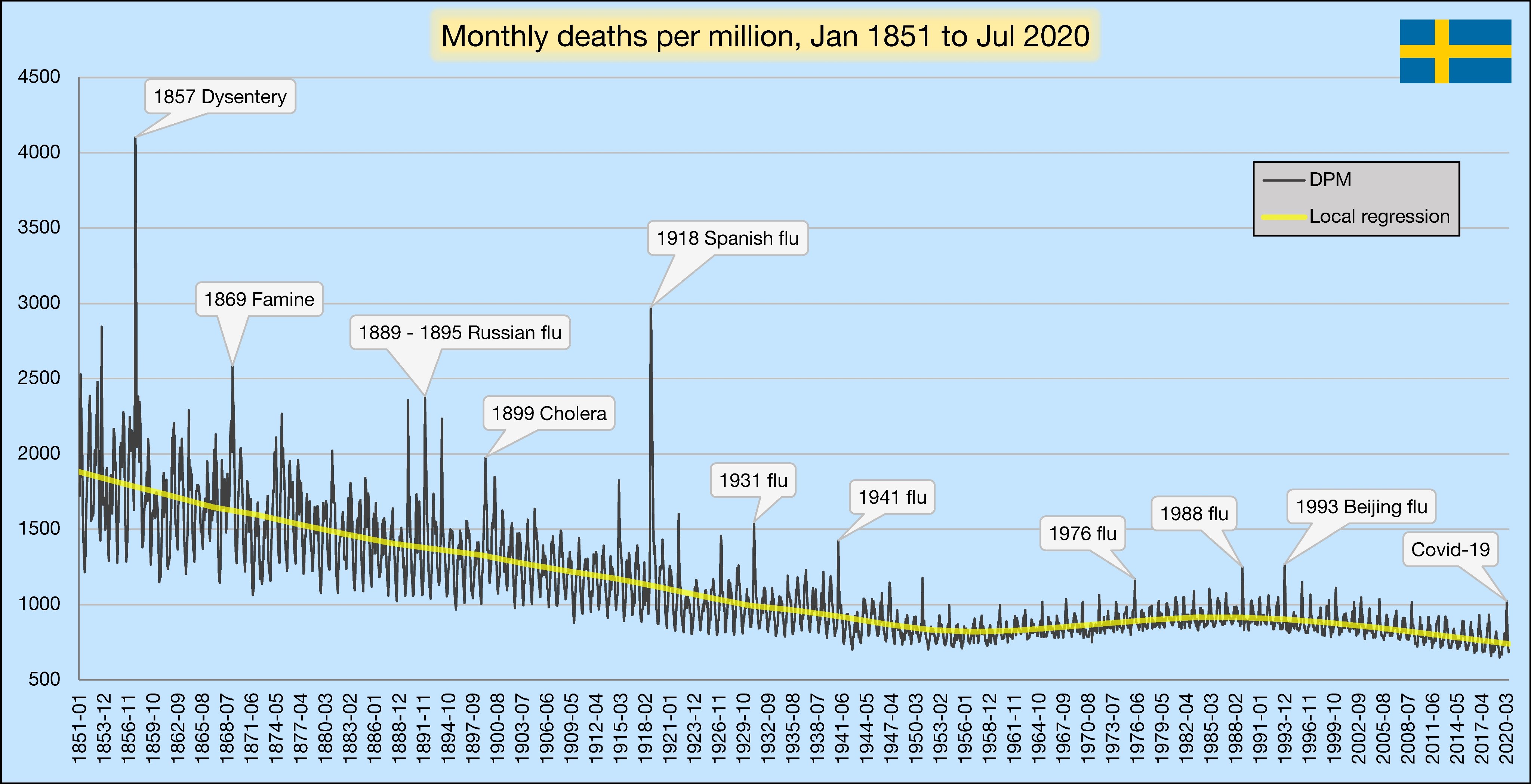
Its just that, using Swedish data again, Western societies are significantly more aged: eg. there 120,000 80-84 year old men (prime COVID death territory) in 2020, vs only 101,000 in 2009. Its similar in many other Western countries: about 20% more elderly people, in absolute numbers.
As such, the 'same' types of respiratory viruses will simply kill more people.
The decisions is thus a social and political one: do we lockdown and force 6-monthly vaccinations on everyone, based on elderly deaths that will occur anyway simply due to the baby boomer cohort entering their twilight years?
I think we need to just get more efficient at end-of-life care, focusing on simpler treatments and comfort, as well as euthanasia-on-demand for anyone over age 75.
CDC Director Rochelle Walensky
The four elderly members of our immediate family are all fairly adamant that the young have suffered enough, and "hell, yes" they want to see their grandkids, and no, they aren't asking about vaccinations and negative tests.
I'm minded to respect their opinions.
https://www.webmd.com/lung/news/20211122/us-covid-deaths-202...
Given widespread availability of vaccines, I think it is acceptable to turn away any non vaccinated people without medical exemptions to preserve hospital capacity.
https://www.cms.gov/Regulations-and-Guidance/Legislation/EMT...
I wish I could tell people that:
The vaccine does not prevent transmission as much as you think it does.
You do not spread as easily as you think you do, and you can personally attempt to reduce it even further.
You are vaccinated, and if it is indeed effective and you believe in it, you should not be worried much.
The unvaccinated are people too who probably do not have any malicious intent, and most likely pose little, or no risk to you.
Merry Christmas!
Always puzzles me to see people suggesting all these “just let them die” silver bullet algorithms.
Is there any evidence that this is true at the point of presenting with equal acute symptoms? Sure, your symptoms are likely to be less acute if you are vaccinated, but that's not the issue, the issue is response to treatment given similar symptoms.
Person A is "fully vaccinated", last dose five months ago, hasn't taken a Covid test since.
Person B is unvaccinated, but had a PCR test yesterday and is negative for Covid19.
Let's say you're clinically vulnerable, which of A or B would you rather sit next to during a meal?
This is clearly not the case for the vast swaths of our public health institutions who have supported and eagerly carried out mass terminations of healthcare workers who refuse the Covid vaccines.
IMO, the rational answer to this question is 'the same risk and mortality that we have already accepted from influenza.' There is a lot of variability there, of course, but it is way above zero in any case.
https://www.webmd.com/lung/news/20211025/covid-pandemic-may-...
To be clear, they are attributing this drop off of this flu strain to be likely due to pandemic mitigation efforts, as well as maybe lucky timing and some specifics of how this strain spreads
Since it doesn’t seem plausible to repeat the wide scale pandemic mitigation controls any time soon, I doubt we can keep wiping out flu strains, but we could certainly reduce the damage the flu does if we want to
Vaccines, on the other hand, seem promising. Though the effective mutation rate seems quite a lot lower than influenza and there are good reasons to believe that the covid boosters will be considerably more durable than the original shots. If it really did come down to getting a booster every year, though, I think a lot of people would be okay with that if it meant no more attempts at lockdowns and mask mandates.
Very few people actually try to wrangle with putting numbers on the cost (in dollars) of a human life, or the economic burden of disease. There are no right or wrong numbers, but only if you begin there can you say you're rationally considering the economic or political tradeoffs.
Edit: and deaths could absolutely reach zero. If we threw everything and the kitchen sink at the problem, we would eradicate it in absolutely no time. The underlying question is the same here, namely whether the cost of eradicating the disease would be larger or smaller than what we would gain from doing it.
Then you're left with the "leaky bucket" of transmission between humans and animals... But this is a known vulnerable point which could be monitored effectively and very cheaply.
Despite all this, human cases of rabies still happen. Fortunately it's rather hard to spread rabies between humans and it's symptomatic by the time it becomes infectious. In the case of an easily airborne virus even with such measures available like vaccination and prophylaxis for possible exposure, it seems daunting to the point of impossible even in a very wealthy country. In the developing world it would be certainly hopeless.
https://www.canada.ca/en/public-health/services/diseases/rab...
Genetic surveillance is just around the corner, and will soon be / is now within reach even of developing countries, with solutions like Oxford Nanopore's ultra-portable sequencers.
The virus is here to stay. Eradication is a total fantasy, just a distraction and waste of time.
- what’s the date on these figures?
- can we extrapolate this to other countries?
- are these figures generally accepted, or are they controversial?
- how do you account for age, sex (differences in life expectancy, child bearing capacity, etc), education level or professional skill, etc?
Imagine if China didn’t or couldn’t pursue a zero covid policy. What happens when the world’s manufacturer closes? We’ve already seen huge supply chain issues.
Across the Western world the vast majority of the economic and social issues have been caused by legalities rather than pandemic reality.
For example, for better or worse, if the 10 day isolation and testing regime did not exist in the UK then staff shortages would not either. People aren't actually getting ill en masse - we've just recalibrated what ill means.
This is, in my opinion, the primary underlying disagreement. Some people think that no amount of deaths from Covid is acceptable. Some people believe that even the peak pandemic mortality is acceptable. And others fall somewhere in between, by, for example, focusing on hospital capacity. I don't think there is any long-term solution to Covid as a social issue, something we talk about and can't move past, until some kind of consensus is reached on this.