Sure, I can go around and tell everyone I know that they shouldn't bridge Signal to Element One because <cryptonerd rant>, but there's no way for me to tell that my advice has been followed. Previously, the chances that someone had set up such a bridge were small, but by nature of making these things accessible, Element One also increases the risk of my conversations being (benevolently?) MITM'd.
I think it's a great offering, but I share GP's reticence about a system that puts what used to be zero-knowledge conversations in plaintext on a third-party server...all without me realizing.
This sounds like a made-up concern.
How do you stop me from screenshotting your convo and posting on twitter, or just copying and pasting from one app to the next?
My concern is about giving messages in an automatic fashion to a third party, which I'm completely unaware of and have no way of making an informed decision about. The third party could be breached (they run an online service, which is much, much easier to attack than some dude's iPhone).
Look, I'm not up in arms or anything, I just can immediately see a drawback to bridging Signal specifically. There exist many other services (Telegram, Slack, Discord, the list goes on) that can be bridged to Matrix without compromising the security posture in any terrificly meaningful way, IMO. So the idea is great in principle.
Perhaps in some sense, yes, but in precisely the same sense that you reduce the security of your messages each time you send a new message, or each time you start a conversation with a new person, or each time any of your contacts reads a message on the train where someone might be looking over their shoulder. None of these things strike me as a meaningful reduction in security, at least in the threat models that are appropriate for most average people (namely where you don't expect to be personally targeted by an attacker with resources).
An Element bridge is just a Signal client hosted on Element's infrastructure. Them using an Element bridge is no different than them using an extra device you didn't know about. That device could've well been insecure, or shared by many people, or hosted in the cloud. If you care about this, you should ask.
It is different in a big way. That extra device would most likely only transit this one user's messages. The Element bridge transits a ton of users and as such is an attractive target for mass surveillance.
> That device could've well been [..] hosted in the cloud.
The capability of self-hosting is very niche. Only technical people could pull that off. Element is working hard to make using this bridge so easy that your grandmother could do it.
In the end it isn't a huge deal, as most conversations are extremely innocuous, and those I care about I'll take the time to verify. But after all the trouble to proselytize Signal, I get nervous about large public projects that could, in my opinion, strictly reduce the security of my secure messaging system.
Yes, I totally agree that this would be a huge hassle. But what's your proposed alternative? Reaching out to every programmer in the world and convincing them to never write any software that can act as a Signal client? Or pushing for legal prohibition on any non-Signal developers creating software that can act as a Signal client?
Doesn't mean I'm in favor of such ridiculous things as you've suggested here.
Well, you can always switch to Matrix and have democratized and secure native messaging which uses a cryptographic protocol comparable to Signal. ;)
Also, obligatory xkcd: https://imgs.xkcd.com/comics/standards.png
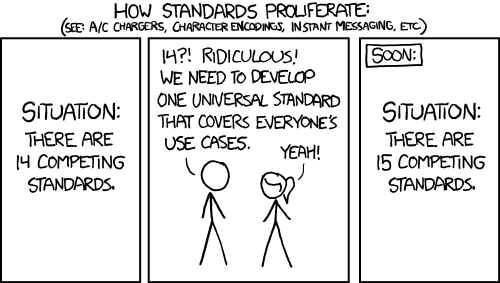
I've been through the pain of convincing people to Signal due to lack of better alternatives at the time. And I've done it yet again for Matrix. In this case, each move brought us closer to a global optimum so I'm not sorry for it.
How about because I'm a regular person, and I don't want everything I say analyzed by the federal government and stored in perpetuity? I'm increasingly repulsed by this notion that unless I'm doing something illegal or in opposition the the ruling party, encryption is just a luxury. Encryption is for anyone with any desire to express themselves honestly without modifying their behavior because someone is watching.
People flock to Signal for a reason and a lot of them will use this "bridge" without understanding what they're giving up. You're doing more harm that good to try to usher people towards your platform.
Why would you go to a walled garden if you want more freedom/control? You should just go to Matrix and host it yourself (and keep all the metadata to yourself, too!).
If you don't want to self-host, then you must be comfortable extending trust to someone. SaaS Matrix and Signal seem to be two sides of the same coin, in that case.
> I'm increasingly repulsed by this notion that unless I'm doing something illegal or in opposition the the ruling party, encryption is just a luxury.
Making encryption and privacy a common thing is important to maintain the anonymity of those who have something to hide for various reasons. It's the same as law enforcement using dubious methods: We don't object because we're criminal, we object because we're not (i.e. and don't want to risk false charges).
Sure, but this doesn't actually introduce a new party in the middle of two Signal clients. Someone has to just decide to authorize a Signal client running on a server somewhere to receive messages from you and forward them onward outside of Signal.
Can't you just pass the encrypted message further without decrypting it? Of course, there needs to be the same decryption mechanism on both sides, but it doesn't make it impossible.
Then there's the issue of syncing those messages between Element One clients which means the client now has to re-encrypt the messages and send them back to the server. And if the client is responsible for fetching messages then providing push notifications will be very difficult.
So if you can actually decouple polling/listening for messages from decryption then it would probably be possible.
A brute force approach would be to provide an open source, self-hostable server but can be configured from the centralized Element One service. This server would hold the actual service tokens & decryption keys and would just be sending re-encrypted messages back to Element/Matrix.
The server/bridge is not opensource? I see their github account has lots of code.
Quick question, is the code for the bridge opensource?
AFAIU GP’s point was that even if I don’t bridge, the recipient of the message might, thereby diluting the trust all users have in E2E on Signal, since you can’t know who’s bridging and who isn’t.
I fail to see anything that Element is doing "wrong" here, the issues you are describing are issues between you and your conversation partner
Also, AFAIK it wouldn't be trivial to extract all the Signal chat histories from an iPhone device - this new service makes that much, much easier (not least because they'd be remotely accessible).
The bridge itself serves a specific purpose (opening up Signal to the Matrix API, allowing for the use of a single app), and succeeds at that. Of course there's a trade-off, and the team (at least allegedly) appears to be working on encrypted bridges so that even if the bridge decrypts from Signal, it re-encrypts on the homeserver at rest in a way that only the user (not the bridge) can decrypt in the future.
I think the complaint here is "you advertised a service doing a thing that was already possible, people might use this." I may be mis-characterizing that, but I think it's worth stepping back and thinking a bit more on the actual threat model you face, and how the proposed product (Element One) somehow subverts that. Sure it can do so at scale, but that just means this is one incremental improvement that needs more work, not that the idea needs to be thrown out entirely.
Disclaimers and warnings are not universal solutions to questions on ethics since they are not certain to be read or understood and will have some failure %. If the residual negative effects are likely to exceed the kinds of outcomes a company's core values can tolerate, then making those states unrepresentable by abandoning product ideas is sane.
Furthermore, this is not the first time privacy issues with Matrix have been brought up to you and dismissed without understanding.
I am going to begin recommending that people actively avoid adopting Matrix/Element.
The libremonde research is over 2 years old now, and the valid bits of it were addressed at the time (https://matrix.org/blog/2019/09/27/privacy-improvements-in-s...)
Every single one of them has a configuration, despite a selfhosted instance, that phones home to centralized servers run by your for-profit company.
I'm not sure if this systemic problem is in your config files, your documentation, your defaults, your js client, or what. It's a failing of some part (or multiple parts) of the process.
Ahh. Seems like an easier problem to fix then. Doesn't Element Android remove that assumption and let you choose?
If you want to avoid your E2EE conversations on Signal or WhatsApp being relayed via a service like Element One (because you’re an activist or whatever), then your options are to not bridge at all, or run a bridge yourself. Clientside bridging may be an option in future, but reliably running a bridge in the background on mobile is somewhere between non-trivial and impossible.
Finally, we are currently crunching on getting E2EE to work nicely between the bridges and the Matrix clients (so bridged conversations are stored E2EE on the Element One server) and it should be coming in the coming weeks. It’s worth noting again that even when that lands the bridge will still necessarily be able to see bridged conversations at the point of bridging.
TL;DR: if you don’t trust Element with your Signal conversations for whatever reason, don’t hook up Signal to your Element One account :)