I think that with your background and investment in improving these problems, it will be hard for you to understand the perspective many people have that Facebook is fundamentally rotten at this point. These conflicts arise from FB's core business model. It calls up a torrent of hate speech and misinformation with the right hand while trying to clumsily moderate with the left.
You can hire whole teams to prevent singed fingers or protect certain possessions, but the point of a fire is to burn. If there are no good solutions while maintaining FB's core approach and business model, then it would be better for the world if it were extinguished.
Not a Facebook employee (or supporter for that matter), but I'm curious if you consider this an issue of Facebook or of social media in general.
Not saying it's OK for FB because everyone does it, but you generally see the same dynamic of the "torrent of hate speech and misinformation" on Twitter, on Reddit, on Youtube even (personal experience: I have a family member that was radicalized by misinformation on the internet. It was all on Youtube, she had never even used Facebook).
I've noticed that people go a lot harder on Facebook than on other tech companies. I think Facebook's reputation is well deserved, but I do think that reputation should be shared with really all social media in general.
I think that a lot of people who had the privilege to be on the Internet before the age of engagement-maximizing algorithms feel that the overall mood was less inflammatory and the prevalence of intentional misinformation much lower. Because these algorithms can reward people who are willing to be misleading or abusive to attract attention, there is a concern that these kinds of misbehavior are encouraged by the application of engagement-maximizing sorting to user-generated content.
Facebook participated in the arms race to develop these algorithms much as the Turks and Hungarians developed the use of single-user firearms (arquebus/matchlock) in warfare, by necessity of competition, but are no less responsible than anyone else. The fundamental challenge is whether these algorithms must be fundamentally modified or restricted to prevent their tendency to support bad actors or whether, as the platform operators seem to be insisting, the problem can be managed by post hoc content moderation without limiting the behavior of the algorithm.
Because there is a wall of trade secrets and a sense of geopolitical competition, regulators have not been able to manage this situation in a manner that yields satisfactory results. So we lament this situation where Facebook appears to be chasing profits at the expense of the political stability of modern democracies, and while Google/Reddit/Twitter may be similarly responsible, this article happens to be about Facebook.
For example, I'm not sure how I got bucketed in the "anti-masker" cohort, but over the past couple weeks I've noticed that I'm pushed a torrent of articles along the lines of "Look at this brave person serving the school board!", showing a person going on a rant about how masks are the work of the devil and how great that is.
I kind of like it, because it's given me a window of "the other side" of my social media bubble. I think the thing Facebook is particularly nefarious at is that, the way the feed works, it makes it seem like of course everyone agrees with you, except that idiot crazy uncle who you eventually have to unfriend, because all you see are seemingly "random" posts that enforce your own viewpoints.
True, though I think the same thing applies to Twitter and YouTube. You see what seems like random things from a huge variety of random people that all happen to affirm your worldview.
I believe Jack Dorsey has mentioned some vague plans to try to address the bubble problem. And I believe I may have been temporarily placed into a YouTube beta test where they tried to include videos unrelated to things I've seen before (I seem to recall an explicit notice about this, and a request for me to give feedback). So, I think they're probably trying, kind of. (I don't use Facebook and never have, so can't comment, there.)
reddit, as far as I know, doesn't do user-specific recommendations in their submission sorting (besides what they choose to be default subreddits), so you have to go out of your way to form a little bubble for yourself. Which many people do, but at least they have some awareness that they're explicitly setting it up to be that way.
That said, especially as of the past 5 or so years, most sites out there have skewed pretty unilaterally right or left, and I believe all or nearly all of the default subreddits currently have a pretty homogeneous political stance. It's not as insidious as the recommendation-based per-user bubble formation other sites have, but it might have a similar effect, especially if someone mostly just looks at their front page and doesn't subscribe to more than a few subreddits besides the defaults.
added: I remember when Facebook switched from showing a chronological timeline to "the algorithm". That turned out to be a monumental paradigm shift.
Not yet, but give them time :)
More generally, social media may be an amplification of crazy people, but it doesn't create the crazy people (pick the side you don't agree with for a definition I guess).
Like, all of this stuff is sortof vaguely like what happened when the printing press got invented, and when literacy became more widespread. It's people, rather than technology, driving these changes.
So, assume that 10% of your friends are responsible for 90% of the content. Is it really a better experience to see all of their content in your feed rather than some of their content plus some other people?
At the very least, you could be transparent about what the algorithm actually is, or even gasp give the user control over it.
> The problem you cite could be addressed in many ways.
Can you suggest some?
If those current big techs were to disappear, would people stop their nonsense and sometimes hated behavior?
I am starting to believe that is not just bad company management or moderation, we definitely have bad actors on those networks too.
The problem is complex
Go back farther. The original plan was no moderation.
Many users will simply mash the "report abuse" button if they see a politician they don't like, or a sports player for an opposing team.
If the normal rules applied identically to everyone, all high profile accounts would simply be inactive in perpetuity.
Maybe a better system would penalize reporters that are found to have reported content that do NOT violent content policies?
Just send them a little message saying "Hey, you've falsely reported a bunch of posts/accounts lately, so we're restricting your ability to report content for 30 days." and if they keep doing it, make it permanent.
Actual hostile actors will have years to find ways to use the rules to create controversy and shut down dissenting posts.
If people learn they get flagged after N spurious reports, they'll start rationing their reports so they don't meet the treshhold; they'll start making inflammatory posts that technically respect the rules to bait false reports. They'll create scandals, eg "Person X said awful thing Y, but when I tried to report them Facebook told me I wasn't allowed to report people anymore. Why does Facebook support Y?"
That's not to say your idea is bad. Just, you're making it sound really easy, when it's a problem Facebook has poured millions into without finding many solutions.
And flagging/vouching privileges can be removed for HN users who abuse them.
Another potential mitigation might be to put a limit on the number of posts that a single user can flag in a day. At some point, the cost of large-scale content manipulation could be made to exceed the expected gains.
It may even be profitable for Facebook to crack down on this. Every celebrity post that gets illegitimately taken down has potential for showing ads to millions of people.
HN has addressed this problem by keeping it text-only.
The problem for Facebook is that adding people is going to be expensive and hurt their bottom line. So they are likely incented to treat these disparities as collateral damage on the road to ever-increasing profits.
And in any case, have you tried applying at Facebook? If you have the answer to their problems and are capable, then why not?
As for this particular issue, I consider celebrities and politicians who stir up trouble largely as fat to be cut. Anyone who builds that much gravity and controversy tends to cause more problems than add value, and detracts from democratizing the platform.
But that's not the sort of content classification you mean, is it.
So the problem isn't technical. Rather it's an entirely self inflicted problem by Facebook. The cause is an attempt to broker a compromise between the original spirit of the site and internal activists who are bent on controlling information and manipulating opinion. The reason they make so many bad judgement calls is because they're not trying to impose clearly defined rules, but rather, ever shifting and deliberately ill-posed left wing standards like "misinformation" or "hate speech". Because these terms are defined and redefined on a near daily basis by ideological warriors and not some kind of universal social consensus, it is absolutely inevitable that the site ends up like this. A death spiral in which no amount of moderation can ever be sufficient for some of their loudest employees simply cannot be avoided once you cross the Rubicon of arbitrary vague censorship rules.
If Facebook want to reduce the number of embarrassing incidents, they can do it tomorrow. All they have to do is stop trying to label misinformation or auto-classify posts as racist/terrorism-supporting/etc. Stand up and loudly defend the morality of freedom of speech. Refocus their abuse teams on auto-generated commercial spam, like webmail companies do, and leave the rest alone. This isn't hard, they did it in the early days of the site. It may mean firing employees who don't agree, but those employees would never get tired of waging war against opinions they don't like no matter how much was spent on moderation, so it's ultimately futile trying to please them.
You ask - isn't moderation the problem they're trying to solve. This gets to the heart of the matter. What is the actual problem Facebook are facing here?
I read the WSJ article and the quotes from the internal documents. To me the articles and documents are discussing this problem: their content moderation is very unreliable (10% error rate according to Zuck) therefore they have created a massive whitelist of famous people who would otherwise get random takedowns which would expose the arbitrary and flaky nature of the system. By their own telling this is unfair, unequal, runs counter to the site's founding principles and has led to bad things like lying to their own oversight board.
It's clear from this thread that some HN posters are reading it and seeing a different problem: content moderation isn't aggressive enough and stupid decisions, like labelling a discussion of paint as racist, should just apply to everyone without exception.
I think the actual problem is better interpreted the first way. Facebook created XCheck because their content moderation is horrifically unreliable. This is not inherent to the nature of automated decision making, as Gmail spam filtering shows - it works fine, is uncontroversial and makes users happy regardless of their politics. Rather, it's inherent to the extremely vague "rules" they're trying to enforce, which aren't really rules at all but rather an attempt to guess what might inflame political activists of various kinds, mostly on the left. But most people aren't activists. If they just rolled back their content policies to what they were seven or eight years ago, the NYT set would go berserk, but most other people wouldn't care much or would actively approve. After all, they didn't care before and Facebook's own documents show that their own userbase is making a sport out of mocking their terrible moderation.
Finally, you edited your comment to add a personal attack claiming I'm making "off topic political comments". There could be nothing more on-topic, as you must know from reading the article. The XCheck system exists to stop celebrities and politicians from being randomly whacked by an out of control auto-moderator system. A major source of controversy inside Facebook was when it was realized that the system was protecting political incumbents simply because they were more famous than their political challengers, thus giving the ruling parties a literal exemption from the rules that applied to other politicians. The political nature of the system and impact of moderation on politics is an overriding theme of concern throughout the documents. You can read the article for free if you sign in - that's how I did it.
I’m not sure that I would consider any site that contains virally-spreading racism and falsehoods to be “fine,” but that’s just me, I guess. Even HN is full of BS, but at least it’s contained to comments and can’t be republished with the click of a button.
Best to apply any moderation as minimally as possible. Tag posts which cause arguments as "controversial" and leave it at that.
That's just silly. Some facts are incontrovertible. Do you really think there's any room for disagreement that the earth is round, or that water freezes at 0 degrees C?
> One man's racism is another man's plain speaking.
There's no room in this world for racism, and you shouldn't be trying to defend it here - or anywhere.
Facebook's problem is that it has given in to the activist class that feels simply not going there is insufficient. Instead they feel a deep need to try and control people through communication and content platforms. This was historically understood to be a bad idea, exactly because the demands of such people are limitless. "Virally spreading falsehoods" is no different to the Chinese government's ban on "rumours", it's a category so vague that Facebook could spend every last cent they have on human moderators and you'd still consider the site to be filled with it. Especially because it's impossible to decide what is and isn't false: that's the root cause of this WSJ story! Their moderators keep disagreeing with each other and making embarrassing decisions, which is why they have a two-tier system where they try and protect famous people who could make a big noise from the worst of their random "falsehood detecting machine".
Edit:
>it's impossible to decide what is and isn't false
I can't agree with this, all organizations have to decide at one point what is false and what isn't, otherwise they have nothing to act on. It would be more convincing if you could suggest ways their moderators could resolve these disputes and determine what is actually true, because what you're suggesting sounds to me like they should just decide that everything is false all the time.
Sure, and I don't! But this thread isn't about my problems or even your problems, it's about Facebook's problems.
"How are they controlling people if you acknowledge that going there is voluntary?"
People go there because they think they are seeing content shared by their friends, by people they follow and so on. In fact they are seeing a heavily filtered version of that designed to manipulate their own opinions. That's the whole point of the filtering: with the exception of where they label articles as 'fact checked', content that is politically unacceptable to them just vanishes and people aren't told it happens, so they can remain unaware of it. Like any system of censorship, right?
"all organizations have to decide at one point what is false and what isn't"
No, they have to decide that for a very narrow range of issues they've chosen to explicitly specialize in, and organizations frequently disagree with each other about what is or is not true despite that. That's the entire point of competition and why competitive economies work better than centrally planned economies: often it's just not clear what is or isn't true, and "trueness" may well be different depending on who is asking, so different firms just have to duke it out in the market. Sometimes an agreement emerges and competitors start copying the leader, sometimes it never does.
Facebook has a disastrously collapsing system here because they are not only trying to decide what's true in the narrow space of social network design, but trying to decide what's true for any possible statement. This is as nonsensical as GOSPLAN was; it can never work. Heck they aren't even a respected authority on the question of what's true in social networking anymore, that's why they had to buy Instagram and WhatsApp. Their competitors beat them. To try and decide what's true for the entire space of arbitrary questions about politics or science is thus arrogance on a galactic scale.
>trying to decide what's true for any possible statement
Any possible statement that happens on their platform, yes. That's generally how it works when you have a company and I don't see how Facebook is doing anything out of the ordinary here -- any company can fire employees/customers for lying. If they know there are lies being posted on their site, it's perfectly reasonable to delete them. In fact I wish they would take more effort to delete more lies and falsehoods, the website is unusable when everybody is caught up in discussing a lie and doesn't want to hear the truth.
>To try and decide what's true for the entire space of arbitrary questions about politics or science is thus arrogance on a galactic scale.
I really can't agree. In general, we know what's true for politics: it's what the elections and the courts decide, at least in the US anyway. By design those are the authoritative sources. There is no authoritative source for science but with that you can verify the accuracy of any statement by testing it yourself and reproducing (or not reproducing) the results, that's the whole point. I don't see why it would be arrogant of a company to do this, as it's what a company is supposed to be doing in order for the system to work.
>Gmail spam filtering [...] works fine, is uncontroversial and makes users happy regardless of their politics
>an attempt to guess what might inflame political activists of various kinds, mostly on the left
This is more of what I meant: I find these arguments to be unconvincing, if you're going to make these claims convincingly then you need to show proof of this. Remember we're talking about two billion users here. Your post does not read like an actual attempt to solve the problem but instead an attempt to attack "activists on the left" and "the NYT set" which I don't even know who you're talking about or what that's supposed to mean in this context, I would advise against making these type of statements. It would be more convincing to mention a specific person or persons, what their claims are, and what you disagree with and why.
>Finally, you edited your comment to add a personal attack claiming I'm making "off topic political comments".
This is false, there's no personal attack, I'm saying your comments are unrelated to the argument and are not convincing to me. If you're confused about this, a personal attack would be something along the lines of "X person is a bad person because they follow Y political persuasion" which your comments could be construed as doing about Facebook's employees. So please make sure not to do that. This is again why I highly suggest against making this a political argument, usually it results in someone getting defensive, when there's no reason to do that.
If you want me to put this more frankly: I don't care about your politics or facebook's politics, that's not an interesting subject to me. It's nothing personal against you or facebook. Just talk about the problem please, otherwise I don't want to continue this discussion.
>A major source of controversy inside Facebook was when it was realized that the system was protecting political incumbents simply because they were more famous than their political challengers, thus giving the ruling parties a literal exemption from the rules that applied to other politicians. The political nature of the system and impact of moderation on politics is an overriding theme of concern throughout the documents.
This also seems not really related to the argument. Sure it affects politicians but as has been established, that's a side effect of the way the system has been designed. I don't think it makes a difference whether the side effect was intentional or not.
To flesh this out, look at the examples in the article where moderation decisions split or were reversed - that's the problem XCheck is designed to solve. Most are about politics:
- Saying "white paint colors are the worst" was classed as racism. Trying to define and then scrub all racist speech from the world is a left wing policy.
- A journalist who (we are told) was criticizing Osama bin Laden was classed automatically as supporting him, and then human moderators agreed. Scrubbing this sort of thing is (in the USA) historically either a right wing or bipartisan consensus. We don't know why the moderators agreed because the comments themselves are not presented to us. This was later overridden by higher ups at Facebook.
- Split decisions over Trump's post saying "when the looting starts the shooting starts" that got escalated to Zuckerberg himself.
- "The program included most government officials but didn't include all public candidates for office".
etc. If you try to ignore politics, the entire debate becomes meaningless, because indeed, you would not even perceive any problem with unequal enforcement in the first place.
This again would be a side effect. Obviously it's not irrelevant but I have seen no reason to prioritize that over anything else.
>because the concerns are fundamentally political to their core
If by political you mean "needs to be solved with politics" then I can't necessarily agree, this is also a technical problem. To put it another way, it wouldn't just magically get fixed if you elect some new congresspeople or replace Zuckerburg, the new people still have to take additional technical steps to fix the problem. If the solution already exists and is being ignored then I would agree, but I have seen no solution offered in this thread. Instead of trying to present the solution, which I have asked you to do repeatedly, it seems you're still trying to make this a political argument, which I wish you wouldn't do. I don't know how many times I need to say that it's not convincing to me to come at it from that angle. I'm sorry if that seems rude but it's the truth of the matter. If your end goal is to campaign for me to vote for somebody, please stop, I'm not interested to hear it (again nothing personal).
On the rest of your comment: I honestly have no idea what your examples are supposed to mean, why you are making these assumptions or why the political motives or policies of some other parties matters. There will always be some users that take issue with any kind of filtering and it makes no sense to me to prioritize ones who happen to have adopted something as a political position at some arbitrary point in the past. If your issue is "unequal enforcement" then can you please elaborate on how a different kind of filtering would help with any of these examples? Why would a different system result in not needing to step in and reverse controversial decisions? I asked for proof of this a few posts ago and you didn't give any.
This might work if the response to a report wasn't so arbitrary. I've been given bans for using heated language, yet had comments that were just as heated AND making direct threats at people marked as not violating any rules when I made the report.
You would think with the literal legion of geniuses Facebook has they would have a smarter way of handling reports than simply counting them and taking down content that receives over X reports.
Has anyone considered the possibility that this is a signal from the non-elites that something is wrong? That ignoring this "mass downvote" is the essence of the structural elitism?
The rate can still be (and probably is) higher for high-visibility accounts of course but in the example you gave the rate of reports is the same and the problem is using a naive "10 reports = ban" metric.
I wouldn't be surprise if a million users understood "report" as a downvote for a post they don't like.
That is manipulating society.
Think literally selling elections to foreign governments as a business model, but in the open.
You might say that maybe 99.99% isn’t good enough and the engineers should try for more 9s. Maybe it’s possible but I don’t know how. If you have ideas on this, please share.
Your concerns about different treatment for some people is valid. But again, their experience is different. For example, if an account or content is reported by hundreds of people it’ll be taken down. After all, there’s no reason for accounts in good standing to lie right? Except celebrities often are at the receiving end of such campaigns. There needs to be exceptions so such rules aren’t exploited in such a manner.
Hire a large human moderation team. Facebook can afford to. They choose not to.
You're not the only person who has suggested this. Let's think about that for a second. Let's say it takes 6 minutes for a moderation team to review an older account. There's 2 billion accounts, so it'd be good to review all of those. It would take about 200 million hours. Presumably you'd want to re-review positive cases so no moderator has too much power. Additional time. Even if Facebook literally doubled the number of employees, and hired 50000 people overnight, they would still take 2 years to complete the review. But in that time it's possible that previously benign accounts turn abusive.
And then think about the 20 million odd new accounts that are created every day. How long before each of those are reviewed? And what signals will you use to review them? These are mostly empty accounts, so there's not much to go on.
And that's just the problem of aged fake accounts. How about bullying, harassment, nudity, terrorism, CEI and all the other problems?
It's interesting talking to people who say "oh that problem is easy to solve, just do X" without realising that the problem is more complicated than it looks.
At no point did I state that the solution was easy. My response was to your claim that you do not know of any possible solution, not an easy solution; to wit, you invited input:
> Maybe it’s possible but I don’t know how. If you have ideas on this, please share.
I also don't follow your examples. Why are you tasking this hypothetical team to review all two billion accounts? The main issue at hand seems to be lack of sufficient staffing to review reported accounts. Why not start there?
If human moderation won't work. And whatever they're doing now is an unqualified disaster. Then what is the solution?
Oil companies tell us that oil spills and pollution and ruined ecologies and the burning planet are just part of using oil. Sad face.
They're doing their very best to minimize the negatives. They hire the very best lobbyists and memory hole as much as possible and donate to some zoos and greenwash and "recycle".
What more could they possibly do?
Really, what do you expect? Stop using oil?! Please. That's crazy talk.
More seriously, I'm not saying that Facebook is an unmitigated evil, that their biz is the moral equivalent of trafficking (humans, arms, drugs, toxic waste), or that humanity would be better if it had never existed.
I'm only asking why they continue to create a mess that they are incapable of cleaning up, by their own admission.
--
I understand these questions are for The Zuck, The Jack, and their cast of enablers (profiteers) like Thiel, Andreessen, etc.
Toxic waste companies engaged in the conduct you described and had the impact you described and they were condemned after we found solid evidence that they were doing so. Do you have any argument or evidence whatsoever that Facebook is behaving similarly? If you want to argue the moral equivalency, argue it. Don't spin an evocative narrative about the disasters of the oil industry in the same breath as Facebook's moderation policies then disclaim it "I'm not saying that...".
Also, 99.99% only seems like a high number when we think anecdotally, not statistically. For anything at Facebook's scale, the number of nines should be increased! Because .01% of the actions of three billion people on a single day gives you a city roughly the size of Tampa, Florida (~300,000 people).
Given Facebook's financial resources, it should be no problem to increase the size of the team working on the tool. Like any engineering problem, the problem can be broken down into smaller parts, the edge cases can be caught and/or anticipated, creative solutions can be applied, etc.
If history teaches us anything, it's that all public facing systems will be exploited. Those who design them should anticipate this.
(Thanks, by the way, for posting about your perspective. It looks very different to those of us on the outside.)
And I worked for 4 years on one such small part (internally called UFAC), trying to help potential false positives of such a system.
As for classifier with a true positive rate of 99.99999%, I don't know much but I don't think it's possible. But if there's someone out there who might know, then they should say so.
From the outside, it doesn't seem like a strictly data science problem. Instead, it seems like a design / product / brand expectation issue as well.
This is extremely simplistic view which is extremely prone to obvious abuse, I really hope FB does much better than this. With obsessive surveillance that FB collects on pretty much everything it can lay their paws on and then some, they could do much better than just counting abuse reports. Much, much better if they really had some smart people - like behavioral science PhDs they surely can afford and they now surely use to figure out how to better sell ads - to work on it for a couple of years, I'm sure they could arrive at something better than "if it gets more than N reports, shut it down". If they don't, it means they don't care enough.
> After all, there’s no reason for accounts in good standing to lie right?
Of course there is. Politicians lie all the time. MSM lie all the time. Why won't regular people lie all the time? Of course they do, for a myriad of reasons. And since there's no punishment for lying, there's zero incentive for them not to.
> There needs to be exceptions so such rules
No, there need to be better rules. If you rules suck, and you have to do exceptions for the nobles, they still suck for the peasants. Making it easy for friends of Zuckerberg is not fixing it, it's just sweeping it under the carpet and leaving it to rot.
The problem is when the rules are not applied evenly, especially when high profile users with greater audience can abuse those rules.
Remember back in the day when a friend got a new game console and invited you over to check it out with the ideal that you'd get to try it but they only had one controller? Really all they wanted to do was have you come and watch them play, and you sat there until you got bored of never having a chance to engage with it? That is the modern social media experience.
They play with your ability to be visible even to people that follow you for updates on your posts. The only way for non-elites (people deemed worthy of ranking) is to pay for ads, which appear as lower quality "promoted" content.
The model of social media started with everyone on the same playing field, but there are so many dimensions that can be manipulated to keep users thinking that it is functional while these sites change to serving the purpose of generating revenue for partners and paying interests underneath a façade of being fair communities. If you speak out against them, they censor you as well, all behind the scenes.
It's simply better to go back to creating independent sites, and then to hope you get ranked fairly on Google, and that people bookmark you... We become powerless when we allow corporate control of our communication, because governments are not aware nor vigilant of/to the impacts to regulate social sites until it's far too late, and because profit is king in that world over simply doing what is fair and positive. The business model feeds misinformation, chaos, disharmony, and conflict, just like reality TV does now, Why? Because it keeps people glued to their screens.
Even these platforms are terrified of instituting positive changes out of fear of losing their market share and user base... Overnight Twitter, FaceBook, IG, or any of these sites can lose their user base and reach just like Club House and Vine... That has to be said as well.
A big problem is that many accounts that post sensationalized (violent, graphic, sexual) content are really run by people that are building follower accounts to sell later on, as a symptom of heavily limited organic account growth (the ability to get followers) on these platforms... People build accounts by posting wild content and then sell them on the black market to others who start out looking like popular individuals because the accounts come with followers already included. Being successful on social media is no longer about having quality content, it's about how much you pay and how professional your image is... No wonder why class-ism has taken hold on it all.
There are still plenty of ways of maintaining fairness on any of these communities/platforms, and company leadership needs to go back and review the original promises they made to everyone in order to build their current user base (promises that they've all now totally broken) and fix those issues as the primary basis for resetting their flaws and oversight.
Let's take your example of Mark Z.
What makes you think that this is unique case? What about people that suddenly come to fame, like viral video subjects?
A simple solution is to disallow logging in from new devices and the attempt being silently dropped so you are not bothered, unless you do some magic like generate one time key to complete the procedure on the new device.
I could think of a lot of people that would find it useful.
Or allow setting up 2FA token (other than mobile) correctly.
Instead what FB does is make it impossible to secure your account because they insist whatever you want you should always be able to recover your password with your phone number.
Years ago when I was still using it (I had reason) I tried to secure it with my Yubico. Unfortunately, it wasn't possible to configure FB to not allow you to log in on a new device without the key.
I understand how the discussion probably went: "Let's make it so that we can score some marketing points but let's not really make it requirement because we will be flooded with requests from people who do not understand they will never be able to log in if they loose the token."
But that's exactly what I want. I have a small fleet of these so it is not possible for me to loose them all but unfortunately most sites that purport to allowing 2FA can't do it well because they either don't allow configuring multiple tokens or if they do, they don't allow really lock your account so it is not possible to log in the next time without the token.
This is a great point. AFAIK, Google is the only service which allows you to set mandatory U2F login requirements. Does any other service offer this functionality?
Consumer apps try hard not to do hard security unless they are forced to, usually for cost reasons.
Security measures like these create a ton of administrative tickets - check any sysad ticket queue a good chunk is password reset/recovery, in enterprise apps the org sysads are paid to handle this.
In consumer apps, the app company has to manage it, also it lot harder to verify identity of a random user than company employees making it harder to do this kind of support.
A good jarring example is AWS, the amazon.com and AWS did (does?) share authentication stack so some basic 2FA functionality like backup codes is not there for AWS .
Google is better at this because they have for long time also focused on SSO service as a product.
Many companies use Google AD /SSO workspace/suite because third party apps support google login out-of the box free[1], maybe charge for AzureAD/SAML2 and likely not support others at all without customization costs.
[1]It is standard because SMB/mid market companies are more likely to use Google for productivity than Azure/o365 as it is easier to manage albeit with lesser features. Third party apps don't want to expend support time on smaller customers if they can avoid it
As to TOTP it's a shared secret, so just clone it. If they allow you to set multiple secrets it would just reduce your overall security because more random guesses work. Also, get WebAuthn instead.
It’s the same with Neymar. How many times do you think his profile is reported for any number of violations by people who don’t like him? If an ordinary persons account got 100 reports a minute it would be taken down. Neymar’s won’t be.
I don’t know how every Integrity system could be modified to make an exception for any of these classes of accounts or how to codify it in a way that would seem “fair”. If you have an idea for a better way, you should share it.
More to the point, after a human reviewed Neymar's conduct and it clearly violated Facebook policies about posting revenge porn, his account still wasn't taken down. And that's not a technical issue of the false positive rate -- it is a double standard.
From the article: 'A December memo from another Facebook data scientist was blunter: “Facebook routinely makes exceptions for powerful actors.”'
(Edited: changed verb tense to make it clear that this already happened and wasn't a hypothetical.)
Popular users are going to have more false-positive reports than others, but when those reports deviate from the norm on individual pieces of content (say a nude photo) then the system should still be able to pick it up. It's an exercise in feature extraction.
The login blanket exception (for the CEO of the company) is a different use case and purpose than content control, one that blanket exceptions can solve efficiently.
I'm certain that the other poster won't present some kind of practical outline because part-way through the brainstorming they will realize they are designing a "Social Credit Score" and become too frustrated to continue.
Moreover, I assume this bug was reported internally, probably pretty quickly. How long did it take to get fixed? If the fix wasn’t prioritized and corrected within, say, a day (along with a regression test to ensure it never happens again!), then that would be pretty damning of the company’s culture and priorities as well.
Currently if you register a Facebook account to manage a business and post ads, it will be banned off and on for weeks, and the recourse suggested to me by a director in the Integrity org was "try posting on facebook like a normal person."
Why does this disparity exist? By your own account, the number of times this happens for normal users is significantly smaller than for high-profile users, so why is Facebook incapable of having sufficient staffing to deal with this case for all users? _This_ is what has a lot of people annoyed.
Then the rules should be different, like Twitter giving a blue check mark. If there are accounts that need to be treated differently then it should be clear why and how the rules are different. Fixing problems with tech (like not allowing Zuckerberg to login) should be the exception.
Twitter caught hell for letting Trump break their rules because they pretended the rules were the same for everyone.
There is not a trade principle of having to treat all customers equally (the sole exception being not denying service for a specific list of protected groups), and there is a general principle that people can trade with others as they please and provide different conditions for arbitrary reasons.
It should be obvious why "Shut Facebook off" is not in the domain of potential solutions Facebook will entertain to this technical challenge.
Not sure what the correct analog for physical product is, but we accept everything up to and including catastrophic failure resulting in deaths from physical products under the right circumstances, so you're going to have to be much more specific.
Why do you think this? I mean it isn't like there was a plebiscite on what "social media was supposed to help".
As with most things of consequence in our world, social media is more of an emergent phenomena that any sort of planned effort. We have a legislative system that is there to provide a mechanism to adapt our legal system as needed.
> the direct vote of all the members of an electorate on an important public question such as a change in the constitution.
> ROMAN HISTORY: a law enacted by the plebeians' assembly.
saved you a click
This is literally the first time I’ve heard anyone voice this expectation, and it is a ludicrous expectation to have had at any point in time.
That was the hypothesis. The worldwide experiment that is still running seems to have falsified it.
I heard people voice similar expectations about roughly equally ludicrous categories of online services then, but never social media as such. Most of them were ludicrous for reasons that were obvious at the time, and apply equally to social media:
(1) In the short term, the digital divide was acute, and any benefits they brought would naturally increase inequality across that divide.
(2) In the longer term, where one might presume the digital divide would erode, they overlooked that while the services involved were generally still in the venture-subsidized artificially underpriced/undermonetized phase, any plausible business model would either promote inequality by narrowing reach to an elite or promote inequality by creating sharply tiered service or (most commonly) a sharp division between a broad class of users being engaged to be marketed to moneyed interests and the moneyed interests buying their eyeballs. Any prediction of resolving inequality was based on venture subsidies and monopoly building dumping being converted into a permanent state out of charity.
> Most of them were ludicrous for reasons that were obvious at the time, and apply equally to social media:
It seems post facto to conclude that they were obviously ludicrous at the time. Perhaps with hindsight it seems as ludicrous as a belief in alchemy in the middle ages, but it wasn't obvious that you couldn't turn lead into gold before we had chemistry. In the Web 2.0 era lots of smart people thought social media could make the world better. I raised money and founded a "social media" startup expressly thinking it would empower people, and many of my peers in that world were equally earnest.
Supposed by whom? Zuckerberg created Facebook when he was at Harvard and had never seemed interested in leveling any playing field.
The internet, and social media in particular, changed all that. First only nerds could make a web pages. Some, like me, published our thoughts there using raw HTML. Then Moveable Type allowed anyone with an FTP site to publish. Then Blogger allowed anyone with a browser to publish. Then Flickr and Facebook and Twitter and all the rest. It was an exciting time.
I hope this help explains why we thought this would "level the playing field." What we read and what we watched was no longer dictated by TV Network bosses or editorial boards. Governments could no longer demonize people in other lands, because we were all free to (for example) be Facebook friends with those people. At least that was the theory. As I mentioned in another comment, it sure hasn't worked out that way.
When you compare the profits of newspapers and TV stations to FB, it becomes obvious why so many media mogul billionaires are pushing for harsh regulations for Social Media...
> As I mentioned in another comment, it sure hasn't worked out that way.
It was fun to dream.
You can see for yourself by searching for “2005 Facebook screenshots”.
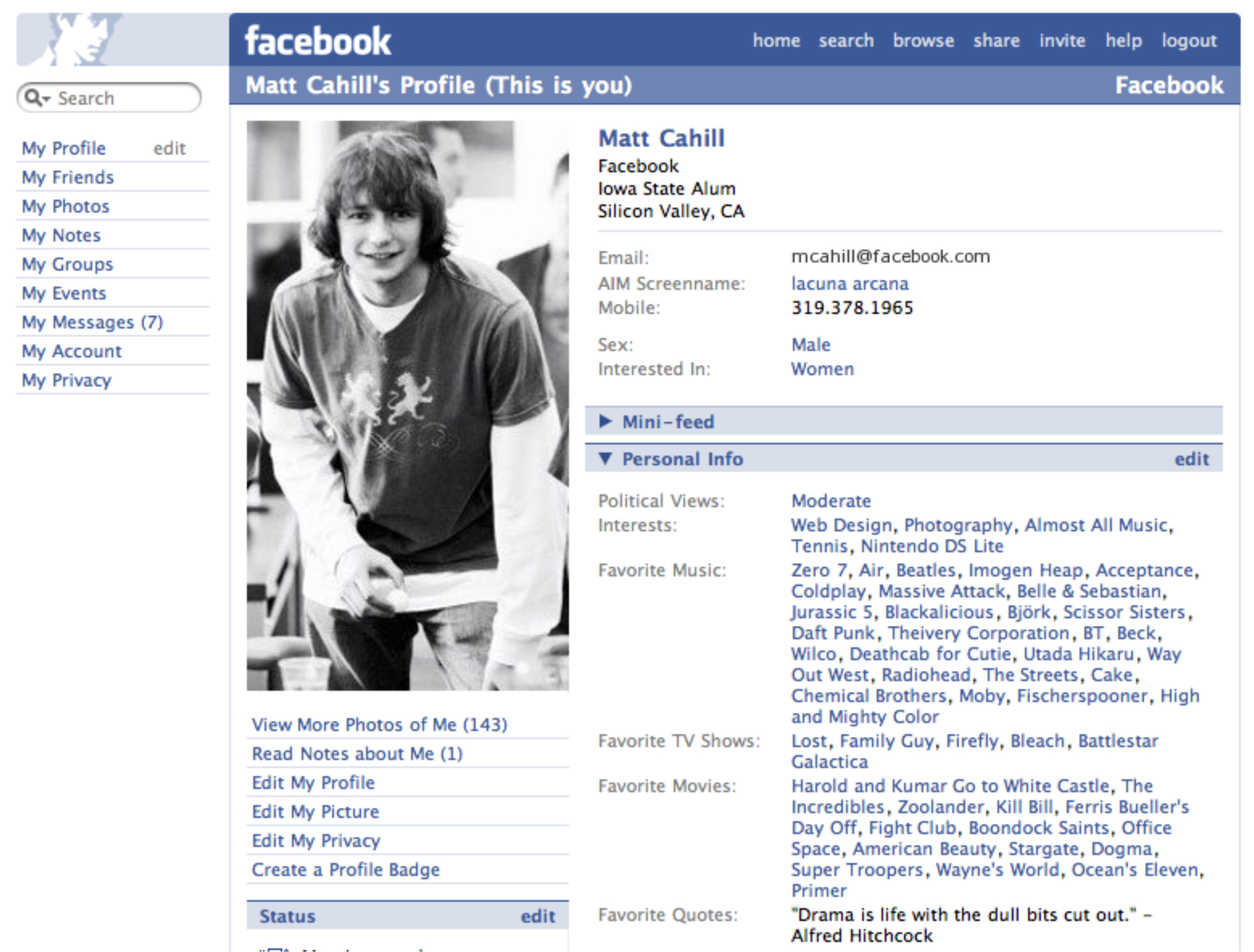
I think it looks so much better than the current design.
—February 2004 Facebook user
High profile accounts cannot work under identical rules or they'd simply all be suspended all the time.
Is everyone at Facebook this naive? You didn't think a system that creates a secret tier of VIP accounts where the rules (and laws) don't apply while publicly claiming the opposite would end up ... in the news?!?!
I was presented with a system I had never configured, which asked me to contact people I don't know to get them to vouch for me. At the same time my FB profile was blackholed, and my wife and long time actual friends can't even see that I exist anymore. Just some person that astroturfed my name with no content (I have a globally unique name).
So I no longer exist from FB perspective, which made both my decision to not use FB as well as never use any FB products like Occulus much easier.
I also assume if he's on the internal network it might be easier to just manually allow auth attemps from a few internal IPs for a few seconds.
This whole idea of “Zuck can’t log in from a new device” is laughable. That’s like saying Biden doesn’t have the keys to Air Force One. He doesn’t need them.
I mean unless you are the 5th directorate of KGB.. but even then shit like this always comes out.
If you have a substantive criticism to make, you should articulate it.
That's not what the article mentioned, which is why people are saying you don't seem to understand. The article mentioned there is a system, which does work for a small minority of people, not that it doesn't work for them. It's as if you unintentionally have blinders on and can't see the issue.
The rest of us don't get that. If someone hacks our account and changes our password, the majority of us have little hope of really getting FB's attention to help us fix it.
The point about popular accounts getting 10000x the number of abuse reports is much more relevant.
It's saying "Do we all agree that some accounts, such as Zuck's, might need different treatment?"
Because once you have established that, it's clear why some other accounts might need different/special treatment compared to the typical user.
A company will make exemptions for very famous people. In every case, when something grows too big, you will find that are special cases that must be exempt from the general rules. There are very few exemption to this. Usually rule of law. Almost anything else has exemption.
Disclaimer. I don't and never worked in Facebook. And I barely use Facebook. BUT I've build big systems that deal with the web and the real world.
That's interesting. Was this because of the volume of mail I/O, for scale/fanout-related performance reasons, or to simply keep responsiveness at p99 for that account "just because VIP"?
Perjury before congress can result in jail time and I hope he's made an example of.
Edit: downvotes from shills
I think I might have agreed with the author of this article before working in Integrity for a few years. But with time I learned that any system that’s meant to work for millions of users will have some edge cases that need to be papered over. Especially when it’s not a system owned and operated by a handful of people. Here’s an example - as far as I know it’s not possible for Mark Zuckerberg to log in to Facebook on a new device. The system that prevents malicious log in attempts sees so many attempts on his account that it disallows any attempt now. There’s no plans to fix it for him specifically because it works reasonably well for hundreds of millions of other users whose accounts are safeguarded from being compromised. His inconvenience is an edge case.
With XCheck specifically what would happen is that some team working closely on a specific problem in integrity might find a sub population of users being wrongly persecuted by systems built by other teams located in other time zones. They would use XCheck as a means to prevent these users from being penalised by the other systems. It worked reasonably well, but there’s always room for improvement.
I can confirm some of what the article says though. The process for adding shields wasn’t policed internally very well in the past. Like I mentioned, this was being exploited by abusive accounts - if an account was able to verify its identity it would get a “Shielded-ID-Verified” tag applied to it. ID verification was considered to be a strong signal of authenticity. So teams that weren’t related to applying the tag would see the tag and assume the account was authentic. And as I investigated this more I realised no one really “owned” the tag or policed who could apply it and under what circumstances. I closed this particular loop hole.
In later years the XCheck system started being actively maintained by a dedicated team that cared. They looked into problems like these and made it better.