This incentivizes abusive behavior by users who want refunds, and cheapens the cost of abusive behavior. This mechanism was discussed in relation to OnlyFans somewhat recently -- creators that wanted to ban abusive "fans" had to refund them. (Unfortunately, I don't have a link handy.)
The problem here is that Facebook couldn't tell OP had been impersonated by an abuser -- as you say, "actions outside the user's control."
But I still had to buy a headset, put in a real credit card, pass Facebooks initial "real identity" checks etc. With real human review and some basic policies to prevent repeat abuse this doesn't seem like something that would really open a wide level of abuse. Perhaps sporadic situations where the headset breaks the user decides its the easiest way to get all their purchases refunded.
It's that brand new price Facebook would be refunding after a ban.
So the same perverse incentive exists even with a 2nd hand market.
Of course no one in their right mind would pay the retail prices for a "rental" so screws the business model, but honestly, they need to pick one, either they are selling products or renting them
This mixed model where they try to have the best of both has got to stop, if you ban my account you need to refund me, done want to refund on ban well do not sell me things, rent them to me under a service
In this case we can’t accurately identify cases where a user has legitimate cause for refund without false positives letting through a few abusive users.
The decision to be made is whether we skew the system to be in favor of the corporation or the consumer.
In this age where we no longer own the software we run I find it strange when people advocate for less protection of the digital goods they use.
1. Allow the user to play it's purchases, just without social features.
2. Refund the user
If this was the law they'd figure it out I promise you that.
it’s their decision to introduce this account, when there is really no need for it, let it be their problem to fully refund everything when this affects you. the solution is simple: quit forcing people to use the account nobody asked for.
The status who incentivizes abusive behaviour from the company, and cheapens the cost of mistreating users
I guess we can’t be purist anymore but being pragmatic is still possible and you can divert funds away from FB this way to a company that cares about the headsets they sell and the user experience
https://www.oneangrygamer.net/2020/06/steam-user-loses-game-...
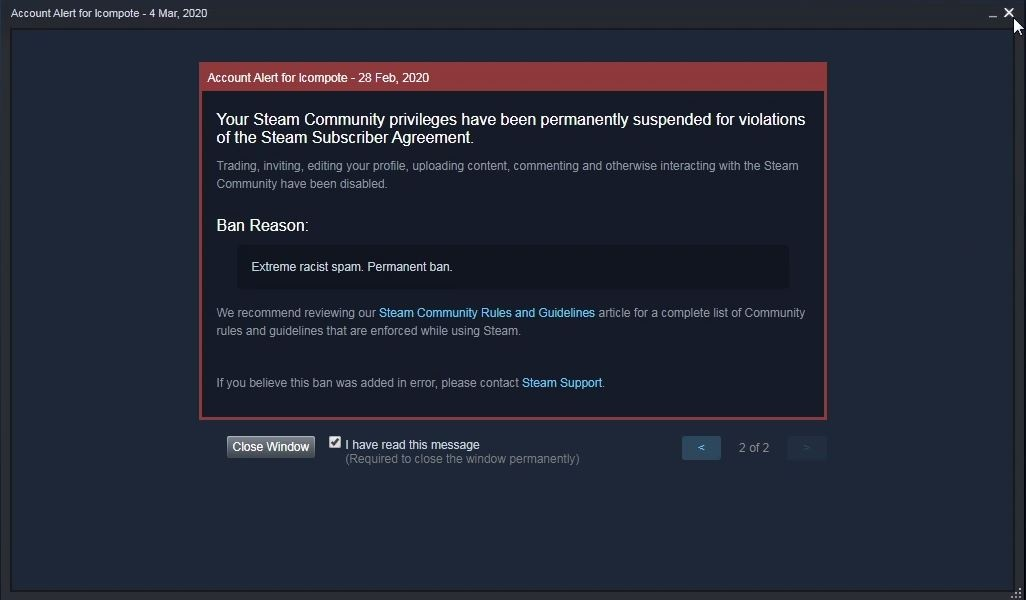
Looks like this user received this message[0] after being banned from the community and only because he mentioned russian law did Steam suspend his account.
> Going to support and blalblab again my rights and the russian law, they slapped me with a perma community ban and 1 month ban to contact the support.
And then people wonder why I'm never buying anything digital. That's the reason. Buying digital makes your continued access to the thing dependent on your account being not banned and the servers being up. In other words, even if you "own" it, you're still at the mercy of the seller. But if you bought something on a physical medium (or torrented), no one could take it away from you.
Remember people who used to have a huge collection of video tapes or CDs? They hardly used them for anything except decoration of their living room. Hoarding old crap that you never use isn't the best use of money.
Physical things can readily be taken away in divorces and debt recovery or less common things like police seizure if you're suspected of a crime. The world's richest man had half his wealth taken like that. Property rights aren't as secure as you think.
Sure, if one buys a newspaper, chances are that one won’t hold on to it for long. But it is important that one can. If one wants to cut out a story from it and hold onto it, perhaps in a scrapbook, one can do so.
It is also important for archival and preservation purposes.
If you're talking about Bezos, all of their wealth was made after they got married. The news can say it's "his wealth" but it always belonged to both of them. It's not "taking half his wealth," it's splitting their co-owned assets.
lets start with this
>The world's richest man had half his wealth taken like that
I assume you are talking Bezo's divorce, you might want to actually look into that if you believe that. he did not have half his wealth taken, far far far from it.
>Physical things can readily be taken away in divorces and debt recovery
That is not being "taken away" in the sense you are talking about in context, for debt recovery it is being "taken away" because you did not actually own it, the lender did, you do not own it until you have paid it off. I own my car, that means I have no debt on my car...
Divorce is not "taking away" it is splitting assets owned by multiple parties. Sure the process can been seen as unfair, however legally the assets is owned by both people, the courts then choose who the new owner of the asset is.
That is a far cry from what we are talking about in this context.
>Just think of it as like paying to see a movie.
But it is not, That would be like a Netflix Subscription, where I pay to access content, not pay to own the content. Ownership and Renting is different.
If they want to rent content there are methods to do that, however most people will not pay the prices they charge for a rental that is why they need to guise it as a "purchase" not a rental
>Remember people who used to have a huge collection of video tapes or CDs?
I used mine, then I ripped them (legally) to enjoy them on other technology... Sad you just used them for decoration. Probably should have spent money on something else you found enjoyable
Who?
People gather enjoyment from different types of things. Not everyone aspires towards minimalism.
It is perfectly possible for games to be sold digitally online with no drm, such that you could easily (without requiring uncommon technical know-how) copy it to a flash drive and run it on a computer with no internet connection.
Of course, games sold this way are extremely easy to pirate, because it is, essentially, pre-cracked. But one can distribute a product like this, and on occasion people do.
But let them keep their hardware running, and access their game library.
Seems good for business, tbh. You might not want neo-nazis posting whatever they want on their profiles, but who cares if they're buying video games?
If the purchases were < 6 months ago, I would do credit card charge backs...
This would put the cost of a ban to Facebook for real users in the order of hundreds of dollars which is more than enough to have a support person do a realistic evaluation of the situation. It also reflects the non-recoverable portion of the cost to most users - you can sell the headset, but you can't transfer the value of the library to anybody. That is a straight up and very significant financial loss.
While other aspects of the ban policy are obviously still very problematic, the fact that an arbitrary ban that is caused by actions outside the user's control can result in hundreds of dollars of losses sits at a whole different level and should be legally problematic for Facebook.