This would never be a real scenario. McMurdo supply runs are not designed for such high transportation costs. With such transportation cost expectations you'd be pressed to lower the mass of the supplies in the first place so that the sum of the cost of preparing the supplies and the cost of transferring them were minimized. You need to compare two Pareto optima completely, not just one axis of them.
That said, the ISS doesn’t do long distance missions dropping off equipment etc the way McMurdo and presumably any Moon Base would. So, the ISS isn’t that great of a model.
ISS has a 90 minute orbital cycle. It requires 45 minutes of power reserve. Not 14 days' worth.
All else equal, a lunar base would require ~500x more energy storage if solar-reliant.
According to the blog post, the dry mass of the fuel cells would mass similar to LiIon of the same energy storage capacity, not counting the mining equipment to get the lunar water.
Also I've noticed that despite of what ben_w claims the article says, the article still assumes 100 kWh/t for a battery system and 1 MWh/t for a fuel cell system. So it doesn't really say that "the dry mass of the fuel cells would mass similar to LiIon of the same energy storage capacity", otherwise the numbers would be in the opposite order.
"""Even using Lunar water, the mass of the cells, condensers, electrolysers, power electronics, storage tanks, and heat exchangers is comparable a Lithium-ion battery, while the round trip efficiency is much lower. And that’s not even including the mass overhead for mining lunar water!"""
Also, that’s just the start. Team fuel cells are also dramatically lower efficiency so you need a extra solar panels and all the associated equipment with that. Which again scales linearly with energy demands.
And solar panels go up to 200 W/kg these days (UltraFlex/MegaFlex design), with up to 300 W/kg in labs. They're the least of your worries.
Batteries at ~90% bump that to 55kg/MWH. Fuel cells at ~30% bump that to ~170 kg or another 110kg /MWh, not that significant but still important.
> assuming an optimistic 1/2 of total weight for solar collection is panels
What does that even mean? 200 W/kg is system efficiency, so not just cells but all the structures involved.
> runs around 50 kg per MWh per month on the moon.
I don't get it. "MWh per month" is 114 watts. A 50 kg array at 200 W/kg has 10 kW peak. At the south pole, a non-tracking unifacial horizontally mounted and elevated array will have at least a ~30% capacity factor, a bifacial array will have a ~60% capacity factor. That's 3 kW or 6 kW on average, respectively, far from your 114 watts.
EDIT: Should have really been 1.4 kW instead of 114 watts - I calculated with 1 MWh per year by a mistake. Still a substantial difference from 3/6 kWh.
> Fuel cells at ~30%
A round-trip from a fuel-cell system will be at ~40%. Maybe ~50% if you use top equipment. But even bog-standard fuel cells are at ~50-55% (LHV) efficiency and bog-standard PEM electrolyzers are at ~80% efficiency, which should give you no less than a 40% round-trip.
It doesn’t but a measure of output from solar panels ignores the storage efficiency which is what we care about here.
> 200w/kg is system efficiency.
You listed that as the panels in your post.
First actual array output falls over time. Whatever it would be new is irrelevant you scale for how long it’s in use. Panels on the moon need to be mounted at an appropriate angle for maximum efficiency, cooling, they need wires to move electric from the panel to your power conversion, electronics to handle that power etc. You also get losses from lunar dust, etc. Simply saying all that doubles weight is a reasonable ballpark.
Don’t forget the moon is dealing with days of full sun panels need to maintain low temperatures for efficiency and you can’t just dump all that heat into the moon.
> I don’t get it
A 50kg array consisting of 25kg of solar panels, at 30% efficiency produces: 25 different 0.2kw panels for 30 percent of the time over 28 days times 24 hours = 25 * 0.200kw * 0.30 * 28 * 24h = 1008 kWh or 1.008 MWh.
Edit: 1.4kW * 28 days * 24h/day = 940 kWh or 0.94 MWh.
> A round-trip from a fuel-cell system will be at ~40%.
I have yet to read about an actual working system over 30% water to hydrogen to water. Do you have any citations or is this assuming some unknown breakthrough?
So why even mention panel efficiency?
> First actual array output falls over time
You always compensate for it, it's not hard.
> Panels on the moon need to be mounted at an appropriate angle for maximum efficiency, cooling, they need wires to move electric from the panel to your power conversion
All included in that figure.
> electronics to handle that power
That is admittedly not included in that figure but PPUs are still fairly lightweight these days.
> Don’t forget the moon is dealing with days of full sun panels need to maintain low temperatures for efficiency
We've already dealt with these things for geostationary satellites, and those are almost always insolated thanks to their orbit.
> and you can’t just dump all that heat into the moon
On the south pole you most likely can, since even though there's lots of sunlight, the extreme incidence angle means that the surface is disproportionately cool.
> A 50kg array consisting of 25kg of solar panels, at 30% efficiency produces: 25 different 0.2kw panels for 30 percent of the time over 28 days times 24 hours = 25 * 0.200kw * 0.30 * 28 * 24h = 1008 kWh or 1.008 MWh.
Heh? A 50 kg array at 200 W/kg produces 10 kW peak and even at 30% capacity factor generates ~2 MWh in a lunar month: 100.324*29.5 = 2.124 MWh.
> consisting of 25kg of solar panels
I already said that the ~200 W/kg for UltraFlex/MegaFlex arrays includes structures, so there's no "25kg of solar panels". There are in fact no panels at all - on UltraFlex/MegaFlex, individual "naked" cells are attached to the flexible substrate of the array directly.
> I have yet to read about an actual working system over 30% water to hydrogen to water. Do you have any citations or is this assuming some unknown breakthrough?
No, it assumes perfectly standard system components. But here you have NASA's RFC demonstrating 50% efficiency in 2006 (already fifteen years ago!): https://ntrs.nasa.gov/citations/20060008706
Those fit on satellites in zero g. The moon has gravity so you support them at an angle you need bracing on something else, or for extra long panels connected to a structure you need bracing inside these ultra flex panels.
In space panels can radiate from their back sides into space, but that doesn’t work on the moon as it hits 260 degrees Fahrenheit in the day. Look up panel efficiency curves with temperature. Cooling during the day is a major concern for a long term lunar base, but also needed for panels.
Further you need cables from wherever they are to where up your using power.
Lunar dust again is an issue for solar panels on the moon vs satellites.
All added up doubling weight may be generous.
> https://ntrs.nasa.gov/citations/20060008706
Sure, and that worked wonderfully a lab. But, production systems need to worry about a great deal of stuff that doesn’t apply in a lab setting. I don’t mean this dismissively yes I completely agree in theory it could work, but it’s just not working technology yet. I haven’t looked recently so hopefully there is a system demonstration out there.
UltraFlex/MegaFlex is rated for 3g acceleration on those satellites even when fanned out, why do you think it would have problems with 0.16g? That's one twentieth of what they're supposed to withstand.
>but that doesn’t work on the moon as it hits 260 degrees Fahrenheit in the day
That's just not the case on the Lunar south pole: https://agupubs.onlinelibrary.wiley.com/cms/asset/60707425-2...

> Further you need cables from wherever they are to where up your using power.
High-voltage cables are not that heavy.
> Sure, and that worked wonderfully a lab. But, production systems need to worry about a great deal of stuff that doesn’t apply in a lab setting. I don’t mean this dismissively yes I completely agree in theory it could work, but it’s just not working technology yet.
Of course you don't; you're just disingenuously moving the goalposts.
You seem to be stuck on just one issue, heat is vastly more of an issue than this.
Anyway, flexing isn’t breaking. https://www.americaspace.com/wp-content/uploads/2012/04/LIFE...
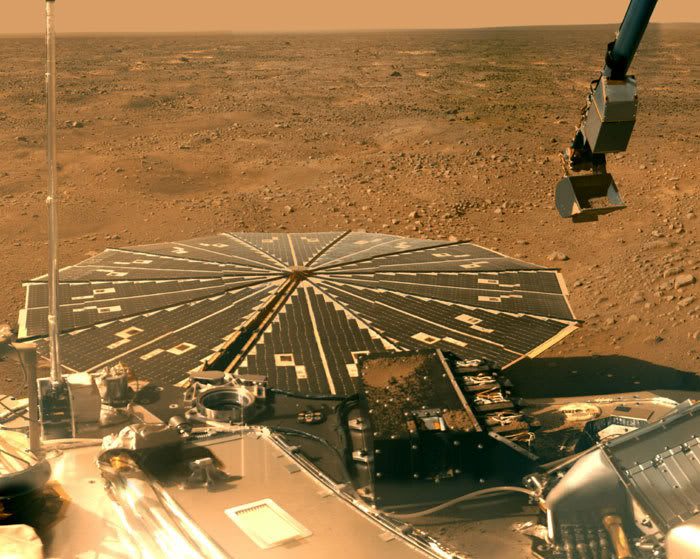
The actual panel on Mars isn’t flat or particularly big. Now, if we’re assuming the Moon mission is going to be at it’s equator then laying them directly on the lunar surface is fine. But big arrays at an angle need to be rigid or you’re losing poster from a using a worse angle due to the curve, either option means more weight for a given power output.
> That's just not the case on the Lunar south pole
Sure, and that deals with heat but now the solar array needs to deal with being at the poles.
> Sure, and that deals with heat but now the solar array needs to deal with being at the poles.
"Now"? It needed to deal with being at the pole the whole time. There was never an intention to put it elsewhere.
Attaching a beam at one end requires a more rigid structure which is more weight, which is exactly what I said the problem was several times.
> There never was an intention to put it elsewhere.
I just said you could lower weight by laying them flat at the equator. My point was simply that isn’t an option, therefore you they need extra support. Operating closer to the poles has both clear advantages and downsides, access to water is a big benefit but it’s not quite as obvious a choice as often assumed.
Not really because that allows you to omit other parts of the original self-supporting "fanned" structure which formerly had a similar role to that beam. Furthermore you wouldn't be building this structure to withstand 3g like the "stock" UltraFlex/MegaFlex arrays but you'd build it specifically to withstand static 0.16g in one axis for deploying after landing on the Moon. Consequently I very strongly doubt that this would give it "more weight" than the current UltraFlex/MegaFlex arrays already have because you're assuming more weight for a flimsier structure and that just doesn't make any sense, unless you'd assume the use of inferior materials for some reason.
And again even at Mars’s 0.38g it’s already bending. It can clearly survive more force, but not at an optional solar collection angle. Use the same thing on the moon near the poles and sure it’s not going to break, but it’s also not collecting 200W/kg.
I struggle to fit "at some times during every hour" into this definition. If there's a 24/7 shop, I definitely don't expect not being able to enter it at some times, or even not being able to enter it 75% of the time.
For example a subway train might only be running every 30 minutes but it still lists hours of operation. The hotel help desk might not have someone there every second, but theirs a difference between someone putting up a “be back in 15 minutes sign” when their on a bathroom break rather than a closed sign when they are leaving for the day. Informally, the existence of a modest wait doesn’t preclude 24/7 service.
> For example a subway train might only be running every 30 minutes but it still lists hours of operation.
But that's a train. It never runs every single moment, so that doesn't make the times with once-per-30-minutes trains different from the times with once-per-10-minutes trains. On the other hand, if it's for example a grocery store, you definitely do expect being able to enter at any moment and purchase something if it advertises itself as "24/7" or "nonstop".
I’m unclear why the blog post is saying this is difficult, as it should be fairly straightforward to make aluminium cables in-situ and just leave them exposed on the surface, the atmospheric pressure on the moon is far lower than the minimum of the graphs on the linked Paschen's law Wikipedia page. (I’m not a physicist, there is a high chance I’m overlooking something any vacuum engineer would consider obvious).
Actually it would be 29.5 days.
If you're mentioning the cycle lengths, the ISS actually has it worse relatively to the length of its cycle than a south pole base on the Moon would have it since ISS can spend up to around 40% of its time in Earth's shadow whereas lunar night can be as little as several days long on some places of the south pole. And if you elevate the solar array by as little as several meters, I believe I saw some papers predicting a period without power as short as 2.5-3 days or so. So rather than a ~500:1 ratio of storage difficulty, it's at least improved to ~100:1 or so. Still fairly bad but not as bad as the simple cycle length ratio would suggest.
The notion of connecting several places with cables is a nice one, and also a neat optimization problem. We should be able to calculate the immediate power curves in different places. Finding a minimum cost combination could be the topic for an interesting study. Long-term, this is definitely what you'd want to do.
But what’s an acceptable delay before purchase. I have definitely spent more than 45 minutes waiting in the line for events etc while their currently open.
It’s all kind of moot as it’s clear what I meant is exactly the underlying reality, but I can see why you object.
That's less than the (inflation-adjusted) Apollo Program budget (which accomplished far less!)
edit: (To be clear, I'm not advocating any course of action -- just pointing out the amazing degree of progress)
https://www.businessinsider.com/leaked-photos-show-chinas-ne...
https://thehill.com/blogs/congress-blog/homeland-security/25...
https://www.popularmechanics.com/military/navy-ships/a359282...
This is an insane position. The US already has a bigger navy than the next 10 great navies combined, 8 of which are close allies. There has never in the history of the world been such a huge power imbalance (the British Empire at its height maintained a navy twice the size of its two biggest rivals). And you think they need a bigger one???
It's not about relative size, it's about desired capabilities. And if China ever makes a move on Taiwan, I think a lot of people will appreciate the "insanity" of those capabilities, just as they've appreciated our policing the world's oceans for the last 70 years.
How many carrier fleets do you need to protect a small colony? And of course, this is assuming the US would actually go to war with China over Taiwan, which is highly doubtful.
> just as they've appreciated our policing the world's oceans for the last 70 years.
That is highly debatable. Most of the world does not appreciate US imperialism.
Then I'll happily debate you and say that most of the word does appreciate US peacekeeping and aid. It's easy to throw around the imperialism word without context. What would you call the Belt and Road initiative by China which now practically owns Africa? And who do you think will defend against it when that situation escalates?
Of course, it should go without saying that most people would much rather live in the US than China. But to most people who are not citizens, the US is much scarier than China. Exceptions such as Japan, Israel, South Korea, Republic of China (Taiwan), Federal Republic of Germany after WWII are just that - exceptions.
According to Gallup poles, the majority of the world fears the US more than any other country.
But sure, some misguided folks might prefer the lifetime dictators of Russia and China much better. I'm sure that'll last until a real conflict starts.
Huge powers are never your friends - that much is certain. Whatever they do is ultimately meant to further the goals of their own citizens (the wealthy and powerful, of course) - this is true of China, the USA, the USSR, and every other empire in history. Some small countries benefit from an empire's influence, when they happen to be in a place where that empire wants stability (for example, Romania has mostly benefitted from US colonization). Other small countries are devastated and thrown into dictatorship (Nicaragua, Cuba, Iran, Honduras, Guatemala, Vietnam, Yemen, Iraq, Afghanistan, Palestine, Syria, to name a few).
Your selective dismissal of conflict is telling. If you're afraid of, and dislike, the USA then that's unfortunate, but it doesn't leave much more to discuss.
[1]https://en.wikipedia.org/wiki/List_of_states_with_nuclear_we...]
Like, I love aircraft carriers, they're so cool. But also physics says not so effective. :S
1. You have to position the rod satellite in the right orbit, or have enough so one is generally over the target.
2. Then when the order comes in to kill the carrier, your 1-ton rod plus satellite has to de-orbit from ~8km/s. Basically it needs the rocket that launched it, but up in orbit to drop it back down. (It's not quite so bad because gravity is assisting rather than fighting as during launch, but it's still a decent de-orbit vehicle.) The de-orbit takes time, and either you're dropping from ~1000km up or re-entering at some kind of ballistic arc from ~200km up.
3. Obviously the carrier will be maneuvering the moment that massive de-orbit burn is detected. So when course corrections will be necessary throughout the re-entry and maybe even into terminal flight, when your rod is hypersonic in the thickest part of the atmosphere, sheathed in sensor-blinding, comms-blackouting plasma.
(I'm assuming a CIWS—point defense gatling—throwing up a cloud of metal wouldn't do much to the rod, nor would an IR missile be able to hit the rod, but maybe those things could alter its trajectory enough to cause a miss.)
4. Then if you actually hit the target, did you over-penetrate it, smashing a 1m hole clean through the hull into the water, or did the rod explode like a bomb against the hull? (I assume the former but am very unsure here.) If it's just an unstoppable but small hole, damage repair teams would patch it and seal off those compartments to keep the ship fighting.
So in the end, you have a very expensive (let's use your $260M), unmaintainable hypersonic slug that everyone can see launch (and who launched it) and it might be able to poke some holes in a carrier.
Or you use normal hypersonic missiles, which should be harder to detect launching, more maneuverable, and might deliver explosive or nuclear payloads.
Or you launch a swarm of hundreds of relatively cheap anti-ship missiles and just overwhelm the carrier defenses that way.
So I agree the dominance of the carrier will last only as long as the next great powers war (and also that guided missile submarines might well be the future) but it's from fear of God raining down tungsten wrath.
1. getting knocked out at the commencement of hostilities by an anti-satellite weapon
2. the Defense Intelligence Agency/National Reconnaissance Office noticing and telling the carrier to change course
3. getting blown up by an anti-satellite missile fired by an aircraft, or a member of the carrier’s strike group
Rods from god are a much more potent weapon when used against static targets!
2. As a species we can land a rocket on a barge, do you think we can't land a big crowbar on a slowly moving target?
3. Might make 2 more difficult but a 1-ton tungsten rod is pretty durable.
Certainly more potent against a static target but with modern tech and one skilled, ethically ambivalent engineer, these days you could probably hit a row boat.
Satellites are not 'sitting in orbit', they are falling on earth extremely fast, and not reaching it only because they fall sideways. Since they go very fast, they have immense momentum. To attack a target you have to steer that momentum elsewhere, and that takes a lot of energy and precision,and you also have a very small attack area for every satellite. So to cover all earth reliably you'll need a constellation with numbers like Musk's Starlink - i.e. thousands of satellites.
However, a huge amount of mass (for dropping) invalidates the former of those.
http://www.projectrho.com/public_html/rocket/spacewardetect....
Just sit up there with a receiver, bank of charged batteries, and just enough awake to monitor for wake transmissions.
Assuming you can successfully attack one, you still have plenty of cruisers, assault ships, support craft, secondary/light carriers, subs, and several other carrier groups now headed straight for you. It's not like countries can't make a crazy plan to take out a single carrier right now, it's what would happen after that is the deterrent.
You're confusing the Air Force and the Navy.
Who is that demonstrated a system capable of delivering these with a CEP that would give it, say, even odds of a hit on a carrier with 100 shots?
> aircraft carrier and destroy how many billions of dollars worth of F22s and ammunition?
$0 billion worth in of F-22s, because Sea Raptor never happened.
The gist was, "Without some sort of recycling and/or use of in situ resources, meeting the lunar settlement goal of 100 people would require delivery of over 1 million kilograms of life-support consumables per year."
And then assuming a PLSS life support system you get to to needing about 5500kg of consumables delivered per person per year.
[1] https://www.liebertpub.com/doi/abs/10.1089/space.2015.0029
There's a lot of science we'd like to do on the moon, chief of which would be to actually test the space-settlement self-sufficiency problems in an environment like that.
With the ISS as comparison, it's not going to be "bam 100 people" it's pretty obviously going to be a process of rotating in progressively larger crews while the systems and bottlenecks are worked out. Not to mention we'll benefit a lot from the sort of focused sustainability research this will generate.
The gating thing may be if lunar dust is workable as raw material for soil or not.
pulling glass for zblan fiber works better in micro g than here on earth. many theorize that low g on moon would also result in a higher quality product than we can make here in earth, and this quality of fiber is very expensive currently up to 1000+ epr meter, if it becomes trivial to make it on the moon, the moon very well could provide all of the manufacturing for the fiber optics here on earth.
there is the helium3 mining argument. although I'm not sure of demand.
it is cheaper to supply LEO from the moon than it is from earth. mining water, growing food, manufacturing rocket fuel, are all possible on the moon, and are a product for Leo space stations. nasa alone payss >6bil a year to resupply the ISS, that's not including Russia, esa, jaxa, etc. not all of these resupplies can be replaced by the moon, but a large portion of them do contain food, and basic products that theoretically could be manufactured on the moon.
mining various minerals on the moon like aluminum may be more expensive, especially at first. but how do you quantify the habitat destruction? regulations may force earth mining into oblivion and make moon a reasonable alternative. not likely to happen, but maybe it should.
as you stated tourism probably will be popular IF you can make it affordable to the middle class.
low g research as a service is also a good revenue model. many people pay good money to have their experiments performed in micro g, it's very reasonable to assume the same will be true for lunar g.
also, all moon/mars bases put a HEAAAAVY emphasis on Insitu resource utilization. early moon bases will be expensive and very likely a net loss. but almost every single plan I see around basically says "step 1. get there. step 2. achieve self sufficiency asap except for complex manufactured goods"
things like water, food, air, fuel, building materials, bio plastics, paper products, basic manufacturing/cnc/printing of tools and replacement parts. most thing short of chip production panel production and super complex manufactured goods are very achievable, and will theoretically mean that 10 years after moon base alpha, very few resupplies are needed
$7bn is 20 usd per US citizen. If the US and EU did it together its less than $9 per person per year.
We can afford vastly more for aircraft carriers or walls between the us and Mexico or farm subsidies admin costs or medicare.
I take the wider point though. Its hard enough to get voters to find money for anything other than pensions, tax cuts or bombs.
People love criticizing Bezos and Musk for spending money on rockers. But I actually think they're fulfilling something we as a society have sadly neglected.
It's genuinely impossible to predict how much money Moon Tourism could generate, until you've built it.
I've always wondered about this WRT "black budgets" and the theories about Breakaway Civilizations; "Of what value does 'Money' have in Space?"
---
Lets assume that trillions are funnelled off into black budgets for [purposes] -- that assumes that hte 'money' (fiat currency (paper/the-concept-of-value/10101010s/etc)) is being used to pay for/buy [goods/services] -- Where the hell is all this money going? is there an economy and a place where such vast amounts are being spent.
Lets assume they are paying their engineers/suppliers/companies/etc - the Deep Workers far beyond the depths of SkunkWorks etc - where exactly is that money going? What are they buying.
This has been the biggest flaw for me in thinking about Breakaway Civs - and spending money/making money in Space.
If we were to assume that the moon had some set of valuable minerals/etc that would be beneficial to mine and then return to earth, where is the value in mining Tungsten on the Moon (given your shipping calc, for example) and bringing that back to earth unless the earth had none of said resource...
Personally, it would be interesting to think about how a production capability could be built on the moon to support the fabrication and manufacture of vessels on a lunar-orbitting ship-dock, which then could carry on to mars/wherever... and pull from the resources of metals on the moon, which AFAIK is supposed to have a lot of metal...
Further, why has Musk constantly talked about "going to Mars", but said seemingly very little about doing a dry-run, proto, etc to the Moon first?
Shouldnt building a Moon-base be much more immediately important than a Bezos-esque trip to Mars?
FFS SpaceX is talking about getting to Mars, but all the required life support eco-system requirements do not appear to have been even addressed?
It all feels amiss... Please enlighten me.
Elon is slightly crazy as most billionaires are, he's just crazy in a very specific direction: some people buy mega yachts, he wants a SpaceX rocket to be landing humans on Mars.
Now in reality...SpaceX can't privately fund a manned mission anywhere. That's got to be a NASA/international thing - if only because the core competencies are so incredibly broad-ranging (SpaceX do rockets - and rockets are already a "here's 50 fields you can contribute a Ph.D to, we need all of them to make this work"). But if your goal is to go to Mars, then you talk about, and build towards, going to Mars and wait for NASA to say "hey we'd like to get the moonbase going".
Which is pretty much what has happened: I have no doubt that in the next 20 years we're going to see a manned mission to the Moon, and I'm very sure that it's going to be a Starship that takes it there.
I'll bet you 100 MoonBaseCoins that China beats Musk to a manned moon landing.
China might land some small lander before StarShip arrives - but with reuse and huge capacity StarShip is an excellent cargo vehicle.
I'm also curious about your assumption that any station on the moon needs to be run for profit from extractive activities or tourism. McMurdo uses a lot of supplies because it can. Its design is not as self-sustaining or fault tolerant as a moon base would have to be. A slightly better analogy would be Amundsen Station.
Perhaps manufacturing? We might find out stuff that is better done in low gravity.
Wow that seems like a lot, which figures for launch and payload delivery are you using? Because NASA was like $1mil per kg to LEO and isn't SpaceX like $5000?
(My gut sense is that if aneutronic fusion is practical at all then it'll be cheaper to build more expensive reactors that can run on terrestrial fuels so cheap we use them for car batteries and as an insecticide, rather than slightly less difficult reactors that are fuelled by magic extraterrestrial unicorn sparkle-dust.)
(I wish I could find the original and link to it. For all I remember it might have been you who wrote it).
(Low gravity is extremely unhealthy. And even a relatively short 1-week stay in such conditions severely affects cardio muscles, so that super-healthy astronauts have to exercise for several hours per day to keep their heart in shape)
Currently, equipment costing tens of millions $USD are thrown away on every launch. It’s hard to overstate the shift fully reusable rockets will bring.
I believe Falcon 9 could be priced a good amount lower and still be profitable on a per unit basis (ignoring ongoing R&D) but SpaceX has little pressure to do so as there isn't a competitor with a similar offering. It's interesting, as once Starship is out it may somewhat cannibalize the Falcon 9 marketshare.
You raise a good point about the shuttle, however SpaceX can learn from that. I'd bet they are striving hard to make Starship more effectively and efficiently reusable than the Space Shuttle was. We shall see how successful they are with that. I'd be very surprised if it was not a significant improvement over the reusability of the shuttle.
Perhaps the real paradigm shift will occur once there are two or more companies with fully reusable rockets such that there is more competitive pressure to cut margins and lower prices.
I’m pretty sure Starship is going to be more economically viable than Space Shuttle ever was, I didn’t mean to compare them directly. And you’re right, $1k/kg to LEO doesn’t sound unattainable even for F9.
With the ride-sharing Starship is totally going to cannibalize Falcon rockets, but I thought that was the point all along? I wouldn’t be so quick to retire F9 though. Even if Starship adoption is smooth, it’ll take years to certify it for crewed flights. And there’s always market for smaller launch systems (Electron seems to be doing well).
This assumes air and water are solved problems and don't need to be shipped.
Note that oxygen != air. 100% oxygen atmospheres are not a good idea for extended stays.
Nitrogen is not common on the Moon. Nor is carbon (for filtering or other organic applications.)
It's not easy to imagine a lunar base generating >$7bn of returns every year. Apart from space tourism, there isn't a whole lot you can do/build/sell on a moon base that has more value on Earth than it would cost to transport back here.
Of course you could argue Science, and that's fair enough. But literally all the commercial arguments I've seen have been "Something will no doubt appear" - which is possibly not going to win over rational investors.