I see it this way, the thought hat we have "destroyed a natural ecosystem" is incorrect. Just as incorrect as when a beaver dams a river and creates a flooded meadow. The beaver, and people, are doing what they do, changing the ecosystem to create a habitat in which they can thrive. Those changes, have changed the ecosystem around them.
What Gedge and others in the article are saying, is that it is in human's best interest to support a diversity of habitats that can co-exist with their own. The benefits are three fold, they keep biodiversity higher (balancing other processes in the environment), they can provide benefits for the humans for "free", and they lower the negative impact of humans on the flora that used the space before humans started changing it for their own use.
An example close to home. I live in a typical California 2 story single family home. Because California homes are typically "next" to each other, the walls on the side of my house are blank since there isn't much point of a window that looks at your neighbors wall or worse inside their house at close range. I built a "bat house" which is really just a couple of plywood sheets separated by 1x2s to attach to the eastern wall. Voila, bats come to live at my house. And those same bats are eating pests such as mosquitos which carry West Nile virus in my area. If we could get all the houses on my street to do the same, the city would likely never catch another mosquito on our street.
So what is the "cost" of that? The bat house takes no electricity, its materials are pretty simple. The bats show up for "free" and take care of themselves. There is a guano disposal "problem" but I just dump it into my compost pile and it adds a crap ton of nitrogen to the soil.
So the net of it is that is saves me money on fertilizer, it saves me money on pest control, and it costs nearly zero to maintain.
How is that not a "win" here?
I don't think this analogy holds, there is a difference between beaver and people: the beaver has evolved and performs services in an ecosystem, and that system has evolved around the beaver within some suitable geological timeframe. Humans are destroying the environment far faster than anything can evolve to.
If Timothy Morton is correct, humans have already destroyed the earth but we don't know it yet because it is a hyperobject.
Humans are just a later stage of life's flourishing than beavers:
Eukaryotes have more extropy than prokaryotes; Multicelled organisms have more extropy than single celled ones; Complex mulicelled organisms have more extropy than simple ones; and humans (once they invented farming and writing) have more extropy than complex animals.
The next stage after that -- the stage we're currently in -- is the industrial revolutuon.
The stage after that is the singularity, when AIs will take over.
But it's all life, doing what it does: expanding, controlling resources, reproducing, etc.
Humans clear cutting a forest is not part of any larger, stable system.
Entropy is a myopic way to frame it
Whales lay dying in fishing nets which trap any and all, their companions watch on, suffocating in our acidic oceans, or choking on a plastic bag, sea birds flying hundreds of miles just to be able to feed on scraps, leaving their nests alone nearly the whole day at the mercy of God, delicate insects burnt to a crisp by gender-reveal forest fires, the very cliched polar bear stands on his tiny piece of ice looking in all four directions for a hint of food, a herd of wild elephants gathers in a circle looking down at their pathetic, poached brethren hunted for a small piece of white sticking out of their heads, turtles being turned into mince meat just to make guitar picks, insects being squished to make colored goo, chickens shitting themselves in fear as they're beheading is up next, all while a know-nothing bloviates self-importantly about AI and Singularity and things he has little understanding of. A shame.
Look at what we've done to the Southern resident orcas in the Pacific Northwest. Kidnapped, murdered, tortured for pleasure and entertainment, poisoned, starved, deafened, stalked, and then gawked out with loud boats. I can't think of a single thing we've helped them with.
Is there a purpose to life? Does there have to be? Humans have invented gods to create a purpose, but the gods don't actually exist.
But if you're looking for a purpose, I quite like this: https://slatestarcodex.com/2015/08/17/the-goddess-of-everyth...
Nature's a beautiful edifice built on the back of hundreds of millions of years of suffering. You could make the argument the most moral thing to do, if you care about the well-being elephants and the turtles and the chickens, is to re-organize it as quickly as is practical and wise.
My viewpoint is simply reality. If you're so full of "bitter spite and hatred", that says something about you.
Your analogy misses the mark by a long shot, and I would say that it's totally irrelevant except that it actually supports the opposite of what I think your point is. Beaver dams, like almost everything we find in nature, sit within a carefully evolved and evolving balance. Beaver damns actually generate and create thriving ecosystems, including benefits for other species, when viewed from a perspective other than a human one. It's only humans that find beavers a nuisance. What humans build does not add to a balance but rather provides an imbalance.
There is no reason to believe, that I know of, that highways and city building, for example, support or diversify or catalyze or <whatever> the ecosystems that they replace and neighbor in any sort of holistic manner. There may be small wins for a very small subset of animal species, but other than that it is destruction and displacement of habitats. Just imagine the next time you're on a highway, even out in the country. Monitor the road kill that you see or the bug splashes on your windshield. They're killed by technology they don't understand while trying to cross a habitat they once crossed freely that is now separated by large swaths of concrete and impassable barriers. Think about all the animals that literally have huge lines drawn in between areas they once roamed. Then notice all the fences, cut grass, buildings, and more that are there and increase in density as you get back closer to the city. All the birds, insects, mammals, and other animals that once inhabited those areas have to go somewhere, or they die off. Now they get condensed and dispersed into areas of tighter competition for resources, all the while still being pushed out by humans in more and more creative ways. There is nothing about this that increases the diversity of ecosystems that once were. It decimates them, literally.
I encourage you to go to a remote place and just notice the area absolutely teeming with varieties of flora and fauna. Then imagine a road there, a house there, etc. and realize what would happen to all that there is there. Then multiply that destruction, degradation, and displacement by the size of human habitats.
Do you know why bat houses are so effective and encouraged by state governments and conversation groups? It's because humans have destroyed and taken over habitat areas for bats, and they struggle to natural find places to call home.
https://www.mass.gov/guides/bat-houses#-why-are-bat-houses-i...
https://www.nps.gov/subjects/bats/habitat-loss.htm
So again, your example supports the opposite of what you think. The fact that bats show up so readily is that they are struggling to find other suitable areas that used to be there.
I would encourage you to think about things from a different perspective when you are out in the "nature" that humans have built. Would you like if another species or even a human bulldozed your house and then built you a little tent to live on a corner of your former plot? Would you call that a "win"? Would you like it if there was, for all intents and purposes, an impenetrable wall or walls built between you and grocery stores and separates you from your family and friends?
What humans have done may be "natural" in a very general sense, but it is almost entirely self-serving. There are clear reasons why extinction rates have gone up and there are countless stories of species struggling more and more in the past 100-200 years.
Fair enough. I agree that if we start from the position that humans are not a part of nature then their impact on their environment is "unnatural." I just find it really hard to support that argument in any meaningful way. I would ask "Are volcanoes part of the natural environment?" When they erupted and created a mass extinction event was that "unnatural"? It is very biblical to put humans "above" nature but that seems to require that the presence of humans on Earth itself is an unnatural state of affairs.
If one subscribes to the theory that Homo Sapiens evolved it feels problematic to me that at one point they were "natural" and at another time they were not. We are quite likely an evolutionary "dead end" if we are successful at pulling off another mass extinction event. But I don't consider us "unnatural", just imperfect.
I would completely agree that our ability to reason has given individuals the capability of choosing how they impact the environment (unlike the beaver that just does what beavers do), but at the same time we are not a 'hive mind' type species where such reasoning was somehow "injected" into every individual.
What the article has advocated are strategies that individuals or small groups of individuals might do to have a different effect on the environment than they currently do. And I think that is an excellent thing.
What I disagree with is that change to an ecosystem is "destruction." It changes what flora and fauna that ecosystem supports, and we may very well change the ecosystem we live in such that it no longer supports human beings. However, if we do that, the world will continue on without us and the ecosystem will continue to change as new flora and fauna evolve to fill the gaps that humans created.
I don't consider it a "cop out" to consider humans to be part of nature, I think of it as a way of looking at human impact in a more dispassionate way. Humans change their ecosystem to support themselves and their offspring. They may do that poorly or in a way that has long term negative effects on their ability to survive, but struggle to define that as unnatural.
What is clear is that humans have continually, and at increasing rates, broken out of the precedence set by everything before in terms of fitting into the existing balance and that this reverberates throughout the world in a way that is on the whole not good for nearly any ecosystem. This is what is argued by people bringing attention to these matters. What doesn't matter is whether this is "natural" or not. What matters is that this is bad for basically everything else, and we've already experienced and we're seeing more signs that it's bad for us as well.
Our propensity for violence and technological development has allowed us to flourish and break out of evolutionary development and "cheat" on regarding what resources are available to us. Other animals are usually checked by nature when resource use becomes problematic. Humans are checked but then adapt new ways to consume resources due to technology and our physical adaptability.
I actually didn't make the point that our ability to reason is the key. Other animals potentially match or even exceed (it is unknown) our ability to reason. Such animals are whales, particularly orcas. So I think our reasoning ability is not actually unique. What is unique is our reasoning mixed with physical attributes that make technology development possible and a selfishness and propensity for violence. This leads to technological development that vastly outpaces social and emotional development, which has led to our ad-hoc world and the mess we're in.
> What I disagree with is that change to an ecosystem is "destruction." It changes what flora and fauna that ecosystem supports, and we may very well change the ecosystem we live in such that it no longer supports human beings. However, if we do that, the world will continue on without us and the ecosystem will continue to change as new flora and fauna evolve to fill the gaps that humans created.
When it comes to human induced change, that change is indeed almost always destructive in that existing flora and fauna are reduced in bother numbers and diversity.
I highly, highly doubt humans are ever eradicated save for Earth-level events (asteroid or something like that). I also think "Earth will continue without us" is another cop out. Yes, it would, but not with out destruction and suffering.
Imagine a world without humans. Every day, millions of animals that are able to feel pain die in horrible agony as they're eaten alive; die of hunger or disease; are afflicted by horrific parasitism, or birth defects, or any of a hundred different horrors.
Earth is a giant ball of suffering, and has been since the first animal with a nervous system sufficient to feel pain evolved. It seems pretty hubristic to lay that at the feet of humanity.
Yeah, if we don't coordinate we might wipe out some species, collapse some ecosystems. So? Those ecosystems have beautiful parts in them, but beauty is in the eye of the beholder; and in any case, their beauty is built on the ongoing torture of (presumably) sentient animals. In that case, bring on the mass extinctions, I say; in fact, we should probably speed them up. Shoot or nuke animals instead of letting them starve to death or be eaten alive.
Maybe we can re-introduce animals once we've made them immortal and immune to pain.
(I don't actually want this, I like nature and forests. But I like them because I find them beautiful, and I perceive their value as originating from humans (and to a lesser extent sentient animals) finding them beautiful. I don't care about them for some other metaphysical reason, and nature is beautiful <=> humanity is evil isn't a viewpoint I've ended up with. )
There are two points. One is that animals and plants suffer in order for others to survive. For the most part, a balance is achieved. Animals and plants take what they need in order to survive, and there's no other way for them to survive. Humans are different. We don't need all the destruction we cause to survive. We simply choose to. The second point is that humans dramatically increase and multiply the amount of suffering in the world. The argument isn't to rid the world of suffering, because how could that even be accomplished? The argument is to reduce humanity's contributions to the suffering.
It is absolutely true that animals do what they do without regard to the consequences of their actions. The western pine beetle doesn't think twice about killing a pine tree that would have lived another hundred years when it uses it to feed its brood. A beaver doesn't poll the prairie dogs that have lived in the meadow for 5 generations before destroying their habit by flooding it.
If I understand your argument correctly, it is applying morality to the question, not whether or not something is "natural." And that is absolutely a fair way to go about it. One can argue that it is immoral for humans to do the things they do. That is separate from the question of whether or not it is in their nature to do those things.
This statement, "We don't need all the destruction we cause to survive.", is also a problem since if we immediately restored all of the habitat we "destroyed" to convert it to agriculture then there would be a lot of "not surviving" going on.
That we should be good stewards of the planet is something that I think we agree.
My original comment here is that we have to consider human's impact on that planet to be just as 'natural' as the impact of non-human forces on the planet. And it helps in the debate to understand how much of our nature we, as individuals, can influence. Humans are inherently tribal/social animals and as such we are strongly influenced by the "norms" of behavior around us. A really good recent example of this is masking. In an area ambivalent about masking, masking behavior reflects what others are doing. A lot of people wearing masks? More likely to wear a mask. Few masks in sight? People less likely to wear a mask.
Because of this effect, we can (and I think should) influence others to good behavior by exhibiting good behavior. And in the original article this was called out as buildings that increased wildlife diversity over buildings that did not provide habitat. That is both a good and 'moral' thing to do.
To bring the conversation full circle, the original comment to which I responded included this: "Have less buildings. Leave more undeveloped land. Reintroduce predators. Remove invasive species. Allow nature to take over (it will)."
We do that by creating park areas. Not by tearing down existing facilities[1]. The philosophy that we could "fix" things by removing human change is unrealistic given human nature.
[1] Yes we remediate things like mines to revert them back to their state prior to mining but it is rare that a former city will be remediated back to nature. See Detroit as an an example of an opportunity to do so which was not pursued.
>there's already suffering in the world, so why do anything about it?
No, that's not what I'm saying. If I care about suffering, I only care slightly (instrumentally) whether it's caused by humans or nature. You seem to care a lot, but I don't. If I 'm going to decide to care about the suffering of animals generally, then that's going to lead me to certain conclusions.
If humans are going to take responsibility for animal suffering, we should take responsibility for all animal suffering, meaning we should reorganize/destroy the ecosphere, replacing it with something more moral. We should also become able to be wise stewards of the new world, of course.
But if I put myself into the mindset of "I care about the suffering of animals", then going from that to "humans should be hippies and let nature be, man" seems pretty evil. If the suffering of animals is bad, then nature is bad and should be stopped.
>For the most part, a balance is achieved. Animals and plants take what they need in order to survive, and there's no other way for them to survive No, animals and plants take as much as they can get, and most of them don't get enough. The ones that don't get what they need in order to survive die, by starvation or by being got by a predator. The balance here is on a see-saw greased with the blood of living things: if I built a system like that, where little furry animals reproduced until there was no food left and then competed increasingly frantically, with some of them eating the others, and then turned around to you and said "look, they've reached a balance! As many of them die horribly as are pumped out! :)", you'd call me a psycho. You're only excusing it because it's natural. It's mathematically beautiful, of course!
>The argument isn't to rid the world of suffering, because how could that even be accomplished?
Wipe out the natural world: Evacuate humans and scans/genomes of all the animals we're interested in somewhere else and build a paradise there; then wreck the surface of the earth so that nothing bigger than a bacterium can survive. Maybe we could engineer runaway global warming, to turn earth into something resembling Venus? Deliberately irradiate the whole surface to the point that nothing survives? Build lots of orbital mirrors to increase the solar irradiance and boil the oceans? Grey goo? Dream big!
If this sounds horrible to you, then I guess you have an aesthetic preference for forests. That's fine, but remember that forests and jungles are hell-pits of torture.
I took a vacation at a 50+ year old home near a river and my goodness, there was just so much LIFE all over. Species of insect I had never seen before, along with land mammals scurrying about. It is absolutely amazing how sterile living in a city / exurb is compared to someplace only mildly affected by human habitation. And it's not like I was living in a concrete jungle either, there are lawns and green spaces but they are just so much more hollow than I ever imagined.
AFAICT there are two main factors:
1. A nearby stream which is part of a protected greenbelt -- never more than 100m wide or so, but miles long.
2. The fact that the area has not been torn up for construction in a generation, so the plants have had time to overgrow everything. I assume the wildlife largely follows the plants.
Of course there aren't any larger animals who need room to roam, because they couldn't survive crossing all the streets. Cars are one of the biggest barriers to wildlife and humans coexisting nicely - or to humans and humans coexisting nicely.
The issue is agriculture which takes up 50% of all habitable land.
https://ourworldindata.org/land-use
We have a really strong bias towards what we see around us, and for an overwhelming amount of us we see the cities, we see buildings, we see roads.
Another alternative is to stop subsidizing absurdly inefficient things like factory farming. If someone is selling beef produced by grazing semi-wild land, great! But intesively cultivating land to harvest it to fed it to cows locked in a pen sucks.
It's obviously not simple to redirect some of that to human food (e.g. wheat with low protein is fed to livestock, high protein is used for bread) but still, worth having the conversation.
But it would also reduce unemployment. I know pre-industrial food production was a massive undertaking, but we don't need to go all the way.
Hunger has mostly left humankind (any famines are first of all political troubles, not lack of food), but this was made possible by improving yields several fold. It's hardly possible without pretty heavy augmentation like fertilizers and pest control.
However, to enable that we'd probably have to get away from monocultural agriculture which is not only an issue for agriculture, but for instects and other wildlife as well.
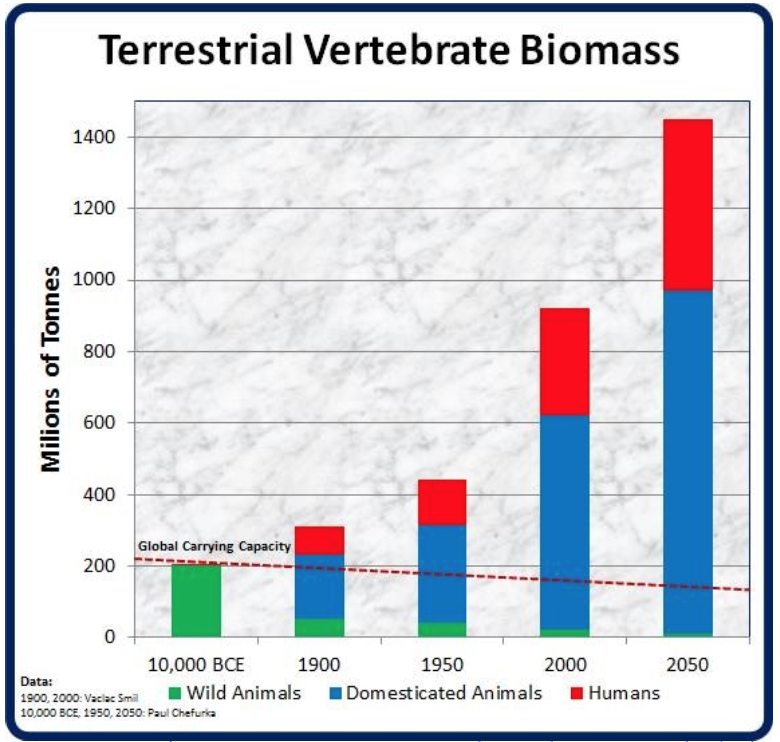
Compare the livestock vs all other mammal biomass from the first chart in this paper https://www.pnas.org/content/115/25/6506
edit: or just look at google earth and look at the amount of land used for agriculture
I think even imagining people were willing to give up meat humans still use way too many raw calories for anything like sustainable organic agriculture to be workable. Maybe it would be interesting to know what percentage of the land dedicated to raising meat is for feed vs grazing. Grazing land is usually more marginal than farmland so while overall good to let it go back to nature it won't replace the sort of biodiversity that turning Kansas back to grasslands would
Also I don't trust it as much, but if it's true that humans right now make up more biomass than all land animals before we exploded it seems difficult to imagine us keeping up without continuing to have huge impacts on the planet, better to keep those impacts dense and controlled than everywhere https://www.greenpeace.org/static/planet4-international-stat...
How long till robots can do that sort of work? At that point, you can have super-green-bio gardens (fields) worked and pruned 24/7 at the cost-over-time of the robots (and whoever/whatever oversees them, plus manure I guess).
We already have a version of this- called a combine harvester- but the more sophisticated farming tech gets, the more it can reduce reliance on e.g. pesticides without reducing yields.
I also encourage those interested in this topic to do this. Exact percentages are interesting, but it is still abstract. Give yourself and hour and just go look for wilderness using google earth. Our stewardship over the planet, if such a thing ever was, has had a sad outcome.
This is why I come to HN. Beautiful!
Example: https://dgunderblog.wordpress.com/2015/06/29/when-is-it-okay...
Ones sensoric deprivation is another ones stress.
The big problem for me is externalities that affect that untouched world. Industrial and agricultural runoff, different pesticides and things like that.
The article is mainly about green roofs, but wildlife bridges would perhaps be an even more important example of "building for wildlife".
https://www.nationalgeographic.com/animals/article/wildlife-...
I even saw a few under the highway in the prairies in Saskatchewan and Manitoba. I think those were mostly for moving livestock across the highway though.
Animals need corridors to move between populations
Green roofs would improve the temperature of our homes making to spend less in energy. We should build more, just by our own interest. They are nicer to see than just a roof also.
50% of habitable land is used for agriculture.
uninhabitable land includes tundra, desert, exposed rock, mountains etc. That's ~29% of all land.
Hedgehogs maybe, but I think in the case of bees humans like fruit and honey.
Leave nature to its own devices to recuperate. It does that surprisingly well if there is a bit of water, sun and soil.
I agree. Let's start by demolishing the building you live in, the building you work in, and the buildings you buy food in.
What, you didn't mean those buildings? Well guess what, no-one wants the buildings they use demolished, so this idea is a total non-starter.
Wait until you see how much more water and land and ecosystems are destroyed by hipsters insisting that "organic is healthier" and "gmos aren't safe"
How much do you think a yuppie city-dweller's medium-density apartment and train usage offsets the rest of their consumption?
For a simple example of this sort of scale efficiency just take a vat of molten steel for one - a larger vat has more volume with less surface area. For a contrasting illustration of an extreme in the other direction, many thimble sized steel vats would be extremely inefficient as they cool off quicker and either need more of them or give it far more time to cool off.
Housing is linked to transit needs as an inevitable knock on effect. The lack of scale is what makes individual cars less efficient than loaded buses.
I would be perfectly willing to consider hard numbers - there are all sorts of counterintuitive truths.
[0] (clickbaitish summary) https://ensia.com/notable/which-diet-makes-best-use-of-farml...
[1] (original) https://online.ucpress.edu/elementa/article/doi/10.12952/jou...
It's about 27% of the way there (assuming europe == EU). Multiply by 7.8B people and you get 2.1B acres, compared with the 2.3B acres actually used worldwide.
Those numbers might look a little fishy (2.1B should be a hard lower bound, and the upper bounds were >2 acres per person), but the low figure of 2.3B acres in actual use is roughly explained by:
- 9% of the world is malnourished
- Meat and other high-land-use foods make up well under 20% of the global diet (on average more concentrated in wealthier, lower population nations).
- Not all of that meat comes from the land, skewing the exact metrics being used a bit.
I'm sure the 0.3+ acre estimate isn't perfect (back of the envelope calculations suggest soybeans can supply the requisite calories in 0.15 acres, and your other nutrients can be furnished in 0.05 acres), but it definitely appears to be in the right ballpark.
Forcing lower numbers of humans is not unheard of; usually this is considered cruel. Mass killings aside, take a look at policies enforced by India and China in 1970-80s.
Choosing not to have kids is myopic: if your genes make you more conscious and thus caring about the planet as a whole, removing them from the gene pool lowers the chances that next generations would share these traits of yours.
The best medicine found so far is exactly what the ultra-green do not like: urbanization, education, higher standards of living, minimal numbers of people doing the traditional countryside agriculture. This puts reproduction rates safely below the replacement rate all over the world, no matter what culture and religion.
You can put every living human on Sicily and still have space. The problem is that 99% would have died of thirst after a few days.
I think today is earth overshoot day, so we used resources the earth could recoup within a year. That problem isn't solved with everyone moving into cities, it is externalities and our resource consumption. Maybe cities are a few percent more efficient, but it doesn't really matter that much. Cities are also relatively unhealthy in most cases. Living expectation are countered by the proximity of medical professionals perhaps.
edit: It is indeed today:
Have less buildings. Leave more undeveloped land. Reintroduce predators. Remove invasive species. Allow nature to take over (it will). And news flash: hedgehogs and bees are only being saved because humans think they're cute. What we actually need more of are creepy crawly insects, weeds, grasslands, bushes, forests, wetlands. You know, that "undeveloped" land that was here before we bulldozed it all and installed strip-malls on top.