Another alternative is to stop subsidizing absurdly inefficient things like factory farming. If someone is selling beef produced by grazing semi-wild land, great! But intesively cultivating land to harvest it to fed it to cows locked in a pen sucks.
It's obviously not simple to redirect some of that to human food (e.g. wheat with low protein is fed to livestock, high protein is used for bread) but still, worth having the conversation.
But it would also reduce unemployment. I know pre-industrial food production was a massive undertaking, but we don't need to go all the way.
Hunger has mostly left humankind (any famines are first of all political troubles, not lack of food), but this was made possible by improving yields several fold. It's hardly possible without pretty heavy augmentation like fertilizers and pest control.
However, to enable that we'd probably have to get away from monocultural agriculture which is not only an issue for agriculture, but for instects and other wildlife as well.
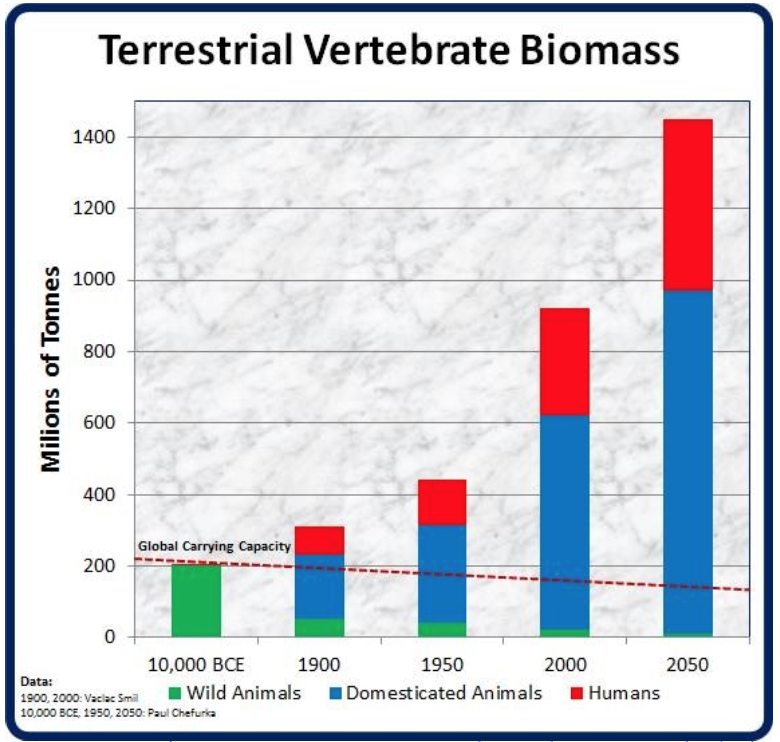
Compare the livestock vs all other mammal biomass from the first chart in this paper https://www.pnas.org/content/115/25/6506
edit: or just look at google earth and look at the amount of land used for agriculture
I think even imagining people were willing to give up meat humans still use way too many raw calories for anything like sustainable organic agriculture to be workable. Maybe it would be interesting to know what percentage of the land dedicated to raising meat is for feed vs grazing. Grazing land is usually more marginal than farmland so while overall good to let it go back to nature it won't replace the sort of biodiversity that turning Kansas back to grasslands would
Also I don't trust it as much, but if it's true that humans right now make up more biomass than all land animals before we exploded it seems difficult to imagine us keeping up without continuing to have huge impacts on the planet, better to keep those impacts dense and controlled than everywhere https://www.greenpeace.org/static/planet4-international-stat...
How long till robots can do that sort of work? At that point, you can have super-green-bio gardens (fields) worked and pruned 24/7 at the cost-over-time of the robots (and whoever/whatever oversees them, plus manure I guess).
We already have a version of this- called a combine harvester- but the more sophisticated farming tech gets, the more it can reduce reliance on e.g. pesticides without reducing yields.
I also encourage those interested in this topic to do this. Exact percentages are interesting, but it is still abstract. Give yourself and hour and just go look for wilderness using google earth. Our stewardship over the planet, if such a thing ever was, has had a sad outcome.
This is why I come to HN. Beautiful!