But if you like those, you should try the berries of haw and ash. They're similar in texture, lack of flavor, and seediness, but their mouthfeel is significantly improved by the lack of scales.
However the honey from them is absolutely special and delicious. The honey is bitter. I fell in love with the honey from the strawberry trees in Corsica.
> imagine a park or botanical garden where every species is edible.
Make it happen! If the way we’ve been doing things is dumb then there is a massive market opportunity. Save the world, become the first trillionaire.
e.g. An idea to plant a garden with entirely toxic plants is just as valid, but not as valuable.
Useful models are still models after all.
Money does represent value of some kind, right? Whether that's time, labor, or [fill-in-the-blank]. It's a tool to represent generic value.
I'm interested to hear what you think a better unit of measurement might be for determining whether or not an idea is 'valid' or worth doing. Can you elaborate?
It does seem like folks are catching on though. Business can be slow to adapt, especially in agriculture, but farmers are pragmatic. Brown's talks seem well-attended.
In large farms, seeds are mass produced, engineered, and go through a QA and testing process to prevent certain diseases. There are many good reasons, BTW, why farms don't grow perennials and engage in mono-cropping, or use herbicides and genetically engineered crops instead of no-till. The trade-off in abandoning these practices almost always involves sacrificing yields and the mechanization of labor.
> The trade-off in abandoning these practices almost always involves sacrificing yields and the mechanization of labor.
The problem (that cannot be escaped) is longevity. Any system of agriculture that does not increase over time soil fertility and volume/mass is doomed.
Systems of agriculture that deplete [various measures of biological health] over time are akin to mining. Once the underlying resources are exhausted the story ends (the resources in question could be water, or biodiversity, or climate stability, etc...)
Even if we compensate with technology, we are substituting our managed system for a automatic system that has been (meta-)stable for billions of years. We should proceed carefully. The billions of people who owe their lives to the Haber-Bosch process (and other innovations) may come to rue it if we crash due to environmental destruction. By some scientific estimates this is the decade when our biomass and the biomass of our agriculture outweighs naturally occurring biomass. For better or worse the world has become our farm.
That's why Gabe Brown (et. al.) seems so important to me: he is integrating modern practices with new (scientifically-validated) regenerative practices and his farm is both profitable and healthier year after year.
> There are many good reasons, BTW, why farms don't grow perennials and engage in mono-cropping, or use herbicides and genetically engineered crops instead of no-till.
But sometimes the pests and disease are caused by these same practices, right? Like, I'm aware the Cavendish banana we all eat is very susceptible to a fungal disease that is slowly spreading around the world. Because we produce so much of a single variety, where all plants are clones, a single disease can be highly disruptive. If production was evenly distributed over many varieties, and if plantations had banana plants separated by other useful crops, the whole system might be more resilient.
Or how about vineyards?
It turns out that when we understand what the plants and animals are doing in detail (through science) we can arrange them in time and space in ways that are vastly more efficient than what we've been doing these last ~12k years.
Think about it, if it wasn't so that would mean that our ancestors discovered optimal farming in antiquity, eh?
Just think: we used to burn chaff rather than composting it. It turns out that that is not a good idea. It's that sort of thing that I'm thinking of when I call ag "the dumbest way" to grow food.
Farming has undergone several fundamental changes throughout history after that though, notably in medieval times and then everything industrialization brought
Can you name some that can't be reduced to "but on a [insert new machine]"? The only one I can think of is artificial fertilizer, which isn't a sustainable practice in the long run either.
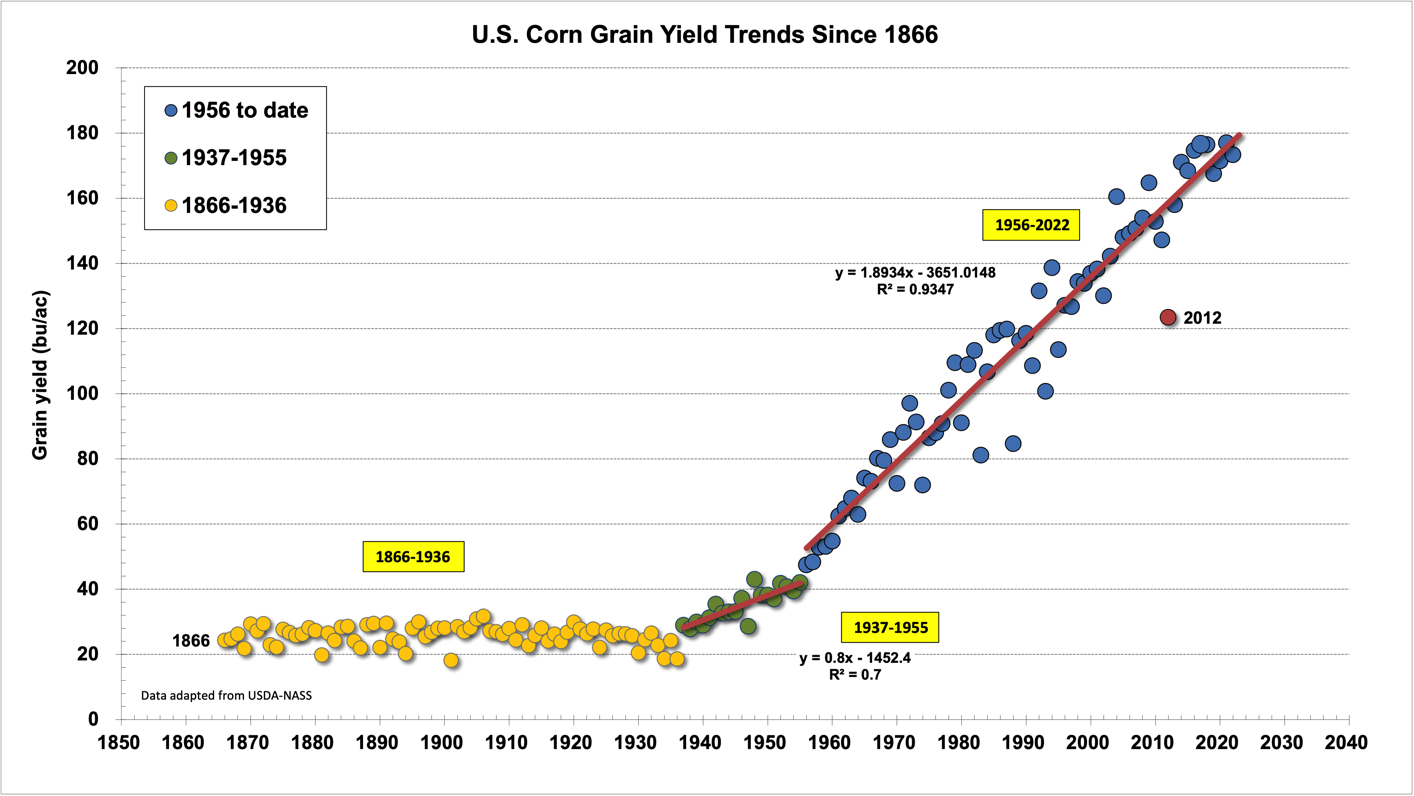
It may take years for new practices to be widespread and accepted, but I assure you, if you can make that chart continue to go up, ~every grain farmer in the US will happily be on board.
There is a certain world-view and a romanticizing to farming, but at the end of the day, farmers are businessmen who just want to grow as much food as possible, as cheaply as possible. They may grumble as much as a software developer when forced to learn new tools, and they won't drop everything for an unproven promise, but they'll happily abandon their old ways in favor of new ones once they're proven.
Compared to that every other revolution in farming was insignificant.
This assumes both systems are optimizing for the same thing.
We know that evolution is optimizing for continuation or duration (technically "evolution" isn't a thing, it's a non-volitional chemical tautology with no purpose or intrinsic meaning so "it" cannot optimize, however, in practice, life is optimizing for more and continued life, overcoming radiation, impacts, and it's own consequences (like the advent of oxygen and aerobic metabolism)) so what is the other system optimizing for?
(As an aside, is "life is optimizing for more and continued life" a definition for "life"?)
It takes volunteers real work to keep it tame enough for a city, but they’ve done it for as long as I’ve lived here and it’s a really beautiful spot.
One perk of this style of gardening is that, for various reasons, pest moderation seems to happen automatically. No pesticides are required, the garden is watered by humans only a handful of times in summer, and no fertilizers besides city compost are used. Everything is lush and happy. Insects are everywhere, and perhaps birds are eating those instead of berries. It's hard to say exactly how each biome functions, but this one is very productive and animals aren't a problem for it.
> One take-away is that agriculture as it has been practiced is about the dumbest way to grow food. [...]
One very useful technique in modern agriculture is crop rotation. https://en.wikipedia.org/wiki/Crop_rotation
You grow each year a different crops, because they have different fertilizer requirements (and some even fix Nitrogen) and also helps to reduce some plagues. It's also possible to plant different crops in succession, so you get multiple harvests in the same year.
For these, a perennial version is bad.
Cool reference that I hadn't heard of before, so I just looked this up. The fruits of this tree look absolutely nothing like strawberries (more like lychees, IMHO), so I don't think this is a good example for what you're describing.
https://en.wikipedia.org/wiki/Potentilla_indica
Incidentally: from a botanical perspective, strawberries are not berries. Nor do they even taste like straw!
[1] https://i0.wp.com/oaeblog.com/wp-content/uploads/2018/06/Ger...

Today I learned that papaya is closely related to cabbage.
cran-, elder-, lingon-, among others.
(Also, the fruit of the strawberry tree, unlike either strawberries or mock strawberries.)
No plant nursery will sell you a Raspberry Jam Tree, but you can buy seeds on Etsy: "Acacia acuminata".
They are interesting also because the leaves (which aren't leaves, but "phyllodes") and bark have a high concentration of interesting tryptamine alkaloids.
There are many other fascinating details about A. acuminata. Millions of fenceposts in Australia more than a century old (and more every year!) are made of its wood.
I just want to point out that the way modern agriculture came to be is not dumb at all, the thing is that its focused on maximizing yield above other things. 7 billion people eat something (almost) everyday, I find it quite impressive that the infrastructure to support that, exists.
I hope the world could be stopped (as it happened, more or less, with COVID) in order to fix some of these problems, but in the case of food, it's going to be hard to ask people to stop eating for a while.
It still loses in profit per investment to modern industrialized farming, so (almost) nobody cares. If you want people to care - tax soil degradation.
Turns out with artificial fertilizers and modern technology neither work nor soil degradation is as important as quick adaptation to market forces and economies of scale.
How old is it? How is the taste? Is the cane woody or is it more like bamboo or something else? Does it flower?
Sometimes annuals are just handy to use the land in a more efficient way. You can obtain three crops in two years in the same land with annual species
I don't even know where to start.
In re: TFA, most annuals that we use for crops have perennial versions. I just planted a "thicket bean" (Phaseolus polystachios) which should grow for years! There are perennial kales that grow into small tree-like "canes". There's a thing called a "strawberry tree" that is exactly what it sounds like: a tree that grows strawberry-like fruit. It goes on and on.
One take-away is that agriculture as it has been practiced is about the dumbest way to grow food. :( Check out Gabe Brown's videos on regenerative agriculture to see how we can grow food and increase fertility and volume of soil by incorporating more species and doing less work. See also the "food forest" concept: imagine a park or botanical garden where every species is edible. It takes a while to set up but then it is self-sustaining with low labor, you mostly just harvest.
Another take-away is that we mostly already have all the technology we need to make a really fun and enjoyable civilization. We have all these species that can develop food, medicine, clothing, fiber, wood, etc. such that the vast majority of our needs can be fulfilled in a garden.