You don't know this at all - we don't know what age groups are affected here, and COVID is pretty much negligible in many younger age groups. It's best to wait for more data to come in before drawing any conclusions.
Risks of long-term consequences don't seem to be all that low.
A year ago there was a lot of noise about things like heart issues induced by COVID, which turned out to be mostly statistical errors in the papers that made the claims.
A lot of people (often people who never actually had a positive test) also claim to suffer from various mental impairments after their COVID infections, and some newspaper ran an article saying that some of these symptoms were alleviated after the people were given anxiety medication. Go figure ...
Check out this: https://www.biorxiv.org/content/10.1101/2021.02.23.432474v1
The Spanish Flu has led to a „sleeping sickness“ epidemic years after it ceased.
> Since encephalitis lethargica’s (EL) prevalence in the 1920s, epidemiological and clinical debate has persisted over whether EL was caused by, potentiated by, or merely coincident with the Spanish influenza pandemic. Epidemiologic analyses generally suggest that the disorders were coincidental.
https://en.m.wikipedia.org/wiki/Encephalitis_lethargica https://www.ncbi.nlm.nih.gov/pmc/articles/PMC2778472/
https://www.cdc.gov/coronavirus/2019-ncov/long-term-effects....
I’ll let the eventual studies give the percentages. But my (personal, non professional) take on this is that long-hauler experiences are a LOT more common then people realize, have been fairly ignored while people have fixated on the death count, and have big possible implications for quality of life for younger, otherwise healthy people.
Long covid:
> Estimates of the number of people with long COVID vary widely. In July, the US Centers for Disease Control and Prevention reported that one in five patients 18–34 years of age without chronic medical conditions and with a positive outpatient test had not fully recovered by 2–3 weeks after testing, and a research center in Rome found that 87% of 143 patients reported persistence of at least one symptom 60 days after onset of the disease. According to a preprint published in October that has not yet undergone peer review, 24% of 233 patients still had symptoms at 90 days after infection. Data from a smartphone app, as reported by the COVID Symptom Study, showed that one in ten patients with COVID-19 have symptoms after 3 weeks. Given the scale of the pandemic, if even only a small percentage of the tens of millions of infected people worldwide develop long COVID, a staggeringly large number of people would need long-term follow-up and treatment.
"Paediatricians in Israel, which has surged ahead in vaccinating its adult population, reported a sharp rise in covid-19 infections among young people, with more than 50 000 children and teens testing positive in January—more than Israel saw in any month during the first and second waves."
A single metric (e.g. positive tests) is not enough to assess any severity here, and even those metrics come with caveats because all of our methods of determining them are imprecise.
https://www.economist.com/graphic-detail/covid-pandemic-mort...
> Moreover, the database is not a representative sample of the sars-cov-2-positive population. Because it only contains records from people who have interacted with a medical service provider, it excludes those who weather the disease at home without medical assistance.
This will exclude the vast majority of people in younger age groups who were affected. Serology studies have shown us that in many densely populated places infection rates have been far into the double-digit percentages - if this statistic was true in the way you interpreted it, we would know that by now.
But in Germany and Europe children can't get vaccinated and by the time young adults can it will be September anyway.
>Or let people have a choice in determining whether the risk is worth it for them.
Are there any countries where the vaccine is mandatory? That choice already exists doesn't it?
On the other hand, getting a potentially faulty vaccine would seem to mostly only be a risk to the individual, although I suppose there is some risk of overwhelming hospitals still.
Please just stay home for a few more months so this shit can finally fucking end. It’s already been a year.
Edit: an important factor, too, is that understanding the potential risks of the AZ vaccine is hard, and the average person may not expected to fully understand them. Right now, it seems like even the authorities don’t understand them.
I'm not sure what your point is with the apparent difficulty of understanding the risks of a new vaccine. Are you saying "it's hard, so just trust what the authorities tell you"?
To be clear, we’re talking about the risk of the AZ vaccine specifically. It seems like there might be something specifically wrong with it. Ceding approval authority to bodies like the FDA is how medicine is regulated all over the world. That’s how literal snake oil is blocked from sale. Among other things, it prevents desperate patients from making uninformed, dangerous, and expensive treatment decisions. The average person really isn’t equipped to read a medical study and adequately interpret the results. This information isn’t even at the maturity level of a study, and the risk is that people hurt themselves and undermine the confidence in this vaccine and others.
As for your comments on regulation - yes, that is correct, which is why I was surprised when I got so much flak for pointing out that, at least in the UK, regulatory shortcuts were taken to rush the approval of Covid vaccines.
There were shortcuts taken in all countries to get the vaccines out. In the US, there is no FDA approved COVID vaccine. Every “approved” vaccine is actually under an emergency use authorization.
FWIW, the LCD of most relevant studies show that maybe banning large gatherings is useful, whereas all other measures we've invented in the meantime have dubious efficacy at best - and extremely high costs.
There are plenty of places in the world that didn't implement the "fight COVID at any cost" policies and they're doing just fine. Trust me on that, I live in one of them.
(Edit: Deleted second paragraph that wasn’t clearly worded.)
Covid is transmitted mostly during its mild phase, it only becomes severe a week later, if you are unlucky. If you are lucky, you clear off the infection and gain relatively strong immunity. For the virus, both scenarios are similar.
The only thing is that if it was just a cold, we wouldn't bother with preventive measures and the virus would spread more easily. However, when both the lethal and nonlethal variants are present, the nonlethal variant doesn't have an advantage since we treat everyone the same way, so it is unlikely for the nonlethal variant to take over on its own. At least not on a short timescale.
The solution is to create our own nonlethal variant, also known as a vaccine. Well, vaccines don't spread, I guess we could make a vaccine that spreads but "what could possibly go wrong..."
The virus needs the host in order to spread. The virus doesn't have any other ulterior mechanism that wants to kill humans.
This is why spanish-flu virus got weaker over time because as it evolves, if it kills humans rapidly, it cannot evolve. So, nature sorts it self out.
http://www.iayork.com/MysteryRays/2007/08/26/rabbits-1-virus...
1. If holding off AstraZeneca vaccine does not affect vaccination rate during the investigation period, it is a prudent thing to do.
2. If vaccine rate is expected to drop, number of expected increase in death per day due to covid vs blood clog should be compared, if we were to minimize short term death.
3. More concerning is unknown effect that could take a long time to materialize. This is a tough call to make since any effect is only theoretical at this point.
It is (or was), AZ was to supply EU with 500M vaccines this year but changed that to 200M.
EU got really served on the vaccine front, UK got more from AZ, US got more from Pfizer/Moderna (both have 3x more vaccinated than EU). And each transport that we ought to get is smaller or dalayed.
I wouldn't be surprised if governments there blocked some of the vaccine export.
I really hope that there will be a backslash for those companies for not fulfilling their obligations. If not now then later when there is a race for subsidies for "free" prescription medications.
For those jurisdictions like the UK, India, and Canada that continue recommending AstraZeneca, I'd suggest that COVID-19 vaccines are like beer; the best one is the one in front of you.
(I’m looking at the linked PDF https://www.pei.de/SharedDocs/Downloads/EN/newsroom-en/hp-ne...)
https://www.worldometers.info/coronavirus/coronavirus-death-...
The 0.0015% is the known rate of blood clots from all the AZ doses on the continent according to what the GP has reported and RFI has confirmed the same numbers today (30 cases in 5M doses but it's not clear how many have died and why).
So 0.4 death rate times 0.004 chance to get covid in my area equals 0.0016 chanches to get covid and die which is one point higher than the chances of getting blood clots from the vaccine. Yeah, I botched the last product, so it's actually about the same risk figure, but the benefits of getting vaccinated outweigh the risks and the allegedly faulty vaccine batch has already been halted anyway. I have acquaintances that were vaccinated with the allgedly faulty batch AVB2856 before it was halted and they're doing just fine.
The 0.0015 risk of death seems high. Where are you getting that from?
https://www.reuters.com/article/us-health-coronavirus-german... gives "The EMA has said that as of March 10, a total of 30 cases of blood clotting had been reported among close to 5 million people vaccinated with the AstraZeneca shot in the European Economic Area, which links 30 European countries."
But if you want to take the German numbers, 3 deaths out of 1.6m vaccines:
3/1,600,000 = 0.000001875 (In percent, 0.0001875%) which is 0.125 of your figure.
And the OP gives a base rate of "two to five cases per 1 million individuals per year" for context; we need to subtract out the base rate from the observed deaths too (because obviously the base rate of this condition occurs regardless of whether you take the vaccine).
[edit: percent conversion typo]
The base rate is per year, the AZ vaccine was used for about 3 mo in the EU. That leaves us with a base rate of 0.5 to 1.25 cases per million per 3 mo, so using your numbers:
1.875 - (0.5…1.25) = 1±0.375
deaths per million if we were to keep the inputs unchanged?
https://colab.research.google.com/drive/1C7K3u3vKrIMt-sa4_t3...
The first cell is the model I was building, I finally got it into reasonable shape. It comes from the published national statistics for death rates. (Comments welcome, I just sketched this to help me think about the numbers here. No claim on this actually being right.)
The second cell is my attempt at rendering your initial calc, though I've not folded in the base rate changes. We can go into the weeds there but looking at the results I don't think we need to; my calcs naively attribute all the blood clot cases to the vaccine and still give COVID as being worse than the vaccinations by a factor of 400-800.
The way you're thinking about base rates sounds right to me though, and it does sound like the best guess is we're at something like 4x above base rate.
Given that I implemented my model with a completely different approach and we're both within a factor of 2 (if I've rendered yours correctly) I think we're in the right ballpark here, at least for "Fermi calculation" level of completeness.
Guardian article with more numbers: https://www.theguardian.com/world/2021/mar/16/benefits-of-as...
Or perhaps not, given that 2020 deaths in Germany were 985,145, only 4.85% higher than 2019, and only 3.2% higher than 2018 (and so basically in line with what we would expect from an aging society).
https://www.destatis.de/DE/Themen/Gesellschaft-Umwelt/Bevoel...
Are we still having this debate.... Of course the overall mortality didn't change much, people stayed at home for literally 75% of the year.
Do you have the split stats for accidental deaths, road deaths, disease related deaths, &c. ? Because otherwise it's meaningless. We can put everyone in an artificial coma and get as little death per year as possible, it isn't a really interesting metric without the context.
It shows that despite everything we've done we've had significant more deaths in certain age groups.
You seem to be genuinely curious. For those who want to scoff it off: look at those numbers and consider the fact that these numbers are what we see after a war-sized effort to prevent more damage: in most populations only a few percent have been hit.
At the moment this epidemic runs unchecked a death rates also increase even more as it easily overwhelms even European health care if it isn't kept down.
And no, it is not just the elderly: my age group (40+) and above are all at risk.
Which doesn't seem to have worked - infection rates are dropping off all around the world, regardless of the vaccination levels. It looks more like we hit natural herd immunity at about the same time in different places whether or not masks and lockdowns were used.
Yes, then it starts to have an impact; without those, there would have been mayhem.
For the two additional things you've mentioned: Limiting travel works to prevent the virus from entering an area, but if it's already there and uncontrolled it wouldn't have an effect. Likewise excessive hand disinfectant doesn't seem to have had an effect, because the virus doesn't really spread through surfaces like that [0] - it was an early precaution that wasn't reexamined.
With that in mind, and knowing that these were only two of the many measures made to reduce the infection rate, your parahprased statement "the measures were meaningless because they didn't stop the epidemic" is completely incorrect.
An epidemic isn't on or off. It develops at different rates, exponential->logistic if R>1 and exponentially dampening if R<1 for each area. A very steep exponential phase will obviously cause the problems we have been trying to avoid, and it's similarly obvious that the defensive measures have prevented that outcome most places.
I'm saying that looking at aggregate outcomes and comparing locations that took these precautions to ones that didn't, this isn't obvious at all. It looks to me more like these defensive measures didn't work, and I kinda want to know why, if they're as effective as the percentages you gave.
It's hard to find a society that took no measures, as the measures so obviously work and no one wants an uncontrolled epidemic, but there's plenty of societies that had differing degrees of catastrophe up to the point where they realized this or started being serious about it. Czech Republic, Peru, Brazil, Bergamo (the latter just being unaware) +++.
Covid initially had a reproductive number between 3 and 6 in the absence of measures - higher for the latest mutations. A cumulative reduction of R of 80% + 40% would make this an R of ~0.25-0.50, but that's assuming 100% compliance everywhere and always.
Indeed, this is what you see in societies that were serious enough but didn't eradicate the virus altogether -- largely no significant epidemic, but wildfire-like eruptions of disease in local communities that don't strictly follow the measures. E.g. classrooms, public transport, homes, pubs/concerts and so on. Norway, as a case in point, currently has an R of 1.33, with measures that kept R cleanly below zero until the British mutation became dominant (through initial seeding through import and then a few almost-inevitable cases). Cities where measures can almost always be followed have almost no disease, the illness only spreads in areas where many people live close together and have children/teenagers in school. This alone is enough to threaten the capacity of intensive care.
Personally I don't really think this merits much debate anymore, if the objective is to seek the truth rather than some ulterior motive (e.g. politicians who wouldn't mind if the pension liabilities fell). It's not subtle if you actually dig into the details.
Germany provides a useful testbed for the impact of mask usage, because the mask mandates have been decided on local regional levels (federal state or city) at different times. From these different times of mask mandates and different progression of epidemic in the areas that are otherwise comparable, we can see that mask usage has a clear impact.
As said, it doesn't stop the epidemic alone, but it helps to contain it. To beat it, we need immunity through vaccines.
It did work, hospitals can only absorbs so many patients in ICU per weeks/months. Once an hospital is at 100% capacity people start dying because they can't be treated (not only for covid)
It really isn't rocket science, of course natural herd immunity is helping, spreading it over a year vs a month is a game changer though.
Sweden, 2020 deaths only 6.2% higher than 2018, and following a weak 2019 flu season.
These are entirely acceptable death figures within the context of aging European societies.
COVID is basically a once-a-decade flu variant: like Swine Flu in 2009, which came and went without lockdown: https://swprs.org/wp-content/uploads/2020/10/sweden-monthly-...
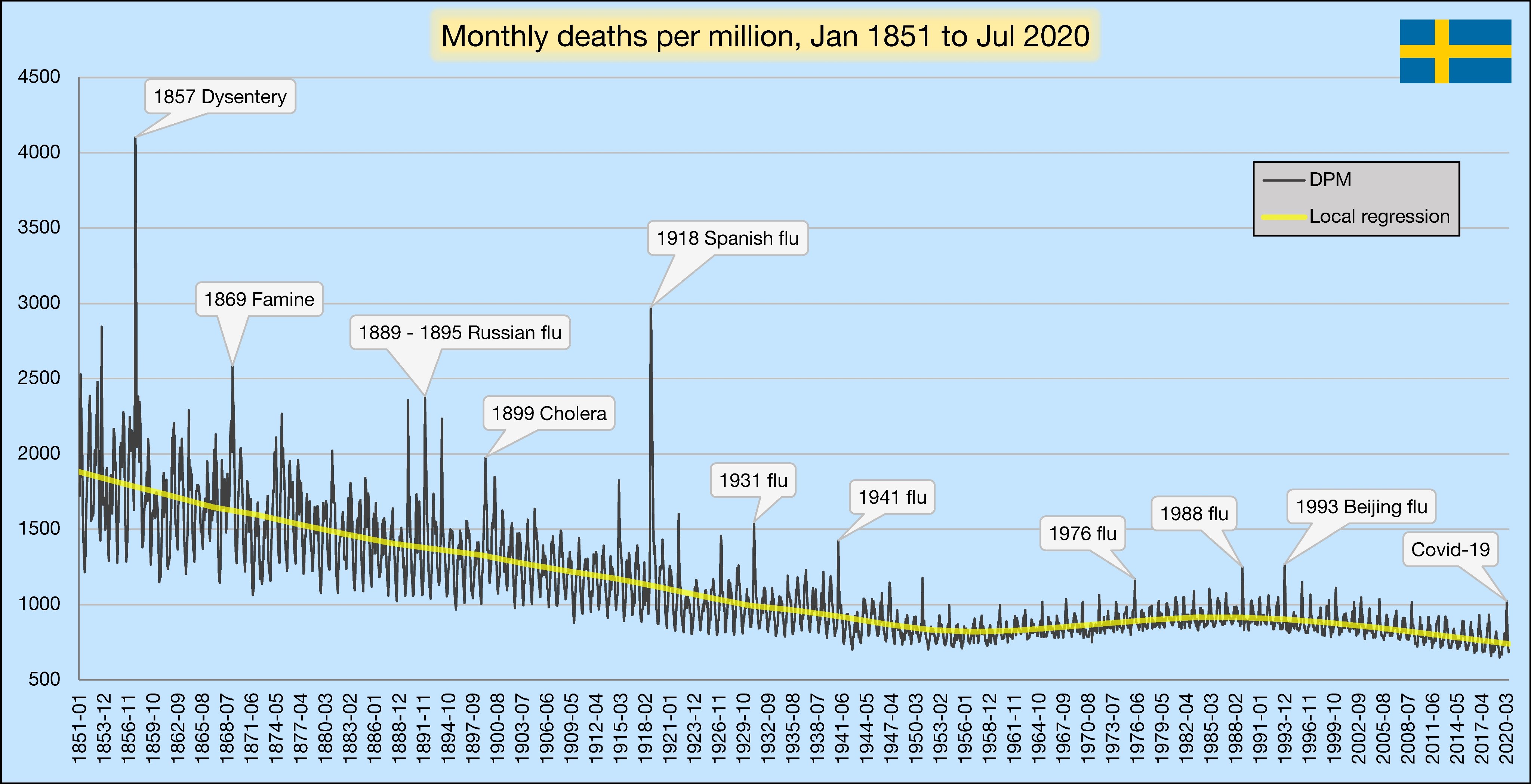
So COVID is dangerous enough to lock down entire societies, but not dangerous enough to justify continued vaccination when 1 in 166,666 have blood clotting? This is probably the background rate.
It seems like Europe and its bureaucrats just can't let go of lockdown. Or alternatively, they wish to push the vaccines and end of lockdown into Spring/Summer, where natural seasonality will take care of COVID and give the appearance that lockdown and vaccines were a success.
https://brnodaily.com/2020/12/16/news/excess-mortality-rate-...
And that's old numbers, since then the situation only got worse: https://www.aljazeera.com/news/2021/3/15/czech-republic-what... https://edition.cnn.com/2021/02/28/europe/czech-republic-cor...
Source: https://opencovid-peru.com/reportes/sinadef/ (1100 deaths per day, compared to 300 average for 2019)
Did you somehow forget that this is the second year of Covid? We've already gone through the whole "natural seasonality" cycle and the disease is very much still here.
https://covid.cdc.gov/covid-data-tracker/#trends_dailytrends...
From an average of about 50k cases reported daily in April through October to about 200k cases reported daily in November, December, and January, then back down to 60k by March.
And there's a similar winter increase in the worldwide cases (some of which is from the US cases, but not all):
https://www.worldometers.info/coronavirus/worldwide-graphs/#...
It's impossible to be sure after just one year, but that hill in the winter certainly suggests a seasonal illness to me.
Further, South American countries were some of the worst hit during the Nov - Feb timeline. South Africa was badly hit around this time. And all these are Southern Hemisphere countries that were experiencing summer around then.
Now, there’s clear evidence that warmer weather makes things easier, since the virus has lower survivability outside a host in the heat, so all things equal, the spread would be lower in warmer weather, but it’s not so much lower that it can be considered seasonal, like the flu.
Same reason it was rampant in the US subtropical south during last summer, when it was uncomfortably hot and people stayed inside where there's AC.
They're referring more to, success can be claimed for lockdowns/etc whether or not they had an effect, simply by waiting until the natural seasonality causes a drop in cases.
> where natural seasonality will take care of COVID
I don't read that as your interpretation at all. It very much sounds like they are saying the spring/summer season will kill COVID.
(In reality, in Sweden mortality is about 4.5 % higher than the average of 2015-2019, but that is still very significant; and of course, covid is not just that one either dies or is fine; there is the substantial but currently not very well known number of people with long-term health impact from the infection)
This is typically about $50,000/year in places like the UK.
If you run this same calculation against what we have done for COVID, the figure comes to tens of millions of dollars per life year.
The same sums spent on lockdown and lockdown compensation could have been invested in general healthcare, or tackling air pollution (which kills 800,000 Europeans a year).
COVID lockdowns should not be immune from the cost-benefit calculations that all other Government programmes are subject to. Its also totally reasonable to ask why we tolerate influenza, which is a leading cause of deaths and fills hospitals each season, but not COVID.
That calculation is profoundly flawed and is based on linearity: some of the most expensive treatments are extortionate, relative to the true and actual cost to produce, against the QALY/DALY calculation. Instead, if a pharmaceutical company or a medical device company charges an extortionate amount of money for a product, the patents should be seized and governments should be allowed to produce them themselves. In a lot of cases, government funding does 80-90%+ of the research and work that allows the medical product to be marketed.
In the case of coronavirus, some governments, such as the United States, had the capability, at least theoretically to at least try and pursue the elimination strategy. That is, if the United States did not have a neoliberal government in place at the time and the citizens of the United States actually trusted its public officials. A lot of smaller countries have fared well during the pandemic. It is clear that the elimination strategy has been quite successful from an economic standpoint, for the countries that have pursued it.
> The same sums spent on lockdown and lockdown compensation could have been invested in general healthcare, or tackling air pollution (which kills 800,000 Europeans a year).
As for this matter, health insurance (private/public/national) should absolutely cover PAPRs (powered air purifying respirators) for people who are immunocompromised, have lung issues, have severe heart issues, or are at high risk from dying from illnesses like influenza. There are now half-mask (non-helmet and/or not full facemask) PAPRs that are more discreet and wearable, that are much more pragmatic than typical masks: https://industrial.optrel.com/en/product-selector-1/swiss-ai...
It is crucial that we first and foremost protect our most vulnerable, out of the principle of solidarity.
Obviously some of those deaths are directly from global warming. We have not done enough with respect to global warming, and people will die. But, this is unacceptable and we knew that it was coming. We have to do more, and putting a dollar amount on the lives of the most vulnerable is a distraction that keeps us from doing better as a society. We all pay a price by doing this.
It's not about the "oh it's worth the risk compared to COVID 19". If it's a side effect it wasn't spotted in the trials, why was that?
It's not a side effect? It was a problem in production? What problem? Was is tampered with or was an accident? What failed in QA to let that batch come to the public? Was is a storage problem that compromised the batch quality? Was it while in transport or in the local hospital?
You talk about this like background noise. It's not. It should be investigated.
It's good that this is happening, because it shows regulators are doing their job. This is what builds trust in vaccines, not disregarding odd occurrences because they seem to have no "statistical relevance". That's just ignorance talking.
Imagine this is the outcome of a production problem, yet regulators refused to acknowledge this until it was out of proportions because the problem wasn't fixed. Not only people would lose trust on vaccines, they would lose trust on the regulator - this extends far beyond this vaccine, but all vaccines and medicines.
People need to feel safe, and to know that regulators are not sleeping on their job. It's not a bureaucratic job, but that they are actively looking at data and reports from doctors.
Banning everyone from getting this vaccine is typical bureaucratic ass-covering. Their incentives are not aligned with ours. They get in trouble if they’re directly responsible for a few deaths, but not if they’re indirectly responsible for hundreds of thousands of deaths.
To give a point of comparison: 250 miles of driving gives you a one in a million chance of death. This vaccine is safer than that.
It's not bureaucratic ass-covering, it's literally the protocol that's in place and has worked to keep populations safe.
>250 miles of driving gives you a one in a million chance of death. This vaccine is safer than that.
Again you're missing the point. The correct analogy would be: driving on a car that randomly combusts, or has faulty breaks, due to bad QA. And this actually happens/happened, that's why some cars are pulled from the market to be fixed when such things happen. Doesn't matter if it has happened on 1 or 2 cars, it shouldn't happen. Want another analogy?
Want another example? The Boing 737 Max.
You should only be allowed to use products that are working as expected, not faulty products. Specially not medicines and vaccines, that could blow up the trust on regulators and the vaccines.
There is no safe option here. We have to think like we are in war time, not peace time. Allowing people with informed consent to take this vaccine will save far more lives than banning everyone from taking it.
Well that's arguable, I haven't had covid yet, and I don't plan on getting it. You had plenty of countries that handled covid without vaccines - we are where we are because western governments refused to take specific measures to control de pandemic (but this is another subject). So the alternative would be get a different vaccine.
Neither me EMA, or any regulator are advocating for not being vaccinated, I don't get where you're getting that from. The alternative to this vaccine is other vaccines, in EU alone 4 vaccines are approved and more are to come. Even AZ vaccine isn't excluded what so ever - they are investigating the potential cause.
>Allowing people with informed consent to take this vaccine will save far more lives than banning everyone from taking it.
Thankfully we have regulators that prevent such behavior. If there's a QA issue no one should be vaccinated with the batches affected by that, because proper QA seem to be without any of this reactions.
It's not a political decision no matter how many people try to spin this. This is the outcome of doctors reporting an anomaly to a regulator. The system is working, and this should give you reassurance, not doubt about the consequences of stopping a vaccine.
I'm pretty sure they know the consequences of this setback, so for them to stop it it's because something is not right.
"It's not a political decision"
From the perspective of the regulators, there are asymmetric personal consequences.
If they make a decision that leads to 50 clotting deaths but saves 5000 people from COVID as a counterfactual, their head is on a chopping block because those 5000 foregone deaths are invisible but the 50 deaths are visible.
If they make a decision to halt the vaccine distribution and this kills an extra 5000 people - well that's no problem because they were just being careful.
Society has set up a political situation where there is literally only one choice that absolves the bureaucrats from a negative personal outcome. Of course they're going to go that route.
Personal incentives are incredibly powerful drivers of behavior, whatever the publicly stated reasons for an action may happen to be.
It may be the case that they've made the right decision, but we can't assume that it was for the right reasons.
I'm more saying that the incentives of regulators/politicians aren't always aligned with public health, since the decision that protects public health and the decision that protects careers aren't always the same thing.
I like to believe that these institutions - regulators - know better then to cover their asses, because if that was protocol until now for sure there would be a lot of problems with medicines and vaccines.
At leas the European ones (the cases I know) seem to have been pretty competent on their jobs, so I doubt that is a motivation.
But what are “the right reasons”? This one is a moral dilemma that has no solution. “OK, let’s kill these 50 people so that that those 5000 could live.” No one in their right mind can propose that.
This is not established at all.
Overall the number of blood clots observed is actually less than expected, with an incidence lower than in the general population (i.e. without vaccine at all). My source is BBC News this evening.
I think it is therefore those who are calling for who have suspended this vaccine to explain the reasons because they seem to baffle everyone.
Bearing in mind the previous 'doubts' some in the EU had about the vaccine's effectiveness for people above 65 I am not convinced that this 'cautionary approach' is all in good faith... And the head of Italy's medicine authority has just said that this was politically motivated...
It's not "just blood cloths", it's the type of cloths, where they are located, with low pallet count, with more incidence on a younger age group, localized in an hospital staff.
The European Union medicines regulator has reiterated there is "no indication" that the Oxford-AstraZeneca Covid jab causes blood clots, after several countries paused their rollouts.
European Medicines Agency (EMA) head Emer Cooke said she remained "firmly convinced" that the benefits of the vaccine outweighed any risks.
But even if the blood clots observed are in fact due to the vaccine the numbers are so small that it seems to me irresponsible to suspend vaccination and to publicise this so much.
The problem isn't the blood clots. That's the spin British media is giving to this, and that's what EMA is addressing.
"The decision today is purely precautionary..." given this level of signal. We don't have details on the age groups involved and the normal rates expected but I can hazard a Fermi Estimate that the risk is minuscule compared to COVID-19 itself. I look forward to seeing the actual data in coming days/weeks. Precaution without downside is acceptable; this is not one of those cases, IMO. YMMV.