This has been pretty evident in the past year when the experts have often been wrong, or at least pushed their opinions in a way that wasn't really supported by the underlying evidence ("the public doesn't need to wear masks" back in March is a good example). It actually wasn't really that hard to dig in to the underlying evidence, assess the validity of that evidence, and make up your mind for yourself.
So in the end it is reliant on science communicators, and there is enough people who are either bad at it, fake it or altogether evil and misrepresenting scientific evidence for it to fail.
You always will have some authority needed as you have to be able to read really well and a lot of practice with the specific field to handle the outputs of science.
But this is disincentiviced and labeled as conspiracy theories.
I feel like its much worse than that. All of current research is very specialized. I am not a scientist but I do work in vaccines. After having worked for the past eight years in this field, I feel I can generally get the gist of scientific articles/papers, and understand if its something useful or junk - but only in my niche areas. Outside of that, I'm pretty much your average Joe.
As an example I have chronic sinusitis without polyps which totally destroys my quality of life, while I can probably live with it for a long time. I’m looking at the successful cystic fibrosis inhaled vaccine trials that looks like a great way to help the cells produce missing proteins.
I’m hoping for similar treatments to be available in the near future, and I have some money that I would happily use to invest / donate in a chronic sinusitis vaccine development, but so far I see only biologics trials that are probably much slower to go through because of the greater toxicity.
Actually your knowledge is enough for you to have an edge over other people in investing in biotech companies.
Last time I saw my ENT doctor he's like well it's not that bad and I just wanted to scream at him.
I liked how someone else on HN put it: your body is constantly sending an error code but there's no way to shut it off.
Do you also have chronically irritated, dry sinuses with no polyps?
I've tried nasal irrigation and a corticosteroid but nothing works.
Right now the only thing I can do is travel away from Europe to south/central america for the winter.
I tried all commercial air cleaners, but they don't decrease toxic gases, just PM2.5, which doesn't help me. I'm thinking of building a house/apartment with very clean air (maybe using nitrogene and oxygene concentrator). Also I'm planning to try cortisosteroid in my sinuses using a biodegradable net.
Biologics may help as well, but they help only IL-4 / IL-5 type inflammation, and I don't know what cytokins are causing my inflammation (I was thinking of doing an cytokin profiling from biopsy, but of course I need a great ENT doctor to help with it).
At the end the main problem is that there are multiple causes with CRS symptoms, so it's impossible to have 1 drug to cure all the symptoms. Also as it's not deadly short term, FDA is much stricter with the drug companies that try to come up with treatments, which is understandable.
I don't know much about the particulars of the vaccine you are referring to, but when it comes to investing, I think it is always safe to assume that all major investing firms have ready access to SMEs that can give them the scoop on any company they're interested in.
As the drug delivery platform is working great, it seems like it can be reused (unlike with older platforms), and the hardest part of developing new mRNA vaccines is to research the genetic code to put in it.
The delivery platform is reusable, which is a big difference from older vaccines, where the virus that is delivered can be used only once (Sputnik-V vaccine uses 2 different delivery platforms _because of_ this.
The other thing to look at is efficiency: as the vaccines can deliver mRNAs that cells express anyways in healthy people, the lesser toxicity can mean a higher likelihood of success for the drug (which is the main problem with drug development in the last 10-20 years).
While we're all cheering for its success, its important to remember that the current authorization was under the 'emergency use' clause. Also, our body continues to evolve to fight attempts by external agents to inject foreign genetic material into our cells. Whether the same platform with work on future vaccines will be known only by performing science. But as always, data >> opinion.
You seem well read so you've already identified one of the key problems - the genetic code that forms the basis of the vaccine. Its not really my area, but from what I understand, dealing with synthetic RNA (RNA Mimics) is tricky since its never identical to cellular RNA. All of the associated problems will already be known to anyone working in that field, so there's nothing of value that I can add anyway.
At the same time the vaccines can't control which cells get the mRNA delivered as opposed to non-syntetic cells, where the cells are differentiated by their methylation and other epigenetics and gene expression control pathways, which I guess can be problematic for some cell types.
But I was making a different point. Even before you get to the final expression of the protein, there are various steps that need to go smoothly. The mRNA sequence is carefully engineered to dodge the body's various defenses, among other things - and this sort of engineering is not trivial - which is the point I thought you were also making with - "and the hardest part of developing new mRNA vaccines is to research the genetic code to put in it. ".
But maybe I misunderstood your original point?
In other words, prophets, pastors and priests.
The conflation of academia and science is starting to grate.
The reason why we haven't done the same for critical thinking is that the people in charge won't be if we had a citizenry which could think logically.
Case in point: NYC and SF have the worst homelessness problem of any city despite being in the hands of the party that keeps saying they are for the poor. That you now have dozens of reasons lined up in your head why it's not their fault despite having the power to solve it for decades and should be let off the hook is the lack of critical thinking in American education at work.
I think this is only true because people think its true. There's plenty of PhD holding scientists that still participate in tribal politics. There's also plenty that are smart in their field and nothing more. This was logic that was used in the past and every time we've educated people the elite haven't lost their positions of power. But everyone's lives have increased in quality, I mean we don't use the streets of London as a sewer.
The knowledge itself matters. The ability to see when is the statement subtly exaggerating what facts say, so that one can use it in manipulative "logical" claim matters great deal. The ability to understand nuance matters a lot too. So does the ability to deal with bad actors in discussion, to understand motivations of whoever wrote this or that document matters.
But in fairness to the average person, scammers have to play big numbers games to find suckers and pick weaker targets like elderly because the average person isn't that incapable of critical thinking.
As you might imagine, students mostly learn this for the exams and forget everything when they leave schools. The poor political and economical situation in the country reflects the ineffectiveness of this approach.
And hey, schools in yugoslavia also taught marxism as a subject I kid you not (it was an established science back then!). Yet the whole generation in the 90s soon abandoned it for the next shiny thing. Most probably expected to become capitalists themselves, forgetting that even in capitalism someone has to actually do the work and only cca 200 families would actually own the businesses.
(Logika curriculum in croatian) https://mzo.gov.hr/UserDocsImages/dokumenti/Publikacije/Pred...
Preferably for their own side first because I am really sick of predicting what the next 4 years will be like, being called shill, having that prediction borne out and then being told that it was actually impossible for anything else to happen from the start.
The last bit is especially common in the most important but soft sciences like psychology, sociology, economy, history or anthropology...
Or worse, it may be in principle verifiable but only at high expense, or the results of the analysis are incomplete or buried.
This is why we have things like the CDC offer guidelines, taking into account the changes and growth in our knowledge base. Knowledge is collected and verified over time and eventually becomes distilled in easy to understand ways to the public.
Homelessness is a deeper problem that requires cultural change. It's not simply an economic problem.
For example, when I lived in Taiwan in the early 90s there was nary a homeless person. That's not because Taiwan's government had a better social net, nor was it because Taiwan . It was simply because in Taiwan's culture it was unheard of for anyone to let anyone else in their family go homeless. That in America people could have a homeless sibling or child or parent was almost unfathomable.
I'm not suggesting America adopt Taiwan's culture. But I am saying American culture's hyper-individualistic sink-or-swim culture has consequences. It's only in the context of such a culture that the neoliberal Democratic party appears "left", when in fact it is quite center if not center-right.
There are several obvious ways of doing this, from "just build more homeless shelters" to a UBI to less restrictive zoning so that people aren't priced out of housing etc. But these all cost money or political capital, so we see where the priorities are.
> It's only in the context of such a culture that the neoliberal Democratic party appears "left", when in fact it is quite center if not center-right.
This is old talking point that might have been true in 1994:
https://www.pewresearch.org/politics/interactives/political-...
Unless you're talking about what they do instead of what they say they're going to do. Then you might still be correct.
Yes. That’s my point about culture.
There’s a reason racism and sexism still dominate despite a constitution that has said “all men are created equal” for nearly 250 years and then clarifying amendments 150 and 100 years ago. It’s the culture. Both problems could have been vanquished long ago if they were truly priorities in people’s hearts. But there are not. American culture, both liberal and conservative subcultures, always put self-interest ahead of common good when the chips are down.
Your link speaks of liberal vs conservative. Talk to any true leftist: Liberal != Left. See “neoliberalism”. See the nomination of Biden by the Dems. See Diane Feinstein continuing to be California’s senior senator. Etc. See the amount of wealth inequality just within the liberal subset of the population. New York has the most segregated school system of any big city despite being liberal, and then look at the backlash by liberals over attempts to desegregate both in NYC and SF. I could go and on.
So for example, a primary reason why there is such high homelessness in San Francisco is high housing costs. But it's in the housing developer's self-interest to knock down some housing valued at $4000/month and build 50 units of the same size on the same lot, even if the aggregate effect of doing so at scale is to cause the value of each unit to fall to $2000/month, because 50*$2000 is still a lot more than $4000. Which in turn reduces housing costs and homelessness. What's stopping this isn't individuals acting in their own self-interest, it's the local government being captured by local landlords who don't want rents to fall.
The reason racism and sexism still dominate is that they're a wedge used by elites to keep poor black folks and poor white folks on opposite sides of the isle instead of voting together against the corruption that victimizes them both, and sow general discord in the population by dividing any group that contains both men and women, which is just about all of them.
They convince black people that their enemy is the redneck and vice versa so that the two groups don't get together and start asking why it's so hard to start a small business. The true solution to racial and economic inequality is upward mobility, but notice that nobody is even talking about that anymore. As if the solution to race is taking down statues and similarly worthless symbolic voids.
But none of this is culture or individualism. It's purposeful manipulation.
I think that this is [citation needed] category.
Actually in both ways, my kids were not taught multiplication as 7 years old. At that age, they were still doing additions in school.
This is a rich take coming from anyone living in the US. It's a two party system - the failure of the party partially aligned with your views does not and has never made voting for the party expressly against your views the correct outcome.
This is you telling people to think critically while failing to think critically (because it suits the politics you want to advocate for).
Instead of this, you can stop acting myopic towards elections and punish your party (vote the other one, 3rd party, or even write-in Bernie Sanders/Ron Paul) and force the political powers to answer accordingly if they want your vote for the next time.
Question: in a first past the post electoral system, what happens if the vote between two parties in a three party election is split 35% and 20%? Does either party take power? Do any of their candidates take power?
NO.
The other party wins - with 45% of the vote. EVERY TIME.
Third parties in the US literally cannot win, unless some mysterious outcome hands them an immediate largest share of the vote. Which isn't going to happen in one electoral cycle, which means the ascendancy of such a party has to involve decades of losses for whichever party they accidentally poach more voters from each cycle.
In NYC and SF? Sure. Or Greens, Independents, Socialists, anyone but Democrats.
I'd be giving the same advice to anyone from Alabama about voting not Republican.
Politics isn't about good and evil, it's about who gets what. If people who keep failing to give you what you want keep getting your vote they will keep doing what they were doing.
science is hard; human behavior is even harder.
This should be the main concern of every individual. Governments can worry about whether they work en masse.
Many people are nowadays wearing FFP2 masks, which are available everywhere.
we shouldn't accept mindless rules from our "superiors", especially incorrect and politically motivated ones, but rather demand timely and correct information devoid of political intent, so that we can internalize the risks appropriately and act accordingly.
There are reasonable accepted empirical approaches in accepted use today. Any team that follows these methods and reports honestly can be trusted more than a team that doesn't.
Also "trust" is a loaded word .. but mostly we just mean "predictability" - ex: to "trust someone" means to be sure that if you know what they've said, you can predict what they'll do. Much of empirical science is about offering up data and models that aid such predictability, so declaring "trust the science is extinct" is an outright rejection of these empirical methods (ex: randomised control trials) that have taken a long time to mature and take root as standard practice.
What is needed though is to be able to separate the science from policy making. As Dietrich Dörner has shown in "The Logic of Failure" [1], folks in the hard sciences don't fare very well when policy making in systems with complex causally interconnected parts is tasked upon them due to learnt heuristics that don't fare well in that world.
Let science do its thing - which is inform and educate. Let policies be made by those with more full understanding of the system into which changes need to be effected.
[1] https://www.amazon.com/Logic-Failure-Recognizing-Avoiding-Si...
The underlying problem isn't actually a problem with science, it's a problem with politics.
You need to hire some scientists to do your experiments. If they follow the scientific method, you get results using the best system we know how.
But if they follow the scientific method then the Republicans work to defund climate science research and the Democrats work to cancel any scientist whose results challenge the orthodoxy on race or gender.
And if politics interferes then it's not science anymore. If research leading to politically inconvenient results has its funding withdrawn or scientists are intimidated into self-censorship then it's all just selection bias and fudging the numbers.
Maybe what we need is to do something like the court system, where you have multiple research funding "judges" which have lifetime appointments and each get a given amount of research money to dole out every year, and their job is to decide how to spend it. Then they can spend it however they like and can only be removed for e.g. corruption, not for funding research somebody doesn't like.
In as much as science deals with things that cannot be affected by policy (ex: stellar physics or nuclear fusion), the "law" doesn't apply I think, except maybe in perception (people may believe that a particular nuclear fusion technique doesn't work even though it's been demonstrated but policy forbade it to be implemented).
For some cases, we would want Goodhart's law to apply - ex: climate change. We'd want actions to be taken to reduce the impact on the planet as we gather and report climate parameters accurately. Similarly, we'd want accurate reporting of gender discrimination in society to result in the reduction of such discrimination. The question really is the way the change is effected. If "salary difference" is an indicator of gender discrimination for example, law makers can pass laws that fix it, thereby removing its effectiveness as an indicator .. but we're happy for even that at some level. That would be similar to a government sending teams to re-freeze melting glaciers because climate scientists are using it as an indicator of global warming.
True policy thinkers, though, would want to ask the "five whys" and work to fix the underlying problem.
Eventually the governments who support technology will win - either via war or economic advantage.
It matters kind of a lot whether the winner is a liberal democracy with free speech and civil liberties or a totalitarian communist dictatorship.
> It matters kind of a lot whether the winner is a liberal democracy with free speech and civil liberties or a totalitarian communist dictatorship.
This is irrelevant to the conversation, but yes that is why we spend trillions on defense technology, so that if it comes to blows we don't lose out.
One year on and that "prophecy" (because that's what that was, just a prophecy) turned out to be pretty damn false. Nevertheless, we still let the people/scientists who deceived us back in March 2020 to take "science"-based decisions that will affect the lives of hundreds of millions going forward. Nobody will be held responsible, apart from a few politicians.
Experts worked on detailed plans for staged re-opening after the lockdown. I don't know about Europe, but the US did not follow such a plan. Different states reacted differently, and politics had a bigger say in how reopening was done than any epidemiologist.
And Sweden wasn't exactly a success, and has done far worse than their nordic neighbors, say, Norway. The numbers do not lie here.
Belarus had a very effective plan - they tested far earlier and more often, and have far more hospital beds per person.
Straight up country comparison is just a fool's game. We will have to learn from this as best we can - what worked, what didn't work, where, and why. If everyone wore masks properly, was lockdown necessary? We need time to study and find answers.
> Sweden wasn't exactly a success, and has done far worse than their nordic neighbors, say, Norway
> Straight up country comparison is just a fool's game
Of course, had no action been taken to slow it down, and millions had died last spring (in the US alone), the public opinion would strongly demand a lockdown, as well as become so scared that they voluntarily self-isolate.
As you can see we now have vaccines - it would not have been a few years of lockdowns.
New Zealand did lockdowns for a month or two and became completely Covid free.
China did lockdowns for a month or two and became almost Covid free.
Most European countries did lockdowns for a month or two and were quite open over the summer.
So either it was a different prophecy in the rest of the world or the prophecy was correct after all.
not any more https://time.com/5939502/new-zealand-covid-19-lockdown/
Then how did the lockdowns work in say New Zealand or Australia, or Singapore, or China? What is the mechanism of action?
I know Australian people in Europe who haven't been able to visit home in a year. I know second-hand that in China if you had multi-stop flights you needed to quarantine at every stop. I don't know what test and trace measures the AU and NZ governments decided on, but I'm pretty sure that I wouldn't like them if I knew.
And it's easy to say 'well, good, people shouldn't travel now' - but this is not just about holiday. These restrictions keep families apart, make it more difficult for people to care for each other. Imagine someone close to you is in distress and you can't go help them because of this, how would you feel?
I don't know about you, but I would not want to live in China, even it gets to zero covid. And I wouldn't particularly like being isolated in AU or NZ either.
My comment was a response to parent, who feels betrayed by science, because lockdowns were supposed to work.
What I will say though is that there is no win scenario. It's lose-lose, either way. A non-Covid world does not exist anymore. Lockdowns come with exactly the downsides you describe. No lockdowns come with an overload of the health care system and high death tolls. Light lockdowns are a combination of both.
Both proponents and opponents share the same motivations by the way - to be able to see relatives, meet other people etc.
Please stop pushing the unproven narrative that lockdowns stop the healthcare system being overloaded. It's morally wrong to push for such a destructive policy without good supporting evidence.
Sweden, Japan, Uraguay, South Korea. No lockdown. No problem for any of those healthcare systems. It can be easily shown that curves were flattening before lockdown had a chance to take effect.
This is about as close as we will get to a controlled trail on lockdowns.
https://www.medrxiv.org/content/10.1101/2020.12.28.20248936v...
You don't need lockdowns to stop the healthcare system from being overloaded, if everybody wears masks, socially distances, agrees to track, trace and isolate programmes, there is mass testing, no incentives for people to come to work sick, etc. One year on we have a pretty good estimate how each behaviour/measure influences the reproduction rate of Covid-19.
> Please stop pushing the unproven narrative that lockdowns stop the healthcare system being overloaded.
I don't understand what exactly is unproven. Lockdowns correlate with behaviour. The Chinese healthcare system was completely overwhelmed, even with CCP spin on things. In Bergamo, Italy, the dead were carried away in army trucks. Look at fatality rates for both countries at the time.
Speculation without evidence.
Lockdowns are apolitical decision, not a scientific one. Lockdowns can be avoided if governments choose not to implement them. But most seem to be relishing in the emergency powers given to them.
But what about when scientists collaborate with the policy-makers to shape public perception about how to inform and educate people?
One prime example is last years long and detailed study on how there was no "gay gene". In effect, homosexual activity and inclinations could not be shown to be the result of any specific gene expression after many trials and searches for such.
The scientists, worried about how this result would look to the public, worked with LGBTQ advocacy groups to shape how the paper would be released to the media and explained to the public[1].
Now, a sizable portion in HN's demographic will feel this is all well and good, but how far should this go? The uncomfortable truth here is that people are not "born gay" as we have been told so often. And that has been a very important talking point in the past two decades when debating about gay rights. Many people were convinced to support gay rights for this reason alone (however we might feel about that, it's true). They very well may feel duped by scientists and no longer "trust the science". How far should scientists go to shield the public from uncomfortable truths? And how much will the public continue to trust them when such veiling of the truth is made known to them?
"sexual orientation is not the expression of any one gene" is not the same as "people are not born gay".
It may be a complex genetic interaction or it may be some other effect at play, but whatever it is, it doesn't contradict that people don't choose their sexual orientation.
Since people have justified all sorts of atrocities based on the misconception that being queer is a choice for people that they could just not make, I can understand scientists who want to make sure their research doesn't fuel that again.
Communication is an incredibly tricky thing. Even when the science is sound, shortsighted approaches at communication can have serious repercussions, even potentially causing deaths (think public health guidance being misinterpreted, misunderstood, or decontextualized, for example).
Being conscious of this doesn't dilute the truth of the message, and being respectful/mindful of others doesn't mean we need to compromise on the science either.
For clarity: this is not a response to any part of your comment other than the reference to the nature article.
That isn't a problem with science. It is politics .. as @AnthonyMouse noted.
I think this is true but I doubt it's anything new. I think the fundamental similarity between religious belief and "trusting the science" is the psychological simplicity of delegation to authority, and probably a deep seated property of the human mind.
Not knowing the right answer to questions we deem important, or worse the mental state of doubting what we've been raised to consider foundational and "obvious", is just too uncomfortable for the majority of people (I would've said all people, but I can't be sure).
Religious teachings can be questioned and reasoned about. Prevalent understanding and interpretations of scripture also change over time and in different groups.
But can we though?
The usual objection to this is that it's hard to assemble the data to make these evaluations. But imagine if society's standard response to this was to simply ignore any scientific claims not backed up by publicly available data sufficient to evaluate the predictions on which the claims are based? Note that physicists, for example, have no trouble making reams of data freely available online, or writing periodic review articles that summarize the current state of scientific models in a field, with copious references to the original research that verified the predictions.
Note, also, that in many cases trials that produce statistically significant results, even when replicated, are not testing any actual model. They are just testing a hypothesis about a correlation. Correlation is not causation, and most such trials are not even capable of testing an actual causal model--they can test for the presence of a correlation, but not why it is present. Figuring out the actual causal process and developing a predictive model based on it takes more follow-up work. So really most such trials are just a first step towards developing a predictive model at all--but even after such a model is developed, you then have to take the time to assemble a good predictive track record for the model.
Yes; I would not consider this as evidence in favor of any scientific model, since, as you note, we don't have a scientific model that predicts what drugs should relieve headache pain. It's just an empirical generalization; as an empirical generalization, yes, it has a solid track record of accuracy behind it, but only as an empirical generalization, not as support for any scientific model. Of course we humans have lots of empirical generalizations we use all the time that are similarly not based on any scientific model. I am certainly not claiming that we should not make use of such generalizations when we have them. We just shouldn't confuse them with scientific models.
If the vast majority of papers can't even get that right, I don't care as much about the HN idea of what 'reproducibility' is - i.e. check if 'git clone <xyz> && run_model.sh && run_tests.sh' says 'All OK!' at the end.
There’s an article on the front page of HN about a nature retraction that came from someone asking authors of a paper for their data. That tells me that the data can be useful for fixing suspicions results. But also that simply asking for it can be sufficient. I wonder how often authors say no to data requests. My guess is only in the fishiest cases and in old cases. Publishing code and data isn’t high up the priority list, but in a lot of studies, it’s simple enough to be good ROI.
https://news.ycombinator.com/item?id=9209761
I think that in science there is an inherent tension between what scientists know and what what the public knows.
Scientific knowledge is covered in asterisks. To read and understand science typically requires an extensive amount of background knowledge; without that it is very easy to misinterpret the strength, significance, or applicability of a scientific finding. Many of the asterisks are themselves scientific conclusions with their own set of asterisks.
The public, at least in areas which are not immediately relevant to daily life, cannot be assumed to have that background knowledge. Therefore, the tension is essentially this: How can scientists make people aware of (or interested in) scientific knowledge if they have to strip out all the asterisks when talking to them?
Making science into a catechism is simply one solution to the above problem. Ignore the asterisks and turn the fundamental findings of physics and chemistry into dogma and dispense it as gospel truth. I actually am somewhat o.k. with this. Sure, Joe Public might come away with an over-simplified and over-confident knowledge about what science says, but I think that a clumsy knowledge of scientific facts is better than the impression that scientific knowledge is arcane and out of reach. After all, it is highly unlikely that Joey P. will find himself in a situation where it is very important for him to really understand all the subtleties behind his k-8 scientific knowledge, but that knowledge is likely to come in handy.
The only problems with the science-as-religion solution are a potential "loss of faith" and the perception of arbitrarity with regards to scientific findings. The first can easily happen when someone learns about a new finding which contradicts the dogmatic version of science but is entirely consistent with the heavily asterisked actual scientific consensus. The second problem is basically "rejectability;" if people think that science is a set of arbitrary rules, then they are free to reject them the same way they would reject other religions.
This seems like a false dilemma. Joe Public is as capable of reading a paper on sci-hub as anyone else. It would probably do everyone a bit of good if JP were more likely to do that when he's wondering what to do about the aphids in his garden, or read a patent relevant to his mechanics business, or assess the evidence around masks during a pandemic. And I think it's the idea that science needs to be dumbed down for a certain kind of person that keeps ordinary people from digging into the asterisks when things are relevant to what they're doing. Executive summaries are useful when something isn't very relevant, which is most of science for most people. But some science is relevant to everyone, and it would be good if we challenged the myth that one needs to belong to some kind of separate class in order to practice science. Science is for everyone. No one can know all of it, but everyone will come to a point where they'd benefit from knowing some of it.
Even when giving scientific talks, the advice I give my students and post-docs is to first have a clear idea of who the audience is: is it
a) experts only from your area? [e.g. conference]
b) people from the same department who may be generally aware of the area without knowing specifics? [e.g. job talk]
c) General public [e.g. showing lab to school kids. This is the level at which you talk to the public. soundbites - so it is invariably misrepresented by the media]
All three levels require different approaches for the same subject. (b) is especially tricky - you are talking to experts, but from a different field. So you have to simplify, while not being patronizing. As for (c), I think it is best to avoid it. Except in situations like the pandemic, it rarely is beneficial. Also, to do it right, it requires a lot of preparation.
I'd be curious if you disagree with any of that in theory or just have a better appreciation of the practical difficulties...
Discussions on social media rarely indicate much effort at nuance...
Why not Math as a religion, dumb down complex problems, if it's wrong for the common Joe, it's okay cause he wouldn't understand it anyway.. not a good strategy.. I think if Science has a knowledge management problem, that should be addressed rather than dumbing down of things for public consumption.
I will point out that math discoveries don't have quite the same kinds of asterisks as the physical sciences.
Math is indeed a religion deep down, at least according to people like Hume, you have to "believe" in things like induction, you have to "believe" that natural numbers "don't end at some point" (for lack of a better word) or that two parallel lines don't finally meet, because who's there to watch them till the end of the world to say that they don't in fact meet? (Hume writes it down way better than I could ever do).
Thus, we come out on top, since we know what happens in all possible worlds.
Talking about "all possible worlds" is religious-talk (at least that's what Hume would say), afaik we only know of one world, talking about the "possibility" of other worlds is what established/institutional religions do.
You're setting up a bit of a straw man that science can not tell us with certainty what is the better course of action. Stating that science can give answers with absolute certainty is a stark misunderstanding of the scientific process (something alluded to in the article). However, trusting the (scientific) evidence (what is typically meant when people use "trust the science") can very definitely guide our decision making process. People typically bring up "trust the science" when proposals are being rejected based on some "ideological" reasoning.
To give a more concrete example, in the discussion about universal basic income, one of the main counterarguments is that people will just stop working. The answer to that counterargument is "trust the science", because every study made, has found that in fact people don't just stop working. Now one might still reject the concept of UBI for various other reasons, but this should be underpinned by evidence based arguments, not saying that the side which says trust the science (evidence) is treating it like a religion.
When people use the term "trust the science" what they typically mean is "trust the (scientific) evidence" and yes that is what we should be doing, even outside the "technological fields". The "trust the science" argument is often made when people reject an
In the medical area (testing medications) history is full of wrong studies either by negligence or just by greed.
"Trust the science" is never a good argument as being to general. I'd trust most of the science in physics, chemistry and mathematics. Apart from those there are too many shenanigans.
What you're saying is that wrong understanding is better than not to try. At least when political action affecting many is derived from science, standards must be higher than currently.
For example the mRNA vaccines: As far as I know there is no or little research for possible long term side effects as the original research is for cancer medication which has vastly different risk trade offs. Nevertheless the vaccines are approved for use. I've read and seen in many discussions if one raises doubts that just "trust science" is the answer although there is no science. At least I expect when asked that a proponent can name a study which researches on the long term effects of vaccines or the underlying technology (eg. safety of packaging, which is deemed a trade secret and thus not public afaik). "Trust us" is the wrong answer as long as regulatory capture is a thing.
You can be wrong but state clear hypotheses and a non logically flawed reasoning that allows you to make statements about the world. These can then be tested for their validity.
What you claim is that the standard for the quality of the test are not high enough. That may be true or false however this is only one aspect of science. For instance many people misunderstand the use of maths in Economics. The point of using mathematical models is not to be able to make predictions about next year's GDP but to make sure that what follows from your clearly stated hypotheses about human behaviour is consistent.
Did the participants receive enough money to maintain their current standard of living? Was the UBI granted for life or just for a few years? If it was granted for life, did the participants fear that the program might be ended prematurely? Did they keep working to be a role model for their children, who might never receive UBI? Did the participants even have a job to begin with? A study can give only unemployed people UBI and if the participants don't seek employment, the unemployment rate doesn't change, and your conclusion drawn from this fact is all wrong.
If anything, I see this as the good example of "trust the science" used as a thought-terminating cliche - a way to shut down questioning without having to provide answers.
One of the main counterarguments to the universal basic income is that napkin math does not work out. You don't even need to get the "science" involved, just relatively simple algebra. Humanity does not have the resources for the majority of the population to receive benefits out of thin air. And no, $3200 AMZN is not really a resource most people would feel comfortable surviving on, unless they can exchange it for something of an actual value.
p.s. the Amazon bit is related to the "let's divide the wealth of the billionaires and we all will live happily ever after" mantra.
That said, answering with "napkin math" to a complex costing problem like UBI is exactly the problem and why we should listen more to scientists.
Unfortunately, many of us engineering types are way too quick to make very strong statements based on essentially no expertise except for some math and engineering education. Interestingly in my observation this behaviour is less prevalent in scientists (i.e. people coming from a science opposed to an engineering background). Obviously, this is only anecdotal, but I would be interested if others have observed this.
> To give a more concrete example, in the discussion about universal basic income, one of the main counterarguments is that people will just stop working. The answer to that counterargument is "trust the science", because every study made, has found that in fact people don't just stop working.
In literally every study ever done, the UBI substitute was not permanent. Studies of the impacts of a temporary stipend do not logically transfer to a permanent stipend. If you get a source of income that will stop in three years, it makes perfect sense to use that income to prepare yourself for life after the income. If you get a source of income that has been guaranteed for life, you've got a completely different set of incentives and there is no reason to assume that studies of temporary stipends apply.
“Trust in science or “because science” are just ways to shut down discussion or lines on inquiry that dare question the existing narrative.
Don’t believe me? Here’s an example.
Have you ever wondered, just hypothetically, if the Covid outbreak may have had any relation to the bio research lab located in Wuhan?
Well, you can’t wonder about that. If you do, being called a conspiracy theorist is the nicest thing anyone will say about you. If you think this is a good thing then you’ll be in for a rude awakening hen you happen to find yourself on the wrong side of the “scientific” debate.
There is plenty of pseudoscience masquerading as science unfortunately. A good book to read on this is Carl Sagan's "The Demon-Haunted World: Science as a Candle in the Dark". A significant portion of the book is devoted to what Sagan calls a "Baloney detection kit" that he thinks everyone should have. If more people could accurately distinguish science from pseudoscience, the world might be a better place.
My personal pick for pseudoscience that is routinely given credence by the general public is nutritional studies. Any study that says an oddly specific food (e.g. blueberries) is a "superfood" is probably baloney. Producers of that food probably got together and funded a study that, surprise, says what they produce is good to eat! Why aren't other berries just as good? What about berries vs other fruit? What is in blueberries that is not present in other berries?
The thing about nutritional studies is that they're so hard to do properly that virtually nobody does. If you wanted to find out which foods are genuinely healthy you'd need a large sample size of people willing to have their diets and activities micro-managed in a way that would make most people rebel. You could probably do a decent study if you had enough money, but nobody is willing to foot the bill. The only people with skin in the game (e.g. blueberry producers) have no interest in a study that puts blueberries fairly in their place amongst a plethora of other foods.
My crazy prediction is that, sometime in the next century or two, we're actually going to become interested enough in optimizing healthy bodies that governments will start funding real scientific studies on nutrition, exercise, etc.. The crap that's out there today is going to be seen as utter quackery, albeit with some nuggets of truth mixed in almost by random chance.
Say you're a researcher fifty years in the future who is doing a literature review. When a paper about anti-hydrogen trapping works in a reference to climate change, you won't even need to look at the date of the paper to know, roughly, when it was written.
You don't. You use the sources you've seen to make the best analysis you can, fully prepared to drop it if with further evidence.
Statistics and reasoning are almost always applicable, and that's the extent science is applied to most fields.
If you want people to act in an evidence-based way without invoking trust/faith, they need to understand statistics and be able to evaluate studies on their statistical merit. Unfortunately that's quite difficult and the educational systems we have do a poor job of teaching it.
Statistics is subtle. For example, "It turns out, most doctors don’t know actually know probability." https://blogs.cornell.edu/info2040/2014/11/12/doctors-dont-k...
Perhaps more controversially, I also don't think statistics in general is a particularly rigorous or well-founded field. Where there is any analysis at all in the field - that is, very rarely - it provides guarantees only with hefty assumptions and in the limit. I'm fine with that from a theoretical perspective, but practitioners of all stripes seem to assume that with real world phenomena, the data either satisfy the assumptions or, more defensibly, don't violate the assumptions by enough to invalidate the results.
I don't know about others, but I see real-world datasets all the time that wildly invalidate the assumptions of common regression analysis, to take just one example.
To reign this little rant back into a well-formed comment, perhaps my summary is "everything and everyone is wrong, almost all the time, and I'm not quite sure how to fix that."
* In my personal experience.
BTW, I think your use of the asterisk goes beyond what was intended. Its typically been used to omit things or add caveats that only matter in very specific situations. 'in my personal experience' could mean you know 5 scientists or 5 thousand so mentioning a rough range would certainly give more credibility to your comment over the asterisk. That said, I broadly agree with the rest of your comment, but this did bug me enough to comment I suppose.
>I don't know about others, but I see real-world datasets all the time that wildly invalidate the assumptions of common regression analysis, to take just one example.
I'm interested in knowing about them. Any major ones that come to mind?
Agreed. Providing us with some statistics would help support their argument here.
This might be because there is very, very little scientific thinking in the general population. People like doctors who, due to their education, should have scientific thinking, no longer can be trusted to have this scientific thinking. Instead of approaching issues with a scientific attitude, the resort to "trust me, I'm a doctor".
Scientific thinking, at its core, is just "things might not be how you think they are". It is a type of skepticism about your own thinking and a reliance, or trust, on a set of processes that have been proven to produce useful epistemic truths. A good example of this is the Monty Hall problem where loss aversion would make most people pick the suboptimal solution. The Cognitive Bias Codex [1] documents a lot of these cognitive biases.
So, the way to move forward is to fix the education process so that this kind of thinking is inculcated into most children by age 12.
[1] - https://upload.wikimedia.org/wikipedia/commons/6/65/Cognitiv...
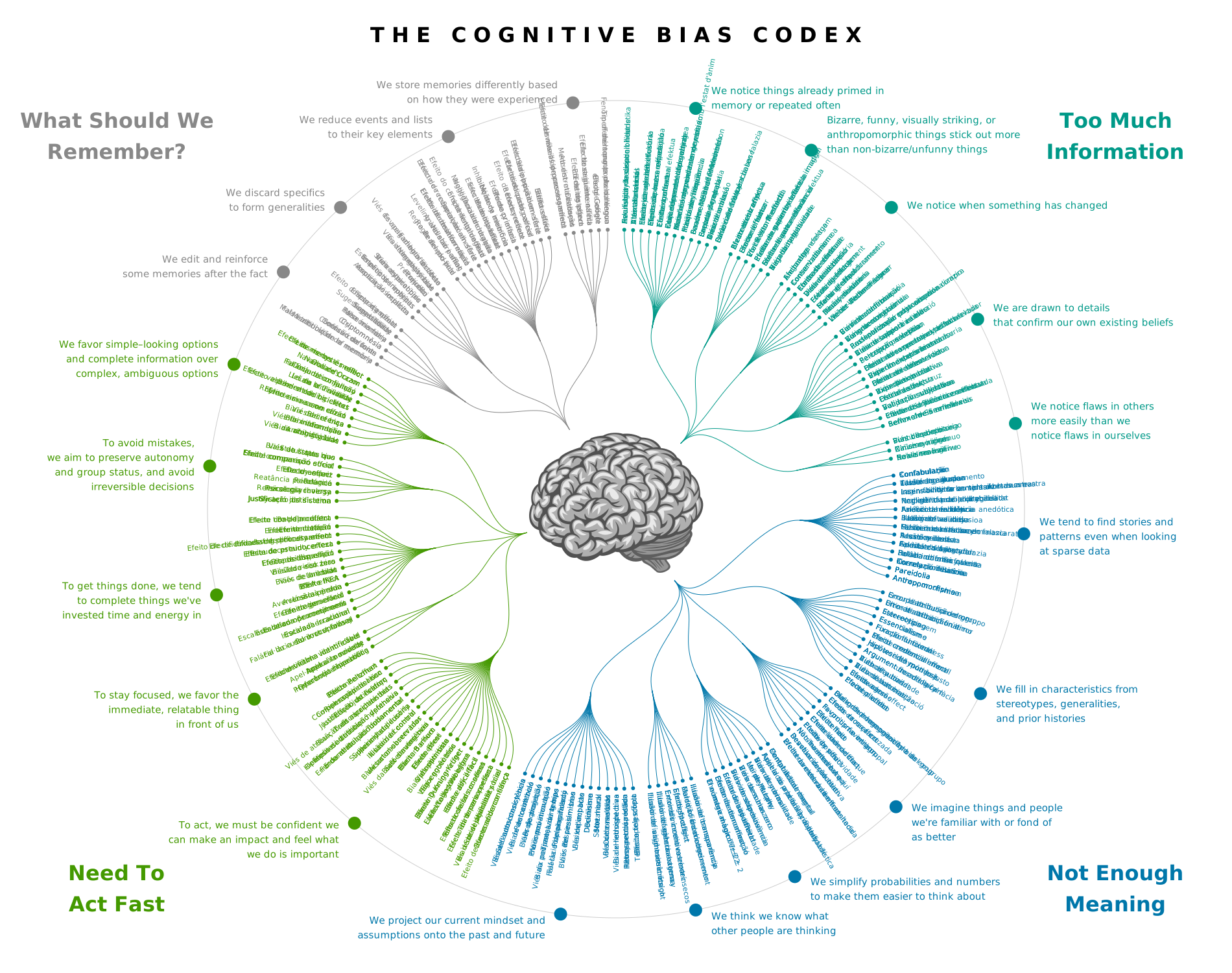
I would add that resolving those issues should involve engineers because they try to design solutions that take reality into account. To often solutions from politics and government are based on hope and intent. Sometimes they dont even care about money, principles or goals.
Most importantly, nobody is actually experimenting. (Not even the Chinese.) Status quo is king, old tried solutions are queen, and propaganda is jack.
Experimentation with society requires risk taking and uncertainty. Of course no one wants it.
What if someone came up to you and said "hey we're going to put your kid into a new type of experimental school. We think there's a a 50% chance we can save money on education but there's 20% chance they'll be severely undereducated. Btw, you can't opt out because that would mess up the integrity of the randomized selection process"
That's some dystopian level shit
And in that light:
Both science and economics are used broadly and brutally to justify a biases.
Both are ignored for their ability to measure, and used to shout over disagreements instead.
May we use both for more nuanced conversations, instead of less.
Popper, K. (1978). Natural selection and the emergence of mind. Dialectica, 339-355.
I have faith in religion. Science my friend stands on that other line there where everything has to be proven. That is the strength of science. If it tries to get in the religion line where I need to put faith and belief it's no longer Science.
Engineering is where things are proven, by building things using or that are proving scientific findings. For example, Randomized Controlled Trials are one of the final engineering steps for drugs, with partial engineering step being chemistry and process chemistry. Similar steps should be done but are often omitted for social sciences.
The exception to this is pure mathematics.
Example from biology: you found some fun cellular process model description. Fine, now you have to mess with it using engineering to prove it actually works in the way you described, is not missing crucial steps and so on. This for example happened a lot in gerontology - studies of aging. People latching on to small pieces of mechanism which actually are not very relevant or actionable.
Examples from physics are machines that use physics theories, such as quantum communication devices, particle colliders, clocks or nanostructured devices.
Examples from chemistry are evaluations of synthesis processes step by step by introducing various process changes.
Analysis is rather on the side, as without engineering first you cannot really proceed with it.
This may be debatable, but seems to accurately describe what most academics call "science". The more common understanding is what's described in the parent.
Often times when people say "trust the science" they're referring to results in the first category, but people take it to mean not "these results are preliminary and unproven" (and filled with asterisks), but instead "to deny this is denying empirical fact."
"-"using the scientific method to judge the scientific method is circular reasoning". Scientists attempt to discover the laws of nature and to predict what will happen in the future, based on those laws. However, per David Hume's problem of induction, science cannot be proven inductively by empirical evidence, and thus science cannot be proven scientifically." https://en.m.wikipedia.org/wiki/Circular_reasoning
See:
People like Jacques Ellul had been warning us about that for at least five or six decades now, I guess that's how long it takes from an idea first being "caught" as actually "existing" (for lack of a better word) to becoming so prevalent as to be very easily observable.
I'd also very highly recommend the works of Ulrich Beck [1], well, his "Risk Society" to be more precise, to quote wikipedia: "Risk society is the manner in which modern society organizes in response to risk" [2]. It is a book written in the mid '80s, right before Chernobyl, and recently other people have (re-)discovered him too, like in this "Foreign Policy" article [3] from last August.
[1] https://en.wikipedia.org/wiki/Ulrich_Beck
[2] https://en.wikipedia.org/wiki/Risk_society
[3] https://foreignpolicy.com/2020/08/01/the-sociologist-who-cou...
And of course, there is no "the science". "The science" for decades said that fat was bad and carbs were fine. There was other science that said otherwise, but that's what "the science" said. Same with tobacco and many other things. And people believed them, because they just "trusted the science" instead of doing their own reading. The most scientific thing one can do is to always view something with skepticism and subject evidence to harsh scrutiny. There is a reason that things as well-established as evolution and relativity are still theories.
I like Murray Rothbard's take on this "scientism", and would recommend his writings. https://mises.org/library/mantle-science
Many of the big society-level issues that we grapple with are more properly questions of economics than science. It's more about how we choose to value various courses of action and potential consequences against each other, and there's rarely a clear, obvious, or simple answer. "Science" can only give us an estimate of what the results of a particular course of action might be, it cannot compare once against another and tell us with certainty which one is better.
"Trust the science" is usually a rhetorical weapon used by a side that is attempting to show one particular potential outcome as the worst thing imaginable that must be avoided at all costs, but in reality there are rarely things that bad. I'd like to have a world where we can look at the actual science and economic costs of all choices and rationally debate exactly which road to take, but it sure feels like we're only moving further away from that world.