But instead of splunking 140 for one i got a used workstation with a Xeon E3-1271 (the 2. fastest Xeon without GPU) for 180. It included other parts, which made the upgrade free (if you don't count the work i did) by selling my old CPU+Mobo+GPU. The GPU (RX570) i had was at the same price level on ebay as when i bought it.
If you badly wan't to upgrade (from a 4670k the delta is way smaller than from the CPU i had), i'd suggest looking for an E3-1281 or 1271 if you have an dGPU, if you need an iGPU replace the last digit with a 6
https://en.wikipedia.org/wiki/List_of_Intel_Haswell-based_Xe...
(edit: clarify, add last paragraph and links)
Little known fact and even less available, but: The best processor for the LGA1150 socket is not the i7-4790K, but the i7-5775C. Faster IPC, significantly bigger cache and a stronger iGPU, and despite not being called a K cpu it's overclockable. https://www.pc-kombo.com/us/benchmark/games/cpu/compare?ids%... shows a comparison with many gaming benchmarks.
The Xeon route can be cheaper though, it's a good alternative.
https://openbenchmarking.org/vs/Processor/Intel%20Core%20i7-...
You can't just swap it out too, you need a mainboard with a 9-Series chipset, which you usually don't if you are running a Haswell.
There are many Z97 boards out there that currently run a Haswell processor, all of them do support this broadwell alternative.
> Well, it has the faster iGPU thats for sure. But if you use it for work it is usually slower:
The pc-kombo collected benchmarks do not use the integrated graphics, that's all cpu performance with usually a high end gpu.
The 5775C not only has a better IPCs, it has 128 MByte eDRAM "L4" cache. That's just cool and helps some applications a lot. That it is slower in some benchmarks is just because of the lower turbo clock. Overclock it and it will always be faster than the 4790K - it likely won't reach the turbo clock of the 4790K, but it just needs to come close, together with the higher IPC that should be enough. Then you have the performance advantages that the gaming benchmarks show and match the performance of the 4790K in the multithreaded application benchmarks.
It's just seldom available, but sometimes when searching for used processors like the 4790K the 5775C turns up and can be had for less.
"The complexity for minimum component costs has increased at a rate of roughly a factor of two per year (see graph on next page). Certainly over the short term this rate can be expected to continue, if not to increase. Over the longer term, the rate of increase is a bit more uncertain, although there is no reason to believe it will not remain nearly constant for at least 10 years. That means by 1975, the number of components per integrated circuit for minimum cost will be 65,000."
Somehow what became known as "Moore's Law" excluded any reference to costs. For a similar distortion, see the "Turing Test".
[1]: https://newsroom.intel.com/wp-content/uploads/sites/11/2018/...
"The complexity for minimum component costs has increased at a rate of roughly a factor of two per year [...].".
When the cost part became tough the "cost side" was progressively dropped by being more and more creative on what cost is considered. First ignoring the NRE part to look only at the marginal cost per transistor. Then even this got problematic and the cost aspect was just ignored.
The "true" Moore low creates a virtuous cycle: everybody move to the next node as it's better and cheaper, so there's no point to stay back. Also, because cost gets down the addressable market gets bigger, sustaining more costly fabs. This virtuous cycle operated for a long while, so much that many takes it for granted now.
But if Moore's law die by not being lower cost (the other way is by not increasing density, and this is still progressing if slower than before), this virtuous cycle is broken. You can get higher density, but at a higher cost. With cost increasing only a subset of the market will move on to higher density. Little by little, the market size supporting the costlier high end will get smaller, while the fab cost is still increasing, contributing to a slower progress too. The virtuous cycle becomes vicious. This is happening now, although it's not too bad yet with enough very large actor able to sustain higher price (thanks Apple, I don't use you products but do benefit from all the money you're pouring into TSMC ;).
And in the end, if this gets to a serious slow down, then there is the specter of commoditization. It won't happen soon, only after a possibly very long transition period as the tech is really hard. But if progress slows a lot, the lagger may eventually catch up. With more competition would come lower margins. Which is definitely bad for stock valuation. We're still far away from this, but it's still a possibility. Look how the process leader has always been the biggest cheerleader for the "Moore low is still alive and well" (and let's not talk cost between friends, shall we?). See how it was Intel when they started selling their 10nm future, and look how more discrete they are now, and how TSMC has replaced them as the "everything is fine" voice.
[1] https://hasler.ece.gatech.edu/Published_papers/Technology_ov...
Cost per transistor is still a relevant property, but it's harder to analyze since cost numbers aren't public, verifiable figures, plus the estimates I've seen were heavily criticized by people with better information, but from what I can tell it would just offset the rate of growth, not negate it.
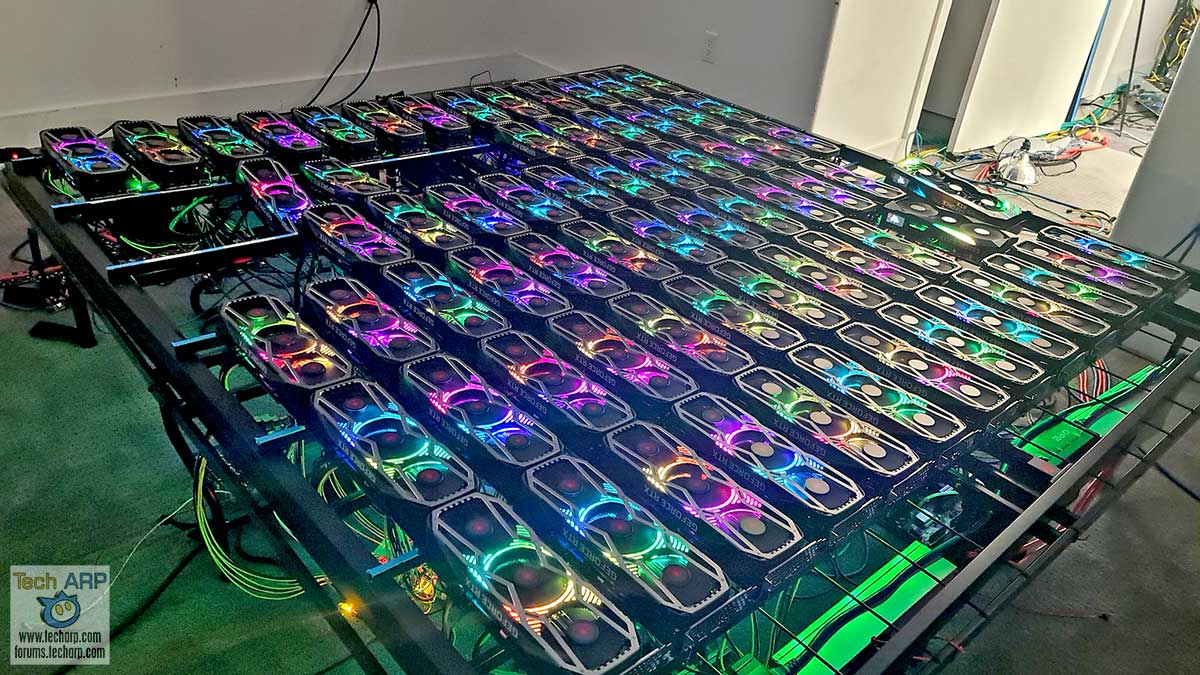
a 6Gb version of it would generate about $3/day on Ethereum as of today, so it would be sweet, even by cryptocoin standards, ROI of ~70 days. The rise of Ethereum prices makes even the 2-3x GPU price growth of the last couple months still a good deal. If one wonders where all the GPUs are i think that provides pretty good idea https://cdn.videocardz.com/1/2021/01/GeForce-RTX-3080-Mining...
That and it’s already hot enough in my office haha
It stops mining when you use the PC.
Granted, this was a limited edition board, but it is still 10 year old tech!
With RAM it’s a more common problem. There’s even software to check for it (memtest86)
Can you elaborate?
CPUs should go pretty much forever, provided they're run on clean power. They're a little square, entirely encased. Motherboards are bigger and with physical connectors you need to use force on.
https://semiengineering.com/chip-aging-becomes-design-proble...
There's electromigration which is harder and harder to mitigate with smaller process nodes
[1] https://www.newegg.com/p/pl?N=100007671%20601351803%20601321...
Looking on eBay, it looks like I could sell that $290 card for about $500...
Intel is releasing Rocket Lake shortly but it won't have any options with more cores than the 5800X. Zen 4 isn't launching until late fall. Not sure availability will be any better on either of these launches anyways.
GPUs are a little bit more ridiculous. You can get them if you don't need it to show up tomorrow but getting one at a reasonable price any time soon is much more a challenge than doing the same for a CPU. That being said I did manage to get a reasonably priced 3070 in a build early on but I put that to luck more than anything.
Motherboards I haven't had any issues with.
I broke down waiting for a 5950X and bought one off a scalper last week :/ luckily got it before the recent spike in price.
Sour milk is not worth very much but it then becomes yogurt and cheese which are much more expensive. So I guess your analogy still holds? ;)
I paid €128 for it.
That's not going to get you anything today. 3 years ago I paid €350 for a GTX 1050 TI. Now, everything new starts at €500, and everything older is a waste of money, says everybody.
Still not dying, and it was made in enormous quantities because nVidia made a big bet on crypto craze.
This is not a good way to measure things. Did you just exchange 10 years of monthly payments for 30 years of "similar" monthly payments?
My mother protested to me over the cost of her new house, defending the idea that she could afford it by pointing out that monthly payments were similar -- property taxes on the new house were about the same size as mortgage payments on the old one. I was kind of horrified by this; conceptually, when you make a mortgage payment, your net worth goes up. When you make a tax payment, it goes down.
Nonsense. It runs all games on High/60fps or better, with the possible exception of Cyberpunk and RTX marketing gimmicks. That's why it's still a relevant card 4.5 years later and goes for $200+. I own one.
> I'd also been keeping track of used i7-4790k CPU prices, looking to upgrade from my i5-4670k. They started out at $120-$130 earlier in 2020 and are up to $160-$170 now. For an eight-year-old CPU!
Funny, since I own one as well (4670k). And I haven't ever felt CPU-limited. Mine is mildly overclocked to 4GHz, and it's been able to crunch everything I threw at it since I bought it in 2014, again with the possible exception of HEVC encoding. It's still a very relevant CPU and handily beats Ryzen 1st gen for example.
It's also the last generation of Intel CPUs that lets you run a non-spyware version of Windows.
I'm sorry you fell for the marketing.
Now for the current iteration of RT graphics cards, it is still very limited so calling it a gimmick is a bit more warranted. But the hardware will improve (and has already from the first RT generation) which will allow more games and engines built arround RT instead of having it tacked on as an option.
Ray traced reflections are realistic reflections and look outstanding in Control.
Because they're based on the real level geometry.
Calling it a gimmick just means that you personally don't care about graphics.
I've got a £450 PS5. I'm playing Control right now and I choose the 30fps ray tracing mode because it looks much better.
That's probably sacrilegious to you.
Can you elaborate on this please?
I'd also been keeping track of used i7-4790k CPU prices, looking to upgrade from my i5-4670k. They started out at $120-$130 earlier in 2020 and are up to $160-$170 now. For an eight-year-old CPU!
It used to be the case that computer components aged like milk, price wise, but with the death of Moore's law in the 2010s that is less and less the case. I remember RAM prices spiked a couple years back too.