Decentralized decision making is ultimately conservative, risk adverse: it is never great -- a lot of people will be wrong, so things will never go as good as they might. But it is seldom terrible: even when context shifts and the underlying conditions everyone was betting on change, the wide diversity of bets means that at least some people won't have been completely wrong, maybe for stupid reasons, but it can prevent a complete catastrophe.
(The difficulty, of course, lies in socializing the losses and gains, so that you can benefit from decentralized decision making without it ultimately reverting to a de facto central committee through successive rounds of winnowing those who guess wrong, until the small number of people who had so far guessed right can begin guessing wrong at scale.)
From the point of view of Western individualism, yes. However, a strong autocracy relies on building a strong collective identity through education and the cultural institutions. That identity isolates the individual from his personal beliefs and justifies his suffering, for the purpose of collectively achieving "macro" goals.
A major mistake is to judge non-Western socio-economic systems through the lens of the Western intellectual tradition.
This makes a society weaker - it's effectively a monoculture that restricts the data available to the decision makers.
It also reduces a societies ability to innovate in art, culture and eventually technology and science - innovation requires the ability to take an outside view, to be self-critical, and a society that is too busy forging a 'strong collective identity' will make it harder for individuals to do that.
It even poisons a societies own understanding of itself and its history, since we have so far failed to come up with good ways of building a 'strong collective identity' without accepting and promoting lies about history.
I think there's some truth to this. But rampant individualism also makes society weaker. It reduces a societies ability to collaborate.
Let's not mistake diversity for individualism. We can be diverse, yet share overarching ideals - such as living together peacefully and in solidarity.
We can, but increasingly I see people arguing that we should forgoe those and determine our actions in society based on our own individual interest and market mechanisms.
Not hard to see why a raise in either of the above would result in the other side getting even more extreme in reaction.
You can have societies that are very community minded and govern them in a free way and with a democracy. You can try to govern very individualistic societies with an autocracy.
There's probably an optimum level of accepted dissent in a society, depending on what it wants to achieve, and I tend to think that social democracies come the closest to achieving it, and certainly much closer than most autocracies.
Japan and South Korea are western only in a superficial sense, in that they have copied the basic institutional structure of the industrialised West. However, the main forces acting on that structure are rather different, and the main actor is certainly not the "egoistic, cold, self-interested, autonomous individual".
I'm not clear what you're saying here. Are you saying that it would be a good thing if society in western countries were more like what it was 400 years ago? Enormous improvements in science, technology, culture and civil society grew out of that 400 year history, and regressing or remaining static over that 400 years would be a disaster.
The only way to have a stable society that spans across centuries is to have a society that can change and incorporate new ideas, technology, people and ways of doing things. It's societies that aren't flexible and strong enough to cope with change that are unable to remain stable over long periods of time.
Going from their nadir in WWII to what they are now in 70 years seems awfully adaptable to me.
By 1700, and certainly by 1800, Europe's interest in science, which then led to developments in advances in technology. This technology is what allowed the "white men on awesome ships with awesome guns" to have their way.
Perhaps if China was so top-down they could have also developed themselves more.
Toby Huff examines this disparity in his books Intellectual Curiosity and the Scientific Revolution. A Global Perspective and The Rise of Early Modern Science: Islam, China and the West. The telescope was embraced in the West, but hardly used (except with a few isolate individuals) in the other major cultures in the 1600s.
The time period you describe includes multiple massive european wars between nation states who were incentivized to improve industrialization, logistics and yes technology.
China's periodic bloody uprisings don't create the same incentive, they basically didn't have foreign policy until it came knocking.
And their collective identity (or huge population) didn't help them fighting wars either, they miserably lost almost every conflict they got in, even ones with themselves.
Your definition of "large disturbance" is pretty narrow. You missed things like the renaissance, the reformation (and subsequent proliferation of non-catholic faiths), the hundred year war, the thirty year war, two world wars, ...
A stable society that spans centuries can stagnate. See Imperial China and Japan before Admiral Perry showed up.
In 1600, the Chinese (and Moghul India) were probably more advanced than Europe in many respects, but there seemed to be little to no desire for further development. The telescope, which kicked off a revolution in the West, was basically ignored. When the Jesuits showed up in 1595, the China still thought that the Earth was flat:
* https://en.wikipedia.org/wiki/Flat_Earth#Ming_Dynasty_in_Chi...
As science developed so did technology, and the European powers were able to basic steam roll over everyone else a century later.
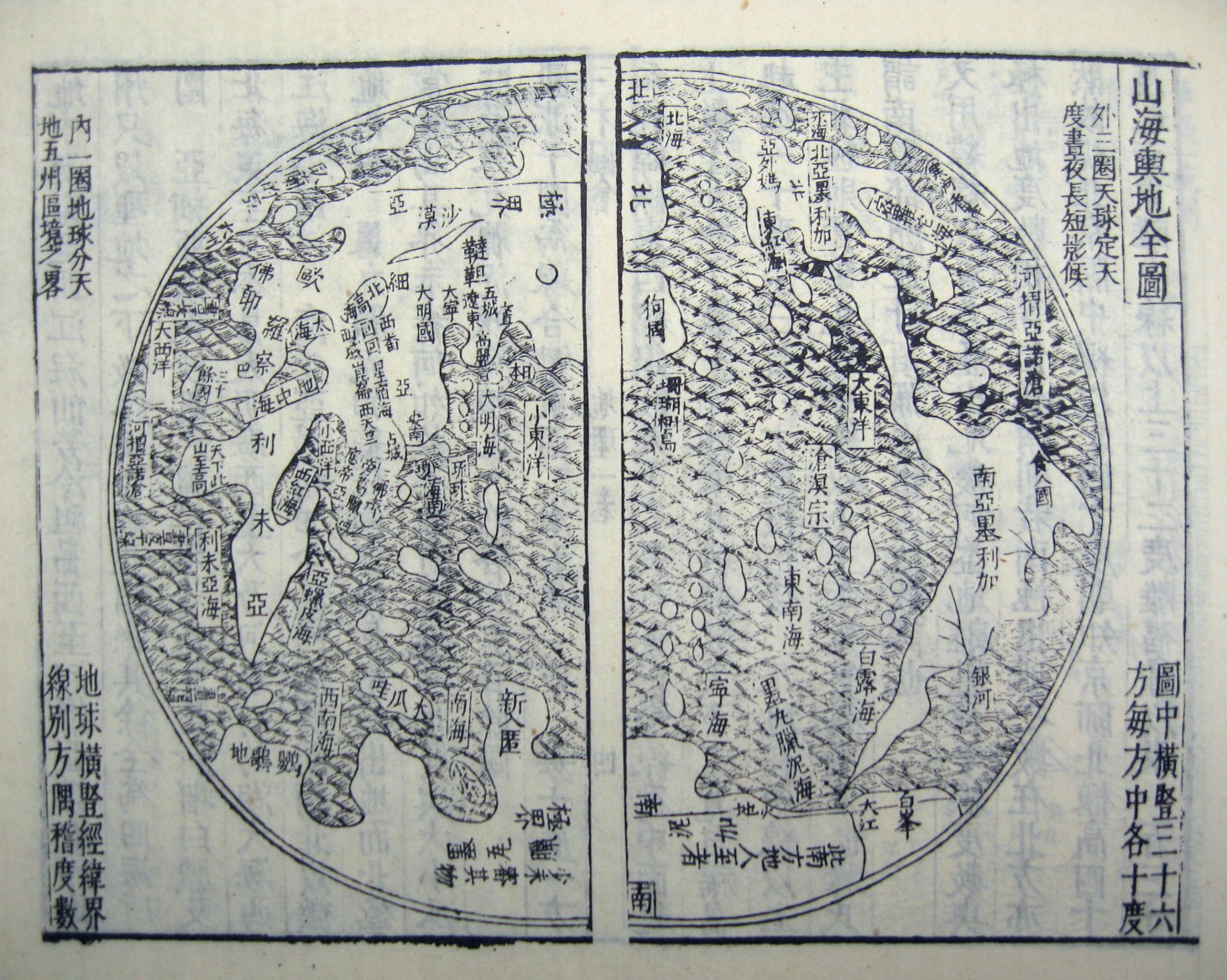
With Piri Reis map from 100 years before: https://images-na.ssl-images-amazon.com/images/I/91XW2CEmU4L...

(which is a part of an atlas, picturing many areas of the world with literally amazing detail and precision)
Granted, Piri Reis did an amazing job, even raising a few conspiracy theories on how he did it, but here is the fairly average European map of the world from 1609:
Would you call Singapore a "weak society" with little ability to innovate? It's essentially what GP was describing.
Singapore is the best example of a monoculture in a diverse environment. Systematic rejection of one community and elevation of the other in government, education, military, etc. Not to mention how difficult it is to get citizenship if you're not Chinese in some form.
Also where are Singapore's innovations? Apart from building a fancy city, they have done nothing. Many Singaporeans comfortable enough and well off that I know often rush to settle down in Australia or USA or the UK, especially in tech. Why is that?
Singapore is a really good magnet for entrepreneurs from other places, but nothing much otherwise. A very artificial place with zero arts and culture - heck, they destroyed their primary language (Cantonese) in schools so as to be cozy with China for business.
I'm not sure I agree that the GPs description is a good description of Singapore, but to the extent that it is, I believe Singaporean society is weaker for it.
Bingo ! A monoculture is really weak because people that act the same and think the same. It's the reason even though Asia has over 2/3s of world population they are not responsible for 2/3s of all innovation in the world.
They destroyed the Asian government, drugged the Asian population, and forced financial restitutions on the Asians to pay for their their own enslavement.
But yet, here we are. Hundreds of years later, and the Asian countries are finally shaking off their colonial enslavement from the white man. And here you are, claiming that they add nothing to the world’s innovations.
It’s just a thought. And maybe something you should consider first before judging others.
Eastern collectivism doesn't need a rod of iron to enforce it.
As you said, autocracies are efficient for hard problems, and we're going to face the hardest very soon
1 foot ocean rise per century.
Threat?
Unimitigated, the forecasts are around 3-7 feet sea level rise this century.
Both of these massively increase the probability of non linear disasters including the release of methane from permafrost and ocean floors, or the disruption of the Gulf stream which would disrupt global agriculture even worse than a 5 degree temperature rise.
Among the many problems, you can expect heat to be so hot that 1 billion people will be living in a place where it's not physically possible to live (humidity doesn't allow the body to cool down): https://eu.usatoday.com/story/news/world/2020/05/04/world-he.... It won't exactly be all roses to the other billions too
It's absolutely a bigger threat than the terrorism that everybody was so eager to throw away their freedom for 19 years ago.
Got better, actually.
After that point (which might be in lets say 10-20 years) there can still be a veeery long downward slope (the soviet union lasted for 69 years).
I would be very interested in what other people think about this (and these timelines)
This argument never sounded very true and intellectually honest to me. I mean, I want to believe in it, but when I scrutinize it precisely, I wonder - how can you measure the ability to innovate of someone who doesn't want (or need) to innovate?
At present time, China's competitive advantage is cheap specialized labour, and they're taking full advantage of that - as they should. That's the whole point of being behind in technology and racing to catc up! It might very well be that when they switch their focus, from copying to innovating, they'd be very good at that as well (or very bad! we literally have very little data to tell)
China's goal under Xi is a return to the golden age of the Kingdom of Heaven, where all Chinese people exemplify the ideals and morals of the most civilized society on Earth. That goal is only tangentially related to the technical innovations they're making, and will eventually stifle them as the definition of "good citizen" and "proper pursuits" becomes more hardened and inward-looking (much like it did during the Middle Kingdom).
The autocratic environment might not be most amenable to free thinking and innovation, but then I'm not convinced that being free from autocracy is truly necessary for innovation to occur. Plenty of innovation occurred when Europe was ruled by Kings, or in 1900 Russia. Even within autocratic corporations, plenty of innovation occur.
Anyways, I don't wish for autocratic governments, but I'm not willing to dismiss China's ability to be innovative based on that.
They're good business, they offer more power to China, why would they change that?
And considering they're history, they've probably learned the lesson about the weakness of ignoring global technology.
And sure, they do have the "great firewall", but it's smart enough to let the science\technology in while filtering the politics out.
That's not true, and given the current trend (everyone gonna use TLS) it is impossible for the "great firewall" to be smarter. For example, HN is blocked in China.
In the industrial sectors that I watch (test equipment, industrial machinery), China has been climbing the ladder at a startling rate, from "outsourced labor" to "copycat" to "bottom tier" to "mid tier" in the last decade. They're now gunning for high tier equipment, and they show every indication of getting there in the next few years.
If innovation is measured by consumer adoption of new technology, TikTok is the first major AI-first consumer application. In other markets too, China has made major innovations in the consumer space that have not caught up in the West yet - ecommerce, fintech, consumer goods and more. None of these are top-down CCP mandated innovations.
It will basically flip the "system" we have now.
You think that democracies are long-term efficient?
Democracies don’t have corruption?
Democracies don’t become self-serving?
I mean, I prefer to live in a democracy because of individual freedoms but it’s not terribly well-organized.
They sure do, but the distributed leadership means there's hopefully someone pushing against corruption, even if it's inconvenient for other goals of the government. Even if they don't succeed, at least they keep shining some light on it. (I'm looking at your Aussie government blocking the anti-corruption group)
> Democracies don’t become self-serving?
Same. There's always going to be some inefficiency, but the closer we are to actual democracy and the less biased it is, the better it seems at ejecting the self-serving members of the government.
What system has lifted the most people out of poverty? It ain't American.
The cogs in our governance (everyone else) are pretty rusty, though.
It's good for other nations who can benefit from their trailblazing, but bad for the nation itself because they're basically fucked in the future when the bill comes due.
Centralization is long-term the worst kind of governance, inevitably becoming as self-serving as kingdoms and monopolies. The bigger it is, the worse it gets and the sooner it gets there.