This makes a society weaker - it's effectively a monoculture that restricts the data available to the decision makers.
It also reduces a societies ability to innovate in art, culture and eventually technology and science - innovation requires the ability to take an outside view, to be self-critical, and a society that is too busy forging a 'strong collective identity' will make it harder for individuals to do that.
It even poisons a societies own understanding of itself and its history, since we have so far failed to come up with good ways of building a 'strong collective identity' without accepting and promoting lies about history.
I think there's some truth to this. But rampant individualism also makes society weaker. It reduces a societies ability to collaborate.
Let's not mistake diversity for individualism. We can be diverse, yet share overarching ideals - such as living together peacefully and in solidarity.
We can, but increasingly I see people arguing that we should forgoe those and determine our actions in society based on our own individual interest and market mechanisms.
Not hard to see why a raise in either of the above would result in the other side getting even more extreme in reaction.
You can have societies that are very community minded and govern them in a free way and with a democracy. You can try to govern very individualistic societies with an autocracy.
There's probably an optimum level of accepted dissent in a society, depending on what it wants to achieve, and I tend to think that social democracies come the closest to achieving it, and certainly much closer than most autocracies.
Japan and South Korea are western only in a superficial sense, in that they have copied the basic institutional structure of the industrialised West. However, the main forces acting on that structure are rather different, and the main actor is certainly not the "egoistic, cold, self-interested, autonomous individual".
I'm not clear what you're saying here. Are you saying that it would be a good thing if society in western countries were more like what it was 400 years ago? Enormous improvements in science, technology, culture and civil society grew out of that 400 year history, and regressing or remaining static over that 400 years would be a disaster.
The only way to have a stable society that spans across centuries is to have a society that can change and incorporate new ideas, technology, people and ways of doing things. It's societies that aren't flexible and strong enough to cope with change that are unable to remain stable over long periods of time.
Going from their nadir in WWII to what they are now in 70 years seems awfully adaptable to me.
By 1700, and certainly by 1800, Europe's interest in science, which then led to developments in advances in technology. This technology is what allowed the "white men on awesome ships with awesome guns" to have their way.
Perhaps if China was so top-down they could have also developed themselves more.
Toby Huff examines this disparity in his books Intellectual Curiosity and the Scientific Revolution. A Global Perspective and The Rise of Early Modern Science: Islam, China and the West. The telescope was embraced in the West, but hardly used (except with a few isolate individuals) in the other major cultures in the 1600s.
The time period you describe includes multiple massive european wars between nation states who were incentivized to improve industrialization, logistics and yes technology.
China's periodic bloody uprisings don't create the same incentive, they basically didn't have foreign policy until it came knocking.
And their collective identity (or huge population) didn't help them fighting wars either, they miserably lost almost every conflict they got in, even ones with themselves.
Your definition of "large disturbance" is pretty narrow. You missed things like the renaissance, the reformation (and subsequent proliferation of non-catholic faiths), the hundred year war, the thirty year war, two world wars, ...
A stable society that spans centuries can stagnate. See Imperial China and Japan before Admiral Perry showed up.
In 1600, the Chinese (and Moghul India) were probably more advanced than Europe in many respects, but there seemed to be little to no desire for further development. The telescope, which kicked off a revolution in the West, was basically ignored. When the Jesuits showed up in 1595, the China still thought that the Earth was flat:
* https://en.wikipedia.org/wiki/Flat_Earth#Ming_Dynasty_in_Chi...
As science developed so did technology, and the European powers were able to basic steam roll over everyone else a century later.
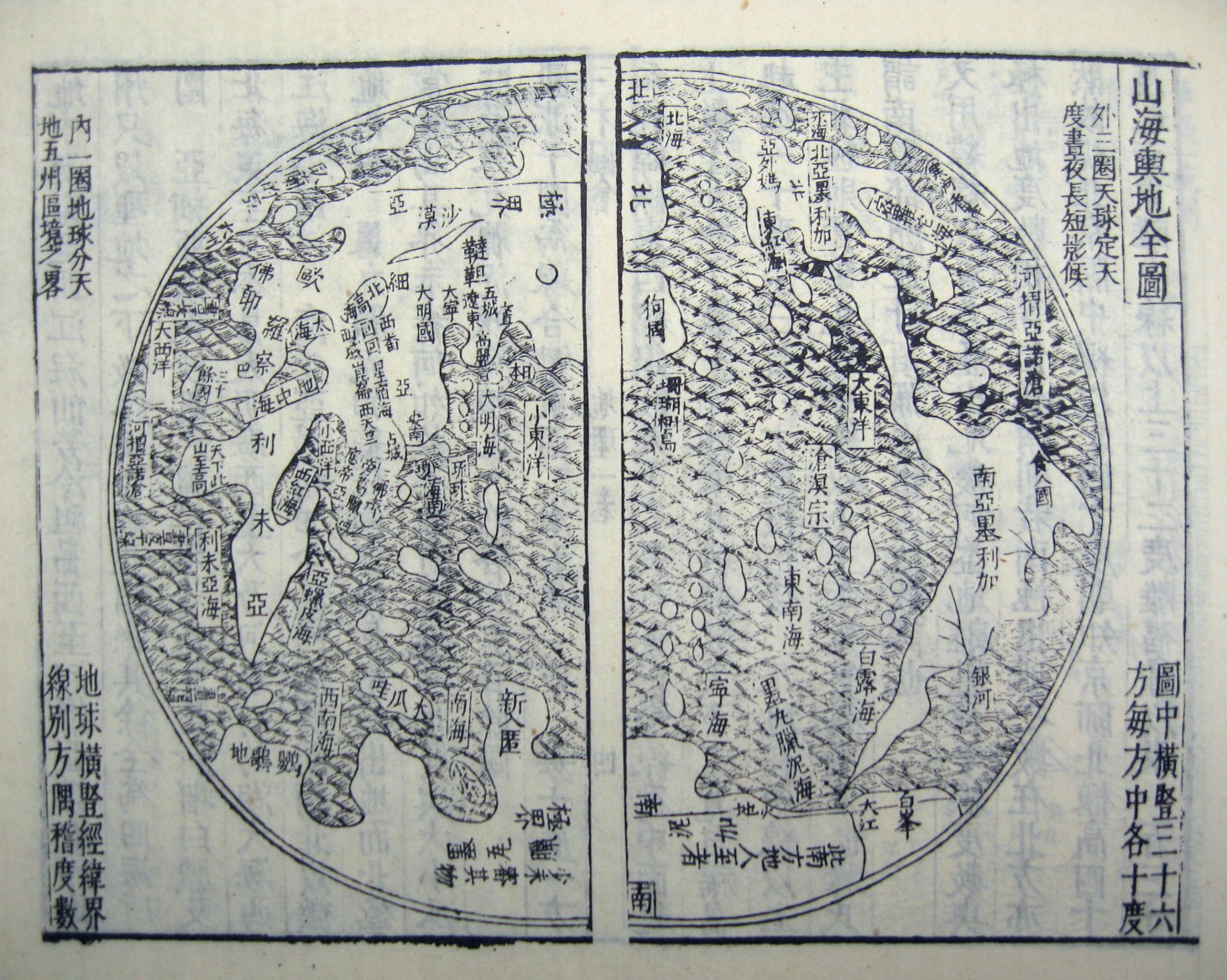
With Piri Reis map from 100 years before: https://images-na.ssl-images-amazon.com/images/I/91XW2CEmU4L...

(which is a part of an atlas, picturing many areas of the world with literally amazing detail and precision)
Granted, Piri Reis did an amazing job, even raising a few conspiracy theories on how he did it, but here is the fairly average European map of the world from 1609:
Would you call Singapore a "weak society" with little ability to innovate? It's essentially what GP was describing.
Singapore is the best example of a monoculture in a diverse environment. Systematic rejection of one community and elevation of the other in government, education, military, etc. Not to mention how difficult it is to get citizenship if you're not Chinese in some form.
Also where are Singapore's innovations? Apart from building a fancy city, they have done nothing. Many Singaporeans comfortable enough and well off that I know often rush to settle down in Australia or USA or the UK, especially in tech. Why is that?
Singapore is a really good magnet for entrepreneurs from other places, but nothing much otherwise. A very artificial place with zero arts and culture - heck, they destroyed their primary language (Cantonese) in schools so as to be cozy with China for business.
I'm not sure I agree that the GPs description is a good description of Singapore, but to the extent that it is, I believe Singaporean society is weaker for it.
Bingo ! A monoculture is really weak because people that act the same and think the same. It's the reason even though Asia has over 2/3s of world population they are not responsible for 2/3s of all innovation in the world.
They destroyed the Asian government, drugged the Asian population, and forced financial restitutions on the Asians to pay for their their own enslavement.
But yet, here we are. Hundreds of years later, and the Asian countries are finally shaking off their colonial enslavement from the white man. And here you are, claiming that they add nothing to the world’s innovations.
It’s just a thought. And maybe something you should consider first before judging others.
Eastern collectivism doesn't need a rod of iron to enforce it.
From the point of view of Western individualism, yes. However, a strong autocracy relies on building a strong collective identity through education and the cultural institutions. That identity isolates the individual from his personal beliefs and justifies his suffering, for the purpose of collectively achieving "macro" goals.
A major mistake is to judge non-Western socio-economic systems through the lens of the Western intellectual tradition.