Infrastructure can also be maintained and last longer than this, which is why I'm personally sad. Had Arecibo always had the ~60 year timeline, it would've been a bittersweet retirement, like Voyager. In this case I just feel like it's gone before it should. Arecibo has been receiving reduced funding since the early 2000s [1].
The end of an era, although thankfully not of science mega-projects. There's still plenty of cool ones operating or under construction.
[1]: https://en.wikipedia.org/wiki/Arecibo_Observatory#Funding_co...
https://www.australiangeographic.com.au/blogs/ag-blog/2013/1...
Rather than a large number of people painting it for a small period of time, which requires a startup and close down overhead; they have instead resourced it so that they can keep a small number of people employed permenantly who accumulate expertise and minimise the mobilisations costs.
Whoever downvoted me, thanks a bunch. Not sure why.
Running a team of painters still costs more than nothing. The cost of painting doesn’t cover the cost of ongoing inspections for metal fatigue etc etc. Engineering reviews, government oversight and so on.
Large bridges, especially with vehicle traffic, vibrate quite a lot and this is causes major ongoing concerns with fatigue, which means extensive monitoring along with the painting. More costs (not saying it’s unjustified).
Keeping a team going is efficient as you say, but more expensive than nothing.
As you say, it would be a lot of work to maintain if they wanted to keep Arecibo running.
Except you get exercise and fresh air.
For those that don't know, paint should be considered a non-optional component of most iron or steel objects, since paint serves the important role of preventing rust formation. It's less important in most uses of aluminum, since aluminum oxide tends to form a protective layer instead of flaking away.
With smaller boats labor is a higher fraction of construction costs vs raw materials. Going big results in massive increases in efficiency which almost paradoxically shift things to a shorter ship lifespan.
What about the Eiffel Tower? Or Blackpool Tower. That proves it can be done.
(Saying that, for example, 300-series stainless, around 30-40% chromium and nickel, "is iron", could be fairly criticized this way. Mild steel not so much, and that was what I really had in mind with the statement, although I concede I didn't say so.)
But if it is obsolete, then that is another matter.
Is a GoFundMe campaign outside of the realm of possibility? I know that I'd contribute to such a worthy effort, but only if the rest of the players would pledge to fund current operations.
The biggest GoFundMe campaign according to Wikipedia only raised $25 million in 2020 dollars (https://en.wikipedia.org/wiki/GoFundMe#Notable_projects, Bannon's et al's fraudulent We Build the Wall project). Arecibo cost $9.3 million to build in 1963 dollars (https://ethw.org/Milestones:NAIC/Arecibo_Radiotelescope,_196...), which is about $80 million in 2020 dollars. Even after one-time construction costs, millions in ongoing operating costs and maintenance would be required as well.
So, no, a GoFundMe campaign to rebuild it is not a possibility. Even hot-button political issues can't get close to the needed funds, and this is not ever going to be a hot-button issue.
Assuming the people supplying the operational funding want to continue to do so it shouldn't take more than low millions to get it going again.
Construction has a lot more costs these days - have to take care of the environment, not kill your workers...
[1]: https://en.wikipedia.org/wiki/ITER
[2]: https://en.wikipedia.org/wiki/Extremely_Large_Telescope
[3]: https://en.wikipedia.org/wiki/Extremely_Large_Telescope
[1] https://roman.gsfc.nasa.gov/
[2] https://lisa.nasa.gov/ , https://www.esa.int/Science_Exploration/Space_Science/LISA
Whereas I live in fear that James Webb will suffer a failure during launch or deployment that just turns it into a very expensive explosion.
My impressions is the neglect comes from having done all the useful things it could do ages ago, and not finding anything new to help with in the areas of science that gets funding.
The state of the art interferometry arrays are ASKAP and MeerKAT currently, in the sense of being the newest and being precusors of the SKA which is the biggest project right now.
In terms of best in class, it varies with the specific frequency and which bit of the sky you want to look at and also with what you consider an observatory: the Event Horizon Telescope that resolved the M87 black hole has the worlds best resolution at their mm wavelengths, but it's really a bunch of existing telescopes collaborating and not a purpose built facility.
Here, for example, is Arecibo on the cover of Nature, in 2018: [1]. And you might want to look into NANOGrav [2]: you'll be hearing a lot more about it (I promise) in one or two years, depending on publication timelines.
[1] https://twitter.com/nature/status/951423495107481602 [2] http://nanograv.org/
And it's too bad the NANOGrav risks getting its results delayed by the inability to extend observations on half its sources, but the loss of Arecibo will not doom the entire project: again not conclusive proof that Arecibo added a unique capability.
The "proof" shows Arecibo was still very useful and finding new things and this disaster will significantly delay research. (As a side note; delays in research can easily mean the death of that research as funding is often time-bound)
Somewhere in this there is a larger story of useful projects not receiving enough funding because they aren't sexy enough.
The VLA may simulate the resolution of a 36 km dish, but it has the sensitivity of a 130 meter one, considerably less than Arecibo's 305. You're ultimately limited by signal vs noise and can't make up for the receiving area that simply isn't there, no matter the width of the baseline.
This makes interferometers and stationary giant dishes different tools, suited to different types of observations. Arrays are not good at imaging extended diffuse sources.
China's FAST telescope was designed without transmit, mostly to save on suspended weight. Its focus cabin is only 30 tons.
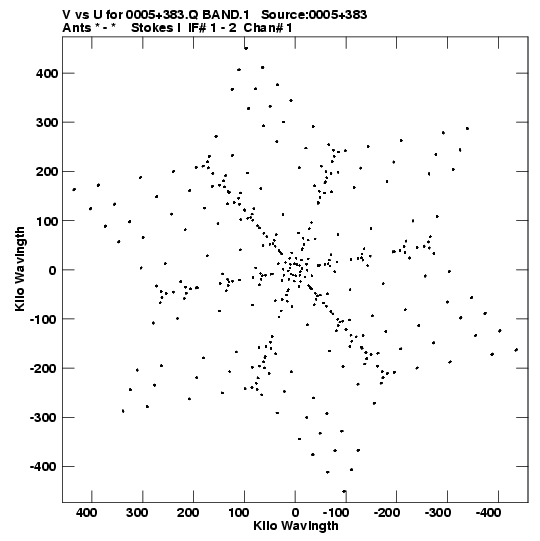
As the object moves in the sky, these dots move around and sort of "fill out" the image in Fourier space, so you get coverage that could look like this: http://www.aoc.nrao.edu/~vlbacald/idx/lowd_uv.gif but it's still not 100% full.
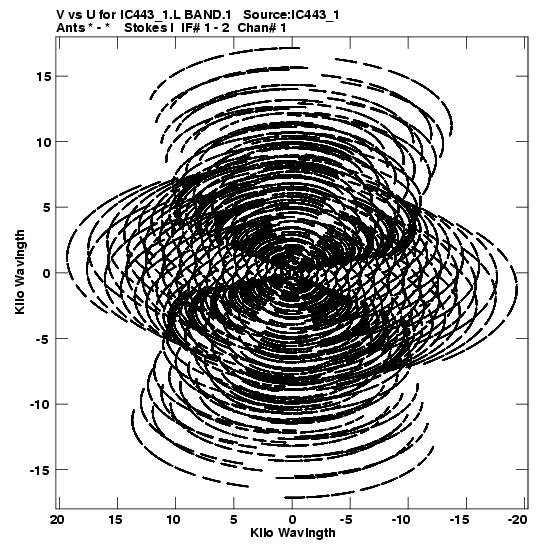
The advantage of a telescope that is a single large dish like Arecibo is that this plane is completely filled. The resolution is more or less the same in all directions. The main disadvantage, of course, is that it is embedded in the ground and can only look at what is directly overhead. (They can maneuver the secondary dish to look at things a little bit away from directly overhead, but I seem to remember it only being a few degrees.)
[1]: See this page for those images and more details: http://www.aoc.nrao.edu/~vlbacald/read.shtml
A logarithmic expansion of baseline distances seems to be the first thing you want in a sparse array. Ideally you want to be able to look in all directions with about the same amount of sensitivity and angular resolution. But the UV coverage of even an asymmetrical, relatively sparse array like the VLBA is surprisingly good, because as the Earth rotates, the antennas describe sweeping arcs on the sky.
The regular UV coverage of the VLA is great, though, for sensitivity at short duration observations.
But Arecibo was great for pulsar work. :-(
A radio astronomer here, and writing opinion for all that's worth.
I visited Arecibo once and stayed for a short project for 3 months. It was awesome, and they have a fabulous small astronomy team doing some really interesting science.
My mentor and long-term collaborator has used this telescope since the 70s, and she will be devastated. This dish has produced so many unexpected discoveries, solid science of highest calibre, and has stayed at the edge of science over 50+ years. It's sad to see such a sudden end.
There are three variants of radio-telescope design:
1. monolith dish (Arecibo or Green Bank) 2. Network of dishes (Very Large Array, or VLA, in New Mexico) 3. Network of individual dipoles (LOFAR in the Netherlands)
One needs to combine all three in some ways to target different classes of astronomical problems. For example, if you want to understand the source structure, separate its left limb from the right, then you need smaller dishes separated by a large distance (like Very Large Array -- VLA). If you are looking at low frequencies of radio light, then you need dipole arrays like LOFAR. On the other hand if you are looking for giant burst of short-term energy, you are collecting light from a distant object. The more you collect, the better it is. So, single dish (or many dishes combined) works very well. Large single dish (Arecibo like) telescopes are also critical to characterize arrays like VLA or LOFAR. So, they are very useful still.
Arecibo's success gave rise to improved design of a single mammoth dish telescopes in China (FAST). So, the design stays relevant and of importance. A new telescope called Square Kilometer Array (of size one square kilometer in effective area) would in principle replace a mammoth dish like Arecibo and tackle very diverse set of problems.
However, Arecibo is like an old Volvo car that kept on going strong. You never want to junk such a old beauty even if you have a swanky Tesla standing outside your door, would you?
Cheers!
Truly sad.
But AO was also a transmitter - it could pump out millions of watts to illuminate asteroids, the moon, and other orbiting objects for mono static and bistatic radar measurements. For example, images such as these [0] are created by receiving the reflection of energy emitted from transmitters like AO and Goldstone (I didn’t find an exact image of an AO-VLA measurement but they’re out there).
The AO and VLA had a unique relationship, in that one could precisely measure and image irregularities of any particular VLA dish panel down to a few tenths of a millimeter using bistatic radar of the moon. It’s somewhere in the eVLA library but my google fu is failing me (also google really sucks now).
They also had a few events for ham radio where AO lit up the moon and hams across the world could hear its reflection with basic equipment. [1]
[0] https://m-cacm.acm.org/careers/182810-high-def-radar-images-...
FAST [0] can be considered an Arecibo replacement, see the comparison chapter on the wiki page. Though it is built in China, so some may say that it's not a replacement for the US and the West science community.
[0]: https://en.wikipedia.org/wiki/Five-hundred-meter_Aperture_Sp...
(a) Why not replace the cables?
(b) What would they do if the cables on the Golden Gate bridge also corroded like this?
The Square Kilometre Array
China already built one: https://phys.org/news/2016-07-china-world-largest-radio-tele....
Given that it's nonmilitary US government infrastructure, I doubt it will be replaced. After all, why spend money on a telescope when the government can cut the budget to lower taxes a little bit more?
In a small sidenote of an absolutely magnificent lecture by Steve Blank, the Secret History of Silicon Valley [0], he notes that the reason the radio telescopes were built in the 60's was because the Soviets were using air defense radars in their interiors that were hard to get information on using other methods that were available, but a few times a month a very sensitive radio telescope would get a very good view of their emissions as they bounced off the moon.
This was the cause of the massive radio astronomy boom during the 60's that built all the western radio telescope megaprojects that have produced so much great scientific data.
[0]: https://www.youtube.com/watch?v=ZTC_RxWN_xo (radio telescope talk at 50m30s or so)
Part of the plot is that a radio astronomer at Arecibo discovers intermittent Alien radio signals originating from the Alpha Centari System. The protagonists can't figure out why the Alpha Centari's are transmitting such strong radio signals and why they are intermittent. It turns out that their planet doesn't have an ionosphere to reflect broadcast radio waves, so the inhabitants instead bounce radio off the moon to broadcast it back to the surface.
Arecibo only picked up the radio signals when they bounced off the moon at the right angle.
The origin of radio telescopes in the 60s must be the kernel for that bit of plot.
The NSF budget had been steadily growing in real terms, and is now over 3 times larger than in early 80s (8 times in nominal terms). If Arecibo has not been getting enough money to maintain it, and if there is no plan for new telescope in its budget, it’s not because of “budget cuts”, but rather because of spending decisions.
I do believe that we are getting less than we used to for the spend, but it’s clear that it’s not budget cuts that are responsible: rather, it’s the productivity of science is falling, and so is efficiency of the government, despite growing expenditures.
Republicans lower taxes sometimes.
They re-allocate budget from one thing to another.
They don't cut the budget.
Please cut out the sarcasm. Let's be nice to one another. (And if you didn't mean it to be sarcasm, never mind.)
One day we'll have synthetic aperture radiotelescope swarms in space. For now, it's a better use of money to improve our earth-based systems first.
But infrastructure ages, and 60 years isn't a bad run. What comes next? Clearly there's going to be a capabilities gap for a while, but now that it's 60 years after its original design, what kind of design is going to replace it? Do we even need giant monolith dishes anymore?
Hoping a radio astronomer can chime in here. For example, I know out in New Mexico they have a distributed array of dishes (literally called the "Very Large Array", oh scientific creativity [0]) where, my understanding is, a bunch of computers stitch together all the individual signals and effectively get a resolution better than any single dish can. Is a design like that now state of the art, or does a monolithic design like Arecibo still give capabilities unique to single large dishes?
[0] https://en.wikipedia.org/wiki/Very_Large_Array