This is misleading at best.
For example: RBG, despite her left-leaning reputation, was easily one of, if not the, most pro-copyright and pro-IP justices on the bench. (Relatedly, she also was pretty pro big business, which rarely fits the portrayed narrative.)
Not all areas of law, especially at the Supreme Court level, easily translate into right/left politics.
https://www.law360.com/articles/1312244/ginsburg-remembered-...
https://www.realclearmarkets.com/articles/2020/09/23/justice...
Just look at the commentary around overturning Chevron deference and non-delegation. Absolutely apocalyptic.
You still have Article III remedies in that case.
If the extreme version of non-delegation took hold, it would be the end of all rational regulation. Do you REALLY want Congress writing technical documents about effective isotropic radiated power? Or the shape of curb ramps?
I think it’s fair to ask how far a non-delegation principle should go. There is clearly a continuum between legislation and enforcement discretion. But does that mean we should have no non-delegation principle at all? Is there a definable middle ground between Congress leaving it to executive discretion address technical minutea and Congress delegating oversight over entire sections of the economy to unelected bodies that can serve as judge, jury, and executioner?
There are ways to maintain an administrative state without stuffing everything into the executive branch: https://www.theregreview.org/2019/12/18/rappaport-stronger-s...
Trying to peg a generic one dimensional (left-right) or even two dimensional (social/fiscal) political position on justices is difficult, even with loosely defined labels/ categories.
It's much easier to look at justices relative position/ rank on a per-topic basis.
Alternatively, and less useful to the general public, but very useful to SCOTUS junkies, is looking at cross tabs of how often a particular justice votes with others. Especially when they break from the publically perceived left/right voting block, which is more often than most think.
Scotusblog is full of this type of analysis for those interested:
I think it's telling that neither Biden nor Harris was willing to rule out court-packing at the presidential debates, and at this point I think they're right to leave it on the table! But, it really would mark the beginning of the end of the Supreme Court. It's easy to predict what would probably happen the next time power changed...
The correct answer to that question was obviously, "Congress makes the laws, including ones about the number of SC justices, not the President."
Hard to make that claim if you're not helping set policy.
But they are still an excellent source, and are about as good as it gets compared to most (supposed) non-partisan media these days.
Fwiw, I also believe their bias to be almost entirely unintentional, which is way more than can be said for most sites. For topical seminars, where authors might actually argue for a side, they do a decent job of getting various opinions from multiple sources, even if it's not always exactly balanced 50/50.
And they disclose all cases in which someone might be involved.
Like anything else, you still need to consider the source when reading it.
What is with the ridiculous hyperbole that's so common when talking about America on the internet, especially by non-Americans? Talk about "American exceptionalism" - just in a different way.
Any other Western democracy (including some Western-model democracies outside of the West proper), sure. But then the left-right axis is not really readily transferrable to outside of that domain, anyway.
It also varies quite a bit by subject-area. In Germany, the constitutional court held (around the same time as Roe) that legalized abortion was unconstitutional, violating the fetus's right to life. Today, it is technically still illegal, but decriminalized up to 12 weeks. (Shorter than in almost every state in the U.S.) The abortion rate in Germany is much lower. The Democratic party's views on abortion would not be considered center-right in Germany. On gay rights, Germany got legalized same-sex marriage a couple of years after the U.S. And things like surrogacy, which gay male couples often rely on to have kids, is illegal.
Or, consider that Merkel, a member of the center-right Christian Democratic Union (CDU) has called for a ban on burqa. To my knowledge, even Trump has not said anything like that. Similarly, on immigration, while Merkel allowed Muslim refugees, her successor declared that a "mistake" which the country had "learned from." Democratic favorability to refugees would not be a center-right position in Germany.
In the area of religion, the U.S. is extremely left wing compared to every country but France. In the U.S., teaching religion (as such) is banned in public schools. In the U.K., Germany, Italy, and Spain (four of the five largest EU countries) it's actually required, either by statute or by the constitution. Children have a right to receive a religious education at the public expense in these countries.
In the area of taxes, the Democratic Party is center-right in some ways but quite left win in others. Merkel has championed Germany following along with Trump's corporate tax cuts. The Democrats' proposal to repeal that would not be a center-right position in Germany. The Democrats' proposal to tax capital gains as ordinary income is quite left wing. Most Western European countries, including Germany, have preferential treatment for capital gains taxes. In general, the U.S. has the most progressive tax code in the OECD: https://opportunitywa.org/u-s-federal-income-tax-structure-m...
But Democrats' tepid support for labor unions, for example, would be considered center-right or even right-wing in Germany.
On the whole, on social, religious, and immigration issues, the current Democratic Party is solidly to the left compared to western Europe. On labor issues, it's to the right. On corporate and investment taxation, it's solidly on the left. On healthcare, its to the right, but mainly for reasons that have to do with minimizing disruption to peoples' current private insurance. Where they want to end up, single payer public insurance, is solidly on the left.
Our next Vice President will very likely be a Democrat who, in 2019, supported single-payer public healthcare, treating capital gains as ordinary income, a 35% corporate income tax rate, a financial transactions tax, publicly funded abortion with no compromises such as waiting periods, Green New Deal, free healthcare for people who immigrate illegally, etc. If she actually believed those things, she would be a solidly mainstream left politician in most European countries.
Democrats generally agree that there should be universal access to health care, and a mostly agree that that should involve a public plan (not just a private subsidy) available to at least some section of the population beyond the current Medicaid population.
There is not general agreement within the Democratic Party on universal single-payer as even a long-term goal. The currently dominant neoliberal faction of the Democratic Party supports a public option as a long-term component of healthcare policy to acheive universal access, but does not generally support single-payer as a goal, in either the near or long term.
> In general, the U.S. has the most progressive tax code in the OECD
As your own source notes, net of transfers and taxes, the US has one of the least progressive systems in the OECD.
> In the area of taxes, the Democratic Party is center-right in some ways but quite left win in others. Merkel has championed Germany following along with Trump's corporate tax cuts.
You seem to be really obsessed with the CDU as your measure of center-right parties, but AFAICT the CDU is to the right of most parties labelled center-right, not just in Europe, but even in Germany specifically (which has a fairly wide range of center-right parties.)
But, yes, its really only the dominant faction of the Democratic Party that is center-right, the "progressive" faction is center to center-left by European terms, and the whole (today, with the gains the progressive wing has made over the recent years considered) is probably more center than center-right; the "Democrats are a center-right" party was most true at the height of the Clintonian neoliberalism of the Democratic Party which as faded over the last decade or so and particularly since Bernie Sanders 2016 campaign reenergized the progressive wing, though it has still not become dominant.
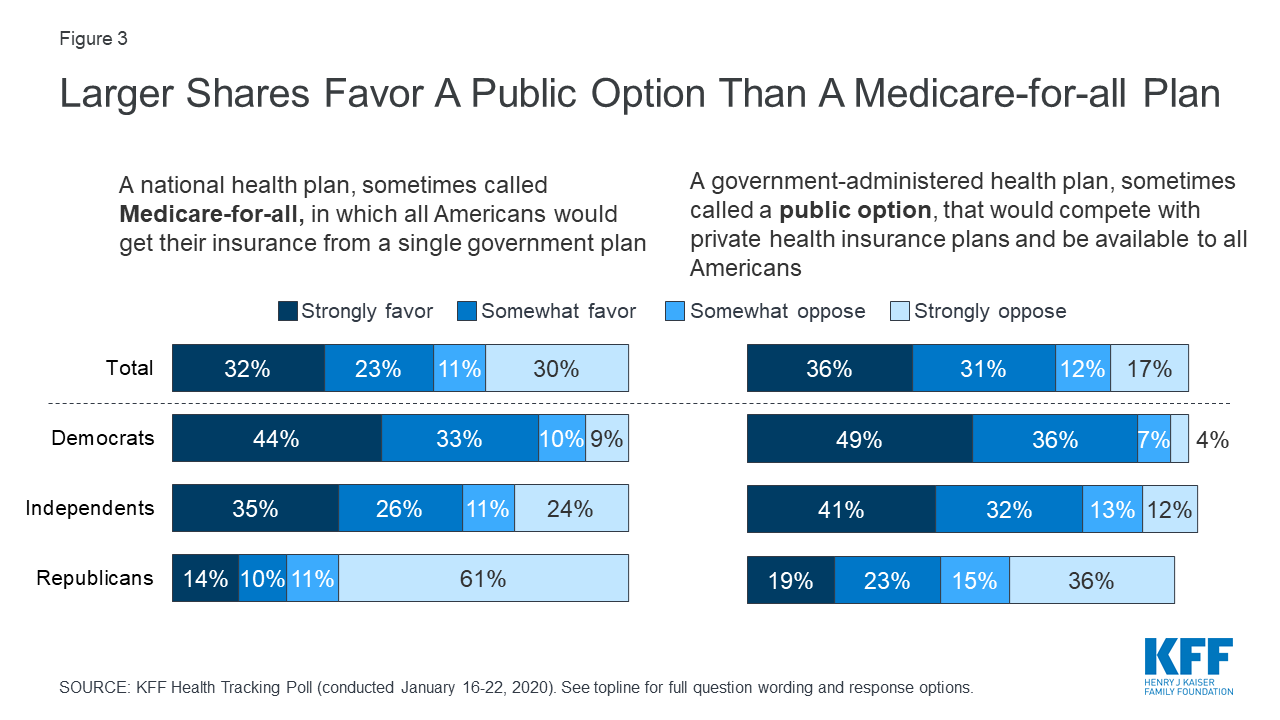
A big majority of Democrats support Medicare 4 All: https://www.kff.org/wp-content/uploads/2020/01/9394-Figure-3.... They support a public option somewhat more, but to me it seems more like they do so to soften the transition to a single-payer system. A “public option” wouldn’t be like the multi-payer systems of Germany, Switzerland, or the Netherlands. Since it would kill private competitors in the long run, it’s just a slower road to single payer.
Regarding taxes: netting transfers mixes up the tax system from the welfare system. As the article points out, our taxation is progressive but our spending is regressive. It’s a system designed to redistribute money from the rich to the middle class, not the middle class to the poor.
As to Germany, I use that as an example because it’s a large European country and I’m familiar with it. CDU has been moving left for the last 15 years: https://fivethirtyeight.com/wp-content/uploads/2017/08/hazar....

Like the above, various international party comparisons show Democrats moving left of center by 2012: https://fivethirtyeight.com/wp-content/uploads/2017/08/hazar...
As to social or religious issues, Italy or Spain would be more conservative in some respects. (Islam isn’t a recognized religion in Italy.)
The recent rise of progressives has moved Democrats sharply left in part because Europe has been moving to the right economically for decades. Low corporate and investment taxes and deregulation is gospel across the European center, but it’s disappeared among progressive Democrats. That wasn’t remarkable in 1975 but it’s remarkable today. Macron, for example, is campaigning on deregulation and a government takeover of Islam, and his major competition is to his right. Center left parties in France aren’t questioning the country’s fairly low corporate and investment taxes. Neither are those in Spain. Democrats (in particular Warren’s utterly cockamamie proposal) really stand out in that area as a throwback.
Green New Deal is a great example of this. It’s an FDR era jobs program. It stands in stark contrast to Europe, which is doing carbon pricing. Progressives seem to have developed an allergy to markets, and while the center isn’t there yet it’s not pushing back either.
I mean that’s before you get started on Sweden’s center-left party continuing to cut corporate taxes and partially privatizing social security.
Oh, I forgot about school choice. Democrats are far to the left compared to Europe in that.
Sure, a big majority of Democrats in the electorate do.
The description of the center or center-right nature of the Democratic Party is not a description of the party-in-the-electorate but the institutional party. In fact, it's frequently expressly contrasted with the views of the party-in-the-electorate to argue that the institutional party is a poor agent of its membership.
Turning to polls of the party-in-the-electorate to argue against the characterization is, at best, not understanding what the discussion is about and, at worst, the fallacy of equivocation.
> netting transfers mixes up the tax system from the welfare system.
In every state, taxes and the welfare system are already mixed up, and the division of function between them isn’t consistent fromm state to state. Viewing them separately miscasts differences in preferred vehicle with differences in preferred function. Or vice versa.
I think the Justices were struggling a bit for analogies, but got the basic gist of the difference between implementing code and declarations.
The difficulty is that they have to think about this in terms of the relevant legal concept (merger) not the relevant technical concept (interoperability). You can copyright expressions of ideas, but not ideas themselves. Merger doctrine says you can’t copyright an expression of an idea if there is only one way to express the idea, because then the idea “merged” into the expression.
Do declarations merge into the idea of the implantation? In some sense clearly they don’t. If you have a set of functions that operate on an object, the convention in C is to put the object first and the parameters after. You “append, into this vector, this value.” In Common Lisp, it’s often reversed. You “append this value to this vector.” Both express the same idea—a command for appending a value to a vector—but there is a creative choice in the expression.
But you can think of the same idea at a lower level. “Calling a function named push to append an element to a vector where the first parameter is the vector and the second parameter is the element.” In that case, there is really one way to express that idea. Why would you think of the “idea” at such a low level? Because that’s what you’re doing when you’re interfacing with an actual API. The “idea” isn’t some abstract hypothetical function for appending, it’s the actual “push” function with parameters in the specific order.
The problem is that interoperability is not really something that goes to copyright-ability, but fair use, which comes after copyrightability. Dictating how you see the “idea” based on interoperability seems a bit like a phase ordering violation.
That has implications for language implementations too. Who would own the standard library for any given language? What about programs that call API functions? Are they derivative works too?
An API is necessarily functional first and foremost. It would cause chaos and some weird dystopian future if Oracle wins.
Thing is, for chip manufactures it makes no sense not to allow others to call this x86 API. Things could get dicier for other who try and virtualize a machine instruction set.
A compiler outputs machine code, it doesn't implement machine code.
Google's Java implementation implements Java APIs.
BUT in this case we are talking not of using part of an API (say the Math library to implement a physics engine is assembly and link it) but of reimplementing a whole language which has, as of today an when the events discussed took place (even if we agree to hate it) an owner.
When they first design and publish it yes, but Oracle didn't design and publish the Java APIs, they bought them after they had becomes very popular and widely used.
At that point they don't need to care about making it popular, it already is, all they care about is milking that existing ecosystem for every penny they can get. If future API publishers care about this they can just license out their API spec, but right now Oracle just wants to be able to squeeze whoever they can until the pips squeak.
Require copyright assignment or a guarantee for royalty free use by any implementation. Standards committees already have to deal with hidden patent dependencies someone might sneak in so this would just be another bullet point on paperwork that should already exist.
For example, glibc is owned by GNU, and it is licensed under the LGPL, so you are allowed to dynamically link it without having to release your own code under the GPL (or compatible). This is all happening today.
The only projects that will be more seriously affected by this decision are WINE and similar - projects that are copying the API but not the implementation. Even here, it is very likely that WINE could win on Fair Use, since their copying is obviously done for interoperability.
Also, APIs are obviously creative human works, and their purpose is first and foremost usability for the end-user.
That's an interesting question. Perhaps K&R? Or maybe their employer? Or perhaps by now the copyright may be with ANSI/ISO?
But this does raise an interesting point, about who would own copyright on something that was not believed to be copyrightable for much of its history.
It's why silly (and inadequate) analogies emerge:
"Justice Clarence Thomas compared Google's copying of the Java APIs to a football team taking a rival's playbook."
"Close your honor, but let me expand on this further. Imagine instead that your opponent publishes their calls and they are regularly available to all individuals of the general public. However, while they may describe a call for going long, they do not give any specifics if the receiver starts from the left, center, right side of the field, how fast he should go, who should block for him, etc. They essentially are just assigning a call to a general concept of 'go long'. Now as a competitor team, I look through their publicly available calls and say "Hey, thats a good idea, we should have a call for 'go long' as well". However, in practice my team does start from the left, and then cut in the center of the field to receive the ball. This may, or may not be totally different then what my opponents choose to do when they call "go long" The additional benefit is if I transfer a new coach onto my team, he can use the call "go long" and even though the team accomplishes the goal, possibly by a different route, he can make the call to accomplish essentially the same thing."
Note: Not a huge sports guys, so perhaps my football analogy broke down a bit there, but hopefully you get the idea.
I'd have argued it's more like copyrighting doorknob placement (opposite hinge, at hand height) and operation (twisting) on doors vs. patenting a novel mechanism inside the doorknob.
A football playbook is more like the blueprints of the inside of the doorknob. Of course it's patentable if playbooks are patentable (I presume they are if considered works of choreography as in a dance).
As far as I can see (but please note that I am not even in the US, never mind a legal scholar) the relevant US law is 37 CFR § 202.1 about “Material not subject to copyright” (https://www.law.cornell.edu/cfr/text/37/202.1). This enumerates several cases that are explicitly excluded from copyright protection. One is “typeface as typeface”, which was apparently interpreted as described above in a litigated case (Eltra Corp. vs. Ringer).
An argument has certainly been made, though I can’t immediately find the original source, that this exclusion is justified because of the utilitarian nature of a typeface design: allowing one party to control all use of it would be against the public interest, because ultimately that principle could allow for all printed communication to become controlled.
It seems to me that APIs fulfil a similar purpose. They are not useful in themselves, lacking a corresponding implementation. They are, however, an essential basis for standardisation, interoperability and communication between practitioners.
Under 202.1(b) of the law cited above, another class of works excluded from copyright protection is “Ideas, plans, methods, systems, or devices, as distinguished from the particular manner in which they are expressed or described in a writing”. I wonder whether a similar argument about the utilitarian nature of APIs as a specification distinct from its implementation could be made based on that.
Everybody loses: manufacturers, because they can't easily create competing products, and users, because they have to re-learn driving every time they change car brand.
And that is one of several arguments Oracle made, that api interface is a stencil.
I think I would agree the law supports that argument from what I know about it, copyright is pretty broad. But at the same time, I think that is perverse and we should change the law.
Such a thing might be considered fair use if the second team's argument was they indeed copied the playbook because they had a recruited some players from the first team and keeping the names the same made it easier for them during practice. But for now the judge is suspicious that they've come up with this explanation after the fact.
It’s more likely the arstechniva writer failed to understand the point of the analogy.
Having just listen to the audio, it really annoyed me that Google’s lawyer kept saying “If we can’t copy this it would be impossible to write software.” And always left of the “in Java” part. Really fucking misleading.
Not in the EU where there is precedence with SAP/R3 saying APIs are not copyrightable.
Any real solution will have to be legislated.
Yes, it is.
> There is no legal definition of "interface" or "implementation".
There is a legal definition of what is included, and what is excluded, from copyrightability, and (though its quite fuzzy, in large part because it was trying to incorporate a fuzzy judicial doctrine grounded in the First Amendment into the statute) what is included, and excluded, from "fair use" even if it otherwise violated copyright.
The courts job is very much to test existing concrete things against those definitions.
As another HN commenter put it to me when I made the same mistake: "The GPL is not viral." If one party breaks the terms of the license, then normal copyright goes into effect.
No, not at all.
OTOH, it does mean if they implement a GPL interface in proprietary software it does mean that they are in violation of copyright (barring a fair use defense) and the GPL, potentially triggering the loss-of-license provisions of the GPL and other legal consequences.
Justice Breyer's QWERTY analogy was pretty good.
Also, Google's lawyer is supposed to supply that framework in oral and the brief.
First, as colejohnson66 pointed out, that may be a derivative work. This will depend on how your transformer actually works.
I can't think of any way to do it that does not involve having access at run time to a copy of the copyrighted API. If that copy is part of the transformer, there is a good chance the transform is a derivative work.
If the transformer does not include the copyrighted API, instead getting information about it from some external source that the user must supply at run time such as via an input file describing the API using some sort of API description language then it is much less likely to be a derivative work. Well, at least if it somewhat general, working with several APIs described in that language rather than just working with the one particular copyrighted API.
Second, even if it is not a derivative work, the people who use it to make the shim might be infringing. Usually that would not be your problem (unless you do something like indemnify your users, which I'll assume you would not be insane enough to do).
However, you have to at least consider contributory infringement. If I infringe someone's copyright using tools I got from you, and those tools have no substantial use other than infringing copyright, you can be held liable along with me for the infringement.
As with the derivative work case, if you can make the transformer general purpose so that it can be used for transforming APIs that are not copyrighted too, you should be able to avoid contributory infringement.
This case has been a ticking time bomb, where the law is to decide whether ideas are patentable. Extremely scary news, seeing it go badly.
relax, its 2020 so now lets just enjoy how "crazy" this whole thing can go to and finally if Oracle wins... we RIOT, won't end well alright
It's nowhere near as world-ending as Google's public policy team would like you to believe. But given that Android is not fair use (it's not interoperable, they just wanted to glom on the popularity of the platform), it sucks for Google.
I don't think this is such an easy argument. Google's interest was ultimately the bottom line.
Without discussing the copyrightability, from a strictly monetary perspective, APIs are product that, in this case, has a very high monetary value (market share == $$$), and Google chose it for this very specific reason (developers == market share == $$$). Again, I don't imply that copyrightability is good or bad, but the entire matter has been about money, and strictly from that perspective, ownership has a sense.
That seems incompatible with the text of Section 107, which includes the amount copied as a factor for determining fair use. The more compatible your implementation is, the more you have to copy, so the logical end of this reasoning is that Android's implementation of Java would be fair use if it had copied all of the API, not just a subset.
That is not at all clear.
But given that Android is not fair use (it's not interoperable
How is it not? Lots of code written for the JVM will build and run unmodified on Android. Not 100%, but WINE isn't 100% compatibile either.
Why it should? It would mean that implementing commercial Java runtime without Oracle license is not possible?
> Why it should?
Because its explicitly a factor, in the statute, for fair use analysis.
> It would mean that implementing commercial Java runtime without Oracle license is not possible?
Maybe, maybe not. If Google loses on both copyrightability and fair use, the entire case law on API fair use will be one negative instance. We might also get a more specific test articulated in the ruling, but we have no idea what that test would be now, so its hard to speculate (well, easy to speculate, but hard to judge which speculation is more accurate) what the impact would be on any other use.
You could arguably implement Java without a license from Oracle provided you were using the GPL, as OpenJDK is released under the JDK, and presumably includes the entire Java API. The problem for Google, of course, is OEMs would've balked at being forced to open source all of their proprietary modifications to Android.
Wikipedia says the OpenJDK was released in 2007, so Google could've legally used the Java API under GPL terms, but chose not to, and also chose not to pay for Java licensing.
OpenJDK have linking exception, so it doesn't apply. In fact Android uses OpenJDK now. It also makes Oracle case looks phoney, suing Google for Java usage while having released freely available OpenJDK.
But that's not the point, I think implementing API/ABI/protocols/whatever should be allowed whether or not vendor wants it. There are many reimplementations of competitors APIs, and ruling in favor of Oracle would basically break that. Under that interpretation Wine would be in danger too, as significant part of Wine development is commercial (by CodeWeavers making their CrossOver product).
So, as long as you are using it under the license Oracle offers it to you under, you could use it without a license from Oracle?
I think that is inherently self-contradictory.
What about improving the API? E.g. some languages may be mostly but not 100% compatible with existing languages and provide more or less the same API but not be 100% the same - both the in the runtime library (API) and the language itself.
For example Free Pascal is mostly compatible with Delphi but not the same and its runtime library is mostly the same as Delphi but also not the same.
Supreme court judges just do not have the conceptual framework to properly adjudicate this. I don't think it's going to be possible to teach them the difference between interface and implementation within the parameters of these arguments. And beyond that the conservative majority is predisposed to treat everything as property. This is not going to end well.