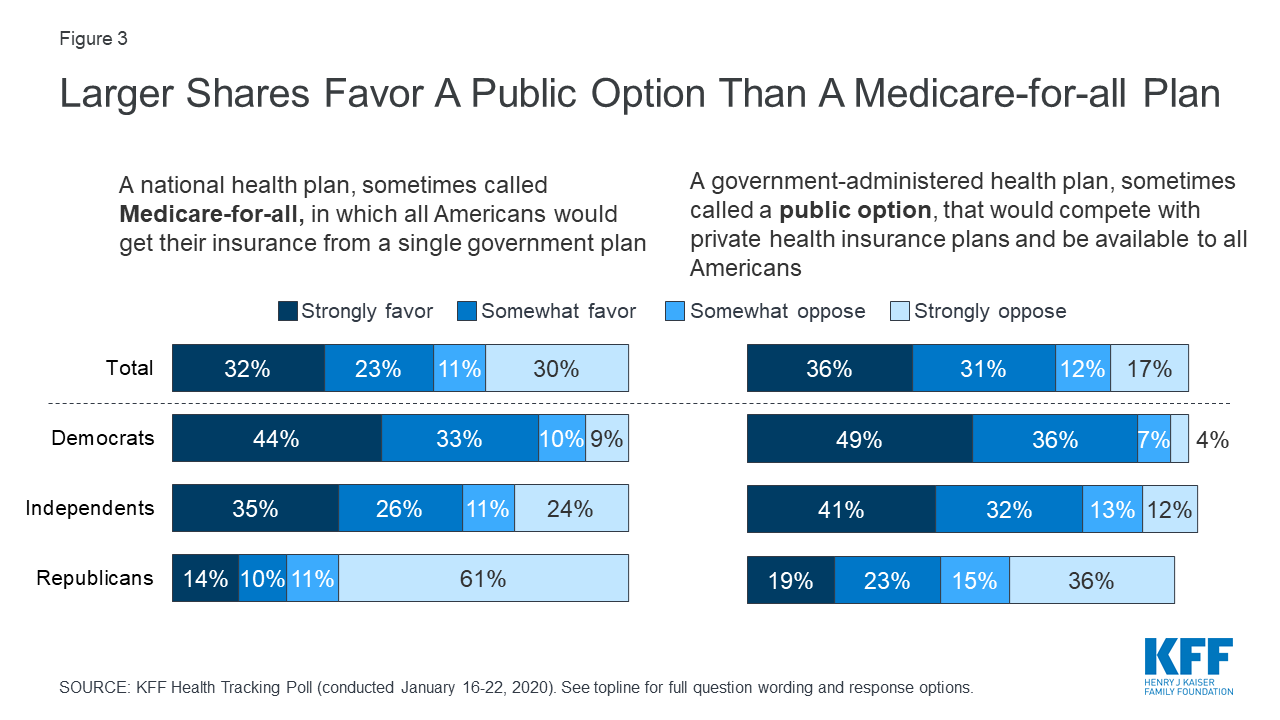
A big majority of Democrats support Medicare 4 All: https://www.kff.org/wp-content/uploads/2020/01/9394-Figure-3.... They support a public option somewhat more, but to me it seems more like they do so to soften the transition to a single-payer system. A “public option” wouldn’t be like the multi-payer systems of Germany, Switzerland, or the Netherlands. Since it would kill private competitors in the long run, it’s just a slower road to single payer.
Regarding taxes: netting transfers mixes up the tax system from the welfare system. As the article points out, our taxation is progressive but our spending is regressive. It’s a system designed to redistribute money from the rich to the middle class, not the middle class to the poor.
As to Germany, I use that as an example because it’s a large European country and I’m familiar with it. CDU has been moving left for the last 15 years: https://fivethirtyeight.com/wp-content/uploads/2017/08/hazar....

Like the above, various international party comparisons show Democrats moving left of center by 2012: https://fivethirtyeight.com/wp-content/uploads/2017/08/hazar...
As to social or religious issues, Italy or Spain would be more conservative in some respects. (Islam isn’t a recognized religion in Italy.)
The recent rise of progressives has moved Democrats sharply left in part because Europe has been moving to the right economically for decades. Low corporate and investment taxes and deregulation is gospel across the European center, but it’s disappeared among progressive Democrats. That wasn’t remarkable in 1975 but it’s remarkable today. Macron, for example, is campaigning on deregulation and a government takeover of Islam, and his major competition is to his right. Center left parties in France aren’t questioning the country’s fairly low corporate and investment taxes. Neither are those in Spain. Democrats (in particular Warren’s utterly cockamamie proposal) really stand out in that area as a throwback.
Green New Deal is a great example of this. It’s an FDR era jobs program. It stands in stark contrast to Europe, which is doing carbon pricing. Progressives seem to have developed an allergy to markets, and while the center isn’t there yet it’s not pushing back either.
I mean that’s before you get started on Sweden’s center-left party continuing to cut corporate taxes and partially privatizing social security.
Oh, I forgot about school choice. Democrats are far to the left compared to Europe in that.
Sure, a big majority of Democrats in the electorate do.
The description of the center or center-right nature of the Democratic Party is not a description of the party-in-the-electorate but the institutional party. In fact, it's frequently expressly contrasted with the views of the party-in-the-electorate to argue that the institutional party is a poor agent of its membership.
Turning to polls of the party-in-the-electorate to argue against the characterization is, at best, not understanding what the discussion is about and, at worst, the fallacy of equivocation.
> netting transfers mixes up the tax system from the welfare system.
In every state, taxes and the welfare system are already mixed up, and the division of function between them isn’t consistent fromm state to state. Viewing them separately miscasts differences in preferred vehicle with differences in preferred function. Or vice versa.
Democrats generally agree that there should be universal access to health care, and a mostly agree that that should involve a public plan (not just a private subsidy) available to at least some section of the population beyond the current Medicaid population.
There is not general agreement within the Democratic Party on universal single-payer as even a long-term goal. The currently dominant neoliberal faction of the Democratic Party supports a public option as a long-term component of healthcare policy to acheive universal access, but does not generally support single-payer as a goal, in either the near or long term.
> In general, the U.S. has the most progressive tax code in the OECD
As your own source notes, net of transfers and taxes, the US has one of the least progressive systems in the OECD.
> In the area of taxes, the Democratic Party is center-right in some ways but quite left win in others. Merkel has championed Germany following along with Trump's corporate tax cuts.
You seem to be really obsessed with the CDU as your measure of center-right parties, but AFAICT the CDU is to the right of most parties labelled center-right, not just in Europe, but even in Germany specifically (which has a fairly wide range of center-right parties.)
But, yes, its really only the dominant faction of the Democratic Party that is center-right, the "progressive" faction is center to center-left by European terms, and the whole (today, with the gains the progressive wing has made over the recent years considered) is probably more center than center-right; the "Democrats are a center-right" party was most true at the height of the Clintonian neoliberalism of the Democratic Party which as faded over the last decade or so and particularly since Bernie Sanders 2016 campaign reenergized the progressive wing, though it has still not become dominant.