The government should find a way to benefit minorities without outright descrimination against those that doesn't fit their definition. My personal favorite idea is improving schools. If we diverted enough money and resources to primary schools in poor areas, we could achieve similar outcomes to affirmative action without just switching the groups we discrimate against.
There's nothing wrong with immigrants but it seems as though immigrants are benefiting from programs meant to help the descendants of African-American slaves. The only question is if the Ivy League universities care about this or not.
You have a completely different disposition to education if you see it as a chance instead of something you have to endure with respective results.
Given, that doesn't apply to everyone, but is definitely a common occurrence.
Where is it communicated that this is the intent of these programs? My understanding is that the criteria is simply race (and to an extent, economic conditions).
Should it matter if you’re an immigrant or not if the program is designed to provide an advantage solely on race and economic circumstance? If so, it sounds like the program should come right out as indicating reparations are the intent.
My (lay) understanding is that universities are (were?) doing a careful dance around Regents of the University of California v. Bakke[1], which permitted them to consider the race of an applicant in order to provide the educational benefits associated with a diverse student body, but did not permit them to use their admissions as a tool for administering reparations.
It's also my understanding that their compliance here is more littoral than spiritual, given the widespread on-campus support for reparations in general.
[1] https://en.wikipedia.org/wiki/Regents_of_the_Univ._of_Cal._v...
I wonder if we'll see a major political bifurcation along those lines in the next decade.
https://en.wikipedia.org/wiki/American_Descendants_of_Slaver...
When they (the affluent ones to whom I'm referring) establish themselves and settle down, they're then in a position to shelter their children from many of the structural inequities faced by the black community writ large, such as access to quality schooling, housing, and living in overpoliced areas.
This does not mean that the descendants of black migrants are immune to racism in the US. Indeed, even the most affluent family can scarcely hope to protect their children from the overt, and even covert acts of conscious and unconscious racism perpetrated by both individuals and our institutions.
But affluence does open doors, and can be used as a buffer against the most systemicly insidious elements of America's segregationist past.
The problem is student outcomes aren't linked to how much money and resources the school has, they're linked to how much money and resources the parents (and the network of the parents) of the children have. Networking is the primary benefit of top tier schools, and so unfairly giving a chance to those without the network is the only way for them to move up the ladder as a group.
This will necessarily displace individually who might deserve to be there more, but the problem is an intractable one due to the outsize gains of being part of that network.
I am not endorsing affirmative action, or discrimination against certain "successful" minorities, simply offering a chain of reasoning for it.
The parents make all the difference.
Yes, poverty is a huge factor, but some parents are more in touch than others, in spite of the poverty.
At the 'standard' school, it was a mess that I won't burden the reader with. One key metric that I found interesting was that the teacher drop-out rate was ~80%. This gives an idea of the quality of the school.
At the 'charter', every single graduate has gone to college in some form. They are quite proud of this metric, as they should be. The 'charter' was richer on average, yes. But many of the kids were opting out of the 'standard' school and going to the charter. The income of those kids' parents was similar to the 'standard' school. The population of 'poor' kids that went to the 'charter' school was much less though.
[0] It's publicly funded, but still a charter. The local district is not like most. Every parent/guardian is forced to rank the schools for their child to go to. All are open for enrollment. City Bus passes are provided for every child for free in lieu of school busses. It works, but still has a lot of issues, like most places.
I think the government adopted affirmative action instead because it was a much cheaper way to placate the masses
I believe it has been proven that as communities become more integrated, outcomes improve for all parties — and not just academically.
One Source, since people seem to disagree: https://www.washingtonpost.com/posteverything/wp/2015/10/23/...
Something more academic: https://gsppi.berkeley.edu/~ruckerj/johnson_schooldesegregat...
The problem is that it's already produced all the benefits it's going to, now it's pure burden with no benefit.
The consistent positive outcomes of disadvantaged students in KIPP Academies would suggest this is not always the case.
https://en.wikipedia.org/wiki/KIPP
---
The authors of The Charter School Dust-Up said that KIPP's admission process self-screens for students who are motivated, compliant, and come from similarly motivated, compliant and supportive families. The 2010 Mathematica Policy Research study found that KIPP schools had a "lower concentration of special education and limited English proficiency students than the public schools from which they draw".[22]
Some KIPP schools show high rates of attrition, especially for those students entering the schools with the lowest test scores. A 2008 study by SRI International found that while KIPP fifth-grade students who enter with below-average scores significantly outperform peers in public schools by the end of year one, "60 percent of students who entered fifth grade at four Bay Area KIPP schools in 2003–04 left before completing eighth grade",[23] although research on attrition at one KIPP school in Massachusetts differs.[24] The SRI report also discusses student mobility due to changing economic situations for student's families, but does not directly link this factor into student attrition. Figures for schools in all states are not readily available.
The American system would benefit a great deal from a systematic reshuffle without a dime extra being spent.
A few realigned incentives here, a little more competition there, and voila... The system pulls itself closer to your goals as it iterates, rather than further down a path that appears to satisfy no one except those whose interests are entrenched.
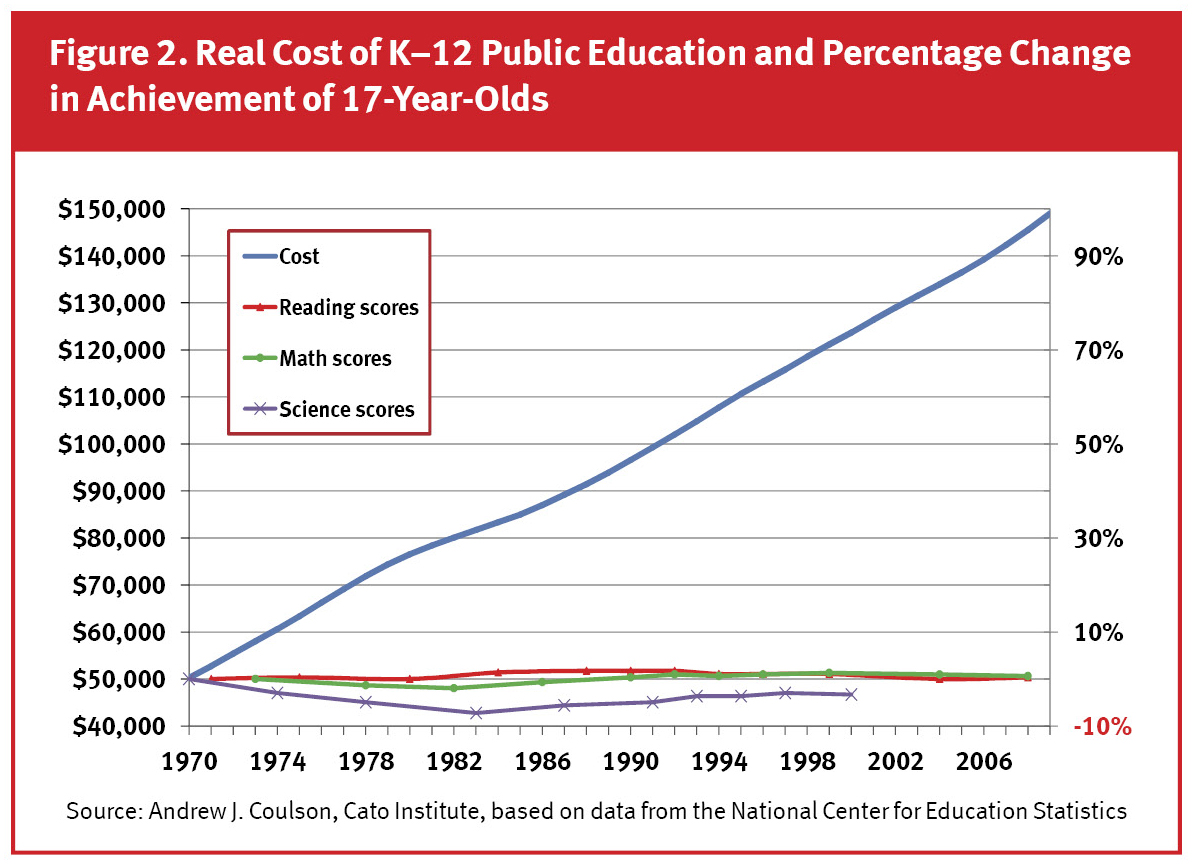
[1] http://www.npri.org/imgLib/20110228_Fed_ed_spending_vs_resul...
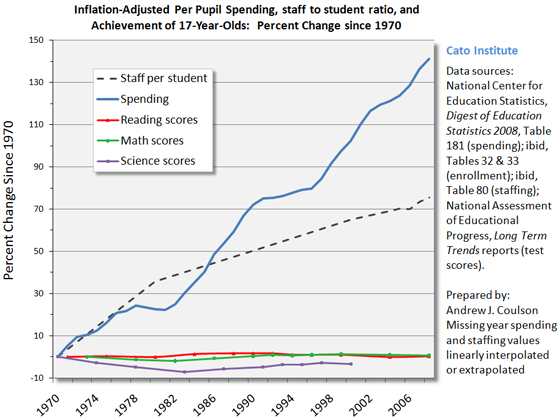
[2] https://rogerkerr.files.wordpress.com/2011/03/derugy-column-...
The purpose of affirmative action isn't to cure racism, broadly defined as racial animosity or something similar. The purpose of affirmative action is to correct the harm caused by previous institutional bias (edit: a given institution previously systematically excluded a group and now is making up for that exclusion). Racial animosity and so-forth should be dealt with in other fashions.
(I'm not sure if you're defending affirmative action or if you're just outlining its supposed purpose.)
There is zero way in which may post claims discrimination against Asians is justified by purpose of affirmative action and implying that I am doing so is a despicable bad-faith troll. Of course, the truth of the Federal Government's claim various colleges are discriminating against whites and Asians is a different corner of this debate, which is to say it's the thing looking at this would argue.
Asian-Americans were broadly excluded as enshrined by law in Korematsu v. United States, to say nothing of the discrimination that Chinese-Americans dealt with.
So... kinda odd that it is correct to continue to discriminate against them in higher education... isn't it?
You shouldn't feel any worse than when you try to minimize your taxes. In a broken system there are no bad actors
If they're going to fall on that sword make sure it's their own choice and not yours.
So it is also possible that a preference that helps your kids get into a school could actually end up hurting them if they end up outmatched by their classmates.
It's also not visible to peers in adulthood, and thus not a source of jealousy or mistreatment or suspicion, as many AA recipients detail experiencing.
It's also the most moral way to address something which - IMO - deserves addressing, but which currently is addressed quite immorally.
See: the OP article.
Do you feel like any correction at all is discrimination, the correction of is flawed in some specific way, or do you feel like its a matter of overcorrection?
It seems unlikely that anything can be subdivided, repeatedly, into arbitrarily many groups by arbitrary criteria whereby comparing all possible groups (i.e. comparing the non-empty members of the powerset) yields statistically insignificant differences for all discernable moments.
Unless the thing is truly homogeneous. Which people are certainly not. For example, I clearly have less than average tact.
However, the topic at hand is 'equal' in a decidedly subjective sense. Even if you have two identical hydrogen atoms, they still might differ in some sort of property you may or may not find significant to the concept of equality. Location perhaps? Can any two things be "truly homogeneous" while remaining distinct entities? True object homogeneity was not intended by my use of the term 'equal.' Does that satisfy the concern? :)
The powerset of S is all possible ways to subdivide humanity into groups of individuals.
Comparing two members of the powerset of S is comparing two groups of people.
Any criterion by which you can divide people will produce elements of the powerset of S. For example, "people that like jazz" are in there. So too are "people who eat peas with a knife". I am saying that there are many ways to lump people into buckets. What defines the buckets does not matter. They are all in the powerset of S.
If humans are equal, then comparing any two arbitrary groups in the powerset of S should always conclude in equality. At least in some statistical sense.
I am giving a counterexample to equality across arbitrary divisions of humanity (members of the powerset of S). I claim that arbitrary groups of humans are not equally tactful. Because if you measure the tactfulness of any member of the powerset of S where I personally am present it will generally show less tact than members of the powerset where I am not present.
I have heard the argument you're making with Jordan Peterson (who I absolutely don't respect - if you're looking for a Christian conservative try Peter Hitchens instead, although I'm not a conservative myself. He's not fashionable these days, but he represents actual long standing conservative beliefs rather than opinions that will fade away in 2-3 years)
I think the parent comment is being deliberately ambiguous in order to skirt around politically sensitive issues.
What does it mean to be equal?
I am asking for a clearer statement. And I am skirting politics because they would detract from shoring up that statement.
In response you're arguing against a strawman. No one has _ever_ claimed that everyone must be equal in all possible ways. That's of course ridiculous. The discussion plays out more or less the same way over decades, so to save time at the risk of putting words in your mouth, I'm going to take the liberty of presenting both sides.
Let's return to the question of "why are some groups more successful than others?" If it's because of either direct oppression, or systemic oppression (i.e. policies that favour some groups over others), then affirmative action is justified. This is the position the ancestor comment holds. Once you move past the rhetoric, there's no difference in reality between affirmative action and "oppressing Asians and whites," but the framing as just vs unjust depends on your idea of justice.
The conservative counter-narrative is decades old. It's not exactly racist, but it claims that cultural reasons are primarily to blame for disparities in success. Undoubtedly cultural reasons are partly to blame, and its possible for cultures to be improved. But a narrow focus on cultural reasons detracts from a long history of oppressive laws whose effects are still felt today.
Now we get back to what "justice" means. Does justice mean merely removing the oppressive institutions and returning to a natural law Lockian universalistic liberalism? Or does it mean correcting for past injustices.
"Why" is completely irrelevant to this thread.
Returning to where this all started...
> If you assume all groups are on average equal but certain groups are underrepresented you must assume that the selection process is flawed.
Since groups can differ in meaningful ways, for any number of reasons, no conclusion can be made about whether the selection process is flawed. At least not in the ancestor post's framework. The assumption does not hold.
Hopefully much better, affirmative action harms even the minorities it attempts to help, let alone others like Asians: https://www.theatlantic.com/national/archive/2012/10/the-pai...
My neighbor looks pretty similar to me but that doesn't mean we get along (My neighbor is pretty cool and doesn't look like me at all, but the concept should be clear).
Give more money to public schools, and support affirmative action until those network effects start occurring naturally.
I think autocorrect failed here. Did you mean to say "discriminated against by design"?
I think it depends on the goal. Is the goal to rank all students and then send the top X number of students acceptance letters? Or is the goal to set a baseline of what it takes to be an successful student at Yale and then select a diverse group of students that all meet that baseline criteria? The former makes it a direct competition between students. You have to choose if applicant A is better than applicant B. The latter instead looks at each applicant individually and whether they would be a successful student. They are now competing against the overall population of applicants instead of any other individual applicants. Considering the number of students who could be successful at a school like Yale is always going to greatly exceed the number of applicants who are admitted, the Asian student who could do the work at Yale but is rejected is not discriminated against just like the Black student who could do the work at Yale but is rejected is not discriminated against.
Also, the diverse argument doesn't hold much water to me, because they basically only want a diverse group in terms of race, but not other factors such as income diversity, height diversity, ugliness/beauty diversity, national diversity, parental-scholastic-achievement diversity, athletic diversity, etc.
Imagine if an NBA team said "Sorry, we can't hire you, we have too many black people playing right now"
This whole topics rests on the premise that "positive discrimination" is acceptable or even necessary due to historical injustice.
An analysis that reverts to "racism is always and everywhere bad" will fail to reconcile, even if you believe it.
Not contradicting you, but FWIW there seem to be a half-dozen-each implicit definitions of 'racism' and 'racist' floating around society these days, and each might have widely-varying senses of magnitude or extremity associated with them (from innocuous to extreme). It becomes difficult to parse logic and moral logic around these words, when various interpretations are taken into account.
Also your NBA example doesn't fit because it clearly falls into the category when you need the top X basketball players. I don't think needing the top X students is or should be the goal of college admissions. The goal of a basketball team is to defeat other teams in competition. It is inherently a zero sum game. The goal of a university is to educate the population. It is not a zero sum game and having a diverse student body actually works to support that goal.
The NBA does something similar with positions
If they need a backup center they’ll get a backup center regardless if a better scoring point guard is available
For a software comparison, it is like finding a Data Engineer for a Front End position. Sure if the Data Engineer is super smart, you can have him or her switch roles for a bit; but if the needs are immediate, like they are in the NBA, it is not going to produce the best results.
What if the student body is part customer, part product?
Colleges give out sports scholarships all the time to unqualified student athletes- a trade off from the academic excellence purity test - because it enhances the college’s value.
How can those be OK but diversity scholarships wrong?
There's not great data about college admissions out there that I could find, so I don't know if this is true or not.
Do you think that any Black student who could be successful at Yale and applies to the school will get in? Maybe in super niche graduate programs the school has a problem finding qualified diverse candidates, but at an undergraduate level they turn so many people away that I seriously doubt they have a problem finding good applicants.
Is that the baseline? Top tier schools aren't top tier because they let in anyone who might be successful. Their requirements are such that only top tier candidates make it over the baseline. And, due to various institutional problems, Black students are under represented in that top tier of candidates.
>We estimate that over three quarters of the students who apply for admission to Yale are qualified to do the work here. The great majority of students who are admitted stand out from the rest because a lot of little things, when added up, tip the scale in their favor.
The numbers of people who apply to the school combined with the selectivity of the school all but guarantees that there are top tier candidates of every race who are rejected.
> The Supreme Court has ruled colleges and universities may consider race in admissions decisions but has said that must be done in a narrowly tailored way to promote diversity and should be limited in time. Schools also bear the burden of showing why their consideration of race is appropriate.
Apparently the accusation is that Yale goes beyond what is reasonable.
Nothing was proven. This is just an allegation right now.
Wait until the court date. And then the SCOTUS overruling the decision, because like you said: discrimination is required for affirmative action. And universities like Yale are specifically allowed to discriminate for that purpose.
For any allegation to stick, the Feds will have to show that the reason was not for diversity. Which, obviously, it is.
Not true. There is a third way. This is a problem of artificially induced scarcity. Instead of recognizing the problem for what it is, we are creating a false dichotomy of choice between merit and justice. We sacrifice one for the other, blind to the possibility that we can have both.
I will use a metaphor comparing seats at great universities to slices of pie:
When a bakery finds that customers are routinely fighting to buy the last few pieces of pie, it should simply bake more pie. The U.S. government isn't just one of the biggest pie bakeries around, it also subsidizes all the other bakers and loans money to their customers. No one has more leverage than them. If they say "you must make more pie," the other bakers must fall in line, or else they stand to lose a lot of money and decline relative to their peers.
If X # of university applicants are admitted due to affirmative action, the government should mandate that the university expand its capacity by X students. Otherwise, the government should threaten to remove all subsidies (including loans to students pursuing an education at that institution).
For its part, the government should also fund an increase in capacity at the best public universities. Perhaps it should even create new universities to help solve this problem. While people deserve the best education they can get, private universities do not deserve public monies if they refuse to increase positive externalities at the perceived expense of their prestige.
The only effective system is one that is fair to all. You can't make up for socioeconomic differences this way. College isn't a magic pill if you are disadvantaged. And I would be genuinely surprised if it actually helped the people it is aimed to help because unfair systems are always co-opted by the people who have advantages.
Also, I went to school in the West with many students from Asia. They worked harder. That is it. It wasn't a fair sample, the school attracted kids who wanted to work and attend university in my country. But they out worked everyone else bar one or two people. I am not sure exactly what the allegation is here: that working harder is cheating?
From what I've heard the main datapoint in support of the claim that Asians and whites are being discriminated against is the average SAT score and GPA of successful applicants. But even if you don't believe that those numbers are inherently biased, I hope no one would claim they represent the totality of a person's qualifications for attending college, or their value to the institution and their fellow students.
Can be done with increasing seats, so same count of existing racial profiles + additions for the affirmative actioned populace
>"all Asians" have personality defects that make them disproportionately bad candidates for college
I think it is important to accurately reflect their position if we, as a society, want to have a rational discussion about the role race should play in college admission.
A more accurate characterization of the Yale claim is that asians, on average, have personalities which detract from their application.
This is a much more complicated assertion to refute, because differences between races can and do exist, as demonstrated by above average test scores among asians.
Test scores are problematic because tests have some measurable level of bias. The answer to that isn't to codify drastically more bias into the process.
I'm not sure what your point is or how it relates to mine.
The purported claim was:
> "all Asians" have personality defects
"All A has P" is a world of difference from "A has P", or "on average A has P".
>How do we even calculate an average personality? I doubt that even Yale people would stoop to such sophistry.
This is exactly what Yale is doing and the DOJ is going after them for. Yale requires personal statements, which they grade and rank based on personality attributes they find desirable. By Yale's metrics, asians, on average, score lower and this is used as rationale to deny acceptance. Asians who score high on the personality assessment are given acceptance. After ranking tens of thousands of students of different races, Yale or a 3rd part can look at the scores given by reviewers, and see if there is a correlation with race. This is the avereage, as reviewed by Yale.
YES, this can have bias. YES, this is highly suspect. Yes, I think this should be investigated. As said in my original post, I don't support Yale's position.
That said, I think it is important to have the moral and intellectual honesty to represent it for what it is, and debate it.
There is no need to lie and claim that Yale says "all asians are inferior". refuting this claim is a waste of everyone's time because nobody is making it.
Although it's perplexing just how...nasty?...the discrimination against Asians is. I can't imagine ever trying to justify that "all Asians" have personality defects that make them disproportionately bad candidates for college, as is proven to be what the colleges are doing here.
Utterly unacceptable, IMHO.