Also that seems like a silly test. Couldn't you just measure the differential after mixing? TFA also mentions it, but noise is also a factor. For the water-heater example, the limited number of probes introduces a known amount of potential variance.
Rather than a straight % efficiency, a more useful number to report would include the confidence interval - Its 99% ± 3%. Consumers can't do stats but at least it's more honest. TFA touches on this but doesn't draw any conclusions other than "we need to look at the source data and do our own analysis".
The industry has made a bit of progress, surprisingly unprompted by regulations - female and child dummies came into circulation before they were required in tests. But overall, testing is still run against a tiny handful of body types which move 'realistically' in only a few regulation-guided respects.
The main reason the DOT standard is so bad is because its mired in bureaucracy and managed by a severely underfunded organization.
https://en.wikipedia.org/wiki/List_of_eponymous_laws
Though I'm not aware of a law stating that for any given principle there is an existing eponymous law.
... oh, wait: https://en.wikipedia.org/wiki/Stigler%27s_law_of_eponymy
The water heater was designed with the test in mind but functions the same regardless.
VW was clearly cheating whereas the water heater is taking advantage of known deficiencies in the test (is that cheating?).
VW knew the parameters of the test (stationary car, no steering input, prescribed throttle inputs, etc). And they configured the car to pass the test.
Water-heater engineer knew the parameters of the test (number and location of probes). And he configure the water-heater to pass the test.
Same-same. In both cases, an engineering team willfully committed fraud to improve their sales figures.
The only differences are a bit pedantic. VW's "configuration" was more elaborate. But, both groups gamed the test.
Apparently it is common for cars to have a "test mode" bit, because they run on a dyno (only one set of wheels spin), and the car may disable certain traction control systems, etc.
VW changed the way other systems (the engine itself) function in this mode. So even if everything is exactly the same on the road (e.g. 30mph in a straight line for hours), the car will perform differently and have different emissions. You don't drive around on a dyno.
Optimizing for the test may go up to the line, but VW crossed it.
The VW engineers designed the car to do different thing while being tested vs used by consumers. While being tested, the emissions system was on. While being used by consumers, the emission system was entirely disabled.
The water heater engineers designed the water heater to do the same thing while being tested vs used by consumers.
If the water heater engineers designed the water heater to never turn on and keep the water at room temperature while being tested, ("works good boss, water heater efficiency is infinity percent") then yes, it would be reasonable to claim they did essentially the same thing.
I think the difference between what they did and this is only a difference in degree and not kind though, right?
In both cases there was an intentional design change to deliberately changed mislead a measurement, and the final product does not match the intended thing. Both adversarially directly cause the consumer's purchase to not be the intended item; no one gets a car that has emissions measured and no one gets a heater that has the efficiency measured.
It is like the joke about Soviet factory metrics for some item like nails. They set the quota on numbers and got useless ones better described as needles. They wised up a bit and set the quota by weight next month and got one useless massive nail instead. It isn't even too far from the truth given actual management involved things like a train line circularly shipping coal between depots instead of retrieving from source or distributing to end users to boost their "metric tons transported kilometers" metric.
VW meanwhile had a covert illegal configuration while claiming mileage and lack of maintenancd urea. The claims are outright false - that it provides all three benefits instead of two of three.
The water heater runs the same regardless of whether it's being tested or is running normally in someone's home. Really, this test "cheat" exposed that the test itself was not measuring what it thought it was measuring; and hell, a manufacturer could accidentally cheat with their design.
The car would run differently if it detected it was in a test situation. In the real world, with a real driver, it would run in a way that would give different test results (if you were in a position to run the test while it's being driven).
"Cheating" a better efficiency rating is significantly less reprehensible than cheating a legal obligation which was legislated for public health and environmental reasons.
There are other differences here too, I think. The water heater trick is passive manipulation that stays in place at all times, which limits how far from "real" performance it can get. And per the story, it seems more like "teaching to the test" than "cheating". That is, Volkswagen consciously moved away from the mandate outside of testing. The water heater was (potentially) as energy-efficient as they could design, with the test score manipulated on top of that.
None of that makes it harmless - if "as good as you can make" doesn't hit standards without manipulating them, that's still a problem. But I do find it less galling than "intentionally worsens emissions outside the test bench".
The difference between the water heater and VW is the water heater manufacturer is providing a representative sample. And VW was not. It'd also be dubious to say that the water heater company is acting in bad faith. Where VW's bad faith rose to the level of criminal. On the other hand Volvo appears to be acting in strictly good faith.
Bad faith for a crash test would be crafting a silver plate model for testing. Reminds me that's what my uncle said the power supply manufacturer he worked for did.
While I agree that this particular water heater manufacturer was doing something shady in order to get the best score, at least they weren't selling a product that did something differently while under test conditions vs. in real-world usage. They merely realized that the test itself had wide error bars, and designed their heater to "err" in the positive side of those.
VW, in contrast, sold a product that lied to the testers about its emissions in order to pass certifications, while in real-world driving would behave in a way that would not pass muster.
And to me I think that's the key: VW's cars intentionally behaved differently depending on if they were being tested or if they were being driven in normal real-world usage. This water heater behaved the same regardless of whether it was being tested or was heating water in someone's home.
In a way I think of this in academic terms. The water heater manufacturer studied the SAT to learn what kind of questions were going to be asked. VW stole the answer key to the test and memorized it.
1. Actively detecting test and behaving differently. It's like stealing a test vs teaching to the test.
2. Lower stakes. Health issues are much more serious than inefficiency.
3. It affects the buyer. It's more acceptable for the buyer to be cheated than everyone around them.
4. People could have created these layers by accident. Favouring those who got lucky is unfair.
Honestly I think basically all my gadgets exaggerate how energy efficient they are, by tuning parameters for tests that don't correspond to the real world. My dishwasher has an energy efficient mode, the manual literally says it's just for compliance and recommends other modes. It's just a fact of life.
Your point about fairness and passive design is the one that makes me view these cases differently also. In the anecdote, the product being tested was the same one being sold, and there's no sign the heater was worsened to improve test performance. The designers just picked the best-scoring option among some reasonable configurations. (Frankly, once they noticed that issue, what were they supposed to do? Pick the worst-scoring, or pick the spec out of a hat?)
In the VW story, the test-bench vehicle was fundamentally different from the market vehicle, and the road version was designed to behave worse on the metrics to get other gains. I happen to know someone who bought a diesel Jetta specifically because it was more eco-friendly than other options, and I think he'd draw a clear line between tuning for test metrics and VW consciously lying to their buyers.
Having measured all my gadgets with a Kill a Watt meter, that's not my experience. It seems that many gadget-makers realize that people don't really care about power draw, so they just slap the maximum draw onto the specs.
The VW test is not like that. There's no way to innocently arrive in the scenario they did. They did not game a bad test, they literally lied to the test administrators. The car ran in "clean mode" only if it was in the test environment. If the car ran like it did on the road, they'd have failed (which is how they were caught, with a mobile testing setup).
One of the points in the article is that regulating for safety based on known testing conditions is going to result in over-fitting for the test. The water heater company is guilty of intentionally over-fitting. VW just straight up lied. I don't think those 2 actions are equal, VW is worse, but I agree that both are dishonest to a degree.
We don't have to. In this case we have clear admission of intent. The intent to deceive is what makes it fraud and not just being wrong.
What VW did was to take a clean-burning car and disable the pollution controls under normal driving conditions, for performance reasons. So while to the consumer it seems deceptive that VWs get better performance than they should, given how clean they’re supposed to be, in reality the cars are illegal and spewing toxins they were supposed to be removing from the exhaust. This makes the cars not only a pollution source but a health hazard to people living nearby.
To get on the same level of VW, the water heater would have to be doing something like emitting low levels of carbon monoxide into the home while having a feature that avoids doing that in the laboratory. In other words, reckless and willful disregard for human health and life.
Also, for the water heating one, there's a plausible reason for the regulator to care about the discrete measurements rather than the total amount of thermal energy in the water. Hot water at the top of the tank is more valuable, because it's used first and less likely to be wasted, so you could wait it more heavily in a test. There's no parallel for the VW test cheating. No indication that's what happened here, of course.
What placement of components would be ethical? Should engineers required to be separated from the test parameters by a Chinese wall? Do they need to build the system for the worst result? Some middle ground? If the engineers are unethical, where is the line?
The obvious answer to optimizations like this are for the testing body to tweak the test procedure based on what manufacturers do over time. That provides an incentive to be more conservative or accurate.
If the water heater manufacturer had special heating elements that only ran during the test, it would be equivalent.
I think this is what I disagree with.
The water heater story is about a viable-for-market design which also optimized for the test. The equivalent for a car emissions test might be optimizing the transmission to reduce emissions at the specific speeds which will be tested. Those speeds could be sweet spots of the engine curve by accident, or they could be planned that way. I don't think that's necessarily right, but it's within the bounds of "natural" design for the product.
Instead of doing that, VW submitted something for testing which was fundamentally different from what went to market. Rather than being misleading, the test results were fundamentally irrelevant. Creating two completely different modes of behavior isn't something you could do by chance, and it means there's no real limit on how badly they could cheat.
Rarely the purpose of tests is to assure the public of your fitness (e.g. a driving test) and cheating those might be a problem, but if you cheat my CS 101 course and then struggle because you needed remedial classes but the cheated test means you don't get them that's your problem.
> Sun managed to increase its score on 179.art (a sub-benchmark of specfp) by 12x with a compiler tweak that essentially re-wrote the benchmark kernel.
I agree that what Sun did is very similar to what VW did, with the exception that VW's increased emissions (statistically speaking) killed people, and what Sun did likely had no health impact on anybody except a few hurt paychecks.
The water heaters don't sound like they'd fail any given test.
Why are we not holding those doing the measurement accountable as well?
If you produce a test that can be gamed and your job is to test things to meet consumer expectations, you've failed at your job.
After all is said and done, what is a better outcome: a) VW is punished for gaming the test b) the test is significantly harder to game
With (a), we have only one less manufacturer gaming the tests, VW. With (b) we have tests that none of the manufacturers can game any longer or at least will take time to game. The testers should be expected to always be two steps ahead.
This is not unlike whitehat/blackhat security engineering. We should pay bug bounties to teams that successfully exploit the tests and we should be actively running red team drills.
https://www.motorsport.com/f1/news/analysis-fia-settlement-f...
Eh? How come that temperature differential doesn't cause convection? The colder water being more dense and sinking down, the warmer water being less dense and rising up.
If the heating elements aren't at the bottom, specifically for this reason, how come they aren't?
There are typically two heating elements, one near the bottom and one further up. You can use the higher one if you only need a half-tank of hot water.
I'm not sure if this is the complete answer to your other question, or if sometimes conditions are such that convection occurs extremely slowly despite a substantial temperature difference.
It's your claim "the water at the level of the heating elements gets hotter and hotter and the water away from it gets cold" which is surprising me; water being quite a good conductor of heat, and "efficient boiler" suggesting that the tank will be insulated so not much heat is lost to the outside world, so the water away from the element should warm up by conduction from the other water faster than it gets cold from losing heat through the insulation (in my head). OK maybe I can imagine that in a fixed pressure with no room for expansion, the warm water cannot be less dense, so there can't be much convection - but then won't the heat radiate and conduct outwards in a "sphere" from the heating element including up and down, and not make any layers?
And here[2] is a video of Thunderf00t putting an infra-red thermal camera on a closed water bottle with a peltier cooler attatched to the side of it, and showing that the cold water does sink, there is some convection happening with a cold "heating element" halfway up the "tank" on one side. (But there is compressible air in the top).
Maybe it's that you don't want to run a boiler long enough for all the water to get to a uniform temperature before you can get warm water out of it, and if you don't then you risk getting super hot and cold water unmixed from "impatience" more than anything else?
[1] https://ae01.alicdn.com/kf/HTB1_U_RSpXXXXbYapXXq6xXFXXXy/DC-...
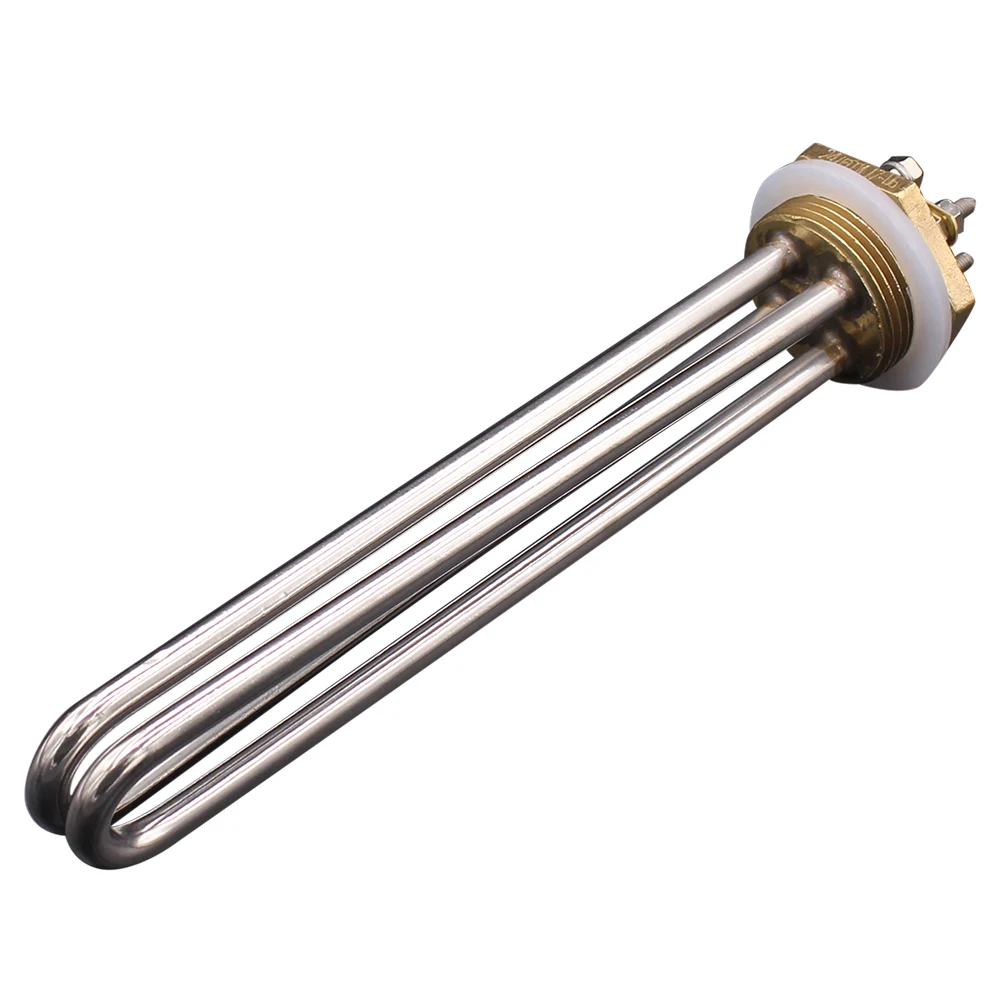
Suspicion of mine is part of the answer is that the viscosity of water drops with temperature. Rising hot water in a warm layer hits the cold layer above it and spreads out then turns down. Also water is a middle of the road non metallic solid when it comes to heat conduction. But it has high heat capacity and is a liquid.
Complicating things stratification at least in a well designed water heater happens rarely. So it's easy enough to set up conditions where it doesn't happen. But of course it's a known problem. And not a totally solved one either. Suspect that simplified models probably don't display the behavior.
The test consists of replacing the anode with a rod that has a series of temperature probes to measure the water at different levels in the water heater. Since water would form layers of different temperatures you needed measure at multiple locations to know the overall energy in the water. Then a series of water draws are performed with pauses between them and the total energy used is compared to the energy delivered.
Our engineer realized that if he could put the temperature layers at just the right locations then the calculations with the limited number of probes could be skewed. And this can be done by tweaking the height of the 2 heating elements. Just moving them a few inches.
The first time he tried this, an internal test came back at 101% efficiency. At little more tweaking and the test returns a consistent 99.x% that was respectable.