All this is not to say that there's any reason for upstream to accept any bad patches that rely too much on proprietary code. But in this case, I think the analysis of the underlying motivations for that patch was outdated.
EEE was more effective when Microsoft was completely dominant, but it's clearly still effective even when that dominance has diminished.
This move, for instance, will cause Linux users to depend on a proprietary, closed-source API entirely controlled by Microsoft. It's very bad for Linux and very good for Microsoft. It's a lever of Microsoft control, extended into the rival Linux system. Very easy to see how it effectively fragments the Linux ecosystem and allows Microsoft to forcibly pull users who come to depend on DirectX from Linux to Windows by manipulating this lever - reducing Linux support in the future, etc.
This is classic EEE, and the only way you can dismiss it is if you believe their PR, as apparently you do:
> they are no longer the 500 pound gorilla in the room, they're the "hey, fellow kids" oldtimer trying to fit in and get in on a piece of the action.
As the other comment explained, they are still a huge gorilla in spaces that are absolutely vital to Linux: server, desktop, and laptop.
Linux as we know it lives or dies on the server and desktop / laptop markets. Yes, Android is technically based on the Linux kernel, but it builds an entirely different ecosystem on top of it. The Linux ecosystem is only on the server and PC - exactly where Microsoft is competing.
Finally, the availability of this proprietary API will reduce the incentive for hardware companies like Nvidia to allow development of direct Linux support (drivers etc) for their products - which is what Linux really needs in order to survive, let alone prosper.
No reasonable person at Microsoft considers Linux to be a threat on the desktop/laptop. No reasonable person at Microsoft considers Windows Server to be a threat to Linux on the server.
The on-premises infrastructure market has been and is projected to continue shrinking in favor of cloud spend.
Googling around one can find reports with names like "IDC Worldwide Operating Systems and Subsystems Market Shares report" that show how prevalent Linux is vs. Windows Server even in Enterprise IT.
I agree with your general sentiment, but just wanted to note that high-end embedded systems are also a very Linux-heavy domain. Even though from hardware side it might look similar to the mobile space (ARMs everywhere etc.) it is actually a completely different world.
Said of a company which owns a market-shaping player in every layer of the stack: OS, directory, database, applications, development languages, source code repository, and the second-biggest cloud to host it all in. Given that mobile and web involve about half of that list, I fail to see how they're some sort of non-player, trying to play "catchup" to the rest of the world now.
Perhaps in some countries, definitely not everywhere. At my university, there is only a single Mac across 40 or so laptops.
> because it compiles iOS apps
I doubt students buy Macs for that. iPhones are not nearly as popular outside the US.
> and it's a *nix
Students don’t care about its UNIX certification. Most don’t even know what that is when they start their undergrad.
> it easily runs most of the same tools as a linux webserver
No, it does not. Many important dev tools are not available, not even through brew.
> That's what WSL is about, trying to win back developers
Globally, the majority of developers are on Windows/Linux, not macOS.
> They're trying to make it feasible to target a linux webserver
I’d bet this is about avoiding Linux becoming the major platform for ML/DS/AI, rather than anything about macOS.
So in other words, what you're saying is they are Embracing this FOSS linux-based developer workflow...
And you could almost say they're Extending the linux kernel to support DX12 on WSL...
Am I missing something?
It's not so hard to imagine picking up a legacy project at some point in the future, and pretty much having to develop it on Windows and deploy to Azure because of some WSL-specific dependencies baked into the framework it's built on.
That's just one scenario, but the point is why would you expect that they wouldn't leverage their market-share to disadvantage competitors if they ever got into position to do so? Just because they aren't in that position now doesn't mean we shouldn't be put off by the fact that they're building those levers to fragment the ecosystem now.
So if you want a machine that can play games and run a Linux dev toolchain, that would require a Windows install. If you can incentivize folks who may never have installed Windows to do so, and keep them there as the only place they can both play games and use their preferred dev environment, then you've extinguished that portion of the desktop linux install base.
EDIT: Also I absolutely love the "I don't think Microsoft thinks so either." Microsoft is a for-profit corporation who's eyeing a way to get users who traditionally avoid them to come to their platform and stay there. They aren't some benevolent font of cool tech, they're trying to sell you products.
Microsoft is taking steps to embrace desktop Linux, we've seen that with WSL. Instead of ditching Windows for a different/better dev platform, just keep using Windows.
They are extending their own desktop Linux by adding the capability to use DX12 in Linux, so long as it's run on Windows. Note that they are not adding this capability to a straight Ubuntu install, let alone any other distribution.
To claim "Microsoft knows they can't Extinguish desktop Linux" is naive at best, and shill-like at worst. They don't need to completely eliminate desktop Linux for EEE to apply here. the "Extinguish" part comes naturally from fewer and fewer devs choosing an alternative to Windows.
Yes we are. I was talking about the motivation behind their action. And I think it's quite obvious that 'get businesses to use Azure over AWS' or 'get web developers to use Windows instead of Macs' is a much, much more likely motivation than 'Extinguish desktop Linux'. Why would they care about that? Desktop Linux is absolutely no threat to them, and there's no money to be made winning that fight more than they already have. Know what, I'll grant you that in their attempt to steal web devs over from MacOS, and getting a better user story for a web dev deploying Linux servers from Windows, they will probably also hurt desktop Linux - if nothing else, simply by creating another viable alternative for devs that isn't MacOS. But I can pretty much guarantee you that extinguishing desktop Linux is not their motivation - it simply makes no sense.
Presumably because we smart and they dumb. Or something, I don't know?
Personally, I think that their thirty years of experience and billions of dollars might make it possible for them to come up with a plan I wouldn't have thought of.
They don't have to kill Linux, and in fact, would not want that IMO, because then someone might bring another pesky antitrust suit against them. But if they can dent it in any way, they will.
For those who say Microsoft has changed, is a different company, is embracing open-source, etc.: if that truly is the case, wouldn't they release DirectX for all Linux distributions, not just theirs?
Microsoft is the dragon here. Even if it appears friendly you still don't cut a deal with it, or you become a pawn in its game.
The modern form of EEE is being platinum sponsor of the Linux Foundation and insert a CoC into the source tree.
Corporations don't want the "angry young OSS men" of the 1990s and early 2000s, who could be an actual threat.
Corporations want submissive, neutered and obedient developers.
Apple can be as hardheaded as Microsoft. I have several Apple machines and each of them was bought specifically for developing iOS apps, other uses appeared later. Apple can provide Swift for Windows and Linux, but they will never allow building iOS apps on non-Mac hardware.
First of all the market share of desktop versus mobile is roughly 43% for the desktop, 57% for mobiles and tablets. More importantly however is that the rise of mobiles has been sharp since 2009, but it's been stagnating since 2017 and this stagnation trend is clear. Mobile devices too are a commodity, their market isn't growing any bigger and people aren't replacing their phones as often. The market for the desktop did not shrink. It just reached saturation. And as it will become increasingly clear, mobiles have reached saturation too.
What devices do people use in companies to do their jobs? Laptops. Sometimes tablets, for drawing on them, although a piece of paper would do. Mobile devices have been and remain essential for communications, this meant phone calls in the past, nowadays it means WhatsApp, Slack, email, along with shitposting on Facebook/Instagram/Twitter, but that's about it.
> "webservers (where Linux is massively dominant)"
Sorry to disappoint you, but the market for web servers is actually small, unless you're Amazon and Microsoft realized at some point that selling Linux boxes on Azure is probably more lucrative than what they were doing. The web servers space was never Microsoft's so they had nothing to lose.
But the enterprise space is dominated by Microsoft, with their dominance only increasing. Exchange, Sharepoint, Office 365, Skype, Microsoft Teams, Azure DevOps, freaking Yammer, MS SQL, soon GitHub, their reach in the enterprise and their adoption, once you're familiar with the space, is actually quite scary.
I have to hand it to them, they became really good at marketing. Otherwise I can't explain this portrayal of them as being the underdog. Or the constant nagging messages I see about them having changed, due to them releasing VS Code or .NET Core.
No they haven't changed much. The tooling they make for developers has always been top notch and while .NET was proprietary, they standardized it and they never attacked Mono. Office has been available on Macs since 1989. And they no longer target Linux with patent threats of course, they target Android instead. Until they'll find some way to sell Android. They adopted Chromium, a master move since now they can cut some development costs and win back some users and sell them on Bing too. We'll probably see them windowfying Android too.
---
Note that I do enjoy several Microsoft products. But I'm always skeptical when hearing about their motivation. I don't understand what makes people cheer for these big companies, as if they are sports teams. Use their products for what they are and dump them as soon as you find something better.
I have to emphatically disagree there. Up until recently Windows didn't even have a decent terminal app. As a developer I tend to shy away from Windows precisely because the *Nix alternatives offer a better development experience, from cli to package management and more.
In fact Mac OS also didn't have any until OS X.
People should be much more concerned about EEE from Google, as we’ve been seeing more of all the time with Chrome.
Not only US government, but almost every government around the globe is using it. And on macOS, that's still the case.
Most recently with the Live Share extension for VS Code. From skimming the licensing it is only to be used with the Visual Studio family of products. Which is an incredibly disappointing approach.
I think this is simply about ML and GPU compute for WSL. And I think Microsoft is genuine in that it sees business value in doing open source work, integrating well with Linux, etc. But at the end of the day the business interests are there and different parts of the company can be motivated quite differently.
Some skepticism remains warranted.
https://github.com/MicrosoftDocs/live-share/blob/master/LICE...
I don't presume to know if EEE is Microsoft's strategy here, but if it is, do you think a fleeting moment of amusement at Linux's comeuppance is worth the damage done to the larger open source ecosystem in its wake? Linux and FreeBSD are on the same team here.
And if yes, can you point to an example of *BSD doing something similar while pushing their platform forward?
I administrate multiple systemd-based linux distros, FreeBSD servers and buildroot-based embedded systems and I can tell you that systemd still gets in my way regularly while the sh-based init systems tend to Just Work and are very simple to understand and maintain.
Of course I know that a big reason is that I'm very familiar with un*x system administration and the gotchas of shell scripting while systemd is probably more approachable for somebody who doesn't want to learn arcane knowledge about chmod and file locking and setuid and symbolic links but I think that explains why there's still so much pushback against systemd all these years later: people who care about init systems know enough about them that systemd feels over-engineered and unnecessarily complex while not bringing a lot to the table.
Never once in the past years of running systemd have I thought "oh man, I sure am glad I'm using systemd and not an old SysV/BSD init system!". Not a single time. I did have multiple occurrences of systemd breaking stuff after an update though.
For me systemd based systems allow me to have declarative, portable unit files where init scripts don't. They allow me to reliably monitor and restart services, they shut things down properly instead of just force killing as many init scripts end up doing.
I instantly know how to manage most major distros now that systemd's common among all of them, have no hesitation of writing a proper service file even for minor tasks and I get a ton of functionality 'for free' too.
Init scripts were always a poor-quality mess, non-portable among systems, non-consistent, non-deterministic. If your experience differs there's still plenty of non-systemd choices out there. They're not as prevalent as systemd ones, but that's because the people who sit down and actually write the code we all use find the services systemd provides valuable.
And even if portability was the point I'm not sure I see the big deal. Writing an RC script from scratch if the software you use doesn't provide it is generally trivial. The vast majority of the time you wouldn't have to do that anyway as it ships with your OS's packages anyway. Sure, systemd might be "tidier" with its standard APIs and whatnot but it's also a lot more complicated and opaque than a bunch of shell scripts running one after an other. And if you're serious about sysadmin you'll have to learn shell scripting one day or the other anyway.
>Init scripts were always a poor-quality mess, non-portable among systems, non-consistent, non-deterministic.
They're non-portable, that much is true but so is systemd, that's a weak argument. If everybody had adopted FreeBSD-style init it would be equally as portable, it's a self-fulfilling prophecy. With that logic we should just all ditch un*x and start running Windows since most people already use that anyway.
The rest is nonsense. It's poor quality, non-consistent and non-deterministic if you write them that way. Sure, shell scripts being turing-complete opens the door to a lot of nonsense if people go wild and gives more latitude for very sloppy code but it doesn't have to be that way.
>the people who sit down and actually write the code we all use find the services systemd provides valuable
Systemd has been pushed down everybody's throat for a while now, saying retroactively that people use it because they find it valuable is a bit of a stretch. I'm sure many of them use it because that's what's available. I wrote a bunch of systemd unit files myself, I assure you that it wasn't meant as an endorsement.
Besides it's only one side of the equation. Maybe it's nicer for the people writing the unit files, doesn't mean that it's a good thing for people actually having to use them. I'm sure many software maintainers would prefer if everybody ran the same OS on the same hardware with the same use cases but that's not how the real world works.
It's merely a statement of fact, systemd services accept the same set of commands across distros, which is rather unlike SysV.
> It's poor quality, non-consistent and non-deterministic if you write them that way.
That's a bullshit statement, because everything fits it. Of course everything is great if you make it great. And?
The point is that systemd's declarative nature makes it hard to screw up services and even badly written ones will get enough common functionality for free that they'd be usable.
> Systemd has been pushed down everybody's throat for a while now, saying retroactively that people use it because they find it valuable is a bit of a stretch.
Systemd got adopted because people generally found it valuable enough to adopt over what they had before.
> Maybe it's nicer for the people writing the unit files, doesn't mean that it's a good thing for people actually having to use them
Matter of opinion, but I happen to think that having a uniform set of commands working at work and at home is nicer for users too, over the patchwork of scripts that SysV was across the various distros.
Portable to what?
sysv init scripts simply weren't portable between distros, leading to tons of non-standard, incompatible fragmentation.
Users simply couldn't simply take their own scripts over to another distro and expect them to just work, given said differences.
With systemd, unit files will simply just work between all systemd distros, given the standardized format.
You're ignoring what the parent said and talking past.
It's not the 'sets' that are standardized, it's the set of commands that are applicable to a systemd service and to any systemd Linux distro that is.
If I was approaching building an init system I'd make a better language for writing init scripts than bash, some kind of interpreter that processes mostly declarative init files, sets things up, and then exits. An incremental improvement that works with existing systems instead of putting a whole bunch of new (generally un-audited) code into PID 1, with all the security implications that implies.
Redhat may contribute the majority of the work but they're also very good at positioning themselves so that outsiders can't really contribute any work, or get any independently developed standards implemented.
The problem is less the init system itself, but applications that depend on a specific init system [1] (gnome used to be a major source of contention in that regard).
[1] https://wiki.gentoo.org/wiki/Hard_dependencies_on_systemd
Gnome does not depend on systemd, but rather logind.
KDE used to be the same, until someone started maintaining ConsoleKit2 again, proper, at which point they were happy to support it.
ConsoleKit was dropped because it just wasn't being maintained, and had various limitations.
Maybe it's simply easier to maintain this way?
elogind exists, if you care. It exposes the DBus interfaces that logind supports for applications to call.
Thus, environments like Gnome can be supported on non-systemd systems if they emulate and/or expose and implement the required DBus interfaces.
See also https://lwn.net/Articles/586141
And like I already mentioned in my previous post.. there are other alternatives around than just SysV-init..
By not tightly bundling their init with other OS components, by not having GNOME desktop somehow depend on what init system you're using (as opposed to services running under that init system).
Also you know how shell scripts have `#!/usr/bin/env bash` at the top of them? Well the reason why my hypothetical init system would be compatible with SysVinit is because instead of `#!/usr/bin/env bash` it would have `#!/usr/bin/env new_init_language` at the top of it. 'new_init_language" could implement almost all the same features that systemd unit files do.
Guess what systemd does?
> sets things up, and then exits
And that's the crux of the issue isn't it? Because on modern systems, things need setting up and tearing down all the time.
Well not really, that's an artifact of systemd's over-engineered design. There's nothing stopping you from tearing something down from an init script or doing more complicated dependency management using the CLI as your RPC mechanism (but red hat needed a reason to use their in-house RPC mechanism).
Honestly something like systemd could be pretty reasonable if it wasn't created with the express intent of "combating fragmentation". Not that there aren't a whole bunch of technical and architectural issues with it, but still.
Except most init scripts I've seen are rather brittle and only "work" if the PID dance is exactly as the author predicted, are not declarative and hard to debug.
I don't want to go back to init scripts, for all systemd's faults, the past was worse.
Using the CLI as my RPC mechanism etc. just sounds like I should spend a bunch of time doing work that systemd can do a better job of managing for me.
BSD init is far better than Sysv. Adopting it would have been a step forward.
There are also other init systems that are better designed, like openrc or runit.
OpenRC is practically speaking a thin wrapper around SysVinit, not much of an upgrade if you ask me.
Why for example are Jails not compatible with Linux? Is that not considered upstream because FreeBSD's "integrated"? How convenient.
I think what you see is happening because these "upstream" projects are actually primarily for Linux and by Linux devs. They just happen to work on BSD as well, but weren't you guys saying this whole time how the BSD approach of having everything integrated into one system is better and the whole GNU/Linux ecosystem of several upstream components is strictly worse?
So what exactly are you complaining about? Us trying to use Linux-specific features to make the Linux ecosystem the best, rather than target the lowest common denominator while you guys take full advantage of FreeBSD's specifics?
Seems less than fair to me.
Any examples?
> Why for example are Jails not compatible with Linux?
What? Jails originated in FreeBSD over 20 years ago? This question doesn't make sense.
The OP was referring to systemd affecting upstream by requiring systemd for things (ie Gnome). Are you saying there are pieces of software you have always used, but no longer can because they directly rely on jails?
I don't even use FreeBSD, but this was a weird argument.
Just because GNOME wasn't using systemd in the 90s when systemd didn't even exist does not mean it should not use it ever, even if it makes sense for GNOME devs to do so now.
The other key, which everyone crying "Extend" seems so eager to ignore, is that they don't actually want anyone to use this API: https://lkml.org/lkml/2020/5/19/1139
"I'll explain below why we had to pipe DX12 all the way into the Linux guest, but this is not to introduce DX12 into the Linux world as competition. There is no intent for anyone in the Linux world to start coding for the DX12 API."
They want people to continue to use OpenGL/Vulkan/OpenCL/etc., and this is just their mechanism for getting those APIs GPU access when running under WSL: https://www.collabora.com/news-and-blog/news-and-events/intr...
"We have recently announced work on mapping layers that will bring hardware acceleration for OpenCL and OpenGL on top of DX12. We will be using these layers to provide hardware accelerated OpenGL and OpenCL to WSL through the Mesa library."
I took that to mean that the developers on Linux are the people who won’t switch to DX even if it was ported.
From the email introducing the set of patches:
> The projection is accomplished by exposing the WDDM (Windows Display Driver Model) interface as a set of IOCTL. This allows APIs and user mode driver written against the WDDM GPU abstraction on Windows to be ported to run within a Linux environment. This enables the port of the D3D12 and DirectML APIs as well as their associated user mode driver to Linux.
The fact that they went through the effort of porting Mesa to get OpenGL and Open CL support, and are working on Vulkan support.
Their porting Mesa to use a proprietary library that interacts with the wsl only kernel interface isn't that same as behaving like a standard Linux gpu
And part of the discussion on the mailing list is how to integrate this with DRI/DRM and dma-buf so it can be used by more Linux clients with less work (although still non zero like you'd have on a DRI scheme as well).
Are we reading the same blog post?[1]
[1]: https://devblogs.microsoft.com/directx/wp-content/uploads/si...
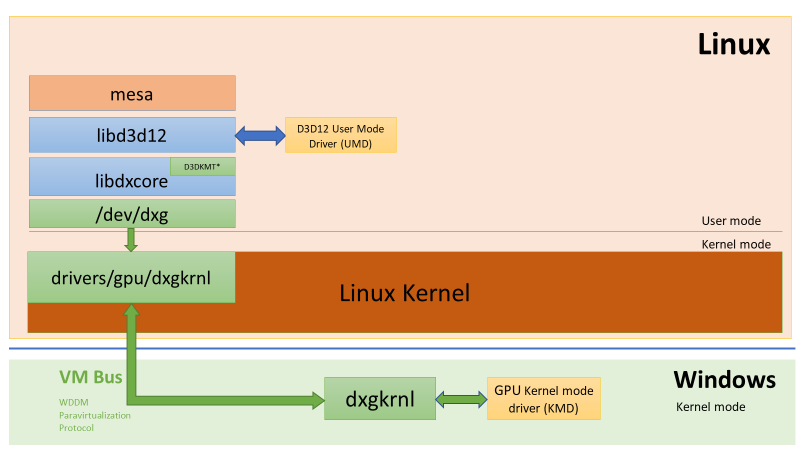
BUT I MUST AGREE WITH YOU that, over time, this is likely to fragment the Linux ecosystem and encourage people to develop software that works only in Windows "with the Linux-thingy installed" environments.
That's because sooner or later, people using Windows will publish important AI papers or release must-have software or do something else with code that runs only on Windows "with the Linux-thingy installed." The "Linux-thingy" becomes a dependency that gets installed in the background. It becomes a near-invisible component of Windows, abstracted away by layers of Microsoft APIs, code, standards, etc.
The "Linux-thingy" on Windows, in other words, becomes like an init system on Linux, which can eventually be replaced in whole or in part without most people caring or noticing. Most Linux users don't care if their Linux machine uses Systemd, a Sys V Init, or even the dead-ended Upstart. That's the "Extinguish" part.
Also, I think linux users (desktop/servers) who actually write code and provide updates for programs, aren't likely to pause the world for WSL. Its not exactly 'linux' nor the destination for their code, WSL stands a risk of becoming obsolete, if not properly maintained etc.
Its also good in some sense, it exposes users to linux capabilities and the like, who might not have had the guts to run a live cd or deal with modern hardware foibles.
>With the "benefit" of forcing the Linux kernel developers to pay the maintenance costs of course.
No. Nobody is forced to maintain this. If Microsoft stops maintaining it then Linux is free to kick this to the curb.
Proof that Microsoft really has embraced Open Source development.
people need to stop using windows, entirely. i recently built a gaming machine, pretty high spec, and i've resolved to never install windows on it. there are plenty of games i can't play, a few that i would like to. but i wont give money to developers that wont release linux versions of their games - even when they are utilising engines that have linux ports (PUBG being the most recent example i can think of, but any unreal/unity engine based game). there's no reason to use windows any more (for people like us, at least).
There's a reason Windows is still dominant in the Desktop space despite all its problems.
interesting. i put ubuntu 20.04 on this and it's been plain sailing. now usually i'd say i've got a high tolerance for bullshit when it comes to linux, but i'm not exadurating when i say i did not have to touch the terminal to:
1. install it without any extra crap
2. switch from nouveau to the nvidia driver - version 440.64, a very recent driver (which isn't very fair to nouveau, i didn't even give it a try, really)
3. install steam and games and have them work flawlessly from the get-go. games i've played:
* counter-strike global offensive (a lot..)
* the binding of isaac (would be bad if this didn't run!)
* deus ex mankind divided (was _very_ surprised to see this available and working perfectly, to be honest)
* black mesa
a short list, but i've only had the machine for a week.
i know it's stupid to say "hey i didn't have to use the terminal", but really, ubuntu has come a long way. i couldn't have said that last year, i don't think.
> nVidia has shit Linux support so that's a no-go.
eh, i'm gonna respectfully disagree there. linux support from nvidia has been a bit patchy (and the nvidia driver windows isn't exactly a dream at times, too), but i've been using nvidia driver on linux on various installs on various architectures on various hardware for _years_ and i've never had a significant problem. AMD, on the other hand.. i don't miss fglrx.
> I also have a used Oculus Rift, which again rules out Linux.
well i also wont support facebook, so that's not an option for me :)
honestly, it's _really_ disheartening to see the replies to this comment and see how far the normalisation of deviance has come. the _only_ tool we have as end users to stop companies from being shit is to vote with our wallets. and yet the majority of responses is to just give up and accept that that's how it is.
i think we're doomed as a species :)
[0] Flatpak can do it if you setup an entirely new installation on that disk, but flatpak has its own issues. Snaps can't do it at all, and while AppImage is really great relatively few projects distribute that way.
if you have a separate OS on the external drive, you could chroot in and install it. If you just want that one application to be on the other disk, you could mount it to wherever on the filesystem the program would be installed. However you probably don't wanna do that on an application by application basis. you could mount /usr/bin/ on the external drive for example. or use LVM to share disk space between the disks
Flatpak, Snap, Appimage and other portable format aren't really preferable. they lead to a software ecosystem that amounts to just downloading and running executable binaries off the internet, each with their own overhead.
Kinda illustrates my point about this being a foreign concept to Linux Desktop people. It's pretty simple: I want to put an application on an external disk and run it from there.
> if you have a separate OS on the external drive, you could chroot in and install it.
No thanks. I'd just like to have the application stored on an external disk, and execute it on the OS I have installed.
> If you just want that one application to be on the other disk, you could mount it to wherever on the filesystem the program would be installed.
Not really, because Linux likes to have an application spread its files all over the hierarchy, so in reality I need to either use some form of union-mounting, and/or simlinks. Of course that is only sufficient if there are no library conflicts between what the application wants and what the system uses, in that case I need to use LD_LIBRARY_PATH and other tricks. In some cases I'll need to use a launch script that calls a different ld.so.
That's a lot of hoops compared to how sane operating systems do it.
> LVM to share disk space between the disks
System breaks when disk is removed. No good.
> Flatpak, Snap, Appimage and other portable format aren't really preferable. they lead to a software ecosystem that amounts to just downloading and running executable binaries off the internet, each with their own overhead.
Which is pretty much what I want, because the alternative is dealing with the bullshit I mentioned above whenever you step outside the package manager's sandbox.
This is what AppImage gets that the rest of Linux doesn't seem to: if an application is a single file/folder, you don't need anything more complicated than a file manager to manage it.
P.S.: after a quick glance at some documentation, I don't see any mechanism that would allow me to install nix packages to arbitrary locations anyway.
Nevertheless it can be done - if you are dedicated, recompile the program with the prefix changed to the mounted root of your separate drive. Presto, automated installs to your external drive. Now, linking up all the bits can still be a right headache, but this is just a bigger nightmare on Windows (what will you DO if your drive letter changes?? You mean I don't have any system to automatically link up random programs on random drives which may or may not be present. Gosh darn, that package manager sounds like a good idea now...)
If you're using a laptop, you're probably due for an upgrade in HDD capacity, or if you're lucky enough to be on Desktop I'd recommend a board with hotplug capability and using LVM. I think no matter your platform you're going to have a hell of a lot of problems doing things your way. If you can patch the package manager to be able to do this, amazing! I don't think any system exists like this, period.
I had similar problem. I joined two physical disks into one logical using LVM and forgot about problem. :-/
Well that's still better, in my opinion, than package managers and all their various restrictions. But ideally I want something like AppImage, where an application is a singular entity that can just be moved at will and run from wherever [0]. Most DOS programs and many Windows programs (if you extract them from the installer) will still work like that.
> I had similar problem. I joined two physical disks into one logical using LVM and forgot about problem. :-/
If you unplug the external disk, your system stops working. This is not what I want, as I mentioned already in the post you're replying to.
[0] classic MacOS, RiscOS, and NeXT all had programs that worked like this too. Linux has yet to achieve the flexibility in application management afforded by the OSs of the 1980s.
LVM can make two disks appear like they're one, but of course if you remove any of them they both fail. Doesn't really solve the underlying "I want to install apps outside of the root partition" problem though.
Generally speaking they have the same problems as the mainstream distros, but with the additional caveat of even less chance of googling solutions and worse or no support at all from non-oss software.
> LVM can make two disks appear like they're one, but of course if you remove any of them they both fail. Doesn't really solve the underlying "I want to install apps outside of the root partition" problem though.
Precisely. The very concept is just so foreign to most of the Linux community that even talking about it gets you strange looks. It is actually possible to do with some significant AUFS-fu, but its a hell of a hoop to jump through for functionality that is pretty natural in every other desktop OS that ever existed.
[0] https://en.wikipedia.org/wiki/GoboLinux
----
What you describe is like installing in $HOME. It's not unusual - python virtualenv, ruby rbenv, node_modules. This comes with trade off - either system knows where to search or one has to define per project. By FHS entire Linux tree is a project. In Windows... configuration is pain.
Flatpak someday.
    └── gems
        ├── irb-1.2.3
        │   ├── exe
        │   │   └── irb
        │   └── lib
        │       ├── irb
        │       └── irb.rb
        └── rack-2.2.2
            ├── bin
            │   └── rackup
            └── lib
                ├── rack
                └── rack.rb
    ├── bin
    │   ├── irb
    │   └── rackup
    └── ruby
        ├── irb
        ├── irb.rb
        ├── rack
        └── rack.rb
I still write code in a Linux environment because that's where the ecosystem is, but for my daily driver I've given up on desktop Linux. And I've found that WSL gets me a Linux based development environment side by side with Windows with less pain than dual booting. I've found that when it comes to using Linux smoothly, it's a lot easier to shoehorn myself into the happy paths than to bend my setup into my way of doing things.
And regarding using Windows: company's behavior is important, but product quality, especially when it's a tool you use every day for work, is more important. Linux is ok for certain types of developers, it's still awful for normal users, abysmal for office work and obviously not a choice if you develop Windows software.
What are the main costs of releasing a Linux version of a game when using Unity or Unreal? My limited experience with Unity has been "check the Linux box, click the build button". It even cross-compiles no problem. People I know tell me Unreal is similar.
It's not like they have to do a full run of play-testing for Linux. Just check if it starts, play for 10 minutes and release that. We know we're a minority so we're willing to put up with bugs. Even if there's only 100 people who'd buy it only if it ran on Linux, that should pretty much cover the couple hours of dev time.
Supporting Linux is hard. So is supporting Windows, but if Windows makes up 98% of your customer base, it's justified. 2%? Ehhhhh.
(P.S. I love Linux. See my profile. This is the kind of stuff I deal with every single day.)
[1] https://boilingsteam.com/we-dont-game-on-the-same-distros-no...
You claim I am being "self-centered" but the fact is if you don't provide something that the distros can work with and instead try to route around everybody and ship an untestable blob then that's your fault. The reason everyone tells you to just support Ubuntu LTS is because they are the only ones who have the resources to support all these random binary blobs for X amount of years, and that comes with all the pains associated with it, as you are well aware of.
Alternative view: distros don't provide a stable platform that developers can target.
Expecting every distro to have the exact same release & support cycle is nonsensical.
To contrast, if you take a Win32 game from 2003 that targets DirectX 9, it probably runs fine on the latest Windows releases. (You might have to enable some compatibility mode.)
"BUT BUT BUT if it's packaged with the distro it's no problem." Remember we're talking about proprietary applications (mostly games) here. Having these packaged with distros for years after the devs moved on to the next project is just a pipe dream.
It doesn't mean that there's no such way, but it does mean that attempting to find it is very risky. Making games is already a very high-risk, high-reward industry, do adding this amount of risk to the equation is advice that's insane for all but most successful companies.
One of the ways these companies can reduce risk is actually by using other proven open source components. If they won't even make an effort to try to expand this, then there will never be a well-understood way.
No, it's not - this is an absurd statement. Cloud services get most of their income from big and medium companies, billing tens and thousands of dollars in privately negotiated agreements. Digital Ocean and AWS don't live on single developers paying them $5. All their real money is on B2B.
Multiplayer games either get a flat subscription from all their playerbase, or rely on micropayments. Either way, they spend much less on account management where they interact with customers as individuals, and much more on analytics, where they measure and work with their customers in aggregate. These are completely different business models, that completely shape companies that operate on them.
> Find the pain points your business customers/partners are having and then charge for solutions.
Games are not solving any problems - they are entiertainment product. I've seen people who have tried to reason about games in the terms you're using, and it always yelded hillarious (but also sad) results.
Which might be one of the reasons Linux Desktop is so awful to develop for.
You wonder why people ignore your platform? Saying it isn't actually a single platform and instead is dozens of different platforms just means each of those platforms is even less relevant. Saying you're not just one platform with 10% market share but actually 20 with 0.5% each doesn't make the case for shipping on Linux Desktop any better.
And many proprietary pieces of software license components from other proprietary pieces of software, so that even if they did want to open their code they'd have to strip pieces out of it anyway which doesn't really help the cause of distros integrating it. And even if it did, then the developers are reliant on the maintainers for their relationship to their customers. Have an issue with the product? Oh, it turns out that's because of this patch made by the maintainer of the package for that distro, who now has to be contacted and convinced to fix it, which they may decide not to for arbitrary reasons. Even open source developers have problems with this!
If you need to strip out some parts and there is enough will in the community to replace those pieces that you stripped out, then it will happen. If you have a product that is anywhere near being popular among the FOSS developer communities then I don't think it makes sense for you to claim that this will doesn't exist, or that distro maintainers will lose interest.
For a simple game that uses the entire UE4 stack, you might be able to get away with that if none of your code is Windows-specific and works exactly the same on the Linux distribution you are targeting. Once you start using your own middleware and libraries from outside of the default engine, you need to make sure every single one works across all the platforms you're targeting. Many won't have a Linux compatible version, and those that do may only work against specific distributions and hardware. Even then: Have they changed the window manager? What have else they customised?
There have been many issues with anti-cheat solutions over the years on Linux.
> It's not like they have to do a full run of play-testing for Linux. Just check if it starts, play for 10 minutes and release that.
For a simple game, you may get away with this. Anything larger will require significantly more testing. I've been a producer on large games, and the QA process starts very early on. You don't 'finish' a game and then QA starts - It's an ongoing process that consists of significantly more than just launching a game.
>We know we're a minority so we're willing to put up with bugs
Some people don't see it that way though. People who have paid for a product have the right for it to work properly. Tickets for Linux support are often higher [1], so the time investment against payback can be problematic.
GPU driver support on Linux can also still be problematic. From feature differences against Windows, to crashes. These all take additional development time. Linux developers are often more difficult to acquire in the game dev world. QA even more so.
Game dev is really hard. Some of it is hidden by engines like UE4 on the surface, but as soon as you start digging down into serious development, it's difficult.
> Many won't have a Linux compatible version, and those that do may only work against specific distributions and hardware. Even then: Have they changed the window manager? What have else they customised?
Outside of truly exotic window managers, the biggest issue I've ever seen with ports has to do with dependencies. Flatpack/Snaps solve most if not all of those problems.
> There have been many issues with anti-cheat solutions over the years on Linux.
That's assuming anti-cheat systems are ethical, even. Most games I play I want to be multiplayer, and moddable. Most games I play can do both of those things and work in a cross platform modding language. Not hard. I don't want any anti-cheat systems for a complex game with tons of modding.
The only place anti-cheat systems make sense is with e-sports style games. Of which, the best anti-cheat systems work server side. Anything else is invasive and tantamount to illegal spying. Shame on you, go burn in peeping Tom hell you perverse game dev.
> For a simple game, you may get away with this. Anything larger will require significantly more testing.
I find this incredibly hard to believe. If you are working within the engine the majority of the time, the majority of the game will play wherever the engine works. Which brings us back to one of your first comments:
> For a simple game that uses the entire UE4 stack, you might be able to get away with that
For which games are you not just using the UE4 stack? I.e. what specific problems are game devs normally experiencing causing their code to be non-portable? A bunch of low level assembly code and non standard C++?
> but as soon as you start digging down into serious development
I challenge you to define 'serious' development. That sounds suspiciously like you're wasting your time fighting infrastructure, or just doing things in a non-portable manner. Solving problems is cross platform, so you can't be doing much serious game coding, its probably problem solving for your particular platform (e.g., as I already mentioned, doing a bunch of work in DirectX shaders or something).
If that would just be the money a single developer got for 2-3 months of work, it could still be fine for some regions (not everyone on HN is from US). But with a studio, you also have to spend money on marketing, payroll taxes, rent, and development of future projects, which most likely sell even worse.
So, no, I really don't see how porting to Linux would pay. Most of developers that I talked to who did it admitted that supporting OSX and Linus turned out to be a giant waste.
But outside EA Games e.g., some of the best games I've ever played were written by solo devs in a cross platform engine you may have heard of called Flash. Yeah, not always smooth sailing on Linux, but it worked, pretty well even.
Don't want to get into an OS war here but merely stating your opinion as fact without supportive evidence is not in the spirit of HackerNews.
> it's still awful for normal users, abysmal for office work
For office work a lot of workload has moved to the web browser. Creating documents and working on spreadsheets for instance can now all be done online with Microsoft's Office offering and other competing products like Google Docs.
And why is it awful for normal users? ChromeOS for example is just linux, and that whole platform is targeted towards 'normal users'. I use linux on all of my personal devices and I use these devices to do very 'normal user' activities like watching YT, social media, blogging, etc. There are many communities that consist of 'normal users' like /r/Thinkpads or /r/LinuxOnThinkpad that are currently enjoying linux.
Precisely why do you think it's awful for normal users and office work?
These things are pretty much self evident.
> Linux is ok for certain types of developers
Web developers and HP computing. Game developers? Haha, no. Embedded? Too many proprietary toolchains that don't run on Linux. Productivity and business applications? See below section on office work. ML? nVidia [apparently I'm incorrect on this one].
> it's still awful for normal users
Alright, this is a bit subjective, but is supported by the stats that show Linux Desktop still in a distant and well deserved third place. You list a few tasks that you seem to believe are "normal user" tasks, I submit to you that you drastically underestimate the things a normal desktop computer user does with their computer, since most of the tasks you listed are now things that people do on phones and tablets.
> abysmal for office work
In most offices, Microsoft Office is an indispensable productivity tool (which many HNers, having little experience with real office work, will underestimate severely) and it is only supported on Windows (No, the web version is not the same).
It's funny/surprising that you'd say that, given that Linux is the single most dominant OS in the embedded device space. What toolchains are you referring to? Here are some well known ones.
https://www.yoctoproject.org/ https://www.ptxdist.org/ https://openwrt.org/
> ML? nVidia [apparently I'm incorrect on this one].
Not only are you wrong about CUDA, but Google's custom built chip designed for ML runs soley on Linux: https://en.wikipedia.org/wiki/Tensor_processing_unit
ML almost exclusively runs on Linux.
> and it is only supported on Windows
Office also runs on macOS. You can also run Office in Linux using WINE.
> Alright, this is a bit subjective, but is supported by the stats that show Linux Desktop still in a distant and well deserved third place. You list a few tasks that you seem to believe are "normal user" tasks, I submit to you that you drastically underestimate the things a normal desktop computer user does with their computer, since most of the tasks you listed are now things that people do on phones and tablets.
It's really easy to say anything without providing any supportive evidence to substantiate your claims. Pray tell what tasks you are referring to that "normal users" partake that supposedly can't be done in desktop linux.
No, and no.
The parent was referring to embedded development toolchains - compilers, IDEs, endless small utilities, debuggers, analyzers, etc. etc. Commercial tooling is almost all Windows-exclusive, even if it's using a smattering of open-source bits underneath.
Also no. The "embedded device space" is v a s t. New projects for phones and similar hardware profiles might choose an Android or other flavor of embedded linux, for sure. Even within sexytech consumer products you're more likely targeting something like VxWorks or QNX as not. The physical world, the domain of embedded devices, is not smartphones and SaaS. Unless you're talking about a very specific product category it's laughable to call Linux dominant here.
I know what the parent was referring to.
> Commercial tooling is almost all Windows-exclusive, even if it's using a smattering of open-source bits underneath.
No it's not. Literally both of the embedded OS' you mentioned (VxWorks/QNX) support Linux as first class hosts.
https://blackberry.qnx.com/en/software-solutions/embedded-so...
https://www.windriver.com/support/site_configuration/docs/wr...
What Windows exclusive tooling are you talking about?
And you are understimating the prevalence of Linux as the embedded OS for embedded devices.
A minor nitpick, but cross platform development is usually a painful work regardless of which platform you use.
In the process, they are rapidly regaining developer trust by building productive relations with the same developers they were alienating under Ballmer.
It's smart. They own Github now. Most stuff that happens there is not windows centric. But increasingly the MS developer ecosystem is being untangled from windows in any case. That's necessary to future proof it.
While the windows kernel is nice and the driver ecosystem around it serves MS well, it's actually been a problem for them as well. They've failed in the phone market (repeatedly) because linux was a better fit for OEMs. Also they've had Google and Apple compete with them effectively with the ipad and chrome os in a market where MS was peddling crippled laptops. These are all examples where windows legacy was part of the problem for MS. They weren't able to compete there. Their crippled laptops were too expensive and uncrippling them would kill their high end market. So people bought ipads and chrome os laptops instead.
Increasingly desktop software that is not web based is getting more and more of a niche. Even office at this point runs well in a broswer and MS actively supports native applications on platforms of all their competitors (android, IOS, OSX, etc.). At this point that's not optional from a revenue point of view. A windows only office would be a problem at this stage. They support it and they actually do a decent job too. This too is something that happened very quickly under Nadella. A lot of the Azure revenue is in fact office revenue.
IMHO this move to support GPU virtualization and ultimately running linux desktop apps, gets them access to a lot of niche OSS applications for Linux, the entirety of the machine learning ecosystem, and the community of professionals using that. Not all of them will switch to a windows laptop of course. But some will and they tend to be the type that spends money on their tools.
Additionally, they are doing a clever play with APIs, github, cloud native stuff in Azure, development tooling etc. where they are not blocking using non MS things but merely make the choice to buy into their premium SAAS subscriptions more attractive. All of this stuff is usable without doing that but if you are using VS Code already, have your code on Github, and are doing some AI stuff in the cloud, etc; it's a small step to buy into a well integrated ecosystem provided by MS where you are using a windows laptop with their oss tools, while deploying to Azure, and maybe doing your office stuff using office 365. The value is no longer in selling the OS but up-selling SAAS and making sure the choice to buy into that is logical, easy, and natural no matter what you use.
Github codespaces is a great example of that. I bet it will be really easy to setup and come with some nice SAAS subscription. It's all OSS and you are welcome to run it on AWS or your own cloud. But I bet it will be easier to run in Azure. MS tools, MS cloud, MS as the easiest place to run linux developer tools (!!!), etc. They won't force anyone to switch. They don't care about individual developers but they do care about what their bosses sign up for in terms of SAAS services. That's where the money is.
If that is what's happening, then what's the endgame? Switching WSL around so that "Windows host + Linux guest" becomes "Linux host + Windows guest", i.e. Windows becomes a Linux distribution running native Windows apps in a VM with seamless integration? I'm somewhat intrigued by the possibility, but I don't see how it could work given the ubiquity of vendor-supplied device drivers targeting Windows kernel API/ABIs.
I'd expect the importance of the windows kernel for revenue growth to be increasingly less important over time. Of course they won't drop it outright; at least not right away and it's likely to stay relevant for e.g. pcs/laptops and gaming. As for games and vr content, a lot of game studios already use cross platform sdks and Linux support for games with and without emulation is pretty decent these days. Also, Android and IOS are big targets for games.
Most hardware vendors don't target windows exclusively. Some do of course but a lot of hardware works fine on other platforms even if vendors don't actively support that. Anything intended for data centers runs linux primarily. Most laptop vendors have a few linux friendly laptops at least to not lose out on the pro developer market that tends to actually buy their more expensive laptops. Likewise, most graphics card vendors want to support e.g. machine learning and that requires linux driver support.
But I get what your saying. My observation is that MS is very friendly lately with Ubuntu. I don't think Mark Shuttleworth is interesting in selling that outright but an MS distribution might be a logical next step given their increased dependency on Linux on the Desktop and in the cloud.
https://lkml.org/lkml/2020/5/19/1527
:(
Disclosure: I work at Microsoft (on the Windows accessibility team). At work, I use Outlook. Outside of work, I use Mozilla Thunderbird, but even there I send HTML emails sometimes.
By stating "HTML email has features that most people actually want. The world has moved on...", you seem to be implying that the primary method of communication of Linux kernel developers is irrelevant and their use-case for email is not important. In fact, the more I think about this, this is a classic example of Embrace, Extend, Extinguish.
This is a step towards moving their API over to Linux so they can dump Windows as an OS and provide it as a docker container service service for enterprise.
Or, much worse, M$ now trying to kill Linux as desktop OS, same way as Elop killed Symbian as smartphone OS.
The CUDA support thing from other comments below seems the only sane use case so far, and in that case I don't really see the EEE either, but just good old "make shit work".
> but who the fsck would target their game at this?
It doesn't have to be games. Maybe MS releases an ML visualization library for Linux which requires D3D. It's not so far fetched.
Given the cumulative pain developers have had to deal with supporting IE6 over the years, I think it's warranted to be wary of this kind of thing.