Inevitably that hamstrings permissible opinions.
Not only that, the purpose of his company is to profit from cryptocurrency in a specific way, whether or not that's the 'right thing' for the space or not.
Their business model basically falls apart, for example, if people stop using fiat currencies and atomic swaps allow trades to happen without a clearing house.
All over this thread you can see waffle about money laundering or whatever else; which Coinbase cannot sidestep because they're forced to interface with banks that will cut them off, governments that don't like it if you don't do what they say, etc.
Increasing block size utilization has series tradeoffs for decentralization, privacy and reliability. Each year we learn and understand those tradeoffs better. Pro block-size increase people never seem to directly address them though, just talk around them and imply they don't matter. They do matter, a great deal.
The current system where every user is a network node is not the intended configuration for large scale. That would be like every Usenet user runs their own NNTP server. The design supports letting users just be users. The more burden it is to run a node, the fewer nodes there will be. Those few nodes will be big server farms. The rest will be client nodes that only do transactions and don't generate. https://bitcointalk.org/index.php?topic=532.msg6306#msg6306
The client nodes have to validate in addition to only doing transactions. Satoshi doesn't say that in his comment. But the faster the block size growth, the faster it gets to "every Usenet user runs their own NNTP server", and the fewer and fewer run full validating nodes.
His comment is self-contradictory.
It's funny you say that pro block-size increase people don't understand the decentralization, privacy and reliability trade-off, while the people against a block-size increase have never defined or quantified these trade-offs. And very often they also have the notion that "everyone must run a full node" that implies they don't have a good understanding of Bitcoin at all.
“Everyone must run a full node” is aspirational but not realistic. It’s nevertheless extremely valuable to continue working on ways of reducing the expense of running full nodes. MimbleWimble, Coda and others are doing a good job of exploring that problem space, as are some projects in Bitcoin that may take longer deploy.
When HN first started discussing Bitcoin almost a decade ago, the smartest skeptics here main objection was the obvious one that a distributed database where all the data is replicated across every node and which grows infinitely is likely not viable. They were right then and right now, it’s a hard problem and arguably the main existential risk to Bitcoin.
Throwing caution to wind so Bitcoin can have fast payments Now at the expense of failing at sound money later is short-sighted and irresponsible.
And nobody will claim otherwise. But there's always a trade-off, and focusing only on reducing the expense is severely misguided.
> Throwing caution to wind so Bitcoin can have fast payments Now at the expense of failing at sound money later is short-sighted and irresponsible.
The funny thing is, the inaction of the Bitcoin devs have made it fail at one of the core features of money. You cannot consider it to be acceptable, as fees are so expensive they price out a lot of people. Money should be easy to move around, and you should be able to buy large and small things with it.
Yet this is somehow preferable, because doing otherwise would make Bitcoin "fail at sound money", whatever that means.
That's conventional wisdom and applicable in lots of other places, but not in cryptosystem design. People have to accept that cryptosystems in general and cryptocurrency in particular are different domain from most other software engineering they're used to.
Any single error or bug can result in the complete compromise and failure of the entire system. The old rules of calculating acceptability of risk and errors based on whether they enable more value creation than they put at risk, no longer apply, because any/every error can result in total loss.
I believe different world views on this issue is one of the root causes of the schism in Bitcoin.
>The funny thing is, the inaction of the Bitcoin devs have made it fail at one of the core features of money. You cannot consider it to be acceptable, as fees are so expensive they price out a lot of people. Money should be easy to move around, and you should be able to buy large and small things with it.
That's a "nice to have" for sure, but not at the risk of a Global Financial Crisis style event happening to Bitcoin itself. The prudence of the Bitcoin devs has made it succeed at avoiding that so far.
>Yet this is somehow preferable, because doing otherwise would make Bitcoin "fail at sound money", whatever that means.
There's no need to be confused about that term, it has a simple, clear and easy to understand meaning. Sound money is money whose supply and value is both transparent and un-manipulatable.
When you choose to store savings in that currency, you know how it works, and you know it can't be changed in the future (to either your detriment or benefit). Sound money is a social contract that can't be broken or reneged.
By way of counter-example, in the GFC, the US Fed pumped up the money supply to prevent the failure of the banking system, risking devaluation of dollar-based savings and hyperinflation to the detriment of everyone else.
For another counter-example, the US Govt's inability to control its deficit and debt may one day result in it having to monetize the debt (print more dollars to pay for it), devaluing the dollar and dollar-based savings, and harming global confidence in the dollar as a reserve asset.
Cryptocurrency as sound money is a hedge against that, and that's the ultimate killer app. But if you lose enough decentralization, you lose this characteristic of it. Then its worthless, regardless how good of a payment system it makes.
And it will never be better than Paypal and other centralized payments services at merely transferring money quickly and cheaply, so if it has no other value proposition like sound money then its worthless.
This entire model does not sit comfortably with a permissionless, even anarchic construction like Bitcoin. Partially because it puts you in constant conflict with regulators whose relationship is your business. Secondly because if Bitcoin becomes a major currency in its own right, your role as an onramp is no longer necessary, or at least far more competitive.
And as every other exchange discovered, the real money is in offering a blistering array of coins and taking a percentage on trade between them.
Thus, it might be disappointing to cypherpunks that Coinbase is only a reluctant proponent of Bitcoin, but it's also quite predictable.
I'm not super familiar with Bitcoin's tech, but that seems sensible to me. The blockchain is already 250 GB at 7 transactions per second. If you multiplied that by 100, you still have orders of magnitude less transactions per second than credit card processors, but the hardware requirements are now high enough that few individuals could afford to run full nodes.
Fact is that each LN "channel" needs a committed amount of Bitcoin that can only be withdrawn by closing the channel. If you want your Bitcoins "secured" in you wallet, you need to close the channel. Otherwise you will - by design - have to constantly monitor the LN for malicious actors trying to withdraw you funds from your channels - which by the way is also only possible with an extremely reliable internet connection. Ultimately it's only possible to "secure" your funds against malicious actors by closing the channel. This leads to nice DoS attack vectors, see below.
Opening and closing a channel requires an on-chain transaction. This means when you only calculate with the US population, you need at least ~700 million on-chain transactions per month, assuming people get paid once a month, which is absolutely underestimating reality. Also assuming business don't trade with each other.
Assuming 7 transactions per second for the Bitcoin network (which in reality is much closer to 3 by the way), you get 7×60×60×24×30 = 18,144,000 transactions per month. So LN cannot even serve 5% of the US.
Reading the LN white paper should give you an idea on how bad it is when you compare it to reality and how people are actually using money.
There are probably going to be some big entities in the Lightning Network ("lightning service providers") that average users use to open channels in exchange for a fee. These LSPs need to closely monitor for malicious transactions, but the average user doesn't have to. The average user would only get ripped off if their LSP broadcast an invalid transaction. In that case, they could prove it to the network and everyone would leave the LSP. Eventually there will be long-standing LSPs with good reputation. People can open long-running payment channels with them. If on-chain transaction fees get really high, they could be set to timeout after a year. That gives both parties plenty of time to notice an invalid transaction. If they're paranoid about DoS or timing attack, they can close the channel a few days before it times out.
That's my understanding only from reading a few articles about how Lightning Network works, so what I'm saying might be ridiculous and I could be completely wrong.
But even if there was a way to identify bad actors, what you describe as "big entities" already exists. They are called banks, just you described one with more steps and that's a lot more complicated.
From where I sit, it seems like BTC was designed to be a currency that would free us from financial regulation, it has failed on both counts, and crypto enthusiasts are trying to turn it into an over-elaborate debit card because the alternative is for it to become a historical curiosity.
> Which can be be reneged on if one party is malicious, meaning they'll only occur between trusted parties?
This is not correct. My understanding is essentially each party is tying up Bitcoin as being between them on the blockchain, then trading cryptographically verifiable assertions of each other off-chain about what the latest status of the ongoing "tab" is between them. Either of them can close the tab at any time and reconcile to the blockchain.
They don't really need to trust each other, although this does introduce a dependency on some entity (whether the user's own server or a third party) to publish the latest version of the "tab" if the other guy maliciously tries to publish an older version of the "tab." And of course, that means you need some redundant storage / handling of those cryptographic assertions from the other guy about what the status of the latest "tab" is. But that doesn't require trust--you'd want to do it even if you trust the other party.
Or at least that's my understanding of it. I like the conceptual idea of LN but some of these details seem like dealbreakers to me.
That's the Lightning Network.
That's how two finserv companies would transact off-chain with each other, but when I go to buy a cup of coffee with a bitcoin, I'm not opening up a payment channel with them for one transaction, that would defeat the whole point. The coffee shop will use a payment processor, who isn't going to deal with me off-chain unless I'm the KYC'd customer of them or some other finserv they trust. (please correct me if I'm wrong here)
You won't want to open up a payment channel to them, but you don't need to. You just need an already open payment channel to someone who is, or (more importantly) there is some route of payment channels between you and them through any number of intermediaries.
There won't be a way to enforce KYC on the network itself, and you don't need trust for this to work.
But because of the inherent cost / time / complexity reduction benefits of just maintaining big channels between large entities, normal people and businesses will inevitably be incentivized to just work through banks to do this. The banks can just hold all their money and handle keeping the channels between themselves open and funded.
And that's where I think you're correct. It leads to a world where KYC can be required easily because the vast majority of legitimate use cases will be through centralized endpoints.
However, 250 GB is approximately 25 GB per year (since Bitcoin started in 2009), which, if you multiply it by 100, is 2.5 TB per year. That means it will take about 6.4 years to fill a 16 TB hard drive, which should cost less than $600:
https://www.techradar.com/uk/news/worlds-largest-hard-disk-d...
It's not hard to imagine someone paying under $100 per year to run a full node, whereas on the day that TechRadar article was published, the average price of a bitcoin transaction was $4.58 as seen here:
https://bitinfocharts.com/comparison/bitcoin-transactionfees...
1) have centralisation
2) assume storage space will expand exponentially since the entire point of bitcoin is many many copies of its ledger
3) come up with a new method more secure than PoW but still decentralised
Good luck with (3). (1) and (2) are not good choices. So they moved it off the chain into lightning network.
https://www.youtube.com/watch?v=agppUdX9YvI&feature=youtu.be...
An actual market-powered mechanism for data-pruning. As the price of new transactions rise, the amount paid by old (rebroadcast) transactions rise more. Network hits equilibrium where data in == data out.
Would you say that the credit card network, or PayPal, has exponentially increasing storage requirements? It's possible for Bitcoin (for example) to be decentralised and useful to the world and only require linearly increasing storage space.
Fortunately it seems that storage technology will continue to scale linearly over the coming years too:
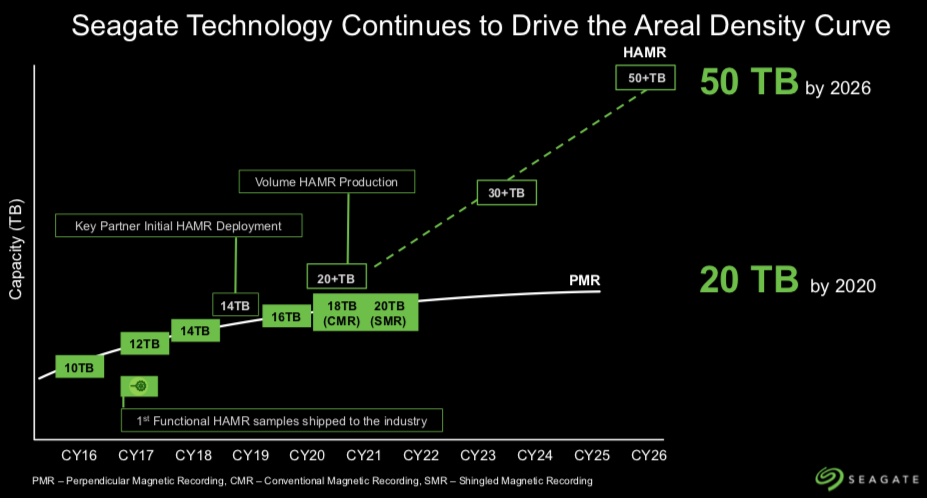
> (ignoring things like High Frequency Trading)
HFT is not a blockchain transaction. They are off blockchain transactions entirely because they trade money between bitcoin / other cryptos and dollars.
> there is only a limited number of potential active crypto-currency users
My entire point is that this limits them from growing. If the blockchain is kept from exploding, it helps to onboard more users.
> Would you say that the credit card network, or PayPal, has exponentially increasing storage requirements?
Indeed not. But their user base is now standardised. So they have a predictable number of transactions every second. However, their storage requirements are still obviously industrial grade server farms. The point of bitcoin is that everyone should have a copy of every transaction (excluding lightning network transactions). You see the connection? Not all of us can have our own server farms. If we all wants to store every transaction in the way the parent of my previous comment alluded to (increase block size), each of us will need our own mini server farm i.e. exponential storage growth.
> It's possible for Bitcoin (for example) to be decentralised and useful to the world and only require linearly increasing storage space.
Yes. It'll level off at some point. But we are far, faaar away from that point. So it'll take quite a while before it levels off.
Is that the point of bitcoin? Satoshi said:
> Long before the network gets anywhere near as large as that, it would be safe for users to use Simplified Payment Verification (section 8) to check for double spending, which only requires having the chain of block headers, or about 12KB per day. Only people trying to create new coins would need to run network nodes.
https://satoshi.nakamotoinstitute.org/emails/cryptography/2/
(He also didn't say anything about "lightning network transactions".)
> If we all wants to store every transaction in the way the parent of my previous comment alluded to (increase block size), each of us will need our own mini server farm i.e. exponential storage growth.
The BTC blockchain is currently 250 GB. If blocks had been 10 times bigger, the blockchain would still be less than 3 TB, and blocks would almost never be full, which would reduce transaction fees and help to onboard more users. I don't think that storing 3 TB of data requires a server farm.
Correct. I'm not going by what Satoshi said, but by what development the bitcoin core team is aiming to create now.
> If blocks had been 10 times bigger, the blockchain would still be less than 3 TB
Correct. The aim of the project is to keep it as small as possible. 3 TB may not seem prohibitive today, but that's because there's hardly been any usage of the network compared to what the real world looks like. If bitcoin truly competed with Visa / Mastercard, both of those numbers will start looking a lot bigger. If the compressed version was 3TB, the bigger blocks version now becomes 30TB - suddenly far out of consumer grade storage for a normal person.
To give an analogy, it's like saying that there should be a law limiting people to only buying 5 books, because if there wasn't a limit then someone could buy a quadrillion books, which would require cutting down all the trees in the world. You're trying to prevent a problem that won't exist, by introducing a restriction that causes a very real problem instead.
I don't think so. That also requires a faster cycling of transactions than the current 10 minute round. But yes, obv a larger number of transactions can fit into the block so throughput will increase.
> 30 TB blockchain (which would fit on two hard drives, which many consumers have)
1) I don't know if you understand who "consumers" are. 30 TB is far, faaaaaar away from what a normal consumer has. Most of us have a laptop at most and that limits us to 1 TB storage. I personally have a lot of cloud storage, but I'm not the average consumer. I'm highly tech savvy compared to the normal person. So go out and talk to people not in tech and see what their tech specs look like. If they can't match up to you, they still need to be able to process transactions.
2) I didn't say it doesn't need a 30TB blockchain. You're completely misunderstanding my point. I'm saying your glib observation of "oh it's 300GB now, it can scale up to 3TB if it's bigger" is highly ill informed. If you push it only 1 order of magnitude, you're going from 3TB to 30TB and it becomes untenable. Now instead if it was 10KB and scaled to 10MB, it obv makes no difference even with 3 orders of magnitude.
3) You're also not understanding the larger picture. If all transactions in history have to be stored in the blockchain, it requires scaling to become less than linear (or at max, linear) to keep up with consumer storage expectations. It doesn't matter what the size of the blockchain is now (as long as it's within say 1TB that the average consumer can access). It matters how big it gets when there are billions of transactions flowing through it every day. So by that account, even 250GB is a very big number because once we hit billions of transactions, unless the relationship is inverse exponential, we'll breach limits long before touching that point.
> You're trying to prevent a problem that won't exist
The problem that won't exist of billions of transactions passing through the blockchain? Possibly if we had off chain solutions, yes. Which we do in very early stages. If not, the problem is very very real.
Why does it have to fit on a laptop? Only miners influence which tx get into a block, not people on laptops.
>The problem that won't exist of billions of transactions?
Visa does 1 trillion tx/yr. Bitcoin tx is ~500 bytes That's just 500 TB/year. Miners with today's hardware can store that easily. A pruned observer node could run with just a few hundred dollars of hard drives even at Visa scale!
The bottom line is that Satoshi and others thought about this and no one saw it as a problem until Blockstream and other VC funded startups began pushing sidechains that they could profit from.
The very fact that you guys are not recognising this means that you still don't understand the concept of decentralisation and want to settle with the altcoin route of making up the word as you go along and if it fits your narrative. If your entire chain was at the mercy of a few large mining corporations, you are dead in the water. The attack vector is easily compromised and you have no leg to stand on.
Each node would need to download 1.4 TB of data per day (500TB / 365) to keep up, and the UTXO set would presumably expand dramatically with a volume increase of that magnitude, making it impracticable to store even a pruned state on a consumer hard drive.
And it needs 3TB?? Cmon, that's not lot of gain for a lot of loss of control by the average.
"Decentralization" is a means to an end. Not everyone have to run a full node, as long as there's enough.
It's amusing that LN is touted as a solution, since decentralized routing is an unsolved problem, meaning that LN will be more centralized than what it's supposed to solve.
Quite cool approaches. The problem is that you can't attach data to transactions, so only useful for a subset of applications, those unlikely to create much bloat in the first place.
Maybe you don't know what it is for. People that are sane like Mr. Armstrong and Satoshi Nakamoto intended it to be used as a currency. If Satoshi is still alive I'm sure he was quite disappointed when Bitcoin decided to not scale past its blistering 7 transactions per second.
"Bitcoin can already scale much larger than that with existing hardware for a fraction of the cost. It never really hits a scale ceiling." -Satoshi Nakamoto
https://steemit.com/bitcoin/@cryptodailyuk/bitcoin-broke-coi...