Don't believe me? Simply don't file your taxes next year. You will get a letter from the IRS sent to you that literally tells you what you owe. They know all of your income down to the cent, they know what you owe. This automagical system exists. Yet the only way to "use" it is to either not pay your taxes, or to pay them wrong.
Yet every year, the IRS makes us go through the charade of putting our taxes together and all the work (and money) that it entails, when the whole time they know what we owe already and expects us to pay that unless we can prove them otherwise.
Under the current system, people aren't sure what the government is aware of. Because we get in trouble for leaving things off, we are more likely to report everything.
Make people file a tax return, but auto-populate it with the data the government already knows. And at the end include a tick box clause that essentially says "I have included everything and reviewed the autofill info, and if I have omitted anything later discovered I will be prosecuted".
20 seconds to file your taxes if there's nothing unknown. Very easy to add extra info. Covers the tax departments back of you intentionally mislead them.
The IRS information is at times comically incorrect in fact.
99.999% of the US population is not trading $20 million a year in stocks, and everyone else here is merely talking about the 95% of the population that has straightforward tax returns.
If you have a W-2 job and all your investments are in a bank or brokerage, but they still don't know your filing situation, dependents, other income, or deductions.
Not that I'm justifying the current system. It's just that the IRS only knows the big picture for most people. The rest is complicated.
To even imply otherwise, and I've seen other comments say they shouldn't / don't have this already in place... even when social media companies are slurping data every way they can... seems absurd.
All that said, you should go through each item and correct their mistakes. Those matching systems aren't perfect.
This is all explained in the letter they send you should you fail to file.
Americans on the whole don't trust their government quite a lot. If the government just said "you owe X in tax this year", nearly everyone's knee jerk reaction would be that the government is overestimating and cheating them.
On the other hand, you can pay a flat fee to let a third party fight the government on your behalf. That's something that many Americans like the sound of.
I think the real problem is that the tax system is complicated, and turbo tax does a good job of making it feel even more complicated than it is. You can fill out your own 1040EZ, if you even know what that is, but people have this sense that the tax system is full of loopholes and they want to exploit that.
That's why most governments that do self-declaration services make it so you can review what tax rules they based amounts off of. It's not like tax law is super easy elsewhere and without complications. I should never have to pay a fee just to declare taxes to reconcile things for the IRS. That is a basic governmental responsibility to give me that service for free.
Right, but since no regular person understands the rules, they can't really double-check. Especially since sometimes you can file stuff under different rules that produce different results, despite both being valid (I say this based on experience from another country, but I suspect the same is true in the US).
Yes, such circumstances exist in the US too. For instance married couples usually file jointly, but they could chose to file separately which results in a different effect.
Well, this is a bit different in that regard. Last time I tried it, it was free to put all my info into turbo tax and see what my amount owed would be, and then it would be a fee to actually file. I assume most tax software works that way.
So it's actually very easy and objective to see the performance of these systems. It would obviously be a big hassle though to spend a whole afternoon playing with all the different tax softwares.
"there should only be one optimal answer once the facts are already created"
Yes, there should be. The reason why accountants can make a living filing taxes for fee is because that optimal answer is often difficult to find.
"Paying for tax filing itself is basically a low-level scam."
Not for me it isn't. If a private company can create a service that makes filing a lot easier and safer, I will gladly pay the fee.
I think you buried the lead here. American public schools, part of the American government charged with teaching children and funded by taxes, don't teach kids how to pay taxes to the American government (maybe it sometimes happens, but it's certainly not standard.) It's ludicrous.
About 20% of people (particularly low income people) have simple tax returns and file using 1040EZ. If the IRS computed that form, then what they send out would be ideal for the majority of taxpayers. So it would benefit those by eliminating the expense of tax preparation without actually costing them more in taxes.
Then there are those like myself who fall into an in-between area. I have more complex taxes, although not as complex as a lot of people, but would gladly pay more than is strictly necessary in order to not have to bother with figuring them out. In fact, I already do, in the form of paying a tax preparer (I fully consider the expense of tax preparation as a tax itself.)
Those whose taxes are more complex are very likely aware of that fact, and would continue to do their own tax preparation.
Also, if the IRS provided a prefilled 1040EZ, that would make computing your own taxes easier because you could use the figures supplied as a reference.
  2017 Form 1040EZ goes up to box no. 14
  2017 Form 1040 goes up to box no. 79

  2018 Form 1040 has no boxes for $ amounts!
  2018 Form 1040 Schedules 1-3 is where they all went, if you needed them.

  2019 Form 1040 added boxes back up to 11b
  2019 Form 1040 Schedules 1-3 also exist
Except many people will try TurboTax or a competing solution anyway, just in case they can get a little bit of money back.
Tax evasion and overstating deductions are common partly because the IRS doesn't have access to the information necessary to verify everything -- that's the same information the IRS would need in order to pre-fill tax forms accurately for the 1/3 of taxpayers who itemize their deductions. 1/3 of American taxpayers a pretty big market for TurboTax and similar services to thrive in.
The Clinton years were the twilight of the fantasy of abusing inbound entitlement tax flows for spending in the present and ignoring the future. That government spending party trick - kicking the can down the road - is now exhausted on a normalized basis, so we're rapidly heading toward perma QE as the only solution remaining other than very high taxation across all major income groups.
That's >22 NASAs-worth of money, if you care about space exploration. It could be roads or high speed trains or education or healthcare or whatever you care most about.
Instead it's going towards paying interest on debt incurred for cheap political wins in the past...
In the United States, and many other nations, the vast majority of taxes aren't collected from payroll. If that was the case, things would be easy. But there are hundreds of other ways that taxes are collected, and they vary from person to person.
More importantly, taxes aren't exclusively about revenue generation. They're used to encourage people to do or not do things: Save money, invest money, buy houses, have babies, buy cars, add solar panels, and thousands of other things.
There are plenty of people who shout "flat tax!" whenever this topic comes up. But they're mostly people who have only led simple lives where the IRS only touches them on their paycheck, or who don't understand the full range of how taxes are used.
They might be better if this were the goal if people could actual interpret what they're being encouraged to do!
Taxes sole purpose should be to collect money to provide services, Nothing else
they should not be used to socially engineer the society the way the government sees fit, that is not a free society or a functioning democracy/republic at that point
(FWIW, I'm generally in favor of this kind of "social engineering" when done by democracies.)
For example, the only slightly complex thing about my taxes are capital gains and interest. It would not be hard to have my brokerages/banks coordinate with the IRS to autopay my taxes on that as well, just like my income taxes are auto paid.
I disagree with that definition. In a limited government, taxes are only for specific purposes, not any service that might be commonly (or even universally) needed/wanted.
You can agree or disagree about whether a limited government is good, or whether tax filing services should fall within those limits. But it's certainly not the definition of taxes to be for any and all "common services".
Our government doesn't respond to citizens, only corporations.
Because they don’t want to make it easy for the government to impose lots of taxes. Americans have the lowest taxes in the developed world. Not especially for rich people, but for everyone else: https://www.heritage.org/sites/default/files/inline-images/I....
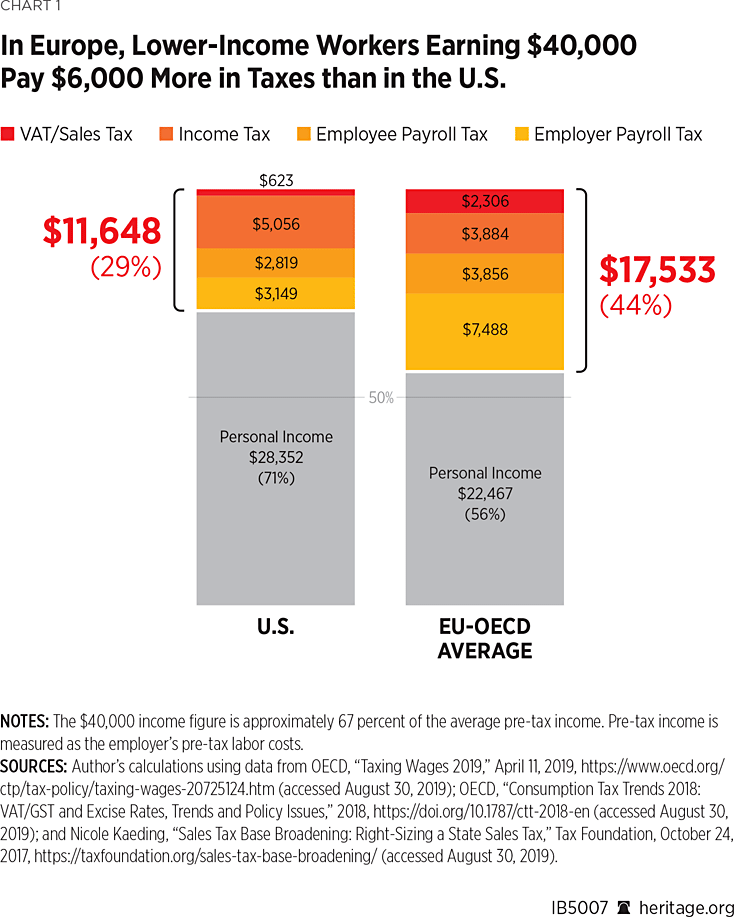
This isn’t the work of some secretive cabal of billionaires. Rich people hire accountants to do their taxes anyway. The absence or existence of free tax filing doesn’t affect them at all. But a platform of “we’re going to make taxes painful so the government is afraid to raise taxes” gets a lot of votes. (In my view, is nothing bad about people being confronted once a year with the cost of the government to themselves. I just looked at my taxes for 2018 and concluded I’m taxed too little and would rather pay more for a government that offers more services. But people should be making that decision with eyes wide open.)
2. Americans don't have the lowest tax rates in the developed world. Mexico, Ireland, Chile, Turkey, and South Korea all have lower tax rates[1]. And in some cases the governments provide more services with less money because they're not spending half their budget on occupying other countries.
[1] https://www.taxpolicycenter.org/briefing-book/how-do-us-taxe...
This. The American military is perhaps the largest and most wasteful social program on the planet. Americans spend way too much time trying to find their way around this elephant in the room.
To raise the percentage rates, politicians have to vote to raise those rates. Private filing means that everyone is very aware of how much they’re paying in taxes. It’s not just an invoice they receive listing how much was withheld. They have to recalculate it. That makes them much more sensitive about voting for politicians who vote for higher taxes.
> 2. Americans don't have the lowest tax rates in the developed world. Mexico, Ireland, Chile, Turkey, and South Korea all have lower tax rates[1].
I don’t think people would consider Chile and Mexico to be developed countries. You’re right that Ireland and South Korea are lower (depending on the year, Ireland cut taxes significantly recently). But they’re together with the US in the bottom band.
> And in some cases the governments provide more services with less money because they're not spending half their budget on occupying other countries.
I think it’s true that other countries do more with less. But it has little to do with the military budget. US government spending as a percentage of GDP is 38%, meaning all levels of US government spend $7.3 trillion annually. The military budget is just 10% of that, or 3.2% of GDP. That’s high compared to Europe, but not a big difference compared to overall government spending. The US military budget is proportionally where the U.K. and France’s was in the late 1980s, back when those countries had robust welfare states: https://worthwhile.typepad.com/.a/6a00d83451688169e2022ad3a0...
If the United States cut its military budget to the same proportional level as France, we’d have an extra $175 billion for other things. That’s not nothing, but to put that into perspective, we spend $970 billion a year on education (5% of GDP). We spend $1.1 trillion on healthcare and welfare for poor people. Cutting our military budget to European levels wouldn’t revolutionize our budget.
I'm not sure how you think private filing is related to manually filing your taxes. Yes, if taxes were just paying an invoice at the end of the year, that would make them less noticeable, but that's not a necessary component of private taxation. Adding up all your income and just calculating a simple percentage would create just as much awareness--probably more, because there's some clarity/transparency that is easier to understand.
In fact, I'd argue that a complex filing process puts a focus on where money is coming from, rather than where it is going, which is arguably much more important to make transparent to people.
> I don’t think people would consider Chile and Mexico to be developed countries.
Any basis you could have for not considering Chile and Mexico to be developed countries applies to large sections of the US (incidentally, they tend to be the parts of the US with the lowest taxes). There's more poverty in the parts of Alabama and West Virginia that I've visited than the parts of Ecuador I've visited.
> You’re right that Ireland and South Korea are lower (depending on the year, Ireland cut taxes significantly recently). But they’re together with the US in the bottom band.
So the rest of your argument doesn't work, since it was based on your claim that we have the lowest taxes.
People aren’t paying attention to tax bills that are getting voted on. But when they do their taxes, they’re forced to actually work out how much they’re paying the government. A bill or invoice they get in the mail wouldn’t have the same effect.
As to the US system being unjustifiable, I think Europeans don’t really understand America. In an ideal world, I’d prefer a Swedish system with high taxes, lots of social services, etc. But Americans aren’t Swedes. They don’t trust their government, and they don’t really trust each other. A quarter of Americans polled favor their state seceding from the country (ranging from 20-34% depending on region). By comparison, only 15% of people in the Basque region of Spain want independence.
I live in Maryland, which is about the same population as Denmark and only moderately smaller than Sweden. It’s a “blue state.” Our capital is Baltimore. Schools in Baltimore spend 40% more per student than schools in Sweden, in a city where you can get a beautiful townhouse for maybe 1/4 of what it would cost in Stockholm. The schools should be amazing, right? No. They’re awful, with terrible test score and enormous gang violence. The city government is corrupt. Not in the way you probably think the US as a whole is corrupt (controlled by wealthy elite), but the sort of reciprocity that typifies developing countries. The former mayor has been convinced of felonies, and in February will probably receive a sentence of 5-10 years in prison.
So despite being a strongly blue state, we elected a Republican Governor by an overwhelming majority that promised to control spending, cancel public projects like transit lines, etc. Because we don’t trust (can’t trust) our government to use our tax dollars effectively.
So yes, there is support in America for things that make people think hard about how much they pay the government: https://www.youtube.com/watch?v=BcEhl5HfGMM. And it’s not irrational or crazy. Our situation is very different than what you face in Sweden.
Except they’re not working it out. They just have TurboTax do it then see they get a few thousand dollars for $35+ and a few minutes of work. Most people don’t understand that a tax return is money that was already theirs; They just see it as an extra paycheck.
I've never heard anyone promoting the idea of keeping taxes complicated to avoid higher taxes.
There's nothing inherent in complicated taxes that stops the government from raising rates.
Conservatives have long wanted the flat tax (file taxes on the back of a postcard) and lower taxes, so simpler lower taxes.
I think the reason it became so complicated was because businesses lobbied for special rules and tax breaks that made things complicated in the first place. Businesses are now setup to take advantage of these loopholes (Amazon passing $0 in taxes, etc.).
TurboTax was built as a result of complicated taxes and they lobby heavily against a simplified tax code.
It's not some cabal of citizens wanting to keep taxes complicated, it's the industries that benefit from the current tax code that wants to keep it this way.
Your theory is wrong.
Even if it could be done simpler, TurboTax and other tax prep companies will lobby against it.
You'd be hard pressed to find any government financial policy that isn't tied to business interests. The tax code is no exception.
There´s nothing more common than tax collection: rich, middle class or poor. Why wouldn't citizens demand a public tax filing process? Even in Mexico we have an automagical tax filing process that makes:
a) The great majority of the population who perceives a salary not needing to file taxes.
b) For the rest of the people, those who don't do anything fancy, just click one button in a portal to do the filing, and everything is calculated by the tax authority.
c) For the small percentage that do more complex things (I'll say it is between 5% and 10% of the population) still can do it in the portal for free, or hire an accountant.