The Dutch experience simply doesn't translate to most of America because of the terrain and climate. Elderly people people will die if you make them walk in the Florida summer. 7 year old children lack the leg-strength to bike up California hills. Both groups are likely to slip and crack their heads open in the icy Boston winter.
Lots of places bike. People who don't like bike infra make all kinds of excuses, but the truth is that bikes work almost everywhere short of the Himalayas. It's just our lack of investment that holds them back.
But I don't think that means we can't borrow any lessons at all from them. The biggest lesson we can borrow from the Dutch seems to be that they set out to intentionally make their cities more pedestrian friendly and bicycle friendly starting in the 1970s when people became extremely fed up with children dying due to being hit by cars.
Ahem. The Alps, the fjords, the Netherlands, the Mediterranean coast of Spain, are all very different landscapes.
The population density of the combined regions is probably a red herring, too: nobody sane will cycle from California across Nevada to Salt Lake City, except as a fitness holiday. Even my 1080-km cycle along the Rhine (flat from Hoek van Holland to Switzerland) isn’t something anyone sensible would do to get from A-to-B, and I flew home instead of cycling back to the UK.
Instead, what will matter is the average journey time from where people live to where they want to go, and how much effort it is to get there. Electric bikes will help on both counts.
Yes you have a wide variety of population densities and climates. So does Europe. So does everywhere else in the world.
It's the most boring and lazy argument to make, and it never actually answers anything. Exactly what is so different about LA compared to Paris that it can't have good cheap internet and cyclists must die at 5 times the rate?
I've lived without a car in the US for over a decade. I no longer have a driver's license. I would like to see America become more pedestrian friendly and bicycle friendly.
I don't think you accomplish that by arguing that "Well, you just do everything exactly like the Dutch!" I think that's a lazy, unhelpful and disrespectful answer that actively ignores real and meaningful differences between the literal and figurative landscapes of the two countries.
It's not good communication to say "Just do everything exactly like the Dutch." If you want real solutions in the US, you need to think in a more nuanced way about what pieces of the Dutch experience you can reasonably use in the US, taking into account real differences between the two places.
Ignoring the differences between Europe and America very often comes across as open contempt for Americans and their presumed stupidity and laziness. It's not an effective means to promote actionable ideas.
No one is likely to take advice that they are just wrong and stupid and lazy and should wholesale copy a system that works well elsewhere without bothering to examine differences between the two places and trying to make some alterations that will hopefully result in a better fit.
Based on the comment I replied to, I feel like San Diego, California could try to borrow ideas from the Netherlands without a lot of critique beforehand. But LA has vastly different weather from Paris and a very different landscape and history of development. So, no, you aren't realistically going to replicate Paris in LA.
I will also note that they have been rioting in Paris. Paris is not some perfect paradise that has figured everything out and never has any problems.
Claims of European superiority are frequently overblown.
You are right that it would suck in the humid south. There are good reasons the obesity rate spikes in those areas.
Most of Christchurch is pretty flat.
---
It only breaks 100 occasionally here in Colorado, but it's plenty hilly and I ditched my car for a bike 8 years back. I arrive at the office sweaty pretty frequently, and I neither shower nor bring a change of clothes. Luckily the air is so dry that the sweat evaporates quickly.
At first I did a lot of showering, but then my skin suffered. The doctor recommended using less soap without going into how much less, so I asked a few close friends to be brutally honest about whether I was stinky while I reduced my soap exposure and started to look for correlations.
I pretty quickly ended up reducing by soap exposure to practically none (I still use hand soap though).
About two weeks after I quit using soap while bathing my skin has started behaving differently. I can no longer correlate sweating a few hours ago with being stinky now. (Admittedly, is hard to get real data on stuff like this).
Somebody always tells me I'm gross when I confess that now I only shower once every four days or so, but 90% of the time somebody mentions a case where I was stinky, they're taking about day two after the shower, not day five.
My theory is that even exposure to just hot running water depletes the skin of some resource, and about 24 hours after the shower I'm at my stinkiest because whatever process replenishes that resource is at a peak. By 48 hours this has subsided and my scent is steady-state. (i.e. body odor correlates with the derivative--not the absolute value, of this resource. It might be bacteria, or oils, or pheramones, I'm not sure).
I've also found that by avoiding cotton or synthetics in my shirts, I can get get a week's worth of wears out of them (I just cycle them so that the color changes and nobody asks).
I think that people in general are frequently wrong about the causes and effects around bathing, but the social conventions are too strong to help them, so occasionally I go on a rant like this, just in case I can help save somebody else from soap. Thanks for listening.
They do it the dutch way.
Things you wouldn't do anywhere else, like leaving babies in their strollers in the streets outside shops when they go shopping.
Denmark is really a big village.
Source: my girlfriend family is Danish and I had saw them last time 4 days ago.
> * Trains to rural areas
It's more easily said than done.
Rural areas are also resistant to things that would make the area less rural, like high speed train.
Look at the fights happening in northern Italy against the TAV (the Italian version of the TGV)
> * Park-and-ride garages for people to drive in, and park next to transportation hubs
Many cities in old Europe cannot do that. Think about the central areas of Paris, Rome, Milan, Madrid.
And those that could are reluctant to do it, because it would immediately lower the value of the buildings around.
Imagine you bought a house for 100 and its value drops to 70 because they made a giant parking lot just below your window.
> * Underground parking garages at the edges of pedestrian zones, or even underneath them, coming up directly above them
In most cities in old Europe digging is very costly and sometimes impossible (most Italian cities for example)
> * Ubiquitous bike storage and bike attachments such that yes,
That would steal space to pedestrian transit
> a mom with 3 young kids can tow them from a single bike - moms in Amsterdam and Berlin do it all the time.
Compare the average street in Berlin[1] or Amsterdam[2] with those of Milan[3]
You will immediately notice a few things: in Milan trams railways are in the middle of the street, they are very slippery and dangerous for bikers; Berlin sidewalks are much larger on average; much of the transport in Amsterdam happens along canals, where cars are usually not allowed.
Things are in a certain way not because people are simply stupid or ignorant, but because the surrounding environment poses a lot of limits.
[1] https://lets-travel-more.com/wp-content/uploads/2019/01/Ryke...
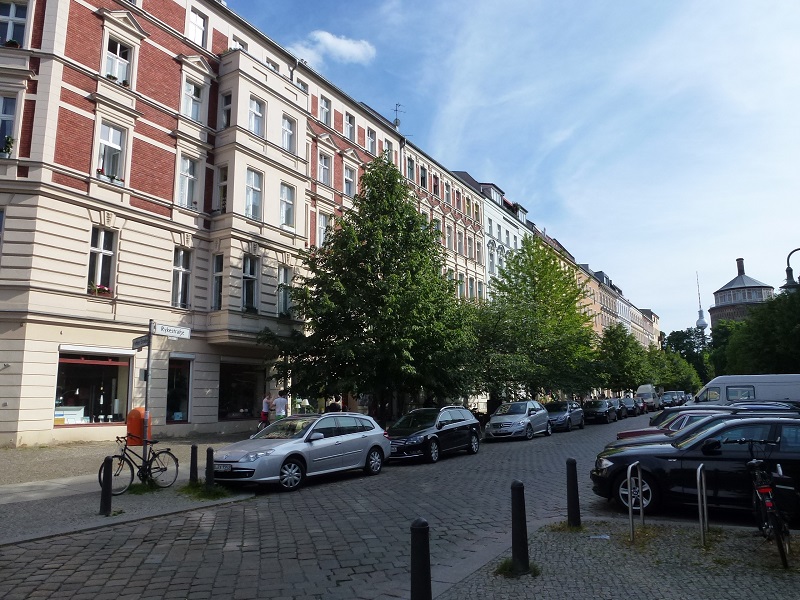
[2] https://i2.wp.com/www.amsterdamredlightdistricttour.com/wp-c...

[3] https://live.staticflickr.com/205/495030650_6d7bf355b8_b.jpg

> Denmark is really a big village.
?????
Why is it that whenever people talk about designing cities for pedestrians and bikes, someone on hackernews thinks it means eliminating all cars entirely forever. For a forum ostensibly designed for entrepreneurs, it shows a tremendous lack of imagination.
Answer: * Public transportation inside cities such as buses and trams
* Trains to rural areas
* Park-and-ride garages for people to drive in, and park next to transportation hubs
* Underground parking garages at the edges of pedestrian zones, or even underneath them, coming up directly above them
* Ubiquitous bike storage and bike attachments such that yes, in fact, a mom with 3 young kids can tow them from a single bike - moms in Amsterdam and Berlin do it all the time.