News for hackers. Stuff that matters.
Re:Berlin Key by odiroot on Sunday September 29, 2019 @02:06PM (#21108585)
I'm surprised some houses still use this. As it's impossible to leave the building without a key in case of a fire.

I suspect it may even be illegal today.

Re:Berlin Key by esrauch on Sunday September 29, 2019 @02:14PM (#21108643)
As an American living in Switzerland one thing that has consistently surprised me is the difference in fire safety rules: not having any smoke alarm or fire extinguishers in homes is common, and it's also common to be able to lock people inside rooms/apartments/buildings so that they can't leave without having a key. It's possible to lock someone in my apartment even if they have the key if the door is locked with the key left in on the other side.

In the US if I checked out a rental home as a possible place to live and it had any one room where you could lock someone in and they would be trapped I'd wonder what weird shit happened there.

Re:Berlin Key by username90 on Sunday September 29, 2019 @02:34PM (#21108782)
You are much more likely to die in a fire in USA, so it makes sense for Americans to take more measurements to prevent it. But in for example Switzerland fires is not a big thing so there is no need to have any laws against it.

https://ourworldindata.org/grapher/fire-death-rates

Re:Berlin Key by novok on Sunday September 29, 2019 @03:22PM (#21109111)
I'm also guessing german europe (swiss, austria, germany) lives in an earthquake free zone, so they can make stone buildings without much consideration for earthquakes while most of the US population has to think about earthquakes and/or hurricanes, so housing is more likely to go towards flexible and flammable wood.
Re:Berlin Key by dpe82 on Sunday September 29, 2019 @04:02PM (#21109316)
Actually, it's mostly a cost thing. US code allows very inexpensive building materials and practices relative to Europe.

I suspect that is a result of different cultural expectations related to who should be able to afford to own their own home - even if the homes don't last very long.

Re:Berlin Key by alister on Sunday September 29, 2019 @04:03PM (#21109324)
The choice of wood for residential housing is based on cost. Trees are plentiful in the U.S., so wood construction is the cheapest option. In countries without lots of trees, they’ll use concrete, stone, or something else.
Re:Berlin Key by wongarsu on Sunday September 29, 2019 @06:18PM (#21109964)
Germany has plenty of wood, and ~300 years ago the majority of buildings were made from wood, with straw and clay as filler material, and straw roofs.

From my understanding the switch to stone was mostly for fire resistance. City walls lead to very dense cities where fire could spread rapidly. Stone walls with clay tile roofs make it much harder for any fire to spread within a building and to other buildings.

Today we would have the fire fighting techniques and more fire resistant wood panels, but old habits die hard (and we are used to buildings standing for hundreeds of years)

Re:Berlin Key by antod on Sunday September 29, 2019 @07:44PM (#21110407)
In a house fire you'll usually be killed by your burning synthetic furnishings before the burning structure gets much of a chance.
Re:Berlin Key by modriano on Sunday September 29, 2019 @04:00PM (#21109306)
Based on this data, the fire death rate in the US is 1.16 per 100k pop. and the rate in Switzerland is 0.28 per 100k pop. Percentage wise, that's a big difference, but that's only because both of these numbers are extremely small. I don't think it's really accurate to say you're much more likely to die in a fire in the USA; it's extremely rare in both countries.
Re:Berlin Key by ISL on Sunday September 29, 2019 @04:06PM (#21109336)
1.16/0.28 is a big difference.

If Switzerland had the US rate, ~75 more people would die every year.

If the US had the Swiss rate, ~2800 people would live to see another year.

Re:Berlin Key by modriano on Monday September 30, 2019 @11:52PM (#21121886)
I know the US (330 mil. pop.) is a much larger country than Switzerland (8 mil. pop.). You also could have said: "The cost of improving the Swiss housing and infrastructure to reduce the mortality rate due to fire would be a miniscule fraction of what it would be in the US". You have to normalize to look at these things, and you also have to look at the bigger picture, or you could totally mislead yourself.

Put in normalized terms,

- 0.00028% of the Swiss pop. dies from fire annually

- 0.00116% of the US pop. dies from fire annually

- 0.001% of the US pop. dies from drowning annually

- 0.001% of the US pop. dies from exposure to mechanical force annually

- 0.006% of the US pop. dies from gunshot annually

- 0.01% of the US pop. dies from falling annually

- 0.015% of the US pop. dies from road injuries annually

- 0.03% of the US pop. dies from respiratory illness annually

Here's [0] a visualization I made of causes of mortality a few years back. Play around with this a little bit; it's pretty interesting looking at actual mortality rates.

[0] http://bl.ocks.org/MattTriano/raw/154e9c142504d61985e2b65287...

Re:Berlin Key by briandear on Sunday September 29, 2019 @07:33PM (#21110345)
An extra 2800 people out of a population of 380 million? Statistically meaningless.
Re:Berlin Key by peteretep on Sunday September 29, 2019 @10:07PM (#21111160)
The victim death count from 9/11 was 2,977, and that appeared to have at least some effect on the American psyche
Re:Berlin Key by twic on Monday September 30, 2019 @03:17AM (#21112500)
The deaths didn't. The news coverage of the deaths did.
Re:Berlin Key by decebalus1 on Sunday September 29, 2019 @02:23PM (#21108710)
Don't know about Switzerland, but as an European living in the US, I think the American fire safety rules are what they are mainly because most houses here are basically matchstick houses built from prefab low quality wood which would get devoured by flames in minutes. And the fire-resistant building materials are super toxic when they actually burn. So fire is a very big deal...

Anecdotal, we had a fire in my building because the wrong type of lightbulbs were installed in the hallways and because of their size, they were too close to the drywall which in turn caught fire. So.. yeah. Matchstick.

Re:Berlin Key by _jal on Sunday September 29, 2019 @02:35PM (#21108786)
I stayed in a house in Germany in which the walls were filled with dried-straw for insulation. It was several hundred years old. There was a no-smoking rule.
Re:Berlin Key by noodlesUK on Sunday September 29, 2019 @03:49PM (#21109258)
I have a similar anecdote. The walls of the main building at my university were full of hay and paraffin wax. This is in the UK. We were very conscious of fire safety there...
Re:Berlin Key by atoav on Sunday September 29, 2019 @02:58PM (#21108957)
> There was a no-smoking rule.

Which to be honest says not a lot about anything, because this isn't that unusual in Central Europe.

Also: a lot of the old wooden houses are far better in terms of fire resistance than you'd suspect on first glance, wood often outperforms concrete and steel when it comes to structural integrity in a fire.

I don't know about the straw thing, I only know it mixed with clay.

Re:Berlin Key by _jal on Sunday September 29, 2019 @04:09PM (#21109355)
The no-smoking bit was me being a bit, ah, dry. Sorry it didn't come across better.

The home in question belonged to the extended family of my host family while I was an exchange student. I went with them to a maintenance day and did wallpaper. I got a very close look at the walls, not to mention the repeated lectures on what a firetrap it was.

Trust me, it was.

Re:Berlin Key by modriano on Sunday September 29, 2019 @04:03PM (#21109321)
For about the last 20 years of my life as an American, 99.9% of all buildings I enter have a no-smoking rule. The only exceptions have been bars in kind of backwards places that I've had to go on business, like Jacksonville, FL.
Re:Berlin Key by masklinn on Monday September 30, 2019 @02:41AM (#21112318)
> Don't know about Switzerland, but as an European living in the US, I think the American fire safety rules are what they are mainly because most houses here are basically matchstick houses built from prefab low quality wood which would get devoured by flames in minutes. And the fire-resistant building materials are super toxic when they actually burn.

Also US electric plugs are inherent fire hazards, much more so than anything you find in europe.

Re:Berlin Key by Swenrekcah on Sunday September 29, 2019 @03:36PM (#21109190)
It’s probably more to do with the age of the buildings. Generally you don’t need to update the safety level to today’s standars unless you do some major changes.

It may or may not be the case that US houses catch fire more often, but fire is always a very big deal if it does happen and then you really don’t want to be locked inside the ‘fire-proof’ house.

Re:Berlin Key by crazygringo on Sunday September 29, 2019 @09:40PM (#21111036)
> prefab low quality wood

Excuse me? What exactly is "low quality wood"?

What are you claiming determines "wood quality"? And are you insinuating that "high" quality wood somehow... burns more slowly or something? All of this is new to me...

Also the vast majority of US homes are not prefab at all, not sure what that has to do with anything. And I'm not aware of a correlation between prefab construction techniques and fire hazards.

Now it's absolutely true that different parts of the world use different materials -- cinder blocks vs. wood vs. stone -- but that has much more to do with climate, available materials, and century of construction, rather than "quality".

Re:Berlin Key by _iyig on Sunday September 29, 2019 @10:07PM (#21111157)
Wood generally falls into two categories: hardwood and softwood. Hardwoods like oak are more dense, harder to light, and take longer to grow, so they are more expensive. Softwoods like pine are less dense, easier to light, and grow faster, so they are cheaper. Within each category there are additional ranges of cost and quality.

New homes in America tend to be wood-framed. Cheap materials are popular in American home construction.

https://en.wikipedia.org/wiki/Hardwood https://en.wikipedia.org/wiki/Softwood

Re:Berlin Key by decebalus1 on Sunday September 29, 2019 @10:56PM (#21111409)
Thank you, you beat me to it.

I would add this article https://www.bloomberg.com/news/features/2019-02-13/why-ameri... which explains my matchstick metaphor

> Building codes evolved, too, as insurers and fire-safety-equipment manufacturers pushed for scientific, “performance-based” codes that emphasized lab-determined fire-resistance ratings over specific materials and incorporated new technologies such as the automated fire sprinkler.

> Stick construction allows builders to use cheaper casual labor rather than often-unionized skilled tradespeople. And it makes life easier for electricians, plumbers, and the like because it leaves open spaces through which wires, pipes, and ducts can run. Still, there’s a reason why stick wasn’t the default for big apartment buildings until recently, and why these buildings are limited in height: Sticks burn.

Re:Berlin Key by decebalus1 on Sunday September 29, 2019 @10:59PM (#21111418)
> Now it's absolutely true that different parts of the world use different materials -- cinder blocks vs. wood vs. stone -- but that has much more to do with climate, available materials, and century of construction, rather than "quality".

Another reason you missed is money. Ticky tacky is cheap and ubiquitous in your average dwelling in America.

Re:Berlin Key by atoav on Sunday September 29, 2019 @02:54PM (#21108931)
I grew up in Austria and live in Germany (so two neighbouring countries to Switzerland) and here it is mandatory to have at least smoke alarms. Fire extinguishers are mostly only needed for public buildings and server rooms and such. Germans especially take their "Brandschutz" very seriously especially regarding emergency exits etc.

However in the end you are responsible for your own safety. If you are in a room with a lock, make sure you don't lock yourself in. Locking people in is a bad idea regardless of situation (and I am pretty sure it is illegal to do so against their will).

Re:Berlin Key by esrauch on Monday September 30, 2019 @12:30PM (#21117094)
> Locking people in is a bad idea regardless of situation (and I am pretty sure it is illegal to do so against their will)

As an American I still find it weird that it is even possible to lock someone in: anyone I've asked has had stories about young kids locking themselves or their parents in or out of a room with no easy way to fix the situation (resulting in things like balcony jumping). I don't see the benefit in designing things that way.

Re:Berlin Key by tmb on Sunday September 29, 2019 @03:44PM (#21109242)
You should also take care not to light your house or person on fire, which is a bad idea and probably also illegal (regardless of will).
Re:Berlin Key by bhaak on Monday September 30, 2019 @09:47AM (#21115268)
I'm currently living in an apartment in Switzerland where the house and the whole street is a UNESCO World Heritage. Due to the building regulations that accompanies, lots of wood is still used. Like for example the whole attic is made of wood.

Because of that we can call the firefighters at not cost, even false alarms are not penalized. But no mandatory smoke alarms or fire extinguishers even though this building still has a working old time furnace for heating. Go figure.

Maybe they expect the Swiss neighbor watch to raise an alarm more accurately than a smoke detector would. Old Swiss people are always suspiciously watching over their neighbors.

Re:Berlin Key by Jnr on Sunday September 29, 2019 @03:39PM (#21109212)
I guess it could still depend on country, but in EU smoke alarms are mandatory.

No one checks it for individuals though.

Re:Berlin Key by dx034 on Tuesday October 01, 2019 @07:39AM (#21124209)
Are they checked for individuals in the US? The only time this would be verified is after construction which is when they'll also be checked in the EU.
Re:Berlin Key by zaarn on Sunday September 29, 2019 @03:05PM (#21108996)
Fire control rules are somewhat different between the US and Europe. In Germany, such a system would be fine. Depending on the door even encouraged.

A large part of German Fire Code is to prevent the spread of the fire and contain it in the rooms where it started for as long as feasible. The lowest rating a fire location can have is E30, meaning the fire takes 30 minutes to "break out" and spread further. The building owners likely also benefit from grandfathering (ie, special building fire code, which depends on federal state in germany).

It also depends on the fire load, ie, how much flammable material the house contains. A concrete or stone house that contains only flammable material as part of furniture isn't a huge fire load and you don't need heavy doors to prevent fire from spreading out of a single flat, a normal door will likely already prevent spread.

Re:Berlin Key by chrisseaton on Sunday September 29, 2019 @02:38PM (#21108811)
> As it's impossible to leave the building without a key in case of a fire.

Isn't that the case for most doors that lock? You can't leave through my (brand new, to-code) front door from inside without a key to unlock it first.

It wouldn't be secure if you could open it without a key - isn't that the whole point of a lock with a key?

Re:Berlin Key by ChristianBundy on Sunday September 29, 2019 @02:47PM (#21108873)
> You can't leave through my (brand new, to-code) front door from inside without a key to unlock it first.

I'm sure I'm just ignorant, but it sounds like your lock is on backward. Every front door I've ever seen can be unlocked from the inside without a key.

Example: https://www.lowes.com/pd/Schlage-Deadbolt-Satin-Brass-Single...

Could you link to a lock that's similar to what you're talking about? I'd feel very uncomfortable entering a house where I couldn't leave without a key.

Re:Berlin Key by wongarsu on Sunday September 29, 2019 @06:31PM (#21110019)
This is what a lock in Germany and most of Europe looks like: https://proxy.duckduckgo.com/iu/?u=http%3A%2F%2Fmax-attachme...

It's the same from both sides (except for the screws, you can only unscrew it from the inside). Both the inside and the outside have a keyhole, and while a key is in one side you can't put a key in all the way from the other side (this way you can lock from the inside, leave the key in, and even someone with the key can't get in).

Normally people don't lock the door while they are inside (maybe at night), on doors facing outside the door handle can't be turned from the outside and you have to use the key to get inside even when the door isn't locked.

Re:Berlin Key by jotm on Sunday September 29, 2019 @07:30PM (#21110331)
You can replace the lock with one of these: https://5.imimg.com/data5/EI/SP/MY-3690463/hardwyn-hcl-301-2...
Re:Berlin Key by blattimwind on Sunday September 29, 2019 @08:02PM (#21110507)
I don't think I ever saw these used in a residential setting. Commercial buildings are a different story.
Re:Berlin Key by twic on Monday September 30, 2019 @03:31AM (#21112601)
I have locks like this in my home. I got a new front door and locks when i moved in [1], and the locksmith offered me the option of these (it's called a thumbturn lock here), which of course i took, because it means you don't need a key to hand to open to door to let someone in, or to escape a fire.

[1] because the previous owner's tenants had broken the door down at some point, and he had replaced it with an internal door, in which for some reason he had installed the lock upside-down

Re:Berlin Key by jotm on Monday September 30, 2019 @05:51AM (#21113317)
I've not seen them in Germany for example, but the cylinders were standard, so it's an easy swap (you can keep the old lock and swap it back if you leave). Keeps you from being locked out, for sure.
Re:Berlin Key by kalleboo on Monday September 30, 2019 @06:41AM (#21113567)
In Sweden I only recalled having seen internal keyholes on older installations, newer homes have a turn on the inside. Haven't lived there in years tho so only going off of vague memories.

e.g.

https://productimages.biltema.com/v1/image/product/small/200...

or

https://dam.inwido.se/files/19/6619/6619_2_820.png

Re:Berlin Key by username90 on Sunday September 29, 2019 @02:55PM (#21108935)
Most homes where I grew up in Europe had two locks, one which you could open without a key from inside and one which requires it from both sides. Not sure why it was like that, but it feels normal to me.
Re:Berlin Key by Sharlin on Sunday September 29, 2019 @03:15PM (#21109065)
Around here (Finland) basically all homes have locks that open without a key from the inside, plus optionally an extra lock that needs a key on both sides, for those who desire more security. I presume those extra locks are more common on house doors than apartment doors.
Re:Berlin Key by stevekemp on Monday September 30, 2019 @01:47AM (#21112088)
Yeah that's the same as the UK-setup as the parent described.

99% of the time most people use the latch, which would be a Yale lock in the UK, or a Abloy in Finland. You'd usually use the extra-lock if you went on holiday, or something similar. Most of the time it would be unused.

Re:Berlin Key by v64 on Sunday September 29, 2019 @02:53PM (#21108917)
Here's an example of my deadbolt that's keyed on both sides: https://i.imgur.com/xXzWS7j.png
Re:Berlin Key by samtho on Sunday September 29, 2019 @03:41PM (#21109222)
Those are peodominately used in situations where someone could reach in (via a broken window or space between bars) and simply unlock it. A solid door should not have this type of lock in the US.
Re:Berlin Key by coderholic on Sunday September 29, 2019 @04:58PM (#21109597)
I think it could be a US / Europe thing. In the UK (where I'm originally from) I think almost all door locks I've seen require a key to unlock from the inside, but in the US (where I've lived for 7 years) I don't think I've ever seen one - they deadbolt usually has something that you can unlock by hand without a key from the side (and not even an option to lock it from the side with a key).
Re:Berlin Key by kwhitefoot on Monday September 30, 2019 @09:38AM (#21115195)
I'm also from the UK but I left more than 30 years ago. I feel nervous every time I visit my family in the UK because now they all have locks that require a key on the inside and frequently the key is misplaced.

I understand the reason for it but I wish a better solution could be found.

Re:Berlin Key by briandear on Sunday September 29, 2019 @07:40PM (#21110388)
> A solid door should not have this type of lock in the US.

Why not? Someone smashes a window, crawls through it, walks around to unlock the main door, through which the burglars unload your stuff. It’s a lot harder to move things through windows.

Re:Berlin Key by kelnos on Sunday September 29, 2019 @08:27PM (#21110665)
I think I'd rather optimize for fire safety than for the possibility that I might lose more stuff if someone breaks in and can more easily unlock my door from the inside.
Re:Berlin Key by tzs on Sunday September 29, 2019 @08:46PM (#21110787)
What about the hinges? If the burglars are inside they can take the door off the hinges instead of unlocking it.
Re:Berlin Key by v64 on Sunday September 29, 2019 @04:08PM (#21109347)
It's not visible in the photograph, but this door has a glass window in the center of it.
Re:Berlin Key by Zak on Sunday September 29, 2019 @07:42PM (#21110398)
It's only less secure if there's something easy to break close enough to the door that a person could break it, reach through, and unlock the door. That's only really relevant if there are no windows anywhere else at ground level that a burglar could easily break and climb through.

Interestingly, the door locks commonly used in the US are much less secure in general than those typically seen in Europe. The average US household deadbolt can be opened with fast lockpicking techniques (raking, zipping) while European ones usually can't. That may be a surprise given the relatively high crime rate of the US.

One crime that isn't as high in the US as most European countries, however is burglary of an occupied residence. It seems the increased risk to the burglar's life may have some deterrent effect.

Re:Berlin Key by umanwizard on Sunday September 29, 2019 @02:44PM (#21108845)
What country do you live in? In the US, almost every door I’ve ever seen can be unlocked from the inside (but not the outside) without a key.
Re:Berlin Key by DoreenMichele on Sunday September 29, 2019 @03:11PM (#21109034)
In recent years, American apartments I've lived in have made it impossible to lock the front door from the outside without a key so you can't lock yourself out, thereby eliminating the need to call the landlord or manager over incidents like that.

They have a knob that doesn't have a locking mechanism at all and a deadbolt that locks from the inside without a key, but cannot be locked without a key if you leave.

Re:Berlin Key by wazoox on Sunday September 29, 2019 @02:58PM (#21108958)
I've never seen that outside the US. Keyholes both sides of the door, everywhere. When it's closed, you need a key or you don't get out.
Re:Berlin Key by DanBC on Sunday September 29, 2019 @03:17PM (#21109076)
Some places have euro-profile locks with thumb turns for the inside.

I think in some English rental properties these are compulsory. (Or Yale latches).

https://www.wickes.co.uk/Yale-P-ET3535-SNP-Euro-Profile-Thum...

Re:Berlin Key by umanwizard on Sunday September 29, 2019 @03:03PM (#21108988)
Well, TIL. Never realized this was a US-specific thing.
Re:Berlin Key by lillesvin on Sunday September 29, 2019 @03:14PM (#21109050)
It's definitely not US specific. Here in Denmark it's standard that the front door opens from the inside without a key. Same goes for at least Luxembourg and Germany as far as I know.
Re:Berlin Key by usrusr on Sunday September 29, 2019 @03:48PM (#21109253)
Germany checking in: all the front doors I know are two stage: first stage closes just by falling into the lock and and opens keyless from the inside, second stage requires key action for both closing and opening, on both sides.
Re:Berlin Key by jwilk on Sunday September 29, 2019 @03:15PM (#21109059)
Same for Poland.
Re:Berlin Key by Sharlin on Sunday September 29, 2019 @03:22PM (#21109103)
Add Finland to the list. Pretty much all of Central and Northern Europe I believe. I don't think I've ever seen a residential exterior door that needs a key to open from the inside.
Re:Berlin Key by yesenadam on Sunday September 29, 2019 @07:45PM (#21110412)
It's not. Same in Australia, I've never seen a house here you need a key to get out of.
Re:Berlin Key by empressplay on Monday September 30, 2019 @02:03AM (#21112163)
If you lock a security / screen door from the outside, you generally cannot open it from the inside without a key
Re:Berlin Key by asveikau on Sunday September 29, 2019 @03:52PM (#21109269)
I don't think it's US-specific, as I have seen it work the "US" way abundantly when traveling.

But having it not work this way is very unusual in the states, while common to not exactly rare in some other places.

Re:Berlin Key by gdy on Sunday September 29, 2019 @04:09PM (#21109352)
Same thing in Russia
Re:Berlin Key by chrisseaton on Sunday September 29, 2019 @02:54PM (#21108930)
The UK. What stops someone breaking glass or a panel and reaching through and unlocking to get in quickly if you can open without a key?
Re:Berlin Key by ghshephard on Sunday September 29, 2019 @03:05PM (#21108994)
You either have strong or no glass on or near your front door.

I have never seen an exit door in Canada, or the United States, that could not be opened from the inside. I'm reasonably confident that is super illegal in those countries.

Re:Berlin Key by umanwizard on Sunday September 29, 2019 @03:03PM (#21108986)
> What stops someone breaking glass or a panel and reaching through and unlocking to get in quickly if you can open without a key?

I suppose this can be avoided by not having any windows close enough to your doorknob that you could reach the lock from them. But people could just break a window and climb through into your house, anyway.

Re:Berlin Key by Gibbon1 on Sunday September 29, 2019 @02:55PM (#21108938)
I think doors that can't be opened from the inside are serious possibly criminal safety violation everywhere in the United States.
Re:Berlin Key by vageli on Sunday September 29, 2019 @09:20PM (#21110938)
> > As it's impossible to leave the building without a key in case of a fire.

> Isn't that the case for most doors that lock? You can't leave through my (brand new, to-code) front door from inside without a key to unlock it first.

Do you live in the US by chance? In my jurisdiction double keyed deadbolts for example are not up to code for residential use, and for those applications the deadbolt must be keyless on the egress side.

Logically, this seems sound as you don't want to be scrambling for keys if your house is on fire.

Re:Berlin Key by cj on Sunday September 29, 2019 @02:50PM (#21108893)
> You can't leave through my (brand new, to-code) front door from inside without a key

Just to clarify, after you lock your front door with the key, it’s impossible to unlock the door from the inside without a physical key?

The vast majority of locks have a physical unlocking mechanism on one side (one side is unprotected, usually the inside)

Re:Berlin Key by mattlondon on Sunday September 29, 2019 @03:15PM (#21109062)
> The vast majority of locks have a physical unlocking mechanism on one side

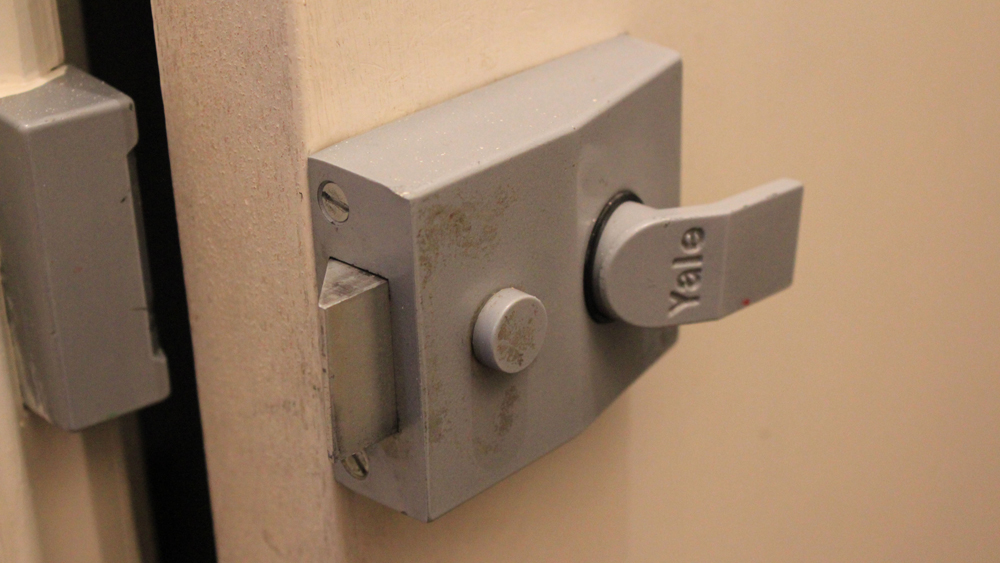
Not where I live. Sure the lock that you use to stop it blowing open in the wind (1) when you are at home has a latch on the inside (making it easy to open door to visitors etc), but you also have the real lock that you use when you leave the house require keys from either side (2).

I think most home insurance in the UK would either not insure you or your premiums would be super-high if you only had the latch and not a proper secure lock.

Random image from the internet showing typical UK front door locks - latch at the top (openable from inside without key), proper secure mortice lock at the bottom (key needed from both sides): https://i.pinimg.com/originals/1b/a1/63/1ba1634b8b6b9c5135b6... or https://i.pinimg.com/originals/a1/7b/77/a17b77bf1ad7a909a0bd... - in the second picture if it just had the latch it would be absurdly easy to break into: just break the glass and open the latch!

1 - https://www.screwfix.com/c/security-ironmongery/night-latche...

2- https://www.screwfix.com/c/security-ironmongery/door-locks-b...

Re:Berlin Key by umanwizard on Sunday September 29, 2019 @03:38PM (#21109195)
As long as you don’t have easily breakable glass within reaching distance of the unlocking mechanism, why is a lock that can be unlocked from inside less secure?
Re:Berlin Key by mattlondon on Sunday September 29, 2019 @03:58PM (#21109298)
I think the problem is not that it can be opened from the inside but more that the ones that just have a lever to flick on the inside are usually yale style locks that are easy to bump or pick, or break a window and reach, or put something through the letter box to reach.

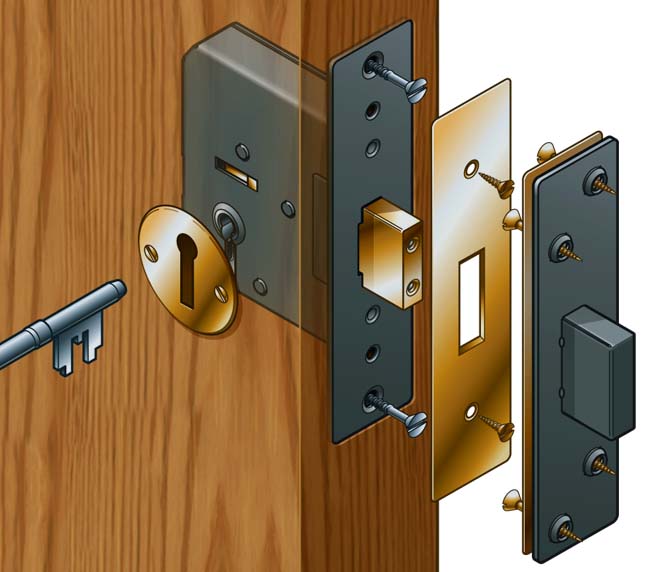
The mortice locks are harder to pick and are usually substantially sturdier in construction. In the UK at least, the mortice lock is physically inside the door structure (1) whereas the latches that don't need keys are attached on the door (2).

We recently had a break-in in the block of apartments where I live where the latch attached on the door was broken off by people forcing a door. If there had been a mortice lock, they'd have to break the door frame or the door itself, rather than just bust the weak latch lock off the back of the door (in this case the door opened outwards, so they just pulled on the door handle whilst bracing a leg against thethe wall and the latch came right off the back of the door)

1 - https://www.buildingsheriff.com/mortice-lock-costs_files/sta... 2 - https://www.diydoctor.org.uk/images/nightlatch.jpg
Re:Berlin Key by chrisseaton on Sunday September 29, 2019 @03:58PM (#21109297)
Because breaking through one small panel on a door and then reaching through and turning the lock is a lot easier than having to break away the entire door so you can get your body through.
Re:Berlin Key by chrisseaton on Sunday September 29, 2019 @07:26PM (#21110314)
> The vast majority of locks have a physical unlocking mechanism on one side (one side is unprotected, usually the inside)

Maybe where you live. I’ve never seen a lock like that except in a hotel.

Re:Berlin Key by Inversechi on Sunday September 29, 2019 @03:19PM (#21109085)
Coming originally from the UK I was surprised about how relaxed fire and safely regulations are in rented accommodation is in Germany.