It's not a technological breakthrough, but in a world where common costs will be more factored into the balance sheets of those who create them, the fact that Tesla can be on the sell side of this and the trend to further quantify those costs might position them well.
I just don't think it really works, it's just financial games in which the rich, as usual, profit the most. The owners of GM and Fiat Chrysler as much as the owners of Tesla.
Up until now ICE manufacturers and users havent being paying for the full costs of that technology, everyone has been subsidising them, this is designed to cancel that subsidy out.
Society subsidized $10k on a Tesla purchase for someone to commute to work, but offered no incentive to take public transport, carpool or work remotely.
It's a shame that it's such a hard sell politically.
For a potential car buyer, this is a good incentive to steer them towards better choices.
Btw, it isn't society subsidising Tesla, its GM and Fiat Crysler customers. Or are you talking about tax credits? Perhaps? But on the other hand they were still paying more than what an equivalent ICE car would cost, so it isn't a free ride for them either. In the end society hopefully gets a sustainable EV industry, at a lower cost than if the government had done it themselves, isn't that what we should be comparing it against?
Talking about a "potential car buyer" is assuming your conclusion. If the outcome is going to be a car then you're steering them in the right direction. But you're also steering them away from non-car choices that would likely be better for society.
> Or are you talking about tax credits? Perhaps? But on the other hand they were still paying more than what an equivalent ICE car would cost, so it isn't a free ride for them either.
It is a free ride - taxpayers subsidize them buying a personal car, whatever their personal motivations for that choice were. And it's disproportionately the well-off who benefit.
> In the end society hopefully gets a sustainable EV industry, at a lower cost than if the government had done it themselves, isn't that what we should be comparing it against?
It is essentially the government doing it themselves - ultimately public money is being pumped into these EV companies in the same way as if they were a part-nationalised industry, with all the problems that that implies. The goal shouldn't be electric cars, the goal should be pollution reduction - imagine putting the same amount of subsidy towards e.g. bicycles for poorer inner-city residents.
But they're being subsidised to buy a more expensive car. The aim is to bring it in line with other more expensive cars.
It isn't $10000 off the default option, it's $10000 off the better for society option to bring it more in line with the default option. If it works as intended the buyer doesn't save money.
I suppose you could structure it to favour those with lower incomes, it would be more costly, more complicated, and I'm not sure how you could get to a sustainable model as quickly. Poorer people would presumably want cheaper cars, but currently EVs are expensive, so you would need to subsidise them that much longer, and potentially right about now you'd have cross subsidy anyway, with rich buyers buying expensive cars with R&D paid for with government subsidy money.
We can talk about alternatives to car, that isn't where politics is at, and I'm not sure tax credits would be a particularly good tool for encouraging alternatives. As I said don't let perfect be the enemy of good.
Again you're assuming the default option is buying a car. Society shouldn't be paying people to buy cars, especially rich people: that's not a good thing to incentivise.
> We can talk about alternatives to car, that isn't where politics is at, and I'm not sure tax credits would be a particularly good tool for encouraging alternatives.
Surely if you believe tax credits work for electric cars then you should believe they would work for other things too.
> As I said don't let perfect be the enemy of good.
Is it even good though? It's hard to believe that paying rich people to buy cars (which still have negative externalities - land use, congestion, traffic deaths) is a better-than-replacement-level use of public funds.
Bicycles are relatively cheaper, I suspect the barrier to cycling isn't cost. Its infrastructure, culture, etc.
I'm not saying it's a bad thing, and if we can't get a carbon tax I'll take what I can get. But let's call a spade a spade.
I do think we are missing out in a big way by not tipping the balance of hybrid TCO (eg a Camry) from slightly above to slightly below their equivalent models. Even a small tax could do that and it would make a much bigger difference than EVs have to date (but of course not in the long run).
If the transfer payments mean Teslas become cheaper or more available, and therefore more people drive EVs, wouldn't that negate the negative externalities of using petrol vehicles?
But they still have significant emissions, and society isn't being compensated for them.
It's better than doing nothing, but that's about all the praise I'll give it!
Could you not then argue that Tesla owners are subsidising everyone else by bearing of lowering emissions which benefits everyone else?
It isn't? Who paid for that $7500 tax credit?
If the middle class would be willing to pay a carbon tax, then the current system would be needed.
I'm not sure everyone quite understands that one big difference between a cap-and-trade type system and a simple excise tax is that an excise tax puts constant downward pressure on pollution, while the cap-and-trade type system only encourages the industry to reduce their externalities to whatever level the government picked as a target.
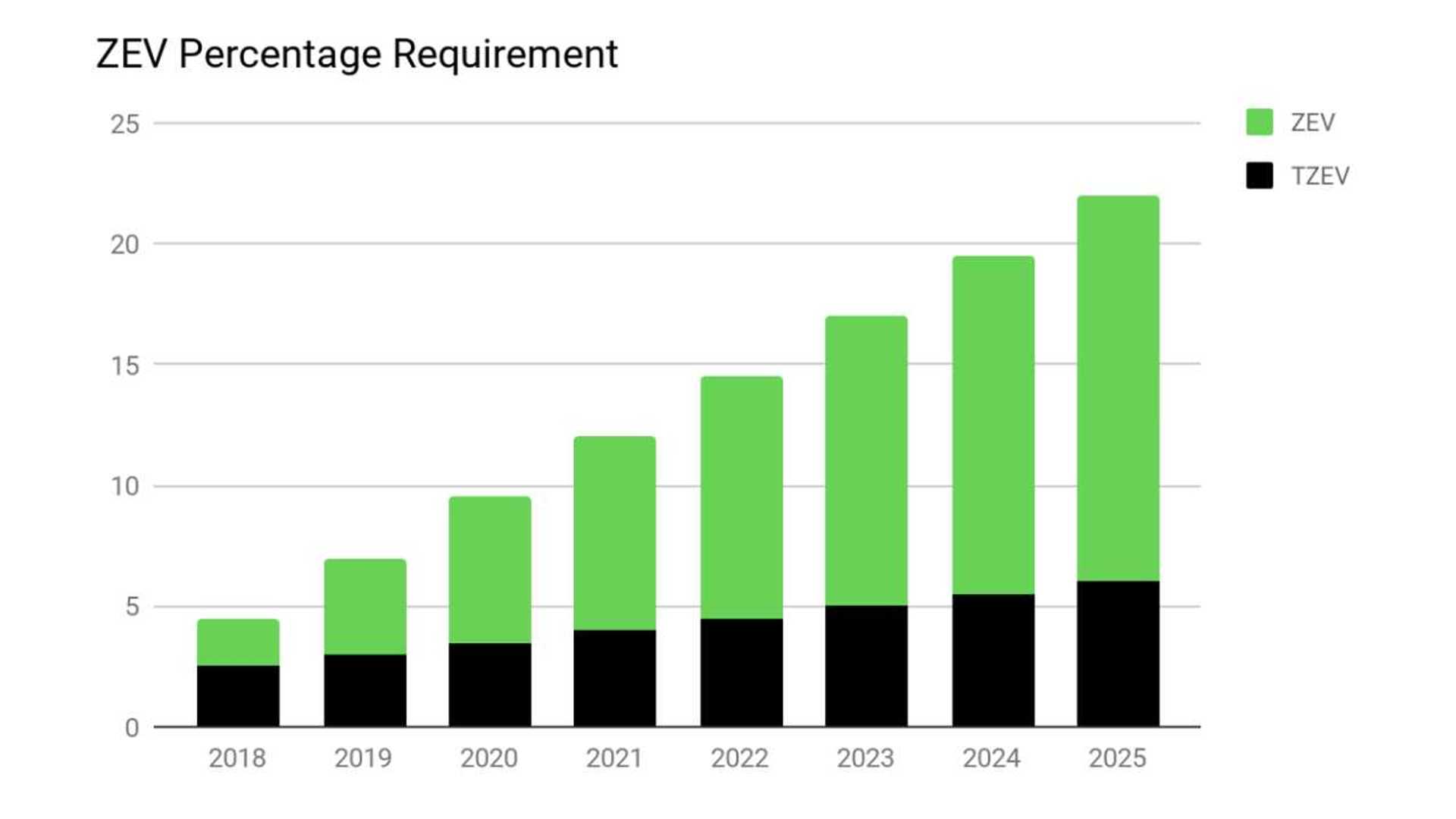
”Manufacturers are required to produce a number of ZEVs and plug-in hybrids each year, based on the total number of cars sold in California by the manufacturer. Manufacturers with higher overall sales of all vehicles are required to make more ZEVs. Requirements are in terms of percent credits, ranging from 4.5% in 2018 to 22% by 2025”
https://www.arb.ca.gov/msprog/zevprog/factsheets/zev_regulat...
About 75% of GMs current credit balance comes from TZEV vehicles, but TZEVs are phased out and an increasingly large share of credits must be BEV going forward;
https://cdn.motor1.com/images/mgl/VZ44G/s1/carb-zev-percenta...
"Oh, definitely the bankruptcy."
(ps. the id of the person you are replying to :D )
A more likely idea would be that without tesla they'd just pay the taxes or lobby for them to be lower citing the fact that they can't hit the goal like they have been in other places like the EU.
In other words it's not much of a statement about Tesla, it's just a credit system working as intended. Tesla has credits left over because they don't sell ICE cars, GM predicts that if the next president is Democrat they might need more credits so they buy now while they are cheap.