Anyways, it is a good one. So is that channel in general.
It is also a good video if you just watched Interstellar, because it also explains why the black hole looks the way it does in the movie. Note that the movie black hole rendering is slightly incorrect for artistic reasons, the video shows the more scientifically accurate version.
He said we would see a picture of Sagittarius A*, but we actually got the black hole at the center of M87.
"The Event Horizon Telescope Collaboration observed the supermassive black holes at the center of M87 and our Milky Way galaxy (SgrA*) finding the dark central shadow in accordance with General Relativity, further demonstrating the power of this 100 year-old theory."
Resolving power is proportional to the (virtual) aperture size, not the total sensor area (that gives more signal strength).
Kind of sad that after all the amazing effort and resources that have gone into the creating the image that the international team couldn't have featured an explanation as clear as this in their actual press conference.
https://www.youtube.com/watch?v=S1tFT4smd6E&feature=youtu.be...
Been able to make testable predictions and then confirming them or disproving them is the entire (awesome) point.
Astronomy/cosmology is one of those strange disciplines where rather than discover new objects in situ, one discovers their possibility in the mathematics and then goes out to find them. So I and many others were hoping that this image was radically different than the math, potentially opening the door to some new theories. Confirmation just isn't as much fun as raw discovery of the unknown. Example: the recent "cannonball star" observations. We are going to need some new science to explain how that is a thing.
That being said, it seems your concerns are being addressed in the TED talk you linked to from 8:45 onward?
Moreover, in the NSF press conference today it was said that they had four different teams in four different locations across the globe last year, working on interpolating the data and generating the images and they basically asked the teams to lock themselves in, i.e. to not communicate with each other at all, and use (more or less) whatever interpolation algorithm they thought would fit the data best. And at the end, when the four teams met up last year, they had supposedly arrived at very similar-looking images.
I briefly(!) looked at the papers that were published today ("First M87 Event Horizon Telescope Results" I-VI) and while I'm anything but an expert when it comes to radioastronomy and imaging technology (I'm more a theoretical physics/mathematical general relativity kind of guy), I came across the following statements which, to me, all suggest that they've at least evaluated the data with due diligence (emphases all mine):
"IV. Imaging the Central Supermassive Black Hole" (https://iopscience.iop.org/article/10.3847/2041-8213/ab0e85):
Section 5.2 confirms the statements from the press conference today:
> The imaging teams worked on the data independently, without communication, for seven weeks, after which teams submitted images to the image comparison website using LCP data (because the JCMT recorded LCP on April 11). After ensuring image consistency through a variety of blind metrics (including normalized cross-correlation, Equation (15)), we compared the independently reconstructed images from the four teams.
> Figure 4 shows these first four images of M87. All four images show an asymmetric ring structure. For both RML teams and both CLEAN teams, the ring has a diameter of approximately 40 μas, with brighter emission in the south. In contrast, the ring azimuthual profile, thickness, and brightness varies substantially among the images. Some of these differences are attributable to different assumptions about the total compact flux density and systematic uncertainties (see Table 2).
Section 6, in turn, confirms the statements from the TED talk:
From the introduction to section 6:
> To explore the dependence of the reconstructed images on imaging assumptions and impartially determine a combination of fiducial imaging parameters, we introduced a second stage of image production and analysis: performing scripted parameter surveys for three imaging pipelines. To objectively evaluate the fidelity of the images reconstructed by our surveys—i.e., to select imaging parameters that were independent of expert judgment—we performed these surveys on synthetic data from a suite of model images as well as on the M87 data. The synthetic data sets were designed to have properties that are similar to the EHT M87 visibility amplitudes (e.g., prominent amplitude nulls). This suite of synthetic data allowed us to test the scripted reconstructions with knowledge of the corresponding ground truth images and, thereby, select fiducial imaging parameters for each method. These fiducial parameters were selected to perform well across a variety of source structures, including sources without the prominent ring observed in our images of M87.
From section 6.2:
> We then reconstructed images from all M87 and synthetic data sets using all possible parameter combinations on a coarse grid in the space of these parameters. We chose large ranges for each parameter, deliberately including values that we expected to produce poor reconstructions.
Finally, in the caption of figure 4 of "I. The Shadow of the Supermassive Black Hole" (https://iopscience.iop.org/article/10.3847/2041-8213/ab0ec7) they write:
> Note that although the fit to the observations is equally good in the three cases, they refer to radically different physical scenarios; this highlights that a single good fit does not imply that a model is preferred over others
…which, assuming that I'm understanding this correctly, means that the bias in the fits towards one model over another is low.
--
Again, I cannot stress enough that I've only skimmed the papers but from what I did read, I see no good reason not to trust their results.
You can imagine that space-time equations have many solutions and properties that can't be contemplated all at once even having them right in front of you.
Schwarzschild took the equations and obsessed over them for countless hours and eventually discovered that one solution to them implied this phenomenon and therefore he discovered black holes by discovering a specific solution to Einstein's equations.
Of course no one knew at the time if the mathematical solution represented real physical objects that exist in the universe, because it doesn't always happen that way. Occasionally some obscure corner of the math predicts something that's a dead end or anomaly that doesn't have any meaning of value as far as it is known.
They had no way to know one possibility from the other.
(As an aside, I have found a whole extra level to nominative determinism since starting to learn German — Schwarzschild = Black shield)
> In 1915, Albert Einstein developed his theory of general relativity, having earlier shown that gravity does influence light's motion. Only a few months later, Karl Schwarzschild found a solution to the Einstein field equations, which describes the gravitational field of a point mass and a spherical mass.
Of course they "invented" Newtonian black holes, not relativistic black holes.
Even so - well ahead of the rest.
Anything which is not in that radius or not already in a path towards it should be safe from not getting sucked by the black hole.
E.g. If our sun becomes a black hole, Schwarzchild radius would be 2.954Km i.e. anything outside ~3Km would be safe.
This was explained in the scishow video on that topic[1].
The innermost stable circular orbit is further out than the event horizon, 3 times the Schwarzschild radius IIRC. Anything closer to that has an unstable orbit.
Thus far, from all the experiment and result observed, the theory has been proven to be correct.
Hence, it can be said with 99% certainty whatever it predicts must be correct. I hope it does mention about possibility of creating a worm hole.
It is a bit old (2012), but comprehensive and with both good audio and readable* slides.
*: In the sense that you can see the letters on them
Part I: https://www.youtube.com/watch?v=VnJYo6LKzgA
Part II: https://www.youtube.com/watch?v=Nlry6LqWwJ0
Peace
"Third, adopting an inclination of 17° between the approaching jet and the line of sight (Walker et al. 2018), the west orientation of the jet, and a corotating disk model, matter in the bottom part of the image is moving toward the observer (clockwise rotation as seen from Earth). "
On the other hand, "almost exactly from the top" is not the same as "exactly from the top".
However, as they mention in the press conference, Sgr A* moves a lot faster relative to us than M87, so it's much harder to take a still image. (In the press conference they used the example of trying to take a photo of a toddler with an exposure time of 8 hours.)
You mean: was eating something big 55 million years ago ;)
The Event Horizon Telescope is interesting because it is, in essence, a radio telescope that uses a "sensor" that is the size of the entire Earth. As such, it is able to make much higher resolution observations.
[1] https://en.wikipedia.org/wiki/Sagittarius_A*#/media/File:Clo...
[2] https://en.wikipedia.org/wiki/Sagittarius_A*#/media/File:X-R...

He does talk a lot about theory, a lot of it interesting and novel to me, but by the end of the video, most of this theory suggests a different-looking image!
https://static.projects.iq.harvard.edu/files/styles/os_files...
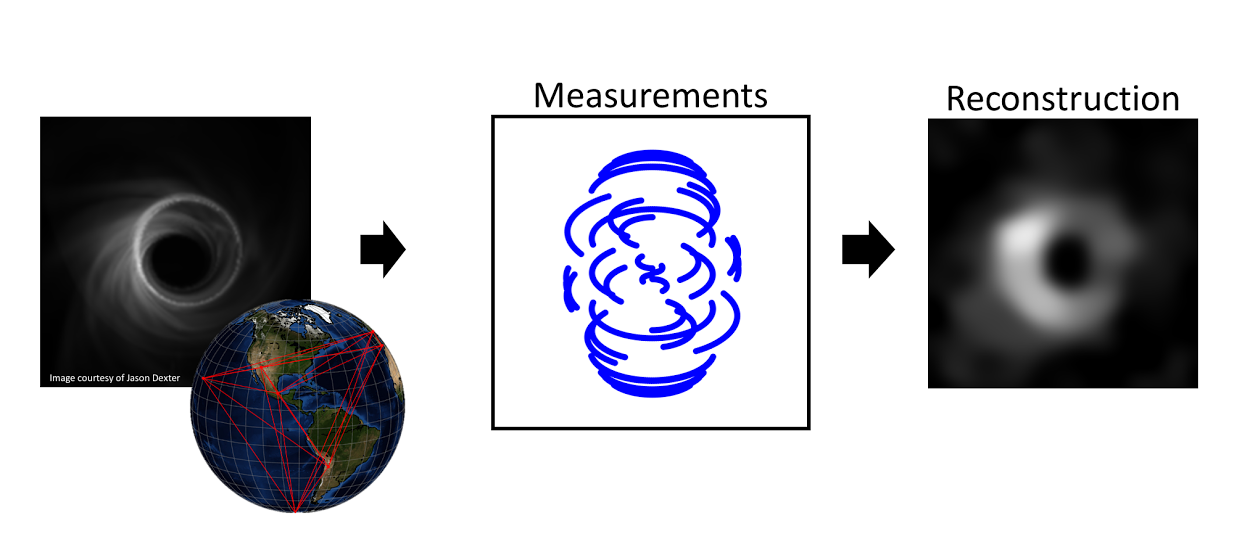
Taken from here: https://eventhorizontelescope.org/science (the official site of the project).
On the left is how it would look like if we weren't so far -- we are 55 million light years far from that. You know the distance from us to our Sun, which you see on the sky but can cover with your own thumb? That object is 3,500,000,000,000 times farther than the Sun is far from us.
On the right is what we can reconstruct from the signals measured because we are so far and we have "only" the telescope the size of the Earth. More details would be visible (the picture would look more like the one on the left) either if we had even much bigger telescope than the Earth, or if the black hole of the same size were much closer to us, which it is not.
The problem here is your expectation does not match the product. It's like you went to a car dealer and are upset they didn't sell you an airplane.
It isn't surprising to me that Derek focuses on one form, since Veritassium is providing content for the armchair consumer, that he chooses what he believes to be the best model and presents that. This isn't a PhD defense, after all, it's just a timely video so that folks can appreciate the image that the EHT group has released (is going to release, at the time of Veritassium's video.)
Did you have some other models in mind?
Interesting to me is that Veritassium's presented model doesn't explain the corona-like features, nor any attempt at explaining the "blobs" although he does say that blobs would be exiting to see. And there they are! What fun.
>why can you expect it to look like this? well because it's just going to look like this.
Now, I'm not trying to say his prediction was unwise. I just think it's first of all bad form to say something like "the reason is just trust me," in scientific discussions (even if you are correct)... but second I actually do want to know at least some explanation to that question. Granted, I'm not saying the video does not explain anything about the image. I wanted to know: why can we be sure it will look like this, and not other simulated images?
That's all.
You can see on the EHT's own website a gallery of other simulated models of what could be expected from a radio image.
And the second part of my criticism, was that by the end of the video, he was using images inspired by other models, and particularly of one where the accretion disk dominated the image.
I dont care how many downvotes I get, I know the difference between right and wrong and this is a perfectly reasonable criticism.
Anyways, since my posts lost 60 karma in 1 hour somehow (almost uniformly coming from posts in other threads, wtf?) some other opportunistic types see it as a chance for bullying. Even writing stuff like 'you've obviously got your jimmies rustled mate!' or other extremely bad faith assumptions like 'if you cant understand why it's fuzzy, it's far away!' The best is the troll bait comment, 'do you really think one person is downvoting you?' Groupthink, bullying, and authority define right and wrong for some people--they can't even write something that even addresses an actual comment or argument. People are crazy. Eventually they just start addressing the negativity itself, abandoning any substantive argument, and focusing on the negativity itself. The next step is using the negativity as its own justification (you deserve negativity because otherwise you wouldnt be receiving negativity kind of assumptions implicig in the above troll bait comment).
But still all that I dont think explains why comments in unrelated posts (even ones that were being complimented) got the same time-unform mass-downvotes?? I think I haven't experienced anything like this before on this site until recently. I lost 60 karma in the a few hours.
Look at this image for yourself. The article is titled: "Here is what scientists think a black hole. Looks like:" https://www.sciencemag.org/news/2019/04/here-s-what-scientis...
There are not massive differences in the images, but the Vetiasium prediction was (and this is very plain) much more accurate.
This isn't controversial at all.
I also thought the particular statement, "why is it like this, because it is just going to look like this" was bad form.
This is very plainly reasonable.
I think the fact that you and a few other users turned this into an opportunity to go through the effort of writing belittling comments and even put downs and troll bait over something as plain and ordinary as this is indicative of some bad qualities of humanity expressing themselves here.
Of course, your only response will be further negativity as bad people dont possess the ability to admit when they were wrong.
And the statement about Assange is very widely expressed. See here(1). There are articles all over the media, just like that one, echoing the same exact view. They are literally everywhere.
Finally, I noticed over the last 30 minutes all my recent comments went down by -1 each. That really makes it look like I'm engaging with some quite petty and insecure people.
Edit: see, right after I wrote this comment, all my recent comments each, in perfect synchronization, down by -1 again haha.
To your point, it's like taking a picture of Uranus with film and waiting for it to develop. People familiar with the matter can guess what the _image_ will look like not what Uranus actually looks like.
This is all very clear in the first 25 seconds of the video if you actually listen to what he's saying.
Unless I'm misunderstanding your intentions and you just meant that as a condescending insult?
You're ranting about Saturn and Jupiter for some reason. Why don't you calm down and look at page eight of the paper that Veritasium video was based on: https://ve42.co/luminet "Image of a spherical black hole with thin accretion disk Astronomy and Astrophysics, vol. 75, no. 1-2, May 1979, p. 228-235"
Look at that last image, and squint at it until it gets fuzzy. Lo and behold, a fuzzy coffee mug stain!
Perhaps it was a mistake for him to make the focus of the video on the physics of black holes, rather than the limitations of state of the art radio interferometry... but I don't think so.
He doesn't need to give a reason. The reasons why it would look like a "fuzzy coffee mug stain" are well known since Hawkings...
Here's the image from the movie: https://www.wired.com/wp-content/uploads/2014/10/ut_interste...

Now imagine that image being taken far away by several ground-based telescopes put together at the edge of their capabilities and using math to error correct and stitch together the final result. What you get is what we saw.
Here is another prediction: https://www.sciencemag.org/news/2019/04/here-s-what-scientis...
I just wanted to know why he went with that one because his prediction was really accurate. And I thought him saying 'just trust me' was bad form.
He did talk some about this, but he didn't really say anything about why he thought his illustration would be so accurate compared to a lot of other stuff seen in the press.
I dont care (or have any idea why) how many downvotes or insults I get. It is a perfectly reasonable question and criticism.
The only changes in the image depend on what angle the black hole is being viewed at which would influence whether we see a band across the middle and the slimmer inner ring.
There is some groupthink going on here affecting people like you and others. The above is obviously plain.
Perhaps you should post exactly what image you're talking about and what you think is different.
In the veritasium video the "coffee stain" was not really as blobby as the real image, but it seemed a lot closer than the smooth-gradiant, no blobbiness and no irregularities predictions.
I dont just mean the fuzziness from low resolution.
This isn't really a big deal, but it's also obvious that I am just stating plain facts about what is in these images.
At the time I saw this video when he said "you can be confident, because... (no reason given)" was really the thing that I thought was annoying.
I think you can see the differences in the images. They're not huge but the smooth gradiants vs irregularities/coffee stain/blobbiness is plain to see I think.
Edit: from the horses mouth himself, one of the lead researchers says he didn't expect the image to look like it did: https://youtu.be/ZrDhHDBHkQY
Some of the people here in other parts of this thread have been really offensive for this. It's honestly pretty ridiculous.
All the models are the same, and the real picture is "blobby" only because of the process in how it was taken. I think you are refusing to accept that but there's nothing else to say about it. It wasn't a direct photo, it was a complex assembly of several different radio telescopes around the world stitching data together. If we were actually next to it, it would very much look like the one from interstellar.
The video you linked isn't about the prediction being wrong, more that he just didn't expect to really see a black hole at all. Even though black holes are generally understood for decades, there's a certain shock and awe to seeing it real for the first time.
Also, my complaint was in fact that I didnt know why Veritasium was confident in their prediction. This complaint is for a matter of fact completely consistent with one of the lead researchers outright saying they didn't know what to expect. I never said I was exclusively complaining about there being simulated models which have some differences. You and others criticized me after I said he should have substantiated why he was confident in his prediction. I gave what I believed was my the foremost reasoning for saying that.
I had little idea what the picture would look like...
I have no idea why you're so intent in disagreeing with me. I'm substantiating my ideas with facts. And saying 'just bbelieve me' I think is also bad form.
At this point I feek like your disagreement has to do with psychological or social biases unless you are able to address the factual content of my comment.
But the one thing you said that was interesting was about the blobbiness. I think what you are trying to saya is that it is fully expected by the researchers to be error. Do you have a good interview or other source on this?
https://arxiv.org/abs/1309.3519
It matches quite good, I'd say. Page 4.
There is nothing complex about my original statement there. The EHT website itself has a gallery of simulated images and I'd like to know why he chose that one specifically.
In the video he says "just trust me."
This is a perfectly reasonable criticism, I don't care how many downvotes or personal attacks I get.
It has nothing to do with anyone "being patient." That thread was 90% bullying, which you are taking part of.
This is of course a bummer, since this means that the acquired image does not give us any new clues of where our understanding of physics is wrong.
Reasoning about an image of a black hole is very much within the realm of standard science. Veritasium was able to explain the prediction using essentially ideas that are so basic they're at the high school level. If our basic understanding of physics down to the high school level was wrong (e.g., very far from the research frontier), there would be very very serious issues.
It's still very early and like the detection of gravitational waves, I think it feels like more of a symbolic step into a new era of space science. It's easy to forget that yesterday, black holes were a result of mathematics and only indirectly shown that they "ought to exist".
So first, I think we need to cut them some slack! Second, I think that if we at all WANT to shatter the Standard Model, I think we first need to be able to do science at the extremes of it! The LHC is one way, probing into the details of black hole mechanics might end up being another
TL; DR The dark area is the entire surface of the event horizon, including the side facing away from us, plus some more due to photons missing the event horizon "directly" being drawn in. One side is brighter due to its being Doppler boosted.
[1] https://www.youtube.com/watch?v=zUyH3XhpLTo