The round it fires is more suited for the reality of combat, which is that 90% of combat takes place within 100 meters and the last 9% happens within 300 meters of the enemy. In fact, you can't even see a normal target with non-magnified sights at 300m, much less a target that's trying its hardest to hide from you.
The M14 is designed to be effective at 600-800 meters. And the cost to being effective at that extended distance is that you have to dump lots of energy into the projectile, which means that the shooter has to deal with a large recoil impulse. If you are taking a shot at 100m with an M14, your sight picture will be completely gone after you fire once.
With the M16, however, the recoil impulse is roughly 1/3rd of the M14's (mainly due to the cartridge; the AK-47 uses a similar one energy-wise). Your point of aim doesn't meaningfully change from shot to shot, so if your first shot misses you now have the ability to try again multiple times (and can fire bursts effectively if needed). Maybe there's a slight chance you need to hit your enemy multiple times, but the cartridge makes getting that first shot significantly easier and you can carry more ammunition anyway.
First, one can easily see a normal target at 300m with unmagnified iron sights. US soldiers have to qualify on drab green pop-up targets at 300m on a semi-forested range and they routinely hit them. At 100m, the target is just a head and shoulders. Easy to do with an M-16 given a little practice.
Second, the AK-47 is quite poor at preserving point of aim across successive shots due to its design. This is because the reciprocating mass (i.e. the piston) is far out-of-line relative to the point of shoulder contact, creating torque that pulls the barrel away from the point of aim even with a relatively low-energy cartridge. The M-16 action, by contrast, has an almost perfectly inline reciprocating mass that produces little torque, among the very best of all common assault weapons, which makes it unusually easy to control point of aim during rapid fire.
No matter how short your shorts are (I hope nobody here gets that reference) trying to lay down full auto suppressing fire with a FAL is going to be less effective than with an with an AK and its intermediate cartridge.
FWIW: 17 out of 20 rounds have to hit the roughly torso-sized target to pass.
And yes, any infantryman in any army on the planet should be capable of hitting a roughly torso-sizes target with decent probability at 300m.
Neither are normal US military rifle range targets; they are drab green popup targets with límites exposure time on a semi forested range.
It's night, in the Vietnamese jungle, and they're popping up from the concealed tunnel entrance twenty feet away you just walked over.
The magazine size alone is not a good indicator of practical rate of fire; that has more to do with recoil, which the M16 reduces by using a smaller bullet.
For an understanding of the assault rifle concept, I recommend reading the history of the first assault rifle, the Sturmgewehr 44 (https://en.wikipedia.org/wiki/StG_44#History):
====================================================
In the late 19th century, small-arms cartridges had become able to fire accurately at long distances. Jacketed bullets propelled by smokeless powder were lethal out to 2,000 metres (2,200 yd). This was beyond the range a shooter could engage a target with open sights, as at that range a man-sized target would be completely blocked by the front sight blade. Only units of riflemen firing by volley could hit grouped targets at those ranges. That fighting style was taken over by the widespread introduction of machine guns, which made use of these powerful cartridges to suppress the enemy at long range. Rifles remained the primary infantry weapon, but in some forces were seen as a secondary or support weapon, backing up the machine guns.
This left a large gap in performance; the rifle was not effective at the ranges it could theoretically reach while being much larger and more powerful than needed for close combat.
<snip>
In the spring of 1918, Hauptmann (Captain) Piderit, part of the Gewehrprüfungskommission (Small Arms Proofing Committee) of the German General Staff in Berlin, submitted a paper arguing for the introduction of an intermediate round in the German Army with a suitable firearm. He pointed out that firefights rarely took place beyond 800 metres (870 yd), about half the 2 km (1.2 mi) sight line range of the 7.92×57mm round from a Mauser Gewehr 98 rifle or less for MG 08 machine gun. A smaller, shorter, and less powerful round would save materials, allow soldiers to carry more ammunition, and increase firepower. Less recoil would allow semi-automatic or even fully automatic select-fire rifles, although in his paper he called it a Maschinenpistole (submachine gun).
Whoever designed the M16 realized that killing the enemy wasn't really necessary. Heavily wounded enemy is as good as dead.
The idea that smaller caliber was deliberately less effective on the basis that wounding is just as good as killing is a much later invention, and it only came about back when they switched from M193 to M855, which traded lethality for better armor penetration, and even then as retroactive justification. There's no evidence that this was ever a part of the design spec for any of the M16/M4 series, though, or any official military doctrine. Neither did Soviets consider it when designing AK74.
In any case, when 5.56 ammo fragments - as the original mil-spec ammo was designed to, and recently redesigned to do again with M855A1 - it produces wounds far worse than mil-spec 7.62 NATO that preceded it:
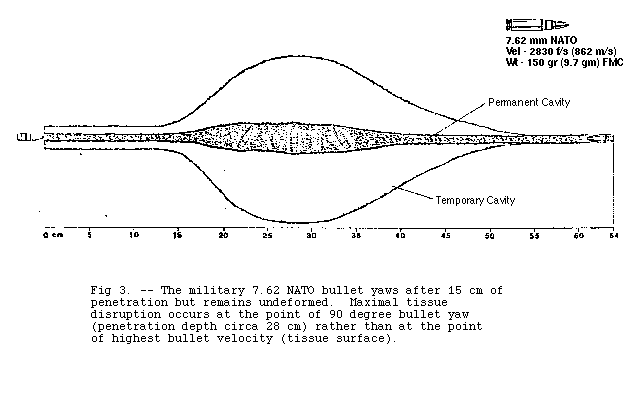
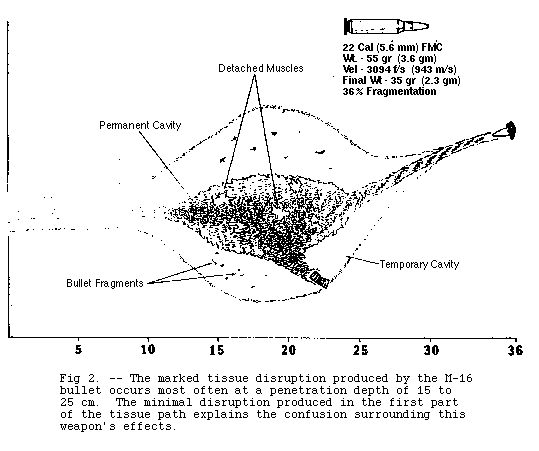
The M16's even lighter round was the result of a separate American innovation, the Small Caliber High Velocity bullet, which trades bullet size for propellant size. Even smaller bullet than the AK, but a flatter trajectory (hence the improved accuracy, helped along by the M16's interesting operating mechanism), and even lighter weight than first-generation assault rifles.
Some time ago there was some drama wrt 5.56 being too ineffective, as well as having poor ballistics at longer ranges, and there were a bunch of intermediate calibers designed such as 6.8 SPC and 6.5 Grendel. Did anything ever come out of this (or, was it always just an internet gun nut dream?), or was the 855A1 improvement enough that the headache and cost of a caliber change was discarded?
(Their use is deterred by other factors, namely ammunition availability and concealability.)
The Army is still looking at a larger caliber for their Next Generation Squad Weapon program, and that experimental round may wind up being lighter weight as well due to its polymer casing.
1) while 5.56 is lighter, when it impacts with the human body the bullet will often impart the so-called "tumbling effect" (i.e. instead of keeping its straight course it basically tumbles around inside your flesh - and may create secondary shrapnel if it hits a bone, causing a lot of damage and hydroshock). So yes, if you want to hit someone behind light cover, like a wooden door, 7.62 is more effective, but if you hit directly the resulting damage is equivalent.
2) yes, the bullets are lighter/smaller - this means your average infantryman can carry more magazines as part of his load, so you may be able to fight a bit longer than you opponent packing 7.62.
EDIT: added some words to clarify the tumbling effect.
In Mogadishu, M855 poked neat little holes, rather than tumbling or fragmenting, in Somali fighters with very little body fat.
M193, which is obsolete for military usage but still the most popular bulk round on the civilian market, almost never tumbles in gel tests as it is overstabilized by the 1:7 twist, 16" barrels predominant in civilian ARs.
I think sooner than later this whole fiasco will be in the past once the move to 6mm cartridges become a thing.
And viable automatic fire. Yeah, technically you can have a full auto M14 but 5.56mm and 7.62x29mm are really in another league compared to 7.62x51mm when it comes to controllability.
The natural extension of this is submachine guns which have even less powerful bullets, effective at even shorter ranges.
They would have had M14's in the beginning of the war, with 7.62MM rounds and 20 round magazines. The M16 was lighter, since the M14 had a wooden stock, but the 5.56MM rounds were smaller, and the initial models also had 20 round magazines.
So, I'm struggling with how the M16 would have been even a paper improvement over being "outgunned". I suspect it was more about being lighter and carrying around more rounds of the smaller lighter ammo.