Yes it is, but you aren't going to solve it without rolling back women's rights. Neighbourhoods are not communities anymore because there aren't enough adults around during the day. With both parents working 9-5, there aren't any moms around to keep an eye on the kids playing during summer break.
It was bad when we as a society told women they're not allowed to work. Now women have to work just to be able to afford a house on two incomes which previously cost only one.
As a parent now I encourage free and outdoor play whenever possible. Winter, summer - doesn't matter. They love being outside and self-organize. Sure they're young enough still to want help with setting up games from time to time, but it's crazy how much imagination and natural inquisitive nature is in them. Parents overcommit kids today. Play is work now. And work sucks as a kid. Don't do that.
But the premise that communities are gone because parents aren't around isn't founded in anything but an assumption and is wildly inaccurate in my daily life.
As a kid I never even considered an adult could contribute in any way to my free time and to the degree to which I will enjoy it. Of course they had a contribution but it was more akin to teaching an autonomous car to drive rather than you driving the car yourself. The end result is still a functioning car, but the implications of each case are vastly different.
Maybe the particulars of the situation made it possible. Small, safe town with friendlier people, fewer distractions available, more relaxed legal framework, fewer dangers out there, etc. But the implication that you need adults to build and maintain an environment in which kids can play is only valid if that's the way you lived it so it's the only way you can imagine it. It is sufficient but not necessary. There are plenty of other ways that don't involve parents to build their kids' playing universe. And having just one more possibility invalidates the premise of the original comment.
The local shopkeepers and retired would keep an eye on the local kids too. If anything we'd be more likely to be pulled up and ticked off by the old lady doing her gardening or the old fella taking the dog for a walk than the local mums. The mums were often busy with the youngest of the family, cooking, and other jobs keeping them inside. Not all had toddlers of course.
The local shopkeepers - newsagent, butcher, baker all knew our mums as they were in every week so if we pushed too far it was certain to get back home. Everyone seemed to know everyone else. A non-automated surveillance state. :)
So what did we kids do? Went and played on the demolished old factory site, along the canal, or on the disused railway station and line. No one got to keep an eye on anyone there.
The situation of women having to work is just as repressive of women's rights as not allowed. I'm sure there's a lot of women, and some men, who would stay home with the children whilst young if it were possible. The expectation now is they have to juggle both.
Now that the supermarkets mostly "won", local bakers, greengrocers and butchers etc are usually cheaper and far better stocked than any of the supermarkets yet of far higher quality. Supermarket prices just aren't competitive any more, as they mostly stopped trying, though of course they beat the open all hours corner shops. Cut price Aldi are now the fastest growing supermarket in the UK. Tesco are laughable on price and quality by comparison with Aldi or Lidl.
There's also an element of having to prefer the one stop shop of a supermarket thanks, in part, to most of us having to have both partners working to survive. I strongly suspect if more couples were still able to support a home and family on one income there'd be many more of those butchers, bakers and greengrocers around and still thriving.
Still, we are where we are, and probably stuck with it.
tho only the rare & remarkable ppl are at the leading edge of that (as is the case with anything else in society)
During my days of play we never were around businesses though we did occasionally see retired people most of our limited oversight was mother based.
For me, this was early 90s in a big European city, there were zero shops even near where we were playing outside most of the time. So sure, this was after school and being 10-14, but it wouldn't really matter (for this topic) if there was someone at home, because most days I'd be outside just after school anyway.
this mega-problem of there being insufficient spaces for play in our current society is undeniably a human crisis (tho this likely has always been the case as 'play' as a concept is relatively new in the history of ideas)
if or not there's less overall spaces for play relative to the past is unknown, and it would seem supa difficult to get data on. but if anyone has extensive evidence on the topic, i'll like to see the links
it's likely accurate that most places in 2019 has this problems (that kids dont play outside). but there are also places, including within cities, where kids do run around and play on the roads
i'd say the contingency of this affordance is based on how good of an area you live in to be able to give this privilege of play to kids, as well as everyone else in society
In other words, there were usually no parents supervising anything in my neighborhood in the 70s, yet our play culture was dramatically different from present day play culture.
The economic pressure to work to support your family is not what I would call a right, but a modern requirement (of both men and women). If anything, this is an advancement of an employers right to extract cheap labor while maintaining a moral high ground in the name of equality and phony, corporate backed, dollars-and-cents egalitarianism.
>It was bad when we as a society told women they're not allowed to work.
To be clear I agree, and, upon further inspection, so do you: :-)
>Now women have to work just to be able to afford a house on two incomes which previously cost only one.
Posting anyway because maybe there's something to be said about the choice of words ('rights' to work) here, which should perhaps be considered for rephrasing en masse (as I'm sure you're aware, but was not explicitly said).
At the same time, there were probably another half dozen kids we knew of living in and around the area whose parents refused to let them come out to play. In hindsight, they were the rising tide that seems to have taken over parenting, despite all those kids probably now being able to testify they missed the opportunity.
I think you misunderstand. Wages may have stayed the same because there are twice as many people competing for jobs, compared to times when women were socially discouraged from working.
Labor gets cheaper, i.e. people are paid less, when there are more people competing for jobs. Supply and demand just like any other market.
I thought this should be obvious, but it seems women want to be like men and suffer through the generally horribly competitive, generally meaningless, and often monotonous drab of having a “career” in some goal of chasing an ever higher number on a direct deposit every two weeks. Why? Why not have the obviously much more fun, relaxed life of being a stay at home mother and be there as your child grows into an adult and builds their own unique personality?
Haven’t there been lots of studies showing women’s self reported happiness declining in recent decades? Specifically those who pursue these cutthroat executive positions dominated by pyschopathic, aggressive men working 80 hour weeks? Why would anyone be jealous of this lifestyle?
Nobody wants to work 80 hour weeks. Women's rights is about not having your gender be a basis of disqualification for anything. If a woman wants to work the same miserable demanding job a man works, she should have every right to. Her gender should not be a disqualifier for a job.
Your argument for why wouldn't a mother want to stay at home and be with her kids could just as easily be applied to any father.
Are you a parent?
I frequently see people argue that you now have to have two incomes to have a normal middle-class lifestyle, but it doesn't square at all with my own experience. I come from a pretty conservative sub-culture, where it's much more common for a husband/father in a family to be the primary breadwinner and for the wife/mother not to work. Sure, a lot of our friends are highly-paid engineers and the like, which makes that easier. But others aren't - off the top of my head, I can name teachers (in a state known for terrible teacher pay), law enforcement officers, city maintenance workers, etc. All of these people are figuring out how to live a fairly normal middle-class lifestyle on one income.
How is that possible? We make other choices that support the goal of a single-income family. Most of us shop at Aldi, not Whole Foods. Nobody drives new cars (our nicer car is a 2005, for example). We do a lot of home maintenance ourselves. We share clothes, toys, and kids' supplies with each other, or get them on consignment. You get the idea. (Oh, and we also don't have to pay higher-tax-bracket taxes on the second income, high property taxes on big homes and new cars, or pay for daycare when we're at work.)
There's of course nothing wrong with women working or with nice cars or shopping at Whole Foods, and I respect the fact that different people choose to handle these issues differently. But don't be deceived - it's still possible for most middle-class Americans to live on one income, as long as they're willing to choose to make the sacrifices in other areas that facilitate that lifestyle.
(I won't claim to be able to speak to how this goes for poorer classes.)
Massively increasing the supply of housing so a parent regardless of gender could stay at home and still afford a house would also fix the problem.
A universal basic income would also fix the issue of both parents needing to work to afford a house.
We could also consider parenting a job and pay parents a living wage to stay at home and raise their kids.
The fact you immediately suggested the only solution to this problem would be to limit women's right to work is a bit sad. There are plenty of good solutions that would work well and don't need to restrict or rollback the progress we've made towards equality. At the very least you could have suggested limiting families to one working parent rather than specifically women.
If you plan on spending you're remote working hours supervising children, your not really working. Working at night will not allow more time to supervise children during the day.
I'm not convinced the OP was suggesting that limiting women's rights was a solution, merely that increased female labor participation will result in less time spent with children.
> There are plenty of good solutions that would work well
I'm not sure there are many.
> progress we've made towards equality
We've made progress in some areas, and regressed in others.
This is an issue about the amount of available time. Focusing more time in work will divert time from other activities. There is no other way of looking at it.
edit:spelling
Remote working means you don't waste time commuting, you can be available during breaks because you're already at home, and you can step away from your keyboard and be there immediately in an emergency. All those things are huge benefits over office work if you have kids.
Changing core hours doesn't mean working nights. It means things like starting at 6am and finishing at 2pm, so you're available to look after your kids in after school hours, or starting at 10am so you have time to take your kids to kindergarten. Or, as you say, working at night so you can be there all day (if you're one of these lucky people who don't need much sleep.)
There are solutions to this problem.
We live in 2019 -- who says it's the women that need to stay at home? I'd happily swap with my wife and stay home while she was working, but I seriously doubt she'd let me. :D
Other than that, you're right. We need people working less (on average), and we need to start building actual communities instead of online social networks.
You know you can also have men keeping an eye on children while their spouse (of any gender) work.
The other issue is that most people don't even know their direct neighbors or spend any significant time together. That is definitely their choice but that is what is required to turn a group of houses into a neighborhood. This is much harder in the suburbs than in the cities where there are already known collecting spots like stores, parks, playgrounds and courts. In the suburbs, most people get home after dark from work and kids activities and then it is off to bed for the kids and Netflix for the parents. We all need to slow the hell down.
The important thing seems to be a balance between the structured activity in the group (I have seen peers that had so many activities, but little connection with the kids they were around, because there is little time to interact in i.e. gymnastic class) and just messing around :)
Reducing required household market labor for basic living, perhaps. But, even to the extent that is true, just because in the past that was done by constraining women's choices doesn't mean that it can only be done with gendered constraints.
May I rephrase this: "without strengthening parental and co-parental rights" (this includes grandparents and the extended family).
Framing it as "rolling back" plays into the feminists' hands. Yes, your rolling back, but you're rolling back what's effectively a regression.
Is that actually true, beyond this anecdote? FWIW, my own suburban neighborhood (a cluster of about 60 townhomes) has enough kids that there's usually a small basketball game going on in the parking lot. And often bikes left scattered around (until dinner time, when the kids pick them up and go home).
In my experience as a parent (my son moved out last year), there were always kids around, but they were scheduled down to the minute in sports, STEM enrichment activities, scouts, or church. And those kids from families that didn't have that kind of budget were glued to TV screens or computer monitors.
We tried to give our son free time to play, but there was nobody around to play with. The kids were there, just not available.
Now that we've moved to a smaller house, with THs instead of SFHs, it appears to be slightly better. More play in the parking lot. But, the kids still seem pretty tightly scheduled (almost all are in sports leagues year-round).
Anecdotally I've lived in a few different places, and it seems to vary a lot, even by neighborhood. In Utah there are tons of kids around. In Alaska there were neighborhoods here and there with lots of kids, and many others with practically no kids. I would guess that perception of kids varies a lot based on which neighborhood you move to, but yes overall it is declining.
More kids are in neighborhoods with... more kids!
TH = townhouse
SFH = single family home
... I think
And for the Brits, that would be detached (=SFH) and terraced (=TH).
Though in the US, we have lots of newer terraced/town-homes than I think you have across the pond (where they tend to be older homes in industrial cities). And we don't really do semi-detached (duplex in the US).
I don't think this is the issue. It's much more a cultural thing, statistically richer countries have lower birthrates. But getting married and having kids is no longer accepted as "just what you do". Less people are getting married, that also may play a role.
I'd also imagine it's different in different areas. Might even map to incomes, or political leanings of different zip codes.
a. The opportunity cost of having children is higher in rich countries. (E.g. If you are richer, you can say travel more.. but can't easily if you have kids! Also the income hit from having children is also much higher in rich countries)
b. Rich countries generally have higher social expectations for parental involvement. Kids cost more in rich countries because parents actually do more.
Clearly, there is something more important to you.
I simply said it is clear that you have determined that other things in your life are of greater priority for you.
I'm not sure what you mean by "stupidest". It isn't wrong. For me it is a trivially obvious observation, and thus kind of lame, but I'm a disinterested observer. Making the correct observation would be more difficult if I were deeply invested in the situation.
FYI, my 11 kids are supported on a single income, and I'm just an experienced software hacker. I don't even manage people or work overtime. Granted, I don't get to live anywhere near my childhood home of the Bay Area, but such is life. Just as you have done, I made choices according to my priorities, but my priorities are different.
When you spend ten years telling people all the ways kids will ruin their lives, it doesn't really seem surprising that they'd be hesitant to have kids...
But of all its problems, what's the problem with kids having to ride 1+ miles to their friends?
When I was about 10-11, I was riding 2kms by myself (and then with my younger sister) in the Australian summer holidays down to a tennis camp. Sometimes it ran late and the sun went down, so my parents would come and pick us up in their car...just kidding, they bought me a generator to put on my bike and a reflector and I rode home in the dark.
When we moved again, I had a regular neighbourhood friend and we'd go and play networked computer games and nintendo during school holidays and after school during my teenage years (having two pc's you could network was quite advanced for the 1990's). But putting this into google, his place was 1.4 kms away from my house.
There was a video store 5 to 6 kms by car that had some rental games and videos, but of course we couldn't drive. But it must of been 4-5 kms by taking a shortcut through a nature reserve with our mountain bikes. And that's what we did. After a year or two, another store opened up a few kms in the other direction and we went there as well.
Even back then, video games were a huge part of my life...we were nerds in the absolute sense, but so were the mountain bikes and the exploring. Maybe we were lucky backing on to some nature reserves, but even in the staid morass of suburbia, are there too many places with nothing in a 10km radius? And even if the answer is yes, even that I'm a bit skeptical of. The nature reserve attracted us because it was a place without adults and it was a little bit dangerous, not because it was set up with activities or playgrounds.
In my mind, the distance wasn't a barrier to playtime. The fact that our parents would let us out to explore, and we subsequently went within about a 10km radius of our homes unsupervised on our bikes and without cell phones WAS the playtime.
The changing variable isn't the distances: its the supervisory culture and the fact that everything is now streamed conveniently into our homes on demand, and the fact that many of these products are now specifically engineered to try to turn people into screen viewing zombies.
Lastly, low density likely means that the one kid available close enough is not good friend match.
Raise a kid on acreage without electronics and internet and suddenly lo and behold, almost all of them will spontaneously go out and start exploring, and if they're all doing this they'll find and latch on to the other kids. And there's parks and playgrounds and church and sports and libraries and other places kids and families from wide areas tend to congregate.
And with all due respect: what is this idea of 'not a good friend match'? They're kids: they eat, sleep and play games. They're not professors or lawyers with 25 years of specialisation and gobbledygook talking past each other with their heads up their own arses about how important they are: unless they're violent and/or their family is dysfunctional, they're a good friend match. Isn't one of the first skills to teach a child the ability to negotiate, mediate, get along with others, irrespective of superficial differences or interests?
Raise children in an environment with on demand streaming, and multiple televisions in their homes and all their neighbour's homes, and hit them with games specifically based around quick dopamine boosts and vying for maximising engagement and attention spans, and with a parenting culture that says they have to be supervised and scheduled, and lo and behold, they act just like conditioned rats in psyche 101 experiments do.
And what is 'low-density'? Again, in my childhood, I moved INTO suburbia from a relatively less dense location. And I haven't even gotten started on the 'horrors' that happened where I lived when I was under 10. I'm in no way religious today (and back then, for context, it was the uniting church, which is barely religious by american standards), but we walked a few hundred metres to a neighbourhood house where an old couple lived and had church services and kids groups for the neighbourhood children: imagine the preposterous concept of 'not a good friend match' when you've got 10-20 kids in a several km radius. I had one friend a few hundred metres down the road. And I don't mean like 'one acceptable friend': i mean, there was a kid several hundred metres down the road. We just walked to each other's houses.
When the community got enough money together to build a church and community space out of cinder blocks, well then we walked a km down the road and back again.
To blame the things like 'kids don't like biking in all directions' or 'distance in suburbia' or 'not good friend match' as the causes or barriers to quality youth playtime? NO! Absolutely not! If anything, the very things that are being labelled as barriers are are the very ESSENCE of quality youth playtime and we wonder where its gone.
Quality youth playtime is BORN of isolation, independence, lack of supervision, self-direction, imagination, boredom, and danger.
The CAUSE of its decrease is not these things. Its not even necessarily technology: we still had TV and computers back in my day, but when you and everyone else have to wait a week between episodes of your favourite show (don't know what it was like in the US, there was no cable in my country), and you have to cycle 4-5kms over hilly terrain to get a book or a video or a game for a week and then return it, you did so (back in the day, our kids network also pirated pc games between us all, but that's another story).
Its universal supervision, scheduling, protection, anxiety, short-term rewards, emphasis on private vs public space, exclusion of children from public space, on-demand universal supply of media and entertainment, absolute abundance of convenience and the attention economy that's driving it.
The rest are just excuses to stop us having to deal with the actual issues. I'm no friend of suburbia, but suburbia itself does not negate quality youth playtime. And the idea that these things are the barriers or causes is somewhat comical to people who actually grow up with significantly greater levels of those things as actual barriers...and still have quality youth playtime.
Even without electronics, beyond age of 6, nearby areas are explores quick and indoor activities are more fun then biking alone again through area you know pretty well. I knew few kids who liked that, but they were very much minority - and they were the kind of kids that don't seek novelty and aresponsibility fine with doing the same thing same way every day. Even without electronics, over age of 6-7, indoor has more options, more interesting options and is more fun unless there is company outside. Hence kids not rushing outside if a chance of meeting someone is low.
Not a good friend is a kid you don't like to play with. It is simply not true that all kids like to play with all kids nor that all they do is games and games are the same. It does not have to be something bad like bullying or being little assholes - through it can be. It can be something as simple as one kid doing mostly focused plays and the other widely running around. With many kids they will sort themselves to groups, with few they just end up doing own thing and not having interest in each other.
How does school work in areas where there's only one kid? And how can that one kid ever learn to properly socialize when it supposedly never ever interact with other kids?
I mean sure, there's probably a situation like that out there with some home-schooled kids, but when I was a kid I also didn't hang out with dozens of kids, I had like 1-2 best friends with whom I'd hang out and that was already plenty enough.
I don't know much about home schooled kids, but afaik that is separate issue. They often live in communities with other home schooling families, it is often religious and thus implies many many siblings etc.
It's interesting how this happens, because there's definitely neighborhoods with a lot of kids about the same age. I can only assume it's the ways the markets function.
My neighborhood was full of kids growing up-- it was a brand-new housing development built to be compact and affordable that seemed to attract a lot of relatively young professionals who had recently started families and were in need of a cheap housing alternative.
In my town a lot of the more expensive housing might be snatched by kid-less couples, retired immigrants (I'm from Mexico, a lot of American immigrants move there to retire), etc.
Established neighborhoods will eventually see the older tenants move out (or, grimly enough, die off) but it happens in such a random fashion you never really see just a single influx of young families into the neighborhood, like you do with a brand-new development.
That doesn't necessarily mean much. Moving from urban areas to suburban ones already greatly reduces density and access to services and the sort of institutions we are talking about.
To give some sense of proportion, the average American suburb has[1] a density of about 2.7k people per square mile. That's about 2 1/2 times less dense than a Western European suburb (6.2k), and about eight times less dense than a Western European core urban area (18.8k).
American suburbia is extremely sparsely populated and fundamentally unfit to provide the cultural institutions that modern, small families and communities require. Calls for larger families is simply unrealistic, because the opportunities that each kid in a large family on a single income in a developed knowledge economy gets are abysmal. In our modern world, quality trumps quantity so to speak.
Of my cousins (about 12 people), only half are married at 35-40, and three couples have kids. That’s not uncommon.
At some point, acquisitions and trips became more important than family. Personally, I think that it is really sad.
Ahh... the Internet delivers:
https://en.wikipedia.org/wiki/List_of_U.S._states_and_territ...
... also:
https://3.bp.blogspot.com/-vWDFXMF6R7Y/Wp4PBC3EpyI/AAAAAAAAF...
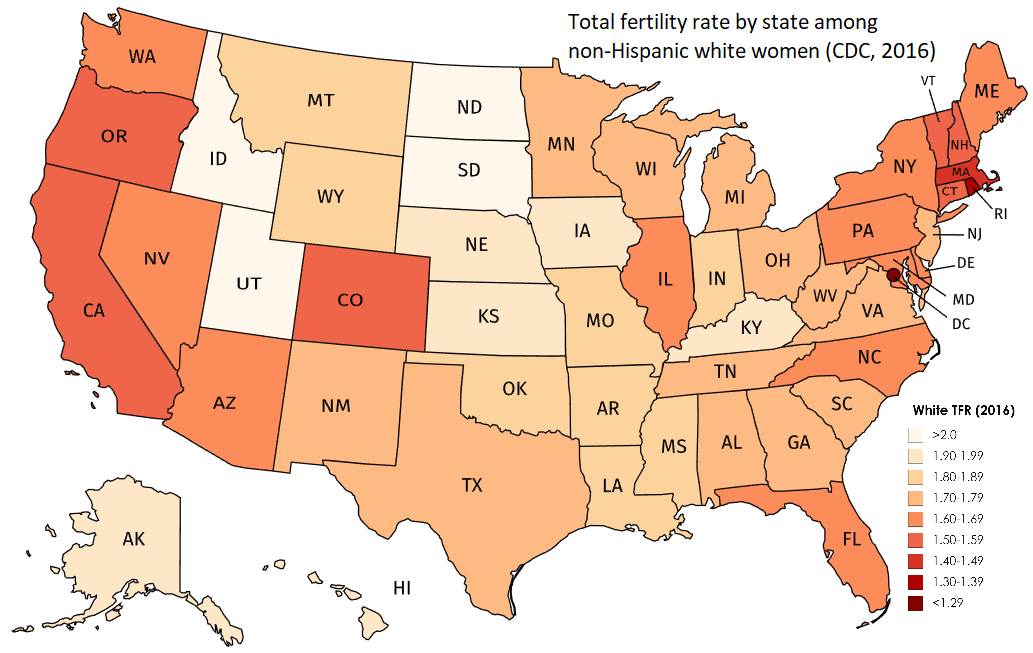
That's just your opinion. Thriving suburbs are practically sustained in toto by middle class (broadly speaking) people in nearby cities who want a greener, safer, larger space with better schools (at least by their perception) for their children on their given level of income.
Perhaps your source is per square kilometer? That seems really low for a suburb. E.g. Bay area cities (not particularly denser) are around 3k people per square kilometer.
And of course there are disadvantages: * Commute time. It takes me 28 minutes to get to work in the morning, so I lose almost an hour per day to travel, but this is relatively ok compared to other cities. * Fewer public transportation options - must transfer from the train to a bus to get to my remote corner of the metro area. These days it's easier to take Uber to the nearest train station when my car is not available. * Fewer night life options within walking distance of home * Fewer dining options within walking distance of home * Businesses have difficulty hiring, with so few people looking for work who are not already employed. * Not near a coast
All of this is to say, if growing a family in a neighborhood with other families with children is a priority, there are absolutely affordable cities around the US where you can make this happen. Even on a single income. Even in low population density areas. Even without giving up access to a nearby metro area and all of the culture and services it has to offer. If you are not willing to move to any of those places, maybe there is something more important to you, as has already been said.
I often wonder how much of my solitary/introverted personality is the result of my environment.
I should mention that I am trying to sum up as best as I can but I don't want to give the impression that I am resentful against my parents. They did what they thought was best.
I was raised in the countryside. My parents were able to have me avoid going to the nearest school (IIRC one the main teacher was alcoholic) and make me go to one slightly farther (30 minutes by foot).
My mom was a stay at home mom, driving me to school and picking me up for lunch.. I believe it lasted until the end of high school ?
So no kids my age near our house, going anywhere was virtually impossible with pretty dangerous roads all around the house and an overprotective mom, not a lot of time spent socializing at school either.
I do have one sister, but she is a compulsive liar and thief. I am not sure what the medical term would be for her condition would be, if any. I have even caught her lying even about stuff that made no sense to lie about since it was completely uninteresting and did not give her anything to lie about it .. She has also has the need to make everything about herself (except taking responsibility for literally anything). So we are not close at all, and she is one of the reasons why I went far from home as soon as I could.
Oh, I also did not have regular access to a TV while growing up. If I remember correctly I could watch it during the weekends ? I never had one in my room, or a computer for that matter. We did have one family computer I ended up spending a lot of time on. Not on programming though, I only started learning that in my early 20s.
I do remember being extremely bored at school .. I learned my 2 first languages in a large by myself, by reading books. So I don't have a good grasp of tenses. My accent is also pretty terrible in languages I have learned by reading.
I don't think I am near 'genius level' intellect (whatever that means) by any mean, but I could have surely used a different learning structure.. I mostly remember reading tons of books, both at home and at school and half assing everything until after high school.
Soo, as an adult, I believe I am reasonably well adjusted ? I can be emotionally distant though. Something my girlfriends have often had issues with. Not in a toxic masculinity way of 'men don't cry', but more that it is often pretty hard to know what is on my mind. I can easily spend lots of time alone too.. I need to make a conscious effort in order to involve myself in group activities and making new friends can be very hard (especially now that I have moved from Europe to San Francisco).
How I am as an adult is an extension of how I was as a kid. It is very hard to distinguish nature and nurture. I do make lots of efforts to correct course on the parts of my personality that I don't know and I think I am becoming less and less socially awkward as time goes on .. It is hard to self evaluate yourself on this though.
Moreover, I can only assume that it was through me that my brother got introduced to the "social scene" of the neighborhood. I was the older one, so when we came out to play, I was in charge of him, and that meant always inviting him to play and introducing him to all my friends.
Siblings are like friends you have no option but having (and playing with). Incredibly reliable, in that sense (:
I care so little about League of Legends I've never played a match outside the ones we play together, but I always prioritize any planned League time over any other leisure activity (:
What changed to make them boring? Couldn't it rather be that neighborhoods are now considered boring due to highly interactive electronic entertainment being available, as an alternative, pretty much everywhere, at any time?
Mind you: I'm not saying these things are equal, but by now electronic entertainment has been designed to be as appealing as possible, in contrast to that, the alternative of going outside to look for stimuli, has become quite unappealing and bothersome to many.
Why go out in the world, to get sensual and intellectual stimulation, when you can just click away on the Internet or in Fortnite to get your "fix"? Particularly with the news cycles constantly bombarding everybody with FUD these days, making parents less likely to give their children unsupervised "outside time" even if the kids actually want to go outside.
In a nutshell, I contend that this is a social problem of neighborhood culture, and parents should work to make their neighborhoods as fun and inviting as video games and the Internet. Simply cutting off electronics and shoving them out the door won't do it because there's no one out there - neighborhoods are very boring. Somehow, we need to create a culture of play, first with parents, and later without, in our neighborhoods. The book Playborhood is all about that.