It really isn't, though, in practice. All these products have packaging that is designed to make them immediately recognizable as plant-based products. They want, first and foremost, to be attractive to their core market: Vegetarians. They may make other overtures in an effort to attract people who do eat meat, but those invariably involve trying to sell their being plant-based as a thing that makes them a healthier product. Even the Beyond Meat brand, which is the one that skirts the closest to being deceptive here, by virtue of their name, still has "PLANT-BASED XXXX" written front, center, and in large contrasting color letters on the packaging of their products.
Banning words like "beef" and "meat" from the packaging sounds like something that would actually engender confusion among consumers, by effectively banning phrases like "meat free" from the packaging.
This whole effort reads to me as a rather blatant example of rent seeking behavior on the part of an incumbent industry in response to new entrants to the market.
This. For all the shit that people give Silicon Valley, Beyond Meat and Impossible Foods are both going to have a huge positive impact on the world. Already they're as good or better than all but the very best meat-based burgers.
Britannica link (it seems to be more comprehensive than Wikipedia): https://www.britannica.com/story/a-brief-history-of-food-lib...
Do they though? I mean here look at this [1]. It totally supports your point, "Plant-Based" is front and center in big green letters.
But what about this product? [2]
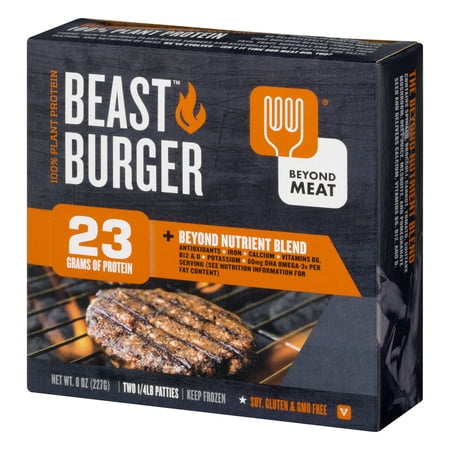
And what about this one? [3]
And this one? It says Real Meat right at the top. [4]
And these are going in the meat aisle? Right next to real, actual meat? This is blatant false advertising and consumers are going to be tricked by these products.
>Banning words like "beef" and "meat" from the packaging sounds like something that would actually engender confusion among consumers, by effectively banning phrases like "meat free" from the packaging.
Oh come on, get real. This wouldn't be a problem if "PLANT-BASED" actually was front and center on all of these products.
>This whole effort reads to me as a rather blatant example of rent seeking behavior on the part of an incumbent industry in response to new entrants to the market.
Well you're welcome to read whatever you want into it. I'd really like to see you defend those beef crumbles though. What if those chicken strips are right next to actual chicken strips? You don't think some consumer fresh off work or wrangling a kid or what have you is going to grab them thinking they're actual meat products? Of course they are.
[1] https://www.amazon.com/Beyond-Meat-Burger-0-5/dp/B074YGZ77H
[2] https://www.walmart.com/ip/Beyond-Meat-Beyond-Beef-Crumbles-...
[3] https://www.walmart.com/ip/Beyond-Meat-Beast-Burger/13728403...
[4] https://www.walmart.com/ip/Beyond-Meat-Chicken-Grilled-Strip...
That said, I'd still say those are cases that are much better handled by lodging a false advertising complaint with the FTC. Dealing with that one company using the existing legal and regulatory channels is fine, and they're well-known enough that it would probably put anyone else who's thinking of doing similar on notice.
Dealing with that by using them as an excuse to engage in crony capitalism in order to pass an over-expansive law that is clearly designed to distort the market is not OK. Crony capitalism in general is not OK.
[1] https://i5.walmartimages.com/asr/59e9d405-24bb-431a-b98b-98d...
[2] https://images.wsj.net/im-13668?width=1260&aspect_ratio=1.5
Ahh so this will clear up the contents of what is in hotdog(and other processed meats) and allow me to not be bamboozled into eating fake meat.
This is a non problem being trumped up by an industry that wants to use regulatory capture to make its competitors products less attractive and visible.
Where do you draw the line for what deceptive labeling is allowed and what isn't? How many of the other existing food labeling regulations should we throw out?
What if I label my package to look _very_ similar to a meat product, but put the words "not real meat" in size 8 font on the bottom of the package, is that acceptable?
Then I think you'd have a complaint under existing laws, rather than trying to make a mountain out of a mole-hill. The same would be true in reverse, if a product claimed prominently to be tofu based but contained meat.
I think it's very, very telling that part of the desired result for the meat industry is to prevent these products from sharing shelf space.
I think that's fair. We already have a healthy set of regulatory requirements around product labeling, and I'm not really opposed to tweaking the labeling requirements around meat vs non-meat products. Regulating shelf-space does seem to be crossing an unnecessary line.
I'm not saying you're making that up, but I would definitely like to see some proof.
Do you even know how milk is collected?
I buy specific things. I want to buy chicken. I want to know the chicken was raised in a humane way, as far away from cages and their most recent defection event as possible. I'd like to buy chicken raised on a omnivorous diet of pecking whatever seeds and animals they find on the ground, but I'll take vegetarian raised chicken too. I usually buy as much of the chicken as possible minus the feet, heads, and feathers.
Reducing the burden I have to go through to buy meat will increase the amount of meat I buy. Forbidding the labeling of meat substitutes as meat will not increase the amount of meat I buy or decrease the burden of researching and choosing that meat, but it will still offer me with lots of meat-substitutes with heavily regulated labeling that allows me to decrease the burden of researching and choosing my proteins.
And if something can be labeled GMO or non-GMO, why can't it be labeled lab-created or bio-engineered or the like? It might be molecularly the same, but what's the harm in letting folks know?
Gatorade is mostly water, and salt.
If I sold you a bottle of urine, and labeled it as Gatorade, would you be OK with that? What if I put "natural flavoring" (what could be more natural than this!)?
My biggest gripe with this whole soy/wheat meat is the price. It is literally more expensive then using a chicken to turn the wheat and soy into meat. How is that even possible? Obviously it just milks the vegetarians for what they are worth. Otherwise it would be a great substitute for chicken nuggets style meat products. They have no texture or natural flavor anyways
I understand their gripe with plant products, that sounds like deceptive advertising. But the lab-grown stuff is still meat. I think they're trying to take a yard here.
>High-tech upstarts say the proposed labeling rules are a poor defense, pointing out that on a molecular level, plant-based meat products can contain the same amino acids, fats and minerals as animal flesh.
>“People don’t get angry when you call your cellphone a phone,” said Ethan Brown, chief executive of Beyond Meat.
Yes but if I try to buy a "computer" and you give me a phone, it's not a defense to tell me that it still has RAM and hard storage and a screen, etc. Veggies and tofu rolled into a patty may be a "burger" but it's not "meat" or "beef."
>Jaime Athos, chief executive of the Tofurky Co., which sells imitation tofu-based roasts and patties, objects to any ban on the word “meat” in labels. Consumers hear tofu, he said, and “expect it to be bland or not meat-like.”
Jaime, this is your advertising challenge. You don't just pretend your product is something else.