Real world economics is infinitely more complex than the handful of rules in a game.
In reality you generally don't want to have 40 years of suck to get to some long term gain, because you need to live those 40 years.
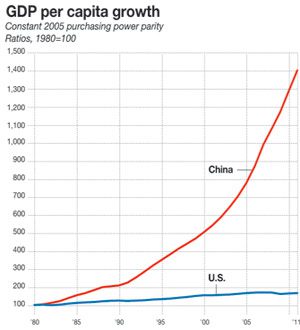
USA in 1980 was already a developed nation with a high relative standard of living. It could only grow GDP by inventing new technology and process not simply import proven tech.
China's continued failures are massive and ongoing. Some numbers look ok relative to their past failures but that's about it.
http://humantransit.org/2013/05/how-sim-city-greenwashes-par...
I don't think that's really true. I don't think any game company or designer cares about forcing a pet economic theory to work.
More that game economies have a purpose and can be explicitly modelled to achieve that purpose, even if that means doing unrealistic things (such as conjure up resources out of nowhere). That's not too say that they can't be an effective test model for real world scenarios, if you bear those conceits in mind.
If an economy makes players have a bad time, they can jump ship in a way that they can't do in the real world. There is a financial incentive for game designers to build an economy that makes players satisfied. Strictly modelling a game on real life economic policies is usually not a good way to achieve this. Vast resource inequality between players is a good way to kill a multiplayer game, for example - unless you even the divide in some way, only those at the very top want to keep playing.
As an adjacent example, City Skylines is a pretty fun city builder. A huge simulation, down to very complex traffic models. You can build sprawling cities with a bunch of highways.
But it's extremely hard to build anything that replicates old European cities, or denser cities like in Asia, because your smallest useful road is very big in relation to the buildings. The tools given to you basically point you directly to American-style zoning that leads to suburban sprawl and huge highway systems.
In a sense, that's the point of the game (to make you fight traffic), but it's difficult if you are trying to build a certain kind of city that we know exist and are, in fact, "better cities".
The simulation presents a certain worldview of how cities are built.
For example, mixing commercial and residential buildings - will it work or not?
https://www.cbsnews.com/news/the-scandalous-history-of-monop...
Some weeks ago a co-worker told me something similar to what you share, how he learned about resources while playing SimCity. He also said his younger sister asked him "If people doesn't have money, why doesn't the government print money and gives it to people?". He said that playing SimCity would have prevented his sister from asking such a naive question.
I also would love so see the results of research about these games on kids. Maybe someday kids will play Sim City and AoE at elementary school or similar games designed for schools.
This is a pretty bold claim and not one that should be stated as fact.
Now if only i could figure out a way to get more people to live in my SIM tower!
Give everyone a million bucks and you'd have a booming economy.
It probably depends on whether your economy is limited by consumer demand or by insufficient investments. For most developed nations it is clearly limited by consumer demand. Giving rich people more money aka 'trickle down' won't get the rich people to invest, because there is no demand (normal people already spend more than 100% of their income)
In this situation giving away money helicopter style makes sense.
Because people are not systemically important financial institutions :)
Whatever the reason, the empirical observation in these days of low inflation seems to be that most governments aren't even close to the true limit of spending.
Couple of questions:
- Does this mean that there’s a case for QE to be made permanent under a low-inflation environment?
- Under this model, govermnents would be directly responsible for the allocation of the newly created money. How can this not lead to a depressed economic output over time?
- Where can I read more about this?
Depressing economic output: Absent inflation, economic output is proportional to overall spending, so a policy like this can't depress economic output almost by definition.
However, I'd say there is a risk of directing that output towards useless things, plus there's the risk of favouritism that leads to hidden inflation via inefficiency (see also: military industrial complex). So it matters where the money is spent.
Personally, I'd like to try something like a "citizen's dividend": just hand out money to all citizens equally each month (or permanent residents, you can argue the details), no questions asked and no strings attached, but vary the amount based on current inflation. That is, increase the dividend when inflation is low, scale it back when inflation rises above some target.
So kind of like a UBI, but with a macroeconomic motivation rather than trying to replace the welfare system. It also appeals to me because it's a sort of direct democratic approach to macroeconomic management: people can literally vote with their wallet about how the money is spent.
Where to read more: modern monetary theory is a good keyword to start with. I found Randall Wray's book very interesting. Warren Mosler's "7 deadly innocent frauds" is less academic, but it's available online and interesting since it comes from a practitioner instead of a theoretician. Though I admit it's been many years since I read either.
1) The government sprays more money around in welfare and salaries than they raise through taxes
2) The government issues bonds
3) The central bank prints money to buy those bonds
It's equivalent to the central bank printing money to pay for welfare programs and salaries (which go to common people in the streets)
It's easy trot out the "but the bureaucracy!" argument.
Helicopter money is in-your-face money creation which brings out the gold bugs and inflation hyperventilators. QE as practiced is in comparison too mysterious for people to latch on to effectively.
Helicopter money was never really championed by anybody in the first place, so nobody really had to argue against it.
It's really unfortunate that a perfectly reasonable policy never got a fair chance. I do think it has a lot to do with ideological bias especially among central bankers, and with the fact that a lot of people on the left, who should naturally be in favour of such a policy, are too averse to studying economics and finance thoroughly enough to participate effectively in such discussions.
All of my 401k is in money market mutual funds.
I'm not sure that a straight up games-to-financial-decision type study would be useful, there are many different motivations between playing games or even gambling, and financial decisions.
Or, more bluntly: There’s nothing like being acutely aware how easily you can lose your stack on a bad gamble to make you invest your savings wisely. :)
Aside from being influenced by government advertising (“This airport in a no-man’s land is going to develop the no-man’s land into a city!”), it also influenced my entrepreneur life: Why see small when you can invest all you have and get increasingly more return? Why spend time debugging when I could have this other big feature on the marketing material? And that’s why I never went past a few hours in Simcity, and why my cousin, a less entreprising person, would succeed more! Ha!
What a cautionary tale.
I later found out all games have a specific pattern you follow to win, many of these patterns are available in online communities/guides/cheat sections where I'd spend tons of time to read, try and experiment. Those were probably the peak happiness and best time I've enjoyed as a little nerdy kid. I never thought too much a big deal of these experiences but nonetheless I believe definitely contributed to a base reality of how resource management work, and how I manage my personal projects, finance, and career choices as I grew up.
I'd be super curious to see research / longitudinal study coming up from the past 2-3 decades of gaming on kids, and see if conservative gaming styles leads to conservative financial decisions etc etc.
I'm not a father yet but I thought it would be a really cool idea to understand my kid through game play like this, but I also don't want the kids to be limited by my personal value though these interactions - sort of like the "observer and supporter" role the author played.
Sidenote: I'm still playing the latest Civ6 and still enjoy a lot from the dynamics in the economy managements with A.I..