The reason that negative power prices look like they would be good for consumers is that it seems like they should lower their monthly bills. But in practice their bill should stay the same, even if there were significant periods during which energy prices were negative. Why? The negative prices don't indicate that the cost of power production is negative for the power company, so the power company is losing money. The power company has to recoup those losses somehow, and they do it by charging more when power prices are positive.
In order to take advantage of negative power prices, a power consumer would have to dynamically increase their power consumption in response to the negative prices. If they have any significant power storage capacity, maybe they could store power and sell it back to the grid when prices go positive, or maybe turn on their mining rig while prices are negative, if they go negative frequently.
The high retail price appears to be driven by the mechanisms driving the Energiewende ie transition to wind and solar.
https://www.cleanenergywire.org/factsheets/what-german-house...
https://www.ovoenergy.com/guides/energy-guides/average-elect...
It mentions high cost of electricity, and that it's due to fees and "renewable investment costs" but then immediately hand-waves that away because "household energy bills have been rising over all anyway."
When combined with your information above (those hand-wavy fees actually account for fully 50% of the costs, with 24% being the renewables surcharge) it would seem that the NYT is being misleading. It seems they want to convey the idea that the renewables are an immediate good thing for everyone (which I do not take issue with politically) while downplaying the significant costs to consumers. Am I missing something?
If I'm not, then this does nothing but contribute to the current view of American media as being intentionally misleading when it suits their interests.
The price for electricity is indeed very high in Germany, rising to new heights with the new year, again.
The problem is, unsurprisingly, regulation and policy, i.e. the fees you already mentioned, and the subsidies for industrial usage, etc.
So, yes, it actually seems that the NYT is misleading here.
Let's leave this as an exercise for the reader, to judge if anyone should really be surprised here.
I always think of this old "Trust, but verify" quibble, and that it is actually based on an old Russian proverb. The irony.. :)
It's not only very high, but the second highest in the world, and we are about to take over the first spot [1]
> The problem is, unsurprisingly, regulation and policy, i.e. the fees you already mentioned, and the subsidies for industrial usage, etc.
The problem are the subsidies for all the green energy. It's not only the direct costs but also the costs for grid interventions (turning on/off capacity), paying for renewables even if they are not producing because there is too much energy available, the huge requirements for new energy lanes from north to south, getting rid of nuclear power etc.
Subsidies for industrial usage is often quoted as increasing the costs by interested parties, but it's also a direct need of the Energiewende, because the economic damage would be gigantic. Unless you want to get the energy intensive factories out of your country, you have to factor in those costs.
> So, yes, it actually seems that the NYT is misleading here.
Yes, as does most media - especially in Germany. Those negative prices are no win for any german. Why else is it, that we will soon pay the highest prices for electricity in the world?
[1] http://www.sueddeutsche.de/wirtschaft/energiekosten-in-oecd-...
> Yes, as does most media - especially in Germany. Those negative prices are no win for any german. Why else is it, that we will soon pay the highest prices for electricity in the world?
AFAIU, it's because you're aggressively shaping the energy market in order to reduce health and environmental costs now.
The technical issue here is that batteries are not good enough yet; and [hemp] supercapacitors are not yet at the volume needed to lower the costs. So, maintaining a high price for energy keeps the market competitive for renewables which have positive negative externalities.
This has lots of positive market based effects e.g. people can invest in energy efficiency and be rewarded in terms of monetary savings.
Unfortunately, most of these claims are either completely false, or come with huge caveats. The reality is that with upfront costs included, most renewable energy today is significantly more expensive to produce than traditional forms of energy. No amount of clever journalism will change that.
As I understand it, the real problem is two-fold. Firstly, wind isn't reliable, and if you have too much wind power feeding into your electrical grid but don't have enough storage, the entire grid becomes unreliable. Secondly, wind turbines cost about the same whether they're producing power or not, meaning that they're always feeding power into the grid if the market price is above zero. This takes money away from more reliable power sources - coal, gas, hydro, storage - and can drive them out of business.
That's a more complicated problem than "NYT is a left-wing conspiracy", and it's harder to solve.
That's not quite the accusation and while you will likely disagree with the observation, I'd hope for a more fair representation of it.
For those of us across the political aisle (so to speak), the issue with the NYT is that they slant away from conclusions or present a muddled set of facts to discourage reaching a clear conclusion when it would contradict what would be a commonly accepted truth on the left. Or to frame it differently, when there is a narrative violation, the conclusion becomes whispered or is turned upside down. But when there is no narrative violation, then all is clear.
Just as one (justifiably!) rolls one's eyes at a certain network's claim of "Fair and balanced", some of us also roll our eyes at the old grey lady and her "newspaper of record" aura. Not as often, but it is a problem for the NYT too.
This seems like something a futures market should be able to cover?
Ie there are consumers that need reliable power, and there are reliable power sources. They should be able to come to an agreement, despite cheap but unreliable spot sources in the market?
The trouble is that you can’t just plug a “reliable power plant” in or off the grid. It takes hours (that’s “quick” here) or days to power on/off.
You need batteries to cope (e.g. hydro power plants) and there’s not enough of them now.
A quick Google search for 'electricity futures' reveals quite a few hits. So this is already a thing.
Please cite your credible source saying that wind energy is currently profitable in practice without subsidies in more than a tiny fraction of areas on earth.
Wind energy is not viable everywhere, but in places with no NIMBY concerns, lots of rural land, and lots of wind, wind energy is perfect. Much of the US plains (especially the closer you get to the Rockies) fits this category for instance. Iowa, not exactly a mecca of environmentalism, is 35% powered by wind now; this is estimated to rise to 40% by 2020. (https://en.wikipedia.org/wiki/Wind_power_in_Iowa)
A quick google for "unsubsidized wind power profitability" turned up a bunch of interesting things, though I didn't delve too deeply into any of them.
Am I (along with the rest of the world, who would be dancing in the streets, dedicating trillions of dollars to deploying wind towers in every corner of the earth at this very moment, and writing thousands of credible articles about how the world’s energy problems have been solved if this were true) missing something?
Edit: the green folks are coming in and downvoting these comments like crazy. Could one of you please justify your downvote by replying with a link to a credible article that shows wind energy to be profitable without subsidies in non-exceptional places? I think everyone would love to see it, including myself! Google doesn’t seem to know about this very special, world-changing article. Perhaps it is protected with an overly aggressive robots.txt.
[1] https://www.dallasnews.com/business/energy/2017/10/13/texas-...
Economically competitive wind power would be an earth shattering development. If it exists, there would be articles about it everywhere. Everyone on HN would be getting jobs at wind farm startups, and trillions of investment would be pouring in. Venture capitalists would be walking the streets to find wind farm entrepreneurs that have hidden their contact info because of the overwhelming number of term sheets being thrown at them. Bakeries throughout the Valley would be offering turbine-shaped gluten-free cupcakes to VC’s, who would include them with their hand-delivered term sheets in hopes that theirs gets a little bit of extra attention from picky entrepreneurs.
I want it to exist too, I just see no evidence that it does.
Renewable energy has a lot less external costs, i.e. negative effects such as global warming, pollution, etc. On a national or global scale, these costs should be accounted for in any study comparing economical competitiveness. Just looking at the balance sheets of energy companies and their costs vs. income is a bit short-sighted.
If it’s unprofitable it needs to be subsidised. That’s not bad per se. But you can’t run around arguing it’s profitable when it doesn’t appear to be.
"We therefore note that wind is now cost competitive with new coal-based generation capacity."
“Over the past 12 months, across key wind states, except Karnataka, the wind tariff has been raised
...
Generation Based Incentive (GBI) restored: In its FY2014 (April 2013-March 2014) budget the GoI reintroduced GBI for wind power.
...
During the past 12 months, we have seen various states announcing their wind and/or solar installation targets (refer to table 3).
...
The GoI has committed to providing low interest- bearing funds from the National Clean Energy Fund (NCEF) for five years to the Indian Renewable Energy Development Agency (IREDA), the nodal agency providing debt finance to renewable projects in India.“
[1] https://natgrp.files.wordpress.com/2013/07/india-renewables-...
[1] http://www.faz.net/aktuell/wirtschaft/technikwissenschaften-...
I know this isn't a satisfying answer, but hopefully the changes in the EU will provide a real-life example before too long.
> Wind has been profitable for years and years even without government handouts
which does not match with
> Unfortunately, I can't give you my source, as it's from a friend who worked at one of the turbine manufacturers
I'd say you wouldn't have to rely on an unnamable source if it were profitable for years.
i'm not aware of any left-leaning readers who want renewables to succeed because of their lower costs. the point is to reduce environmental impact and externalities that the fossil fuel industry simply chooses to ignore. even if the burden of upfront cost must be borne by taxpayers, it's no different than simply taking into account all factors of power generation using existing infrastructure and methods.
But that doesn't change the fact that if we don't transition to renewable energy, we will wreck the planet, at least wrt humans surviving on it. The cost doesn't really matter when you consider that aspect.
1) We still haven't solved the nuclear waste disposal issue.
2) Even if fears around #1 are overblown, "if we wanted to" is the rub: there's very little political or public will to move any meaningful amount of energy production to nuclear, and in some places in the world, countries are actually retiring nuclear plants as the age and replacing them with something else.
The cost of renewables will certainly go down as scale increases; there's no evidence that there's anything special about renewables that would cause them to behave contrary to expectation there. Will fully-renewable energy generation ever be cheaper than the mess we had in the mid 1900s? Maybe, with technology that doesn't already exist, but otherwise maybe not. But that's ok. Paying more for power is better than destroying the planet and being dead.
This statement - 'I'd rather pay more for electricity than die on an uninhabitable planet.' is in question.
Who wouldn't do that?? If it was as simple as that - logic would dictate that is the only valid option!
Unfortunately in the world of facts there is only incidental and anecdotal evidence that paying more for electricity would have even a small effect on the habitability of our planet.
To summarize - while it is possible to suggest it may have a positive impact; it is a huge leap to state this as fact in any way (and the largest disagreement I have personally).
To turn your logic on its head - if you believe this then maybe you would let me re-sell you your local electricity at 2x or 3x the price?
Huh? You're not really making sense here, and that's not what I've said. I'm not saying that the simple act of paying more for electricity will solve our climate-change problem. I'm merely stating that continuing to use non-renewable, polluting means of energy production is wrecking the planet.
If renewable energy is one thing we need to adopt to slow/stop/reverse that trend (available literature seems to point in that direction), and renewable energy is more expensive (as some people here are claiming), then I'm ok taking that hit.
> To turn your logic on its head - if you believe this then maybe you would let me re-sell you your local electricity at 2x or 3x the price?
That is a complete non-sequitur and has nothing to do with my position or the discussion at hand.
Oh and that’s not my idea, it’s someone else’s ;)
Since price is a signal, I would not simply charge 2-3x more for local electricity, but instead switch to 30m charge windows for end customers. Prices change every 30m, and the consumers (or rather, their smart homes) decide whether to charge that Tesla right now, or wait until price goes down. Consumers will buy batteries to store electricity when it’s cheaper, giving an incentive to buy solar panels to match.
I’m glad you don’t have a downvote button, because having a conversation is so much more productive.
EDIT: Added paragraph before last.
I know people who follow the spot electricity price and choose to warm up their wood stove when it makes economical sense.
That, of course, is worse for the environment but luckily unlikely to catch any wider usage.
This is not immediately obvious to me. Care to elaborate?
The less efficient than gas for combustion means an increase of soot and smoke. The soot leads to a reduction of albedo and an increase of heat capture in the environment.
While not always the case, many times, the design of the heating system for wood often has a significant portion of the heat escape the house (compared to a forced air gas furnace). This again reduces the overall efficiency of the system compared to other options.
With both gas and wood it is often the case that this is a whole house solution - not just heating the current room the person is in. There are many approaches to heating the person rather than heating the room (or house). I found http://www.lowtechmagazine.com/2015/02/heating-people-not-sp... is an interesting read - the chairs and beds of old make a bit more sense in their design.
I think you have it somewhat backwards: the ordinary expectation would be increased per-unit costs with increased scale; but renewables are special because they are a hot technology field, so we are likely to see per-unit cost reductions as technology improves.
The reason that per-unit costs typically rise with scale (as illustrated with an upward-sloping supply curve) is because inputs become more scarce. For instance, the best wind and hydro locations are already taken, so new locations will be slightly worse, leading to higher production costs.
"Economies of scale" are an exception early in the supply curve where it slopes downward (due to better utilization of capital, etc.). We are probably past that point because the scale is already quite high, so the supply curve for a given product using a given process is probably upward-sloping, and there are no more economies of scale to be had.
The higher scales will finance technology improvements (in processes and products) so I agree with your overall point that prices will drop. But the reason for the price drop is technology (the R&D for which may be financed by the higher scale) not the scale itself.
I believe this distinction is important because it means we need to watch the R&D budgets, not the scale. R&D budgets will be flush when firms see a lot of improvements to be had, and will dry up when they don't see much more (even if scale remains high).
I agree with you that once we run out of viable locations to put our renewable infra, it'll become more expensive, but I think you vastly underestimate the amount of space we have for that sort of thing.
In an ideal grid, the price of electricity would be a stable amount that hovered around this long-run price.[1] If battery technology was up to par, generators would place batteries between their plants and the grid, and deliver electricity at a predictable rate, which would keep the price stable. Negative rates that deviate dramatically from this price are the sign of a grid in distress. Even though individual consumers might be able to take advantage of these periods of negative rates, that doesn't mean its good news for consumers as a class.
It's like when the power company pays electricity users to shut down during demand spikes. Yes, consumers that can throttle demand during spikes can make money from such events. But if you're seeing the price of electricity spike frequently, that's a sign of something wrong with the grid, not a positive thing for consumers.
[1] This is a simplification, because there's actually more than one energy market involved that generators use to recoup their costs: https://www.bateswhite.com/media/publication/55_media.741.pd.... But it's easier to explain assuming one market and one price.
The only type of cost that strictly determines a price floor is the variable cost. Recuperating fixed costs and profits are based on a revenue prediction which may or may not come true, but once the investment is made it rationally operates until prices descend past the variable cost barrier, regardless of whether long term ROI is positive or not.
What I don’t understand is why prices must go negative. A price of zero should be enough to turn off capacity, modulo switching costs (the cost to start or stop a turbine?)
For any of those reasons, it may make sense for a generator to pay someone else to temporarily take their excess capacity, rather than shut the generator down.
I don't know how things work in Germany, but I'd be surprised if the negative prices there had much to do with the costs of starting/stopping conventional units. In most electricity markets, participants have to bid in their marginal cost. Even if you're an inflexible nuke, your marginal cost is positive. You usually need genuinely negative marginal cost units to drive the clearing price negative. That only really happens when subsidies are part of the picture.
Only variable costs will drive the short-term decision of whether to stay on or not. But the price of electricity in relation to fixed costs and profit will factor into the long-term decisions regarding building new plants and decommissioning ones that need refurbishment/upgrades. In the long run, the price of electricity has to be high enough to ensure sufficient capacity to meet demand.
(That's something of a simplification, as I said. In reality, the incentive for building new capacity comes from both the electricity market, and so-called capacity markets: https://business.directenergy.com/understanding-energy/manag...)
> What I don’t understand is why prices must go negative. A price of zero should be enough to turn off capacity, modulo switching costs (the cost to start or stop a turbine?)
It can take a coal plant ~4-8 hours to reach maximum output after even a warm restart.
> ) increasing demand by expanding the ISO control area beyond California to other states so that low cost surplus energy can serve consumers over a large geographical area; 2) increase participation in the western Energy Imbalance Market in which real-time energy is made available in western states; 3) transition our cars and trucks to electricity; 4) offer consumers time-of-use rates that promote using electricity during the day when there is plentiful solar energy and the potential for oversupply is higher; 5) increase energy storage; and 6) increase the exibility of power plants to more quickly follow ISO instructions to change its generation output levels.
#4 (time of use rates) and #5 (storage) are aspects you are thinking of. That isn't the case in all markets.
The chart in the graph shows an 11k MW demand ramp up for 2016 from the lull in the early afternoon to the early evening peak demand. The market needs to be efficient - and also be able to properly handle the oversupply.
Another part of the "ug, this is complicated" comes into the cost of power hookups. Typically, that's done as a service fee on the power bill. But, if you have residential solar, you are demanding less power from the grid and paying less of the constant cost of the upkeep of the utility. This increases the service fees on the people who don't have residential solar. Also, there is the challenge of managing the residential solar as part of the smart grid - people may not want to curtail their solar mid day even if they're only making pennies - that solar investment that they made isn't going to pay itself off if it isn't generating.
There’s no reason to get so sophisticated: just plug in an electrical heater placed outside, and get paid. A negative price is a perverse incentive — unless we want to get rid of whatever thing is priced in the negative.
It's an uncommon situation, because if it keeps happening then the power plant will indeed invest in giant heaters.
while that's cheap, it feels like a large waste of energy that could've been used for something useful.
Yes, all minor but at scale hardly negligible. Certainly better than nothing.
Ambient also has http://www.ambientdevices.com/about/energy-devices which again has the power information (including cost/kWh) that one could tap into... if the local power company supplies the information.
If you're in California, there's a company called ohmconnect.com. You can hook up your Nest thermostat and smart plugs connected to your lights, fridge, etc. They let you know once or twice a week of peak pricing hours... if you can reduce your consumption during those hours, they credit you. They use your smart meter to verify participation.
(I suppose that's way too serious to be done for the lulz, but one never knows)
Yeah, I hear ya. But at least it mitigates risk.
I understand that's not as easy as automatic. But manual also forces us to embrace "the din of awareness" such that green-thinking is who we are, and not something we "outsource" so we have more time and energy to consume.
Tesla’s backend also supports this functionality (although its only deployed in a few geographic areas).
I find this a bit confusing. That is exactly what a negative price means. There are points in time when you are paid to consume electricity (you need to take into account the transmission costs obviously). What is that if not less than free?
> In a grid with adequate storage capacity, negative prices would be extremely rare.
And to get more storage capacity into the grid, we need a price signal to incentivize for that, which, again, negative prices are.
But yes, negative prices incentivize large scale batteries or other ways to make the supply and demand match up better.
Then it is up to you and your retailer if you have a fixed rate or a rate that adjusts with the market prices if you are able to utilize the cheap electricity.
For whom? Somebody is still paying to generate and store electricity and to maintain the grid. A mismatch between storage and demand therefore doesn't mean you get a refund. It means there is an economic imbalance that will result in costs some other unexpected way.
For the parties transacting in the electricity markets with negative prices. The one producing electricity is paying positive amount of money to the one that consumes electricity. Of course, transmission costs need to be taken into account, and of course, that is not a long term equilibrium, but at that time, yes, very much, electricity is "less than free" with any sensible meaning of the words.
A better way to phrase it is that during short time periods "the cost of disposing electrons is greater than the cost of creating electrons" (and for technical reasons it's impossible to stop creating electrons in the short term) , so consumers can make money by offering electron disposal services to cover their electron consumption expenses.
In various regions in the US prices go negative often. Nothin usual. Good time if you have storage.
But most of the generation, 89%, is in the day ahead market which rarely goes negative.
The article also doesn’t bother to mention that Germany burns more coal than the US as a percentage of fuel mix.
Lousy article misinforming it’s readers.
The 2015 data shows the US at 1.63 metric tons of coal per person (?!) and Germany at 1.38 metric tons of coal per person.
https://www.forbes.com/sites/jamesconca/2017/10/10/why-arent... goes into the breakdown of German power generation. As noted, its actually going to get worse as Germany gets rid of its nuclear power (currently 13% of load).
Overall, for power consumption per capita, yes... Germany uses much less than the US (12,071 kWh for the US, 6,602 kWh for DE).
One thing to note in that is the further north and continental you get (colder winters), the more the power consumption goes up. Norway (24k kWh), Canada (14k kWh), Finland (14k kWh), and Sweden (12.8k kWh) all use more power than the US per capita. Likewise, industrialized equatorial countries also use more power per person (probably for cooling?).
https://energytransition.org/wp-content/uploads/2017/01/img3...
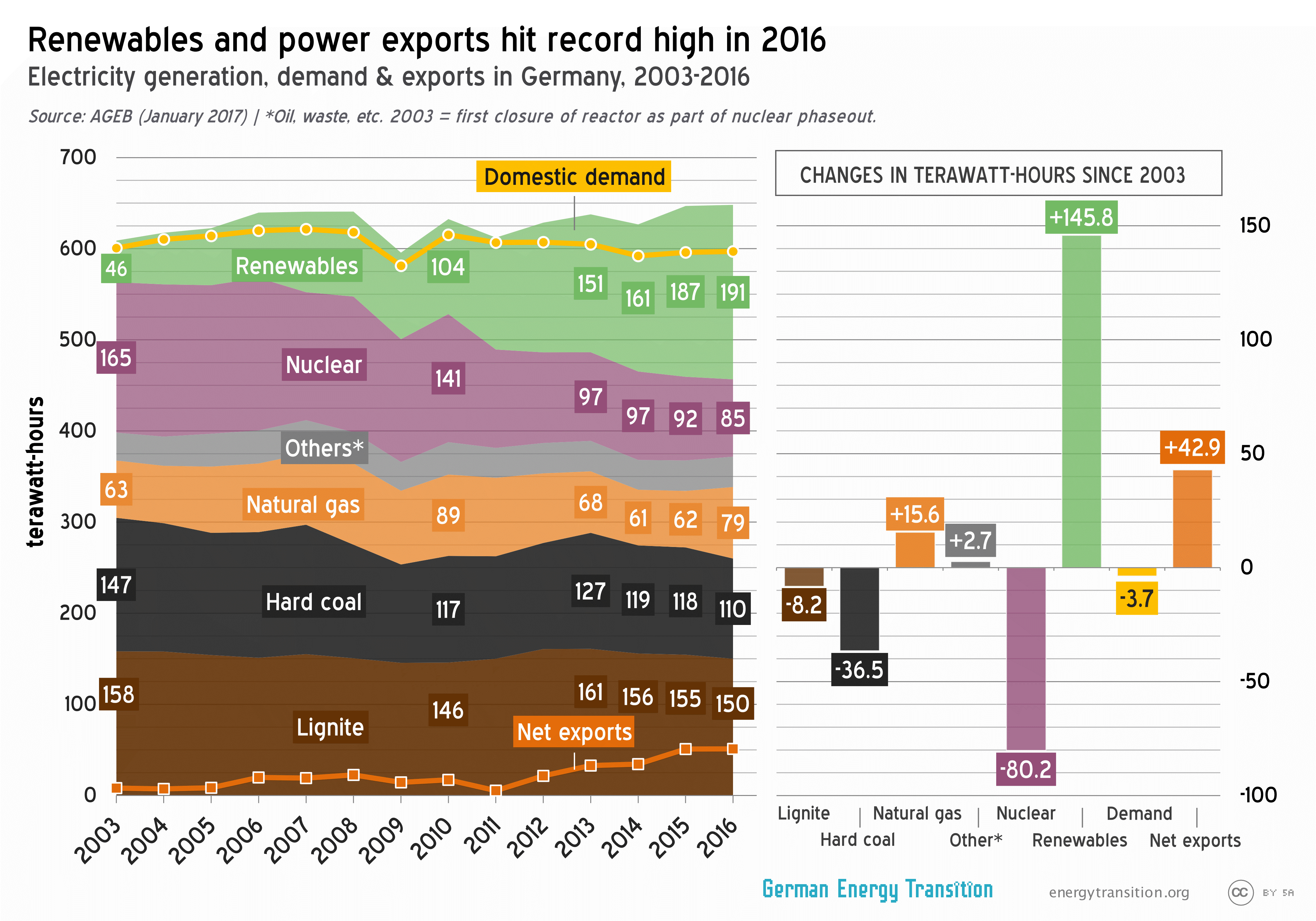
https://book.energytransition.org/sites/default/files/GET_en...

In order to reduce emissions new zero carbon electricity generation will need to be continually built. Germany is doing this.
Germany gave nuclear a chance, even spent billions on a thorium reactor. They learnt that nuclear is expensive and not compatible with their democracy. The currently running plants were built in 80s and will be shut down after running for decades. Much of the cost, i.e. the waste storage will be socialised. The first long term storage site has already failed. There is no public support for building new reactors, nuclear cannot be part Germany's ongoing decarbonisation.
Yeah, it's totally cool to misinform public, and then claim "public does not support nuclear power" . . . NOT.
Current German "decarbonisation" results in more carbon per kWh produced, so job well done I guess. Oh and "nuclear is expensive" - nice, so Germany has cheap energy after turning green? http://ec.europa.eu/eurostat/statistics-explained/index.php/... http://ec.europa.eu/eurostat/statistics-explained/index.php/... NOT


https://www.lazard.com/perspective/levelized-cost-of-energy-...
Keeping old nuclear plants online for a few extra years is not a solution to climate change. If some other western democracy can show how to build and operate nuclear plants cheaply and safely, great, do it.
So far the examples of recent new builds are slow and expensive. See VC Summer, Vogtle, Flamanville, Olkiluoto, and Hinkley point. From where I sit it looks like the German decision in 2001 to phase out nuclear was the right one, but only time will tell. (Merkel really did make a big mess in 2011 though)
Edit: Finish names are hard to spell.
In Europe a lot of residential heating is from electricity, so why not enable this on-demand when the electricity prices go low? Most countries have a cheaper night tarrif as traditionally electricity was cheaper as night, but that’s not really true any more. Often the heat energy is stored (e.g. in storage heaters or an insulated hot water tank) before use, so the energy can be buffered here.
Smart metering is one way to do this, but the basic technology to achieve this has existed for decades. In parts of the U.K. residential electric heating is often controlled by a radio signal [0] that is used to enable/disable the off-peak tariff, but is somewhat dynamically enabled based on the electricity demand.
But usually that's not the case. The grid is first and foremost a power delivery mechanism, not a precision timebase and besides some efficiency issues (resonant cores tend to work best at the frequency they are designed for, such as all transformers in the grid) frequency variation is expected and can be dealt with within limit without further countermeasures.
Far worse than frequency variation would be phase errors leading to massive consumption of power within the grid and imbalance in voltage between phases because it will cause generators or industrial equipment to either break or go into fault states.
Think of the grid as a massive flywheel and frequency variations are slowing down or speeding up that flywheel.
So even if the grid can't store energy directly it can absorb pulses quite well and there are devices that grid operators use that use superconducting coils at very low temperature to stabilize the grid even further. Siemens and a number of US based companies have had these in production for quite a few years, typically you'll find them right next to large windfarms.
But, if the means of production (e.g. wind) is overall still a win and power only goes negative for short periods, if consumers can respond and sink that power more cheaply than the producer can dial back & protect the grid in the process, it might be the best solution for everyone.
That's an important distinction because you're always going to need more capacity, simply because peak use over the day tends to be 2x-3x more than during off-peak.
Whether negative prices are bad for producers depends entirely on the details of their setup. If they run a coal plant it's obviously mostly bad, since they're paying consumers to take their electricity while they're having to pay for coal.
But it's not necessarily going to be the case with other forms of production, e.g. what's the marginal cost of continuing to run a wind farm at 100% capacity v.s. shutting part of it down? Maybe shutting it down is expensive for some reason, and at that point you can just pay consumers to act as a heatsink, and make up the difference during the day.
Now, everything I've read on the topic suggests that excess negative prices are a bad thing today, but that's not some fundamental law.
E.g. let's say that fusion once invented is going to be ridiculously expensive to start up and stop, and can only run at either 0% or 100%, but it'll be cheap to just keep it running once it's started up.
Then you'd expect that there would be negative prices for around half the day, and for both the producers and consumers to be happy with that arrangement, since the alternative for the producer would be to buy a massive heat sink farm to burn off the excess capacity during the night.
Instead they could use the same money as a price signal to consumers to use their existing heatsinks, e.g. running their heating during the night.
> At issue is what happens when too much electricity is on offer. The enormous supply of hydroelectricity during spring runoff can push electricity prices to zero—the BPA gives away electricity to local utilities for free when it’s forced to produce more than it wants to. Since wind producers enjoy production subsidies, they can push rates below zero, effectively paying other utilities to switch off their generators.
The key bit in that passage: effectively paying other utilities to switch off their generators
It is possible to turn off wind turbines (though they get annoyed at this because of clean energy subsidies) or send water over a spillway of a run of the river dam (with some environmental consequences).
There is a neat visualization with that peak demand - https://www.youtube.com/watch?v=jvnaiHFT6nQ - its the visualization of the Columbia river being sent down stream (right to left) through each dam (white bars). The management of "turning on some power for peak noon consumption" begins at 5:00 am as the uppermost dams start releasing more water downstream. So, if the wind picks up in a few hours unexpectedly, the hydro system pays negative (thats at issue in the article) to have the wind power turn off because they can't really stop the river (especially if its a spring high water event in there too).
It's not wasted capacity. It's the nature of wind turbines that in order to have enough to supply a grid on an average wind day, you're going to have an excess of energy production on a really windy day.
Wind turbines are relatively cheap, so to some extent it may be cheaper to build more of them than to build energy storage capacity, even if it means that there is an excess of energy at times.
This happens all the time in US markets - especially where there is wind.
It is done as a price signal to producers to either ramp down or consumers to buy a bit more. The ideal winner here is pump storage. But they may have already schedule themselves in the day ahead market and have no extra storage.
The market is far more complicated than the article let’s on.
Usually when I've read about negative prices "caused by renewables" it's been the case that there is actually still some non renewable running. The negative price is sending them a signal, namely, that inflexible sources will be penalized more than flexible sources. Someone planning to build a new coal, nuclear or gas plant will take these negative prices into consideration and influence them to prefer more flexible solutions, even if it costs more, because the flexibility will be rewarded (or, equivalently, lack of flexibility will be penalized).
Negative prices create incentive for energy storage. Storage providers can generate revenue not only when returning stored energy to the grid but by storing surplus energy in the first place.
Energy markets are artificial markets designed to create various price signals that result in certain incentives on both generation and demand, subject to numerous constraints. One constraint is that demand and supply must balance. The grid can’t store much energy. Oversupply can cause grid frequency to go above 50/60 Hz, threatening grid stability: https://www.e-education.psu.edu/ebf483/node/705. Power prices go negative when there is too much generation capacity online at a given instant, relative to demand. That creates incentives for generators that can shut down (like natural gas) to do so.
Negative power prices are not a good thing for consumers. A negative price in the wholesale electric markets does not mean the electricity is "less than free." Obviously, even wind power or solar always costs positive money to generate in real terms. Instead, it signals a mismatch between generation capacity, storage capacity, and demand. In a grid with adequate storage capacity, negative prices would be extremely rare.